






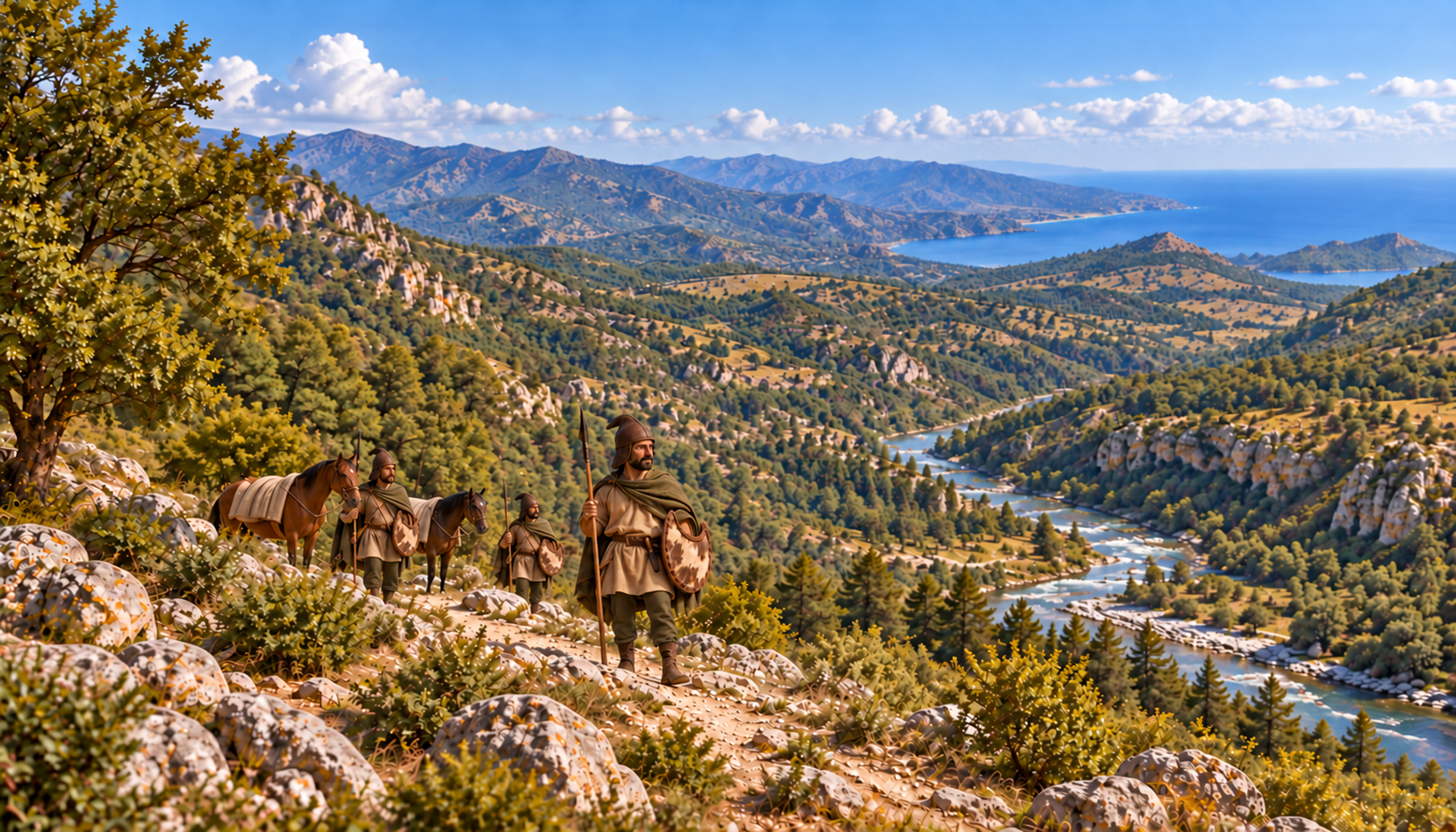
Paphlagonians
An embassy to keep an army away
In 333 BC, Paphlagonian envoys met Alexander at Ancyra. They offered submission and alliance, with a request: his army should not enter their country. Alexander directed them to obey Calas, his governor in Phrygia, and continued towards Cappadocia and Cilicia. The encounter brought Paphlagonia into his claimed dominion without a march through its valleys.
The bargain suited a king pressing towards Darius and leaders determined to avoid the presence of a great invading force. Behind the formal words lay the cost of feeding soldiers, the danger of garrisons and the survival of local authority. Paphlagonia's place in the conquest began with negotiation, and its rulers had experience in making an armed stranger someone else's problem.
The sea and the wooded interior
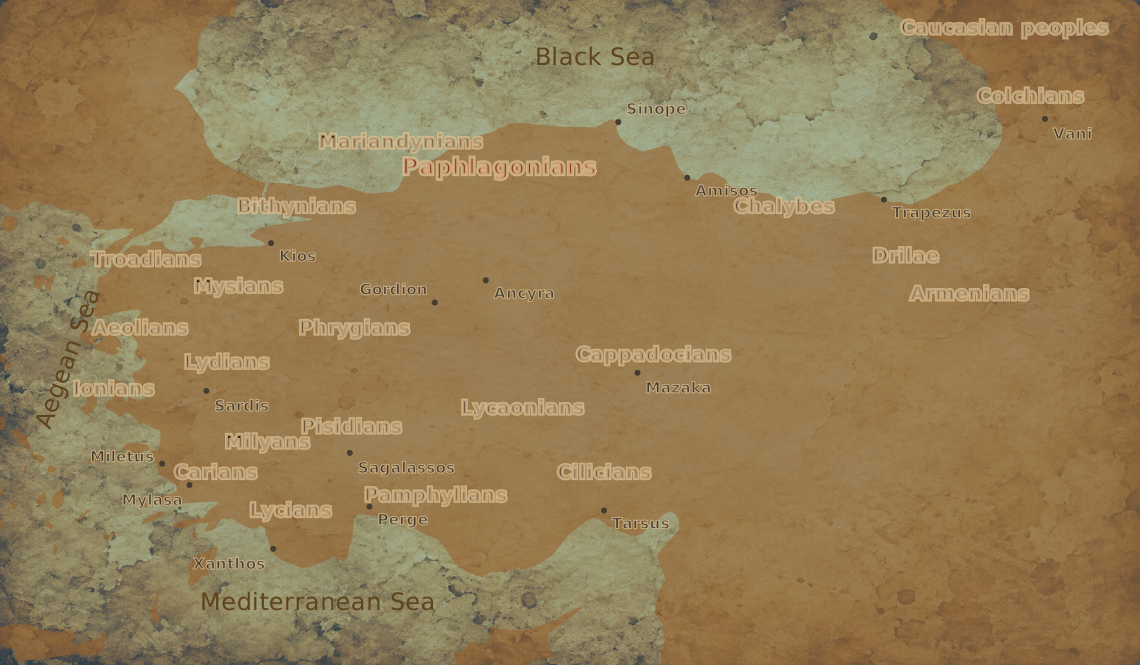
Paphlagonia lay along the southern Black Sea, west of the great bend and lower course of the Halys. The Parthenius marked another important geographical boundary towards the west. Between the coast and the Anatolian plateau rose wooded ridges, broken country and river valleys. Journeys that appeared straightforward along the shoreline could become difficult when an army turned inland.
The coast connected the region with the ships and settlements of the Black Sea. Sinope, a Greek city on a projecting peninsula, held a particularly important position in these networks. Its merchants and citizens dealt with the peoples of the hinterland while maintaining ties with other Greek communities. The interests of a coastal city and an inland dynast could converge in trade or diplomacy and collide over territory and influence.
In Strabo's later geographical account, Paphlagonia appears as a varied landscape of coast, uplands and settlements rather than a country dominated by one overwhelming capital. Its situation helps explain why outsiders repeatedly encountered local powers capable of negotiating for themselves. Possession of a road, crossing or productive valley could matter more immediately than the name of a distant sovereign.
The Paphlagonians of epic
Greek poetry gave the region an ancient heroic ancestry. In the Iliad, Pylaemenes led Paphlagonians from the land of the Eneti to support Troy. Their country was associated with the breeding of wild mules. The catalogue placed them among the peoples who crossed the literary horizon of the Trojan War, alongside the Lycians, Phrygians and other allies of the city.
Later dynasts could draw prestige from that memory. Nepos describes Thuys, a Paphlagonian ruler in the early fourth century, as belonging to an old family claiming descent from Pylaemenes. The Trojan past offered a language of antiquity and noble standing. A local house could present itself as rooted in the heroic age while dealing with the very contemporary demands of a Persian king.
Service and resistance under Persia
Paphlagonians served in Xerxes' invasion of Greece in 480 BC. Herodotus describes their plaited headgear, small shields, short spears, javelins, daggers and boots reaching partway up the lower leg. His catalogue places their soldiers among the many contingents gathered for an imperial expedition far from home.
That service did not extinguish the independence of powerful families. Thuys resisted the authority of Artaxerxes II, and the king sent Datames against him. The two men were relatives, so Datames first attempted a personal settlement. A plot against his life ended the attempt. After escaping, he conducted the campaign and captured Thuys with his household.
Nepos makes the captive's presentation at court a theatrical triumph for Datames. Thuys was dressed in splendid ornaments and led before the king as a captured quarry. The display turned a regional conflict into a public demonstration of royal power. For the defeated family, kinship with a commander in imperial service had offered neither a secure protection nor a permanent barrier to war.
The returning mercenaries
Around 400 BC, the Greek soldiers returning from Cyrus the Younger's failed expedition reached the Black Sea and sought a route home. Their arrival brought danger to communities that might otherwise have had no part in Cyrus' struggle for the Persian throne. An army travelling without a secure supply system could consume the resources of every district through which it passed.
At Cotyora, relations with Sinope became strained. Hecatonymus, speaking for the Sinopeans, protested against the soldiers' conduct and raised the possibility of friendship with Corylas and the Paphlagonians. Xenophon answered that the Greeks too could seek Corylas' support. The exchange brought an inland ruler into a dispute between a Greek army and a Greek city.
When the mercenaries considered continuing west by land, Hecatonymus warned them about rivers, difficult approaches and Paphlagonian horsemen. Sea transport offered a way to avoid the confrontation. The soldiers chose to proceed by ship, but still had to wait for the means of departure. In the meantime, the surrounding country bore the consequences of their presence.
Corylas makes terms
The Greeks obtained some supplies through trade and others by raiding Paphlagonia. Local men retaliated against isolated soldiers and quarters distant from the main camp. The hostility made a settlement valuable to both sides. Corylas sent envoys bearing horses and fine clothing, proposing that each party should cease injuring the other.
The gifts displayed resources appropriate to a ruler whose mounted forces had already entered the Greeks' calculations. They also opened a diplomatic encounter. The generals received the envoys and arranged a feast while the proposal was considered. In Xenophon's account, the gathering became a remarkable scene of armed dances performed by men in the mercenary army.
Thracians staged a combat so convincingly that the Paphlagonian guests cried out when one dancer fell. Other soldiers demonstrated their own performances. For an evening, men whose relations had been shaped by raids and reprisals met as hosts and guests. Corylas' intervention had created space for agreement where continued violence would have damaged both his country and the departing army.
Horses, households and command
The appearance of cavalry in the negotiations was significant. Mounted forces could threaten a marching column, move between open ground and routes through the interior, and make the search for provisions dangerous. A body of heavily armed infantry might remain formidable in battle while finding it difficult to protect every foraging party or outlying position.
Paphlagonian military power therefore entered Greek experience through more than a formal clash of battle lines. It appeared in the possibility of an alliance, the fear of a difficult march, attacks on stragglers and the authority of a ruler able to send an embassy. The choice between resistance and accommodation was part of command.
Families such as the one to which Thuys belonged also operated through relationships stretching beyond Paphlagonia. Datames' intervention shows how a dispute could bring neighbouring governors and royal interests into local affairs. Personal connections widened a ruler's opportunities, but they could bring enemies close enough to threaten his household.
Alexander and the unfinished settlement
Against that background, the embassy of 333 BC continued an established practice. Its representatives recognised Alexander's military position while seeking to preserve their country from his troops. The Macedonian king accepted an arrangement through Calas and pursued his campaign elsewhere. No great Paphlagonian siege became part of the celebrated march towards Issus.
After Alexander died in 323 BC, Paphlagonia was assigned with Cappadocia to Eumenes of Cardia. The distribution of provinces again ran ahead of actual possession. Plutarch describes the territory allotted to Eumenes as still requiring conquest, and the assistance he was supposed to receive became entangled in the ambitions of other Macedonian commanders.
For local leaders, the disappearance of Darius and then Alexander had not removed the need to judge distant claimants. A new governor might arrive with letters, allies or an army; neighbouring powers might offer help at a price. The men who had negotiated to keep Alexander outside their country had lived within a political world in which submission could avert immediate destruction while leaving the next contest unresolved.
Sources
Ancient narratives and geography
- Homer, Iliad, II.851–855: Pylaemenes and the Paphlagonians.
- Herodotus, Histories, VII.72.
- Xenophon, Anabasis, V.5–6 and VI.1: Sinope, Corylas and the mercenaries.
- Cornelius Nepos, Datames, 2–3.
- Arrian, Anabasis, II.4; Plutarch, Eumenes, 3.
- Strabo, Geography, XII.3.
Archaeology and reference works
- Claudia Glatz, Bleda S. Düring and T. Emre Şerifoğlu, “The Cide Archaeological Project 2010: Second Preliminary Report”, Anatolia Antiqua 19 (2011), pp. 279–288.
- François Sabbathier, Dictionnaire pour l'intelligence des auteurs classiques grecs et latins, “Paphlagoniens” and the preceding notice on Paphlagonia.