






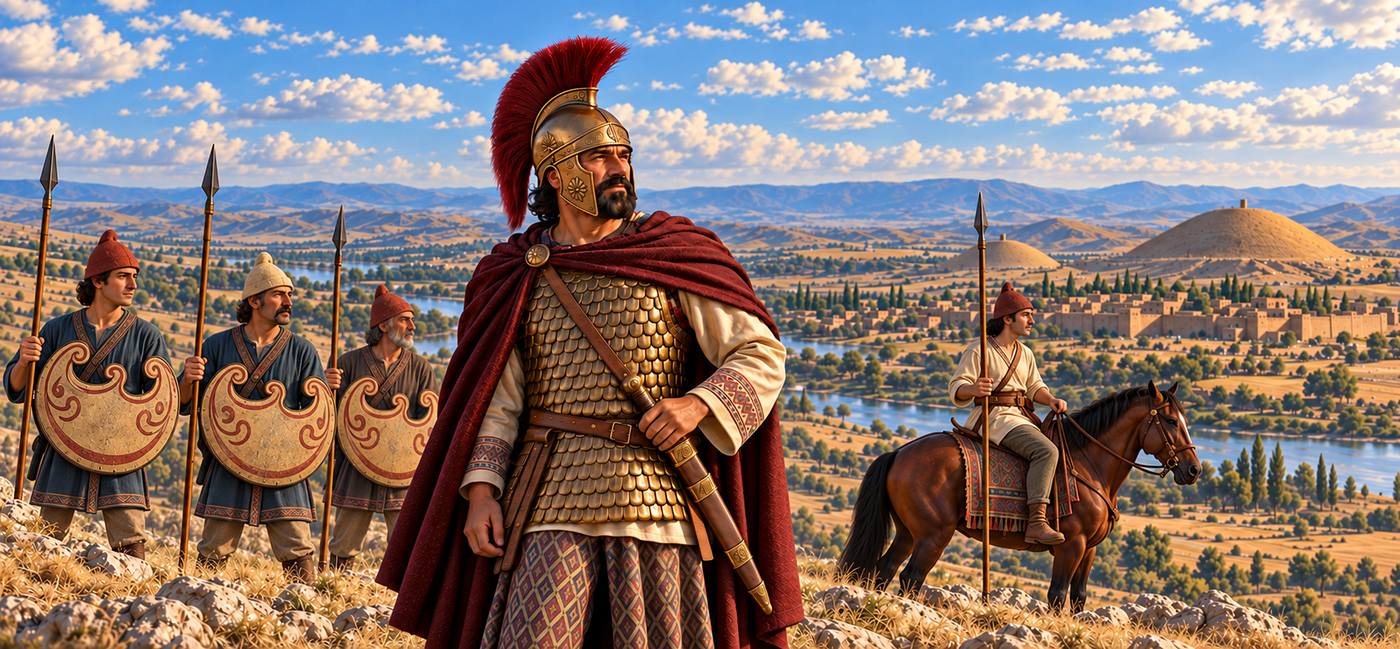
Phrygians
A king before an ancient wagon
At Gordion in 333 BC, Alexander approached a wagon preserved on the citadel and a knot whose loosening promised dominion over Asia. His army had already defeated Persian forces at the Granicus and marched through western Anatolia. Here, in an old Phrygian royal centre, conquest encountered a different kind of authority: a story linking a humble household, a divine sign and the foundation of kingship.
The most famous version has Alexander cut the knot with his sword. Arrian also preserves Aristobulus' account, in which he removed the pin holding the arrangement together. Both versions end with the king and his companions treating the challenge as fulfilled. A storm that night was received as divine confirmation, and sacrifice followed. The ancient kings of Phrygia had acquired a place in the ambitions of a Macedonian conqueror.
The country of Midas
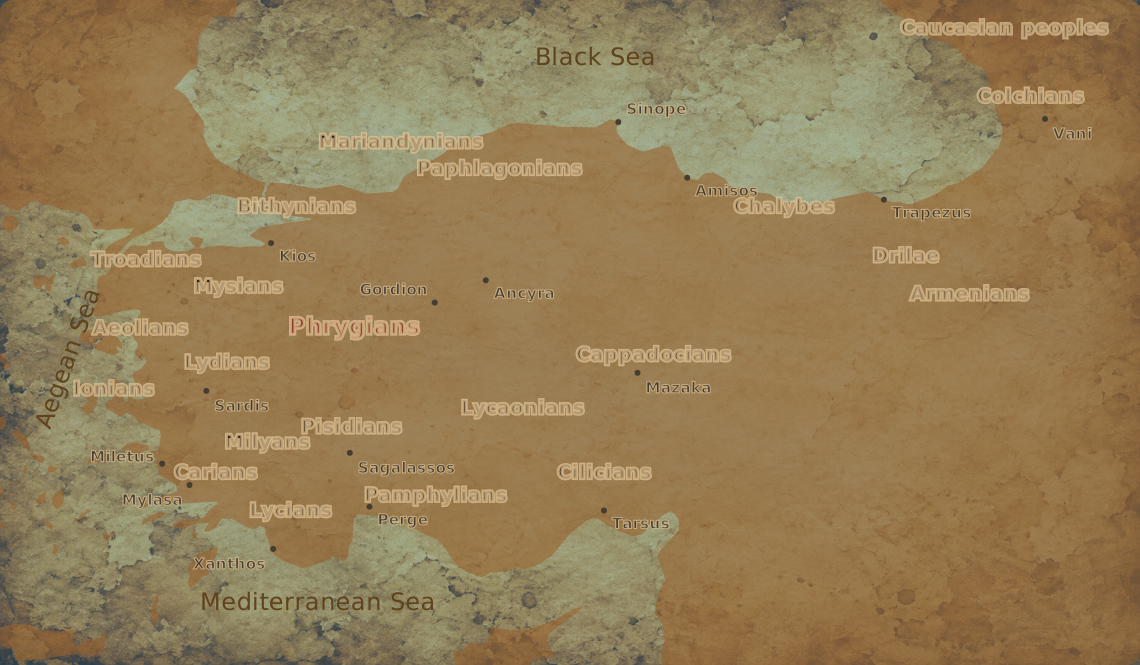
Phrygia lay across the inland routes of western and central Anatolia. Gordion stood beside the Sangarius, the modern Sakarya, where travellers could move between the plateau and the western provinces. Farther south-west, Kelainai commanded another important meeting of roads and waters. Beyond these centres stretched cultivated country, grazing land and highlands marked by remarkable monuments cut into the rock.
The landscape retained visible traces of a time when Phrygian rulers had exercised power in their own right. Burial mounds rose around Gordion; monumental building projects had transformed its citadel. Such works belonged to generations far earlier than Alexander. Their survival gave the place an imposing past even after political authority had moved elsewhere.
Midas, active in the late eighth century BC, was a real ruler as well as the hero of later stories. Assyrian records place Mita of the Mushki in the struggles surrounding Sargon II's western interests. Greek tradition remembered a wealthy king whose influence reached towards the Aegean. The legendary golden touch made that wealth unforgettable, but the royal centre's architecture and rich burials reveal a substantial society behind the tales.
The Mother in the rocks
In the Phrygian highlands, carved façades turn natural rock into the appearance of a building. Niches, stepped altars and images mark places where people approached divine power. Inscriptions name Matar, the Mother; an epithet associated with her contributed to the name Kybele by which she became known in the Greek world.
These monuments belong within the inhabited landscape. Some stood near settlements or gates, others beside routes and approaches to valleys. The goddess could appear framed by a doorway, heavily dressed, accompanied by attributes such as a bird or a lion. Her presence joined the security of a community to the places through which its people and visitors passed.
The Mother would travel far beyond Phrygia, entering Greek and later Roman religious life. At home, her shrines gave worship a durable local setting. An empire could change its governors while a sacred rock remained beside the same road. The persistence of these places helps explain how Phrygian identity endured long after the disappearance of the old royal court.
Between Lydia and Persia
By the sixth century BC, the power of Lydia had extended over Gordion. Cyrus' defeat of Croesus then brought Persian rule into the interior. Archaeology preserves the violence of that transition at the settlement's lower defences: an assault ramp, arrowheads and destruction around the fortress. The arrival of the new empire could be fought out at the walls before becoming an enduring provincial order.
Persian government divided the old Phrygian lands between Hellespontine Phrygia, centred on Daskyleion in the north-west, and Greater Phrygia, whose principal centre was Kelainai. Gordion remained a place of economic importance within the imperial landscape. Local life continued through the change of sovereign, with established habits existing alongside connections reaching towards the Persian court and the Greek coast.
These connections carried people as well as goods. Satraps, envoys and soldiers travelled through the interior. Powerful households could participate in the empire without ceasing to belong to the country in which their wealth was held. Greek accounts of Persian campaigns repeatedly return to Phrygia because its routes and resources brought armies into its valleys.
Cyrus at Kelainai
In 401 BC, Cyrus the Younger gathered forces for his attempt to overthrow his brother Artaxerxes II. Xenophon accompanied the Greek mercenaries and described Kelainai as a prosperous city with a palace and a large park. The Maeander rose there; the Marsyas flowed through the city, beneath the citadel. Another royal residence was associated with the Persian king.
Cyrus halted at Kelainai and reviewed his Greek troops. The gathering made the city a stage on a venture that would carry soldiers across Anatolia and down towards Babylon. To recruits arriving from the Aegean, the Phrygian interior was already part of a vast military system: a place where separate contingents assembled, commanders inspected their strength and an expedition prepared to move on.
The waters of the Marsyas also carried a darker local story. The musician Marsyas, who challenged Apollo, was said to have suffered flaying after his defeat. Myth and royal display met in the same city. A traveller could encounter the household of a Persian prince and a tale of divine punishment attached to the river beside it.
The citadel that bought time
Alexander reached Kelainai after his campaign through the southern Anatolian regions in 333 BC. Its precipitous citadel was held by a garrison of Carians and Greek mercenaries. The defenders offered to surrender if relief failed to arrive by an agreed deadline. Alexander accepted a settlement that allowed him to continue his campaign without an immediate assault on the height.
He appointed Antigonus son of Philip to govern Phrygia and left troops behind. From Kelainai he moved towards Gordion, where Parmenion's forces joined him and reinforcements arrived from Macedonia and Greece. The army could regroup in the interior before turning towards Cappadocia and the passage into Cilicia.
At Gordion, Alexander also received Athenians asking for the release of prisoners captured while serving the Persians at the Granicus. He deferred their request. The same meeting place that supplied a celebrated sign of kingship was conducting the hard business of war: gathering men, receiving embassies and deciding the fate of captives.
Old grandeur and a changed town
The Gordion visited by Alexander had changed greatly since the age of its early kings. Excavations show substantial destruction around 400 BC, generally attributed to an earthquake, followed by the dismantling and reuse of earlier monumental buildings. The old royal centre's fame survived a considerable transformation of its physical setting.
That makes the encounter with the wagon especially striking. Alexander did not need a flourishing Phrygian monarchy to recognise the force of its memory. A preserved object and the story surrounding it could still offer a language of royal destiny. The king's actions at the citadel connected his advance with an authority older than Persian rule.
Gordion also remained useful in ordinary military terms. Its position on the Sangarius made it a natural point for gathering forces and moving into the central plateau. Ceremony and logistics occupied the same ground: the city could furnish a story about the mastery of Asia while the surrounding routes helped an army pursue it.
Antigonus' foundation
The appointment at Kelainai had consequences far beyond the immediate campaign. Antigonus remained in Anatolia while Alexander fought farther east. He acquired a durable territorial base from which he could raise resources and intervene in the conflicts that followed the king's death. At the division of provinces in 323 BC, he retained Greater Phrygia together with Lycia and Pamphylia.
Alexander's former officers soon competed over the country they had helped conquer. Antigonus' refusal to assist the installation of Eumenes in Cappadocia contributed to his conflict with Perdiccas. After the regent's death, the struggle widened, and Antigonus became one of the most formidable powers in Asia.
For Phrygia, the Macedonian victory had therefore brought another transformation rather than a quiet conclusion. The routes once used by Persian princes now carried the armies of rival successors. Gordion's royal mounds and the Mother's rock-cut shrines remained in a country whose strategic importance kept drawing ambitious men into its history.
Sources
Ancient narratives
- Xenophon, Anabasis, I.2: Kelainai and the army of Cyrus.
- Arrian, Anabasis, I.29: Kelainai and Gordion; II.3: the Gordian knot.
- Diodorus Siculus, Library of History, XVIII.3; Plutarch, Eumenes, 3.
Archaeology and historical studies
- Penn Museum, Digital Gordion: Iron Age Gordion; Achaemenid Gordion; Hellenistic Gordion.
- Penn Museum, Phrygian Cult Practice; The Gordian Knot.
- François Sabbathier, Dictionnaire pour l'intelligence des auteurs classiques grecs et latins, “Phrygie”.