






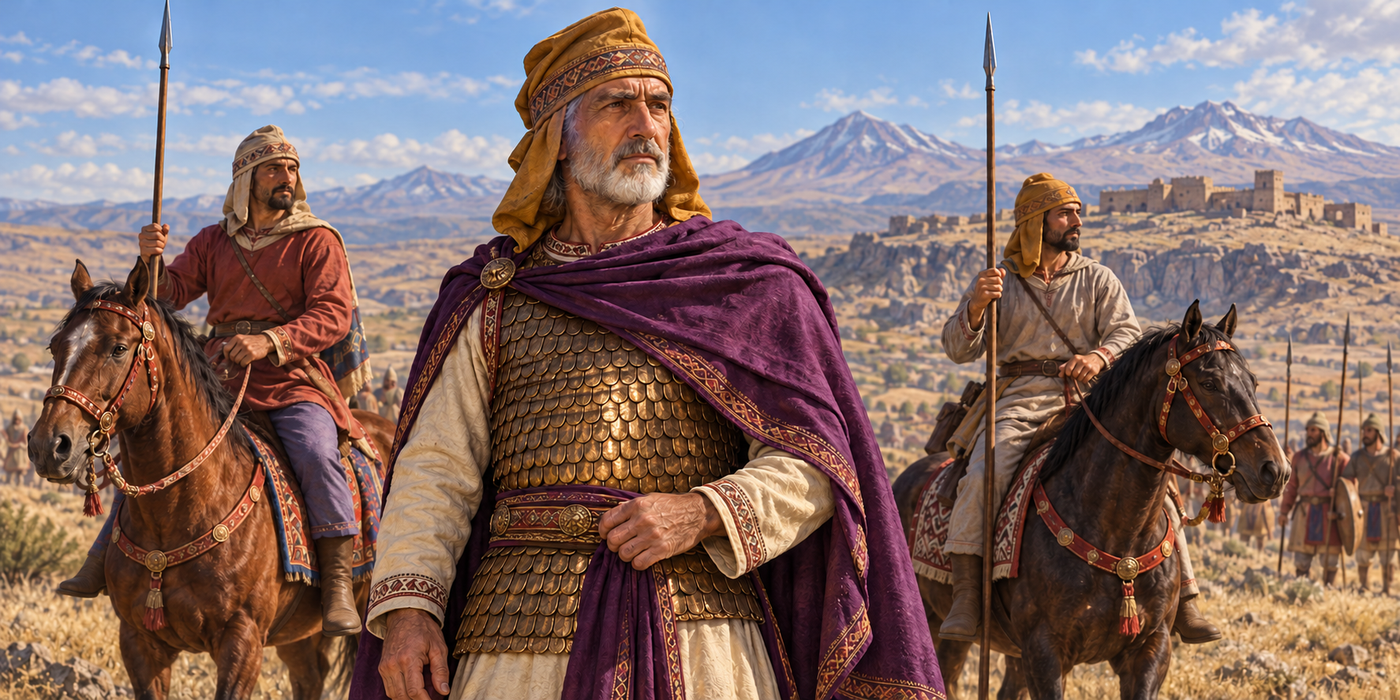
Cappadocians
The country that remained to be conquered
In 322 BC, a year after Alexander's death, the Macedonian royal army marched against Ariarathes of Cappadocia. The old ruler had survived the destruction of the Persian monarchy and continued to command men and revenues in his own country. Perdiccas now intended to make the settlement agreed by Alexander's successors a reality. Cappadocia had been allotted to Eumenes of Cardia; Ariarathes was still there to dispute possession.
The confrontation exposed a limit to Alexander's victories. A king could cross a province, accept submission and appoint an officer without mastering every fortress or breaking every local dynasty. While Alexander pursued Darius towards the heart of Asia, Cappadocia had retained centres of power beyond the effective reach of his government.
Beyond the Halys
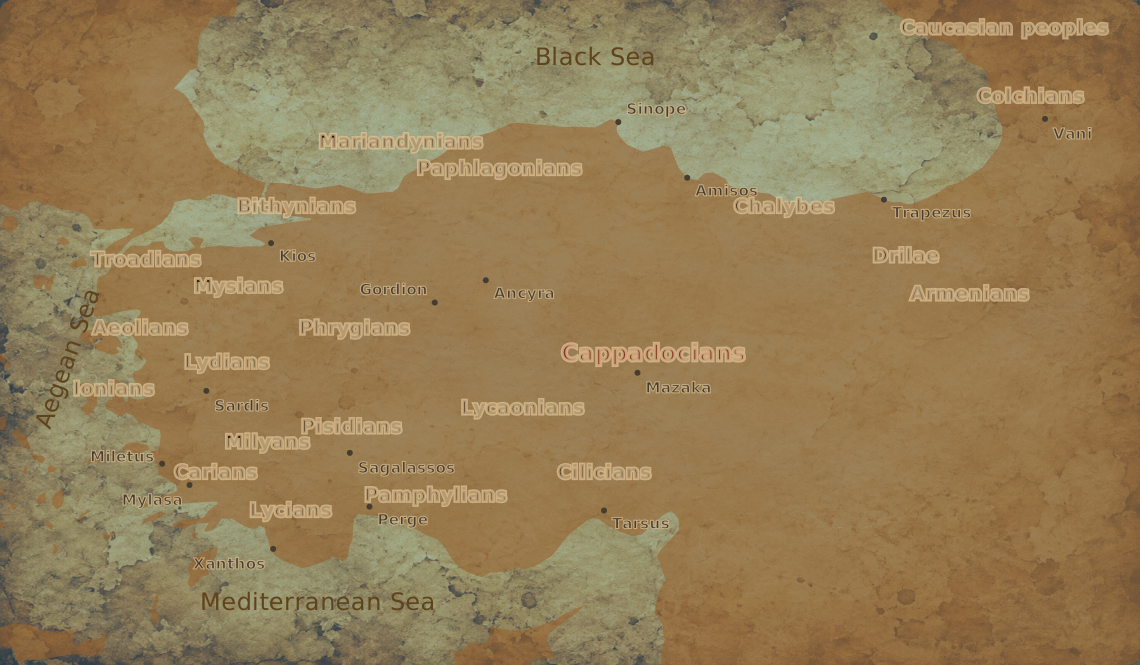
Cappadocia occupied a great part of the Anatolian interior between the central plateau, the Taurus and the approaches to Armenia and the Euphrates. Its distances mattered. The country embraced open ground suited to livestock and cultivation, river basins, highland barriers and routes leading south towards Cilicia. An army marching through one corridor could leave considerable territory untouched on either side.
The Halys, the modern Kızılırmak, curved across the interior. To the south, the Taurus separated the plateau from the Mediterranean lowlands. The road through the Cilician Gates offered a passage towards Tarsus and Syria, giving southern Cappadocia an importance that extended far beyond its own settlements. Whoever controlled the approaches could assist an imperial army or obstruct its movement at a particularly vulnerable point.
Strabo, writing centuries after Alexander, described the striking contrasts within this landscape: the fruit-growing country of Melitene, the broad plain of Cataonia, and Mazaca beneath the towering mountain Argaeus. His account also places strongholds and landed power at the centre of Cappadocian life. The country sustained large ambitions without having to resemble the densely urbanised Greek coast.
A province of the Great King
Under the Achaemenids, Cappadocia belonged to the political and military world of the Persian Empire. Its name appears in royal geography as Katpatuka. Imperial service connected its governors and leading families with courts and campaigns far outside Anatolia. Persian authority operated through men whose power could be deeply rooted in the provinces they administered.
These relationships were personal as well as administrative. Royal favour could secure a command; military success could enlarge it; an accusation at court could threaten everything a commander had gained. Families, friendships and marriages linked neighbouring regions, while fortified places gave their holders the means to resist a rival or a distant sovereign. Allegiance to the Great King did not remove local competition. It gave that competition another arena.
The career of Datames, in the first half of the fourth century, reveals this world particularly vividly. Nepos presents him as the son of Camisares, a commander serving Artaxerxes II in the borderlands of Cilicia and Cappadocia. Datames inherited his father's position after distinguished service and rose to larger responsibilities. His reputation rested on initiative, speed and the ability to make a difficult situation serve his purposes.
Datames: favour, rebellion and betrayal
One of Datames' assignments brought him against Thuys, a Paphlagonian dynast who was also his relative. An attempt to resolve the affair peacefully nearly cost him his life. Warned of a plot, he escaped, returned to war and captured the man who had threatened him. In Nepos' colourful account, Datames then presented his richly dressed prisoner at court as though exhibiting a captured beast.
The same biography follows his break with the king, his return to Cappadocia and his struggle against royal forces. Narrow positions, local knowledge and sudden attacks allowed him to offset superior numbers. Yet victories could not guarantee his safety. His story ends in assassination through a carefully prepared deception, after open force had failed to dispose of him.
For a provincial ruler, the danger lay in several directions at once. A powerful army could approach from outside; a relative could desert; a trusted intermediary could bring a false promise of reconciliation. Datames' career made Cappadocia a theatre of imperial conflict well before Alexander appeared. It also left an enduring example of the resources a determined commander could draw from the Anatolian interior.
Sanctuaries and authority
The religious landscape possessed its own centres of wealth and allegiance. At Comana, in the valleys of the Antitaurus, the goddess Ma received worship in a sanctuary that Strabo later described as commanding extensive land and a large dependent population. He compared her with the Greek war goddess Enyo and placed her priest immediately below the Cappadocian king in dignity.
Such a sanctuary joined worship to an enduring local institution. Fields, revenues, service and hereditary influence gave sacred authority a material foundation. Strabo's description belongs to the later kingdom, but it preserves a view of Cappadocia in which a royal residence was only one of the places around which people's lives could revolve. A ruler had to reckon with religious establishments as well as fortified heights and aristocratic households.
Alexander crosses the plateau
In 333 BC, Alexander moved from Gordion towards Ancyra and then through Cappadocia. Arrian describes the submission of territory on both sides of the Halys and names Sabictas as the officer appointed to govern the province. The king then pressed south towards the Cilician Gates. His immediate objective was the route into Cilicia, where he would soon face the forces of Darius.
There was urgency in the movement. A contested mountain passage could hold up the whole army, so Alexander advanced against its defenders with selected troops. Once the way was open, his campaign continued towards the Mediterranean plain. Cappadocia had become part of the itinerary of conquest, but the king did not remain to conduct a prolonged reduction of its interior.
Sabictas disappears from the subsequent narrative. Ariarathes, meanwhile, retained a territorial power that outlasted Alexander himself. The contrast between the appointment and its outcome is central to the region's history: the new monarchy claimed the province, while an established ruler continued to command obedience within it.
Cappadocians in the final Persian armies
Cappadocian service to the Persian cause continued beyond Alexander's passage. Arrian includes a Cappadocian contingent under Ariaces in Darius' army at Gaugamela in 331 BC. These men stood within the great coalition assembled for the defence of the monarchy, alongside forces from Armenia, Media, Babylonia and the eastern provinces.
Their presence gives Cappadocia a place in both sides of the conquest's geography. Macedonians had traversed its roads and announced a new provincial government; Cappadocians were still fighting for Darius farther east. Local allegiance did not change everywhere at the same moment as an invading army's advance. For those serving the Great King, the decisive battle would be fought in Mesopotamia rather than at home.
Ariarathes and the royal army
When Alexander died in 323 BC, his senior officers distributed provinces whose actual possession varied enormously. Eumenes received Cappadocia and Paphlagonia, but an assignment at Babylon could not by itself remove Ariarathes. The new governor needed military assistance to acquire the territory promised to him.
Perdiccas supplied it in 322. Diodorus describes Ariarathes drawing on accumulated revenues, native troops and mercenaries to defend his position. The result was a pitched battle against the royal army. Ariarathes lost; Diodorus' account has him captured and put to death with members of his family. Eumenes could now take up the satrapy.
The outcome was brutal, but the campaign itself demonstrates the scale of the obstacle. Cappadocia required a major expedition after the Persian king had fallen and Alexander's own conquests had reached India. Ariarathes had preserved enough resources and loyalty to make his removal a matter for the royal army. His defeat began another struggle over the province rather than ending the importance of its local powers.
The fortress at Nora
Eumenes would soon discover how precarious his own position was. During the wars among Alexander's successors, he faced Antigonus, another commander seeking mastery of Anatolia. After defeat in the field, Eumenes withdrew into Nora, a stronghold in the Cappadocian highlands. A man who had needed an army to obtain a province now depended on a fortress to survive the loss of one.
The episode returns the story to the landscape beneath the imperial claims. Roads connected Cappadocia with great campaigns, but heights and strongholds could preserve a smaller force when control of the open country had been lost. Alexander, Ariarathes, Perdiccas and Eumenes each encountered a different face of the same country: passage to the south, a durable local dominion, a province to be conquered, and a refuge amid civil war.
Sources
Ancient narratives and geography
- Cornelius Nepos, Datames, 1–11.
- Arrian, Anabasis, II.4: Cappadocia and the Cilician Gates; III.8: the forces of Darius.
- Diodorus Siculus, Library of History, XVIII.3 and 16.
- Strabo, Geography, XII.2: Cappadocian landscapes, sanctuaries and Nora.
Historical studies and reference works