






Lydians
The citadel surrendered
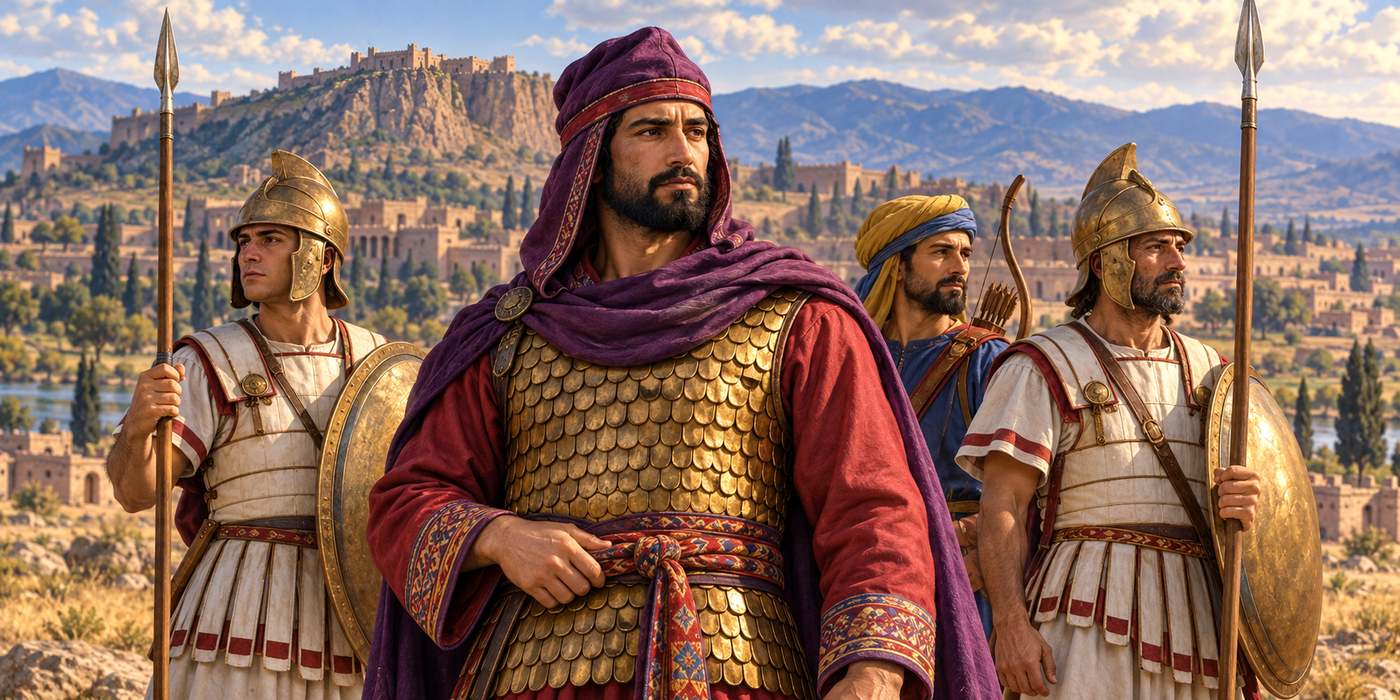
After the Granicus in 334 BC, Alexander advanced towards Sardis. Before he reached the city, Mithrines, the commander holding its citadel, came to meet him and offered submission. The Macedonian king gained a fortress whose position astonished him, together with access to the resources of one of western Anatolia's great centres of government.
The decision avoided a siege and carried Mithrines into Alexander's service. For the people of Lydia, it marked another change of ruler in a country whose own kings had disappeared two centuries earlier. Sardis had been the capital of Croesus and a major seat of Persian authority. Its wealth, roads and defensible height made it valuable to every power that sought to command the region.
The land beneath Tmolus
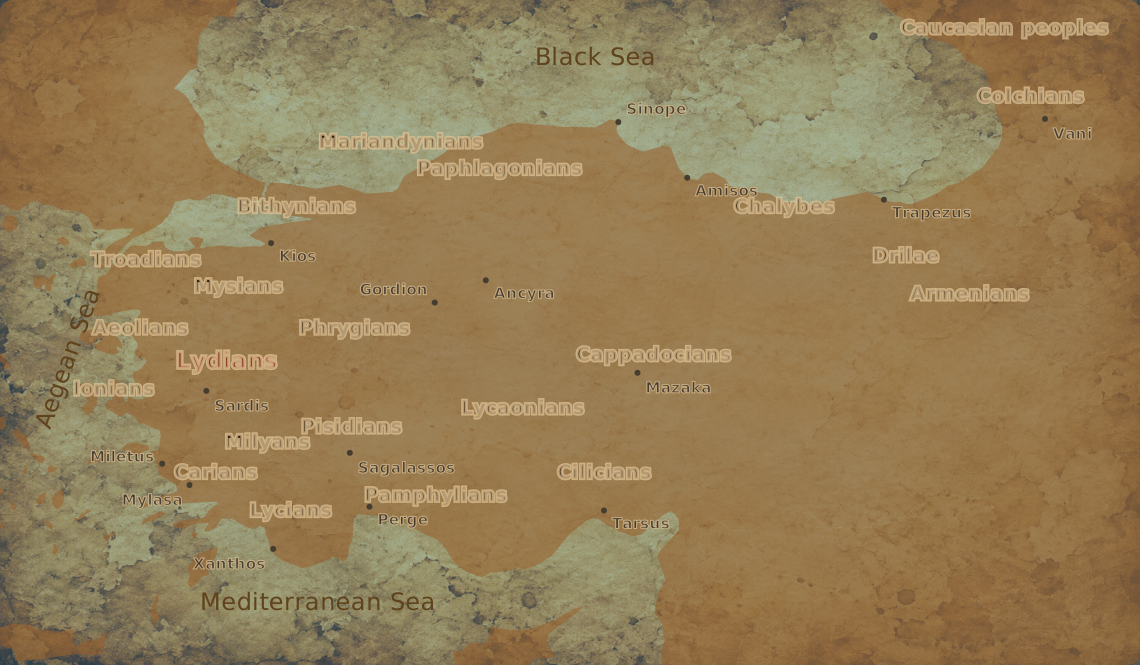
Sardis stood beneath Mount Tmolus, near the Pactolus and the broad valley of the Hermus. The acropolis rose steeply above the lower settlement. Its commanding appearance made it a natural centre of defence, while the surrounding country supplied cultivation and routes towards the Aegean coast and the Anatolian interior.
The Pactolus became inseparable from the fame of Lydian gold. Ancient writers imagined the river and the city through the wealth associated with them. Behind that reputation stood the work of obtaining, refining and using precious metal, together with the larger resources available to kings who controlled a substantial part of western Anatolia.
The country also contained ordinary households whose lives depended on pottery, food preparation, storage and local exchange. Excavated houses at Sardis preserve objects left in destruction deposits, giving a close view of people overshadowed in literary accounts by the magnificence of the royal court. Their possessions make the fall of a kingdom visible at the scale of a room.
From Gyges to the power of Croesus
The Mermnad dynasty acquired its place in Greek memory through a violent beginning. Herodotus tells how Gyges took the throne after killing his king in a crisis involving the royal marriage. The story joins private exposure and public power, making the future dynasty emerge from a choice in which survival required treachery.
Later rulers expanded the kingdom and fought the Greek cities of the coast. Alyattes combined war with the consolidation of a state capable of exerting power far beyond Sardis. His struggle against the Medes ended in a settlement remembered through an eclipse and a marriage alliance. The eastern frontier of Lydian power reached the Halys, where another ambitious monarchy confronted it.
Croesus inherited that position in the sixth century BC. He brought the mainland Greek cities of western Anatolia under his authority and cultivated relationships with sanctuaries and rulers abroad. His gifts at Delphi made wealth into an appeal for divine favour and lasting recognition. The name of the king became a measure of prosperity in later Greek speech.
Gold that could be counted
Lydia occupies a central place in the early history of coinage. Electrum issues and the later separation of gold and silver coins belong to a world in which royal authority and the handling of precious metal were becoming closely connected. A stamped piece could circulate with a recognised value and image beyond the immediate presence of its issuer.
The refinery remains beside the Pactolus reveal technical work behind the legend. Furnaces, vessels and residues show the treatment of metal rather than merely a king's possession of it. Craftsmen needed to judge materials, control processes and test what they produced. Royal wealth depended upon knowledge carried in the hands of such workers.
Coinage also belonged within wider exchange. Lydia dealt with Greek cities, inland communities and eastern powers, while objects and artistic habits moved between them. The court could employ foreign talent and dedicate impressive gifts abroad. Power over the coast did not prevent the king from seeking the approval of the sanctuaries his Greek subjects honoured.
Croesus asks the oracle
The rise of Cyrus transformed the political horizon. Croesus considered war against the Persian ruler who had overthrown Median power. Herodotus places consultation with oracles at the centre of the decision. A famous answer promised that crossing the Halys would destroy a great empire.
Croesus took the prediction as encouragement. Its force lay in what the king hoped it meant and in the confidence supplied by wealth, allies and earlier success. He crossed into the contested country, fought Cyrus and then returned towards Sardis, expecting time to assemble further support.
Cyrus denied him that time. The Persians followed quickly, bringing the contest to the defence of the Lydian capital. The empire threatened by the oracle could now be understood in a much more terrible way. The story would become a lasting example of how a ruler could receive the answer he sought while failing to ask the question he needed.
Horsemen before the walls
Herodotus emphasises the strength of Lydian cavalry. The riders' horses and long weapons made them formidable opponents in the open. Cyrus answered through a stratagem that turned a familiar advantage into a problem: he placed camels before his line, unsettling the Lydian mounts.
The Lydians dismounted and continued to fight, but the battle ended in their defeat. Croesus withdrew behind the city's defences. Its formidable height offered hope that allies could arrive before the enemy forced a way in. The struggle had become a race between outside help and the Persian ability to exploit a weakness.
A Persian soldier observed a defender descending part of the apparently inaccessible slope to recover a dropped helmet. The route exposed by that small action allowed attackers to climb where the defence had relied upon the ground itself. Sardis fell, and Croesus lost the kingdom whose resources had seemed to promise security.
The king on the pyre
The fate of Croesus acquired several forms in ancient storytelling. Herodotus gives him a place upon a pyre before Cyrus, recalling Solon's warning that a life could not be judged fortunate before its end. The story makes a ruined king's understanding arrive when wealth can no longer protect him.
Cyrus hears the lesson and attempts to save him. The episode turns the captive ruler into a source of experience for the conqueror. Royal power remains immense, but the fall of another king exposes how quickly fortune can reverse it. Croesus' later role as an adviser preserves that change from possession of wealth to knowledge gained through loss.
The narrative's influence outlasted the kingdom. Visitors could remember the great gifts at Greek sanctuaries, while the name of the donor carried a warning about certainty. Lydia's wealth and its catastrophe became inseparable in the stories through which Greeks understood kingship.
Sardis under Persian rule
The overthrow of the monarchy brought Sardis into the Achaemenid system as a major provincial capital. The roads linking it with the interior carried officials, messages and armies. Persian commanders used the city as a base from which to address affairs on the Aegean coast, making Lydia part of the great empire's western machinery.
Resistance followed the initial conquest. Pactyes, entrusted with responsibilities after the fall of Sardis, gathered support against the Persian position. The failure of the revolt led to further campaigning and the pursuit of men who sought refuge among Greek cities. Submission had created a new set of local choices about service, rebellion and the risks of sheltering an enemy of the king.
During the Ionian Revolt, an allied force reached Sardis in 499 BC and fire spread through the lower town. Herodotus records the burning of the sanctuary of the local goddess Cybele. The destruction gave a sacred injury a place within the wider war and its later justifications.
Gods beneath changing rulers
Lydian religious life continued beneath Persian government. Cybele and Artemis belonged to a sacred landscape connected with the mountains, water and the city. Inscriptions and images reveal worship shaped by local traditions and contact with Greek and Persian practices.
The sanctuary of Artemis existed before the vast temple whose surviving remains belong largely to later building. The continuity of the sacred place helps explain how a city could preserve important attachments through political change. A new ruler inherited people whose obligations and memories were older than his appointment.
The great burial mounds outside Sardis supplied another visible inheritance. They made royal and elite power enduring features of the countryside. Even after the kingdom had disappeared, travellers and inhabitants encountered monuments that testified to the resources once gathered by its leading families.
Alexander restores the ancestral laws
When Mithrines surrendered in 334 BC, Alexander accepted a position already central to the government of western Asia Minor. Arrian says that he allowed the Lydians their ancestral laws and freedom. The declaration made conquest appear as the removal of Persian domination while the king installed the officials and garrison needed to preserve his own authority.
Alexander also considered a sanctuary of Zeus on the citadel. The choice connected the new command to divine protection at the place whose strength had impressed him. Administrative appointments divided responsibilities, ensuring that the army could move on while the province remained useful behind it.
Lydia's story in the age of Alexander therefore carried a long memory into another transition. Croesus had made Sardis a symbol of royal wealth; Persian governors had made it a centre of imperial action. Its people now faced a king whose victories promised a new order. The citadel survived because its commander chose surrender, and the country's resources entered the service of another expanding monarchy.
Sources
Ancient accounts
Archaeology and historical studies
- Archaeological Exploration of Sardis, historical overview.
- Andrew Ramage and collaborators, Ordinary Lydians at Home, Sardis Report 8.
- Crawford H. Greenewalt Jr., “Gold and Silver Refining at Sardis”.
- Archaeological Exploration of Sardis, the sanctuary and temple of Artemis.
- François Sabbathier, Dictionnaire pour l'intelligence des auteurs classiques grecs et latins, notice “Crésus”.