






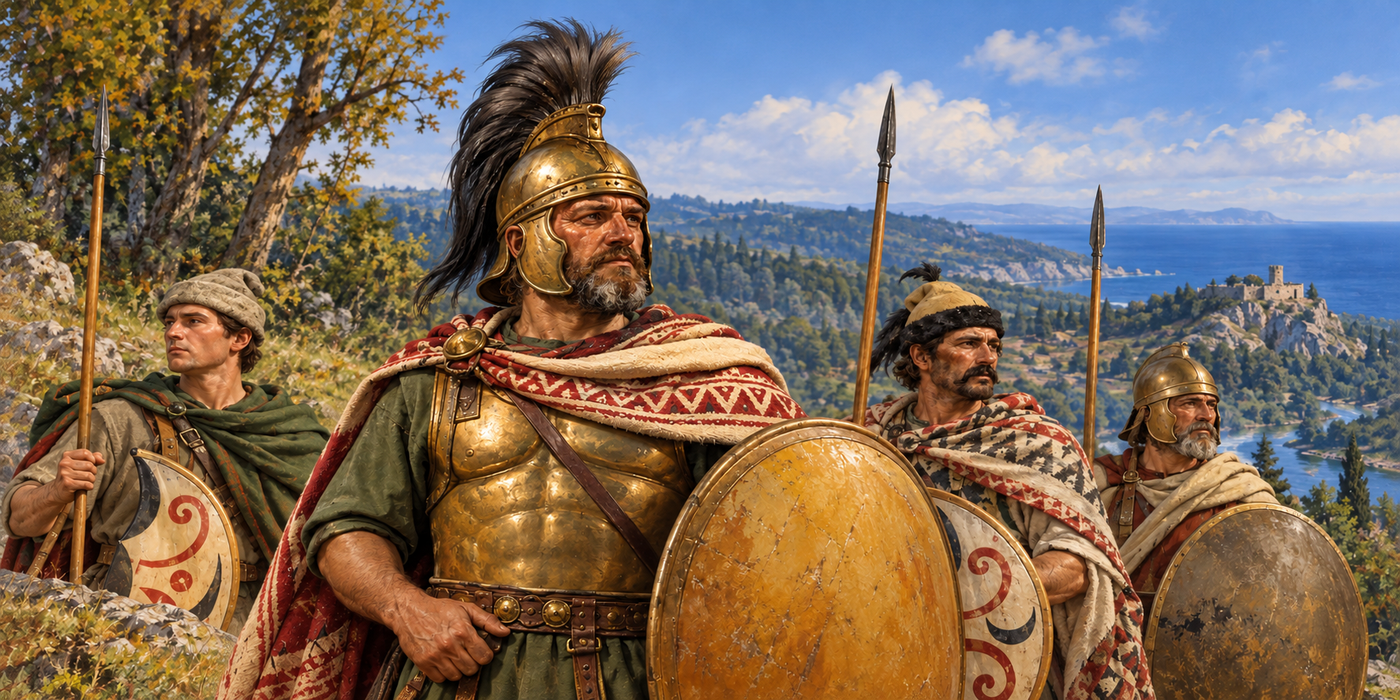
Bithynians
The country Alexander's general could not take
Alexander's victory at the Granicus opened much of western Asia Minor to Macedonian command. It did not make every neighbouring people submit. In Bithynia, Bas defeated the force led by Calas and preserved his own position. The episode occupies only a short passage in Memnon's history, but its result mattered: the great conquest could advance elsewhere while a local ruler kept Macedonian troops out of his country.
Bas belonged to a land whose inhabitants had already proved dangerous to experienced Greek soldiers. Forests, cultivated districts and difficult approaches offered resources to defenders who understood them. Along the coast, Greek cities pursued their own interests beside communities that could trade with them, support their rivals or fight their armies. Bithynian power grew within that crowded regional world.
Between two seas
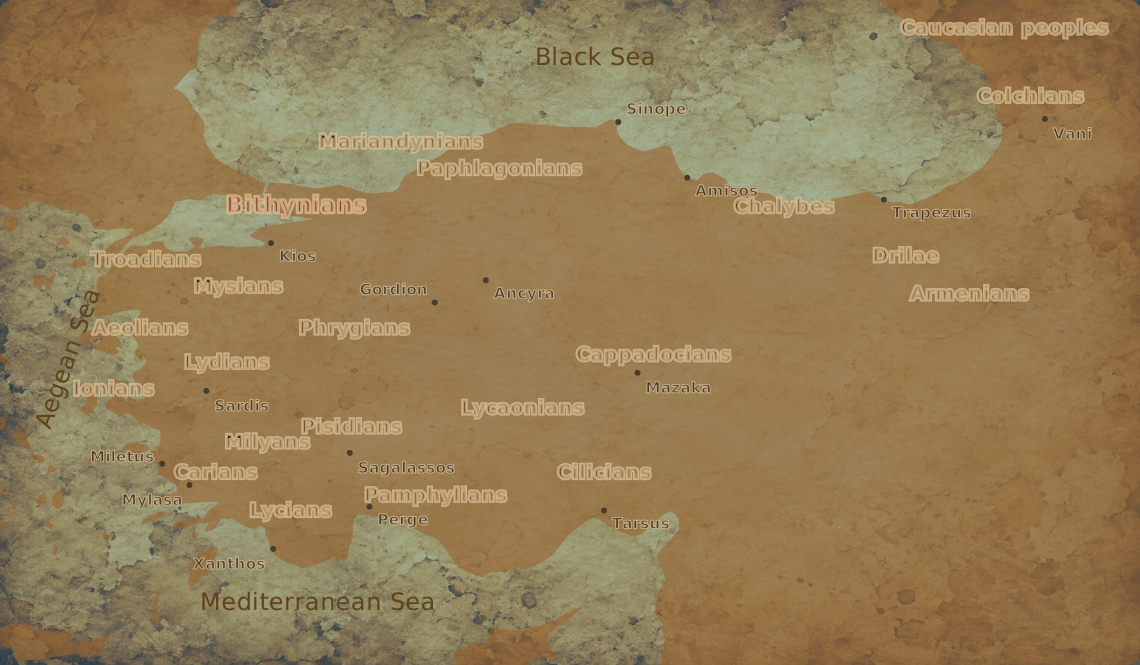
Bithynia occupied northwestern Anatolia, between the approaches to the Propontis and the southern shore of the Black Sea. The Bosporus lay near its western horizon, connecting Asian country with Thrace across the water. Inland routes, river valleys and wooded hills gave the region several directions of movement.
The coast made contact with Greek sailors unavoidable, but the sea did not turn the interior into a dependency of the ports. Settlements such as Chalcedon, Astacus and Heraclea existed within networks of their own. Their neighbours controlled land, resources and approaches the cities needed. Relations depended on agreements and local balances of strength.
Greek writers remembered a Thracian connection for the Bithynians. Herodotus associated them with people who had once lived beside the Strymon. Xenophon also called the inhabitants he encountered Bithynian Thracians. Movement across the straits belonged to the region's older history, while life in Anatolia created relationships with other communities already there.
Land worth fighting for
Xenophon's description of Calpe gives the country a tangible form. He noticed a sheltered harbour, fresh water, useful timber and fertile ground extending inland. To an army that needed provisions, those resources were inviting. To the people living there, they were the substance of homes and livelihoods.
That difference shaped the encounter with the Ten Thousand in 400 BC. Greek soldiers returning from the Persian interior wanted supplies and the means to continue their journey. Some also saw an opportunity to take captives and livestock. The inhabitants had every reason to prevent an armed force from treating the countryside as an undefended storehouse.
The capacity to respond depended on movement and cooperation. People who escaped an initial attack could carry news, gather neighbours and choose where to strike the withdrawing raiders. A village might be taken before its defenders assembled; the route back to the coast could become much more dangerous than the advance.
The raiders become the trapped army
Part of the Greek force divided into separate parties and attacked settlements near Calpe. The soldiers expected to reunite with captives and cattle. Instead, Bithynian defenders gathered around the returning groups and attacked where the ground restricted their movement.
One company under Smicres was destroyed at a gorge. Another suffered severely. The surviving Greek contingents assembled on a hill, where mounted men and light infantry surrounded them. Xenophon describes repeated javelin attacks from opponents who could approach quickly and escape before the heavier soldiers reached them.
The Greeks lacked the archers, javelinmen and cavalry needed to answer effectively. Their position also exposed them to the loss of water. The problem had become one of endurance and rescue rather than the division of plunder. A raid intended to exploit local weakness had revealed the vulnerability of unsupported infantry in unfamiliar country.
Xenophon's own force moved towards them, and the wider concentration helped break the immediate danger. The reunited army had learned that the land between the coastal cities could not be crossed safely through carelessness. Bithynian resistance was organised around opportunities the invaders themselves created.
Ports, neighbours and powerful households
The Greek settlements of the region were political actors rather than a single coastal bloc. They argued over territory, sought help from outside powers and dealt with nearby rulers. Heraclea's history preserves both its own internal struggles and the careers of Bithynian leaders who could affect its security.
Memnon names Doedalsus, Boteiras and Bas in a line of rulers preceding the later kingdom. The succession places authority within a family able to maintain a following over several generations. Its strength had to be demonstrated through war and through dealings with communities beyond the ruler's immediate household.
Persian rule supplied another level of power. Satraps could claim authority over the surrounding provinces and recruit local support, but their practical reach varied. A ruler able to preserve his own position might cooperate when it suited him and resist when an outsider demanded more than he was willing to concede.
The frontier of the Persian war
When Alexander entered Asia Minor in 334 BC, Calas commanded Thessalian cavalry at the Granicus and subsequently received a provincial appointment. His authority belonged to the conqueror's attempt to hold territory while the main army moved on. That task required more than accepting the submission of places already ready to surrender.
Bas' victory against him exposed the difference. Memnon says that Calas came well prepared, yet the Bithynian ruler defeated him and prevented Macedonian occupation. The outcome preserved a local centre of power beside provinces now claimed in Alexander's name.
The wider war made such survival possible as well as difficult. Alexander had urgent objectives elsewhere and could not personally pursue every unsuccessful provincial operation. A ruler who withstood one army might gain time to strengthen his position before another commander could be sent.
Fighting for the approaches
The earlier encounters described by Xenophon show how useful local capabilities could be. Light infantry could move through broken country, while cavalry threatened isolated soldiers and exposed ground. Their combination allowed defenders to keep pressure upon an enemy without accepting every invitation to a close fight.
The same country contained resources that a stronger political organisation could gather for wider war. Productive land, animals and routes supported more than momentary resistance. The dynasty's future depended on turning the ability to defend into the ability to command, while negotiating with coastal cities and larger neighbouring states.
Sacred landscapes also connected coast and interior. Near Heraclea, Greek travellers encountered the Acherusian headland and the traditions of Heracles' descent to the underworld. Familiar divine stories made the shore intelligible to visitors, even while the people beyond the harbours followed their own local obligations and relationships.
Zipoetes inherits the struggle
After Bas, his son Zipoetes continued the dynasty's expansion and defence. The wars following Alexander's death created dangers from commanders who sought to gather Asia Minor into larger kingdoms. Memnon remembers Zipoetes defeating forces associated with Lysimachus and later resisting Antiochus.
Those successes gave Bithynia a more durable place among the Hellenistic states. The royal title adopted by Zipoetes around the end of the fourth century expressed the standing his family had built. His successors would create new cities and make the kingdom a major participant in Anatolian affairs.
The foundations of that future lay in the generation of Alexander. Bas had preserved a command that conquest elsewhere did not dissolve. His people occupied a country outsiders wanted to cross, exploit or govern, and repeatedly made the attempt costly. The result was a kingdom whose emergence depended on local victories as much as on the collapse of greater empires around it.
Sources
Ancient accounts
- Herodotus, Histories VII.75.
- Xenophon, Anabasis VI.2–6.
- Memnon, History of Heraclea, especially chapter 12.
- Arrian, Anabasis of Alexander I.14 and I.17.
Historical studies and reference works