






Getae
Warriors of the lower Danube, between royal treasure and the promise of another life
Alexander crossed the Danube in darkness. His soldiers used boats collected along the river and improvised floats, then advanced through high crops that concealed their movement. Beyond the water, the Getae had gathered to oppose him. The great river was a formidable boundary, but in 335 BC the Macedonian king intended to show that it could not protect an enemy from his army.
The encounter was brief. The Getae withdrew before the advancing force, taking their dependants with them, and Alexander returned across the river after destroying the settlement he had occupied. He had demonstrated his reach. He had not ended the political life of the country beyond the Danube. The Getae would confront the ambitions of another Macedonian ruler within a generation, and the outcome would be very different.
Origins and territory: the people beside the great river
Greek authors placed the Getae among the peoples of the Thracian world. Their country lay around the lower Danube, where river crossings, open land, settlements and approaches towards the Black Sea brought different communities into contact. The river carried travellers and goods, offered fish and transport, and divided the routes available to an invading army. Boats could be a household resource and a weapon of movement.
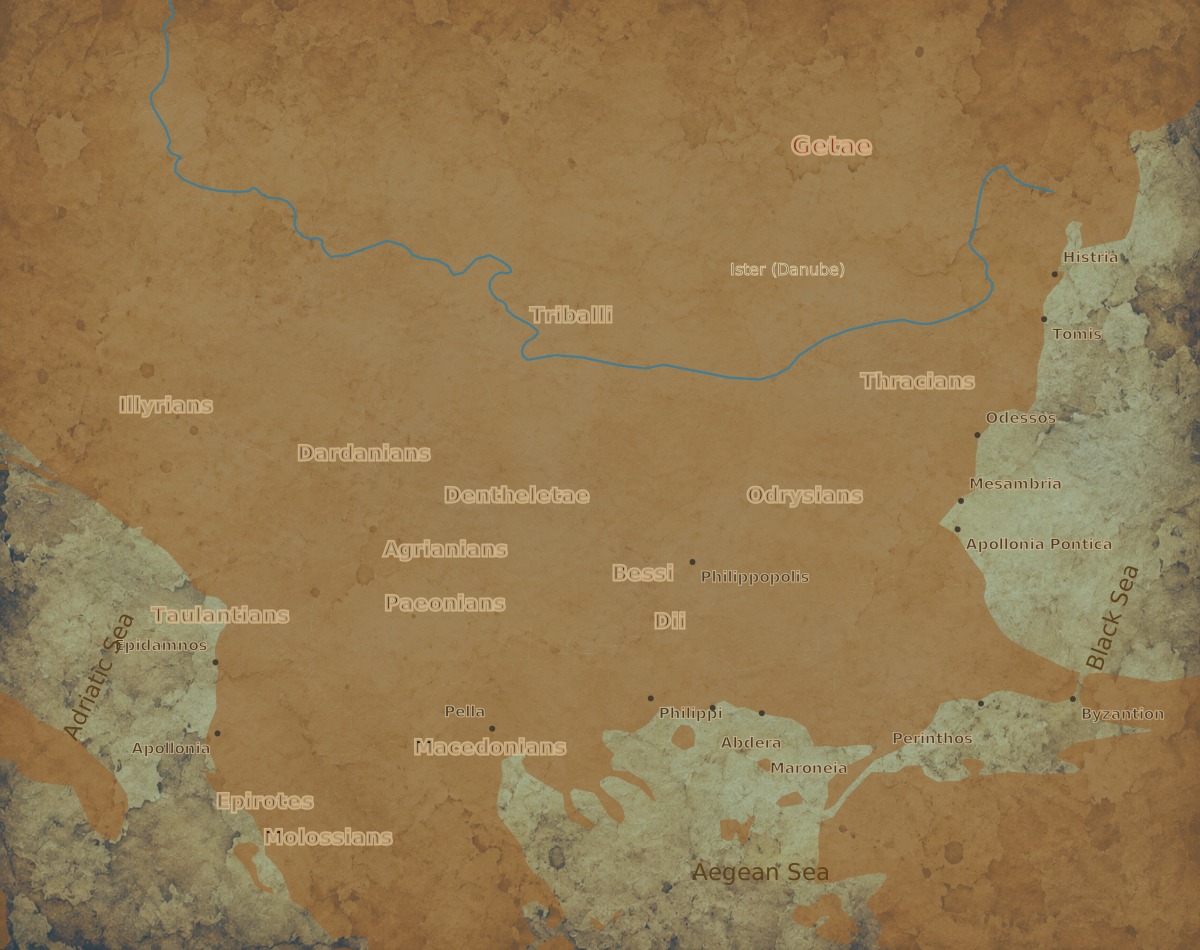
The Danubian setting joined the Getae to several wider worlds. To the south lay Thracian rulers and, increasingly, Macedonia. To the east, Greek coastal settlements connected the region with maritime exchange. Beyond and around them moved Scythian groups whose mounted strength influenced the balance of power. A local ruler had to judge neighbours who might appear as trading partners, rivals or forces passing through his territory.
Ancient descriptions reflect these overlapping relationships. The Getae appear in accounts of Persian expeditions, Macedonian campaigning and the wars of Alexander's successors. Their history cannot be told as the career of one continuously unified state. Particular kings and communities become visible when their actions meet those of the writers' principal subjects. Between those encounters, the region continued to support its own settlements, elites and sacred traditions.
Society: the wealth of the princely households
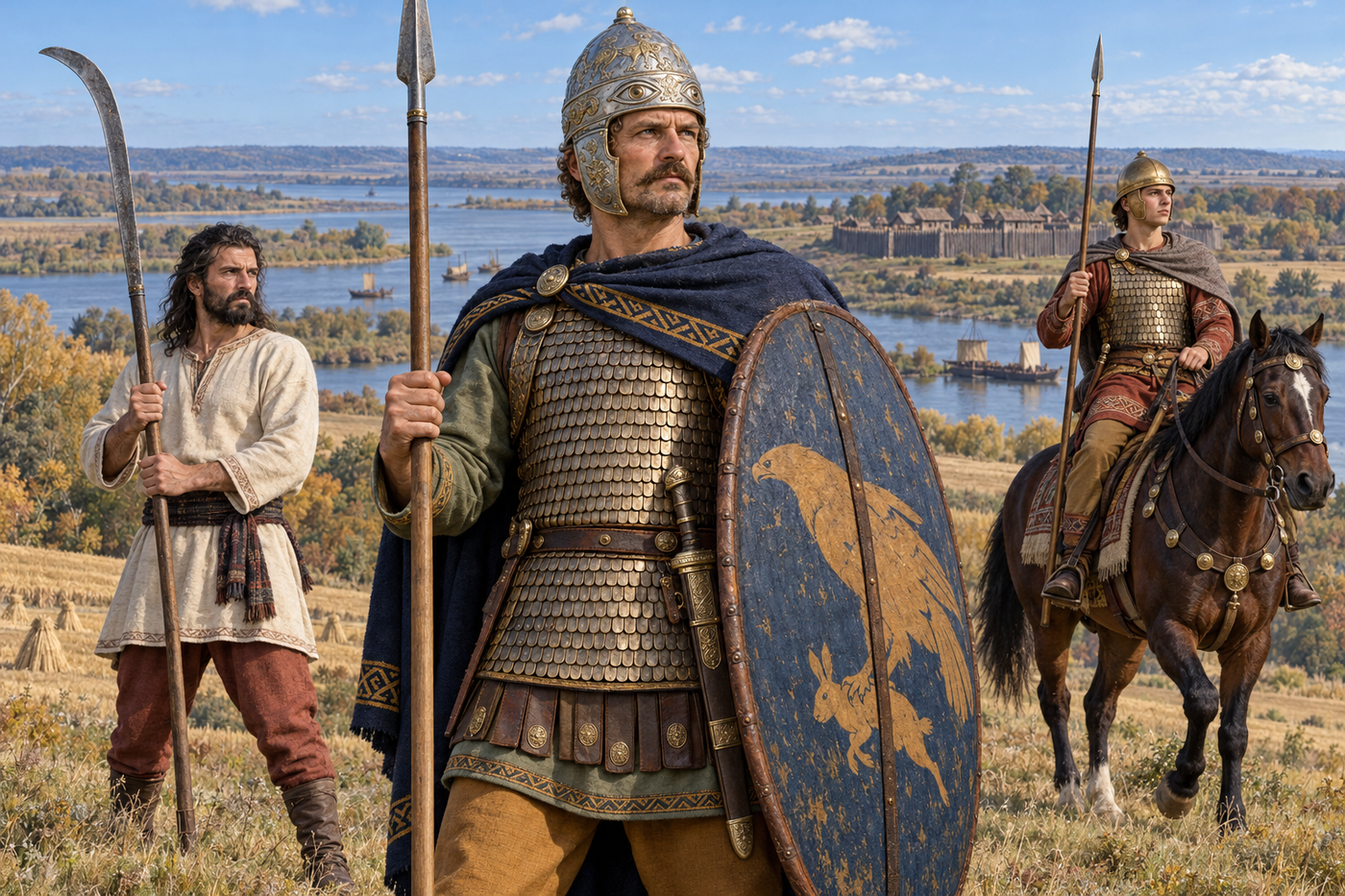
The finest surviving objects from the Danubian world make the power of its elites tangible. A fourth-century silver helmet now in Detroit bears a pair of watchful eyes above the wearer's brow. Animals cover its surfaces: a goat, an eagle and its prey. Related objects show that craftsmen working for wealthy patrons could share tools, techniques and a recognisable artistic vocabulary.
Such equipment announced the position of the man wearing it. Silver was valuable, the workmanship demanding, and the imagery visible to other people. A ruler's authority drew on his ability to command resources and attract skilled makers as well as to gather warriors. Horse gear, vessels and armour formed part of the public language of rank, accompanying the elite in life and, sometimes, into the grave.
Burial monuments reveal another expression of that authority. The third-century tomb at Sveshtari, built after Alexander's lifetime, combines a Thracian funerary setting with striking sculptural and painted decoration. Female figures support the architecture of the chamber, and a painted scene gives the dead person an elevated place within a sacred encounter. The monument belongs to the generations that inherited the upheavals of the fourth century. It shows a society able to transform contact with the Hellenistic world into a distinctive statement about its own great dead.
Beliefs: Zalmoxis and the meaning of death
Herodotus found the Getae especially remarkable for their beliefs about death. In his account, they expected the dead to go to Zalmoxis rather than simply cease to exist. He describes a messenger chosen at intervals and sent to the god through a fatal ritual. The duty was a communication with a divine power whose goodwill mattered to the living community.
He also preserves a story told by Greeks around the Black Sea. Their Zalmoxis had once lived among men, acquired knowledge and wealth, and entertained leading inhabitants while teaching them about a life beyond death. After disappearing into an underground chamber for years, he returned to people who had mourned him. The story presents sacred authority as something established through an extraordinary return from apparent death.
Herodotus himself placed Zalmoxis much earlier than Pythagoras, with whom the Greek version connected him. His account leaves an enduring impression of a people whose understanding of mortality attracted both fascination and argument. In the Getic world, the hope of another existence could give death a meaning larger than the immediate loss suffered by a household or a war band.
Warriors and command: cavalry, foot soldiers and the ground between them
Arrian's narrative of 335 BC gives the Getae both cavalry and a larger body of infantry. Their presence on the far bank was therefore more substantial than a screen of mounted raiders. The force could assemble to watch a crossing and threaten an enemy trying to establish himself beyond the river.
Against it, Alexander combined a surprise passage with close cooperation between horse and foot. The crops concealed his first movements. His infantry cleared a route with their weapons and advanced in formation, while the cavalry manoeuvred alongside. The Getae faced men who had already crossed the obstacle on which their position depended. They withdrew from the settlement and moved farther inland rather than remain exposed to the attack.
Command in such a country involved decisions about when to assemble and when to preserve the community by moving it away. A valuable settlement could be abandoned. A river could delay an invader without guaranteeing safety. Conversely, distance and the difficulty of feeding a foreign army could become strengths once a campaign went beyond the reach of dependable supplies.
The later career of Dromichaetes makes that last danger central. His victory did not depend on matching the wealth of a Macedonian king. The enemy's vulnerability emerged when an army that had entered Getic territory could no longer sustain its position. The ruler who understood the country could gain more through endurance and the handling of prisoners than through a spectacular charge.
Before Alexander: resistance to the Persian advance
When Darius advanced towards the Danube during his Scythian expedition in the late sixth century, neighbouring peoples made different choices. Herodotus says that the Getae resisted and were subdued. He nevertheless singled them out for courage and justice, giving their defeat a place of honour in his account.
The confrontation brought them into the history of an empire seeking to project power beyond the river. Persian demands and movement through Thrace connected local decisions with a campaign whose objectives extended much farther away. For the Getae, resistance meant confronting forces assembled by a ruler with resources from across Asia.
By Philip II's reign, Macedonia had become another power with a direct interest in the northern world. Royal marriages helped connect courts as well as armies. Athenaeus preserves the tradition that Philip married Meda, daughter of the Getic king Cothelas. Such a connection placed a Getic princess within the Macedonian dynasty. Kinship could offer a ruler a place in Philip's political network, even while Macedonian expansion threatened the freedom of neighbouring peoples.
Alexander: a crossing, a retreat and a demonstration
The campaign of 335 BC followed Alexander's fighting against the Triballi. A Getic force across the Danube confronted him with another test of authority. He collected river craft and used the resources at hand to carry a selected force over during the night. The movement brought Macedonian cavalry and infantry onto the northern bank before the Getae could prevent it.
The high crops assisted the approach. Once the Macedonians emerged, the Getae withdrew, first from their position and then from the settlement nearby. Alexander took what had been left, destroyed the place and returned south. The campaign produced booty and a public assertion that his army could operate beyond a great natural frontier.
His sacrifices after the crossing honoured Zeus, Heracles and the Danube itself. Military success was marked through religion: the king had overcome a river and acknowledged its divine presence. Embassies from neighbouring peoples then arrived. The sequence served the purpose of the northern expedition, establishing Alexander's reputation before he departed for Asia.
For the Getae, the immediate loss did not become permanent Macedonian occupation of the entire country. Alexander had other wars to fight. The river, settlements and local rulers remained part of a political landscape his successors would have to confront afresh. His demonstration of force had changed expectations, but it had not removed the difficulties of sustaining a campaign there.
People and legacy: Dromichaetes and the captive king
In the early third century BC, Lysimachus, one of Alexander's successors, carried war against Dromichaetes. The struggle involved captured strongholds, prisoners and attempts to secure advantageous terms. In Diodorus' surviving account, the Getae first released Lysimachus' son Agathocles with gifts, hoping to recover territory and leave a route towards agreement.
Eventually Lysimachus himself fell into their hands after his army had suffered from lack of food. Some of the victors wanted him punished. Dromichaetes argued for keeping him alive: another king might replace him, while a grateful prisoner could restore the disputed forts. The decision converted a military victory into a diplomatic opportunity.
Diodorus gives the settlement a memorable banquet. The Macedonian guests received splendid furnishings and rich food, while Dromichaetes and his companions ate simply. The contrast became a lesson in the folly of invading a country that could not support the conqueror's expectations. Lysimachus was released after agreement over the territory. A king who had followed Alexander through great wars had been forced to accept the judgement of a ruler beyond the Danube.
The Getae emerge from these episodes as people whose resources were different from those of the great royal courts, yet sufficient to make conquest costly. Their silverwork and tombs speak of wealth; their legends speak of another life; their wars turn on boats, provisions and the authority to decide the fate of a captive king. Alexander crossed their river. Dromichaetes made another Macedonian ruler understand the price of remaining beyond it.
Sources
Ancient accounts
- Herodotus, Histories 4.93, 4.94, 4.95 and 4.96.
- Arrian, Anabasis 1.3 and 1.4.
- Diodorus Siculus, Library 21.11–12; Athenaeus, Deipnosophistae 13.557b–e, Philip's marriages.
Archaeology and historical studies
- Detroit Institute of Arts, silver helmet 56.18, fourth century BC.
- UNESCO, Thracian Tomb of Sveshtari.
- The Thracians, Metropolitan Museum of Art Bulletin 35.1 (1977).
- F. Sabbathier, Dictionnaire pour l'intelligence des auteurs classiques grecs et latins, vol. 19, entry “Gètes”, pp. 60 ff.; Christopher Webber, The Thracians 700 BC–AD 46, Osprey Men-at-Arms 360.