






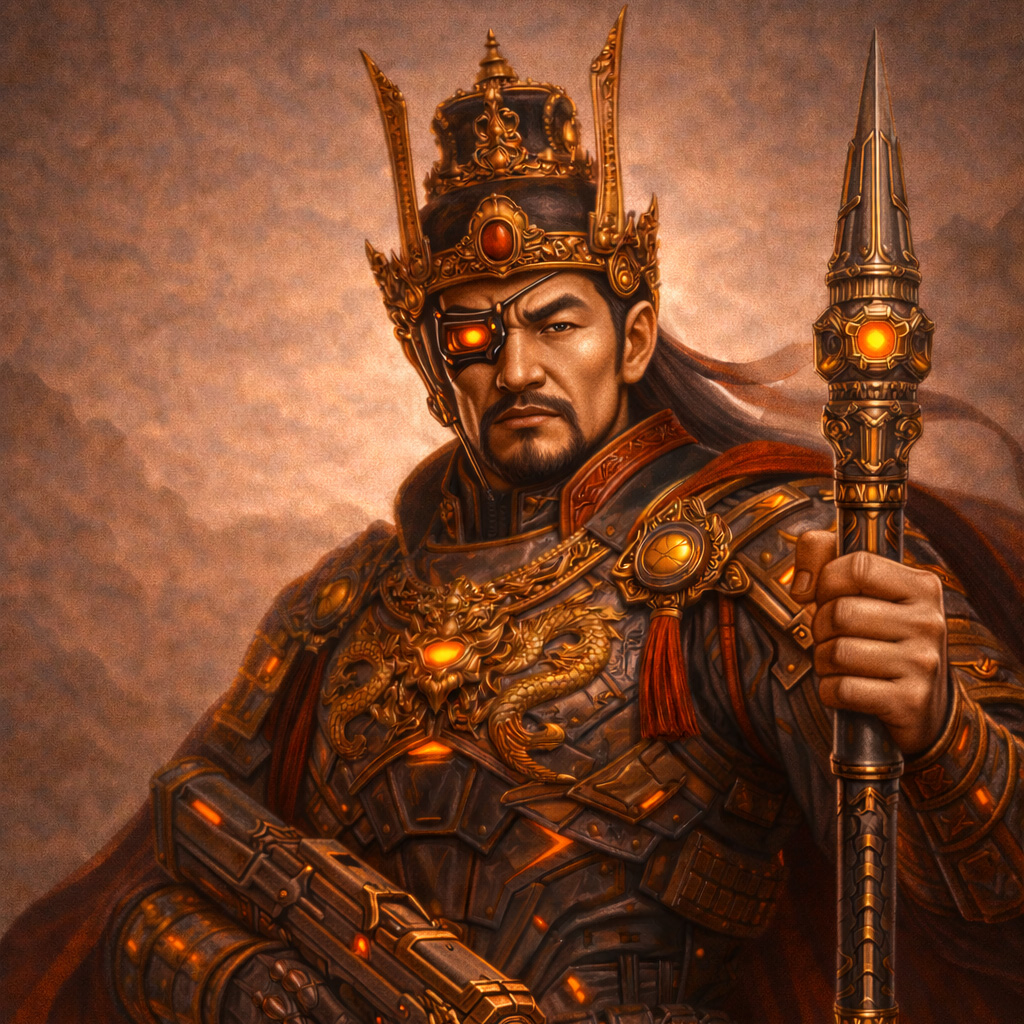
Part I – Heirs of the Sun Empire
Xian traces its origins to the far-reaching age of the old Sun Empire of Wanyue, when ambitious houses, governors, scholars, and military colonists carried imperial civilization across new lands. In the northern territories beyond Voltria, one such branch took root and endured long after stronger realms had risen and fallen.
Though distant from the imperial heartlands, the founders of Xian did not see themselves as exiles. They believed they were extending order into frontier lands, bringing administration, language, ritual, agriculture, and law to regions where power had been more fragmented.
Their settlements grew into cities of walls, archives, granaries, and disciplined courts. Roads linked valleys and fortresses. Officials recorded taxes and lineage. Temples, academies, and noble estates gave the kingdom a structure recognizable to any heir of the Sun tradition.
Over generations, distance created its own character. Xian became less flamboyant than the central empire, more austere, more defensive, and more attentive to continuity than spectacle. What it lacked in imperial grandeur, it gained in resilience.
When the old centers weakened, that resilience would become its greatest inheritance.
Part II – Rivalry of Legitimacies
For centuries, Xian lived in the shadow of the greater Sun Empire. However refined its institutions or loyal its scholars, it was still widely regarded as a secondary branch beside the original trunk of civilization.
The rivalry was rarely one of constant open war. It was more often a contest of prestige, interpretation, and memory. Which court best preserved ancient rites? Which rulers truly embodied the virtues of the legendary emperors? Which lineages carried the purest mandate of history?
Xian answered through discipline and scholarship. Its elites emphasized proper governance, literary mastery, and moral seriousness. The central empire often answered through scale, wealth, splendor, and political gravity.
To outsiders, the difference was simple: one was the empire, the other a respectable provincial cousin. Yet many thinkers quietly noted that peripheral branches sometimes preserve traditions more faithfully than decadent capitals.
By the time history judged the question, the old empire had fallen—and Xian still stood.
Part III – Guardian of a Shared Civilization
When the Sun Empire collapsed, much more than a state disappeared. A common language of diplomacy, etiquette, education, and law lost its central patron. Many customs shared across Damocles suddenly lacked an unquestioned source.
In that vacuum, Xian changed meaning. What had once seemed secondary now appeared essential. It possessed archives others had burned, ceremonies others had abandoned, and schools still teaching the classical tongue that had long served as a common language across the world.
Its scribes copied old texts. Its judges preserved legal forms descended from imperial precedent. Its noble houses maintained rituals that neighboring peoples still recognized even when they no longer practiced them fully themselves.
This did not make Xian a conquering restorationist power. It became something subtler: the last respected keeper of a civilization everyone had inherited in part, whether they admitted it or not.
Even rivals who mocked Xian’s caution often borrowed its words, manners, and symbols without noticing where they came from.
Part IV – Geography and Realm of the North
Xian lies north of Voltria, in lands shaped less by imperial ambition than by the need to endure. Its territory is not the richest on Damocles, nor the most expansive, but it is orderly, defensible, and carefully cultivated.
Fortified towns guard roads and river crossings. Agricultural valleys support dense settled populations accustomed to discipline and seasonal labor. Watchtowers, courier routes, and administrative centers bind the kingdom together more effectively than sheer size ever could.
The climate and frontier position helped shape national character. Life there rewards patience, preparation, and measured authority. Rash rulers rarely prosper in border realms where one bad harvest or one careless war can undo decades of work.
Xian therefore developed as a kingdom of maintained systems rather than dramatic expansion. Its strength has long rested on governance, logistics, and social cohesion more than on endless conquest.
To outsiders seeking spectacle, it can seem quiet. To neighbors who understand power, it appears solid.
Part V – The War of Invasion
When the imperial invasion shattered the balance of Damocles, Xian did not collapse at first shock. Its northern frontier became a secondary theater of war where Lioners ambitions and Voltrmen pressure met determined resistance.
The campaigns lacked the mythic scale of battles elsewhere, yet they were bitter and costly. Border forts changed hands, roads were burned, fields abandoned, and generations of officers tested in grinding warfare where endurance mattered more than glory.
Xian’s armies fought not as reckless fanatics but as defenders of state continuity. They sought to preserve their realm, their institutions, and the inheritance of the old order rather than chase impossible miracles.
Still, strategic reality grew darker with time. The wider war turned against the ancient powers. Fronts collapsed elsewhere, alliances shifted, and victories on the northern line could no longer compensate for disasters beyond it.
Xian had held firm—but firmness alone cannot save a world already breaking apart.
Part VI – Submission and Survival
The fall of the Sun Empire transformed every remaining battlefield. What had been resistance in the name of a greater civilizational order became, overnight, the lonely struggle of isolated survivors.
Then came the deeper shock: the atomic devastation unleashed in Massaloï. News of cities broken, lands poisoned, and whole regions changed by weapons beyond ordinary war forced rulers across Damocles to reconsider what continued defiance might cost.
The King of Xian chose submission. He swore allegiance to the Supreme Empire and accepted a place within the emerging Lioners-led order rather than risk annihilation for a cause already buried by history.
Some later generations would call the decision cowardice. Others would call it wisdom. What cannot be denied is that Xian survived while many prouder banners vanished forever.
Its palaces remained standing, its people endured, and its culture lived on—not triumphant, but alive.
Part VII – Two Centuries of Peace
Two hundred years have passed since Xian bent the knee to the Empire. Enough time for battlefields to become farmland, for ruined walls to be rebuilt, and for the last veterans of the invasion to die as old men whose memories became family stories.
With the generation of war gone, anger lost much of its immediacy. What had once been humiliation slowly transformed into history. The Lioners became less the enemy of living memory and more the distant senior power under whose shadow Xian learned to prosper.
This long peace allowed patient recovery. Irrigation systems were expanded, roads repaired, schools reopened, and noble disputes redirected into bureaucracy rather than bloodshed. A people shaped by continuity naturally excelled once survival no longer consumed every resource.
Xian did not become the loudest nation on Damocles, nor the richest, nor the most feared. It became something rarer: stable. In an age of rebellions, factional rivalries, spreading horrors, and ambitious warlords, stability itself carries prestige.
Many younger citizens now know the invasion only through poems, chronicles, and ceremonial anniversaries. Their loyalty is first to Xian, not to old grudges.
Part VIII – Society, Culture, and Identity
Xian remains one of the great cultural powers of Damocles. Its influence no longer comes from armies, but from language, education, manners, and the quiet authority of institutions that remember more than their neighbors do.
Learning is highly respected. Scholars, archivists, jurists, and teachers enjoy prestige beyond what their wealth alone would grant. Families invest heavily in education, believing refinement of mind is the surest path to honorable service and lasting status.
Ceremony structures public life. Seasonal rites, ancestral observances, court etiquette, formal greetings, and carefully ordered celebrations reinforce the idea that civilization depends on practiced discipline rather than spontaneous impulse.
Family honor remains central, though usually expressed through conduct, competence, and reputation more than empty boasting. To disgrace one’s household through corruption, cowardice, or vulgarity is remembered far longer than a simple failure of fortune.
Above all, Xian possesses a quiet confidence. Others may command larger armies or richer ports, but many still feel that when history wishes to speak with dignity, it does so in the language of Xian.
Part IX – Named Figures
King Zhao Wenli is the current ruler of Xian, a measured sovereign whose greatest talent is preserving balance. Neither conqueror nor dreamer, he understands that his kingdom’s strength lies in stability, dignity, and knowing when not to gamble what earlier generations saved.
Crown Prince Zhao Ren represents a younger current within the court. Intelligent and outward-looking, he favors selective modernization, stronger commercial ties, and a more active diplomatic role beyond the traditional caution of Xian statecraft.
Grand Scholar Lin Meiyu presides over the royal academies and the preservation of classical learning. Revered across the kingdom, she has spent decades restoring archives, standardizing ancient texts, and ensuring that Xian remains the keeper of a shared civilizational memory.
General Han Guoliang commands the northern border forces. A veteran of frontier tensions rather than great wars, he is known for discipline, preparedness, and the belief that peace is safest when defended by those fully capable of war.
Part X – Xian Today
Xian today is proud, peaceful, and deeply rooted. It no longer seeks to restore vanished empires or dominate its neighbors through force. Its ambitions are steadier: prosperity, continuity, cultural prestige, and security within a changing world.
Within the Lioners sphere, it enjoys respect disproportionate to its military weight. Others recognize that some forms of legitimacy cannot be forged quickly or purchased with tribute. They must be inherited, maintained, and believed.
This does not mean Xian is passive. Its diplomats watch regional shifts carefully. Its scholars shape elite thought beyond its borders. Its armies remain disciplined enough to discourage opportunists who mistake courtesy for weakness.
Many powers shine brighter than Xian in any given decade. Few endure with equal grace.
In a restless age, the kingdom stands as proof that survival without bitterness can be its own kind of victory.