






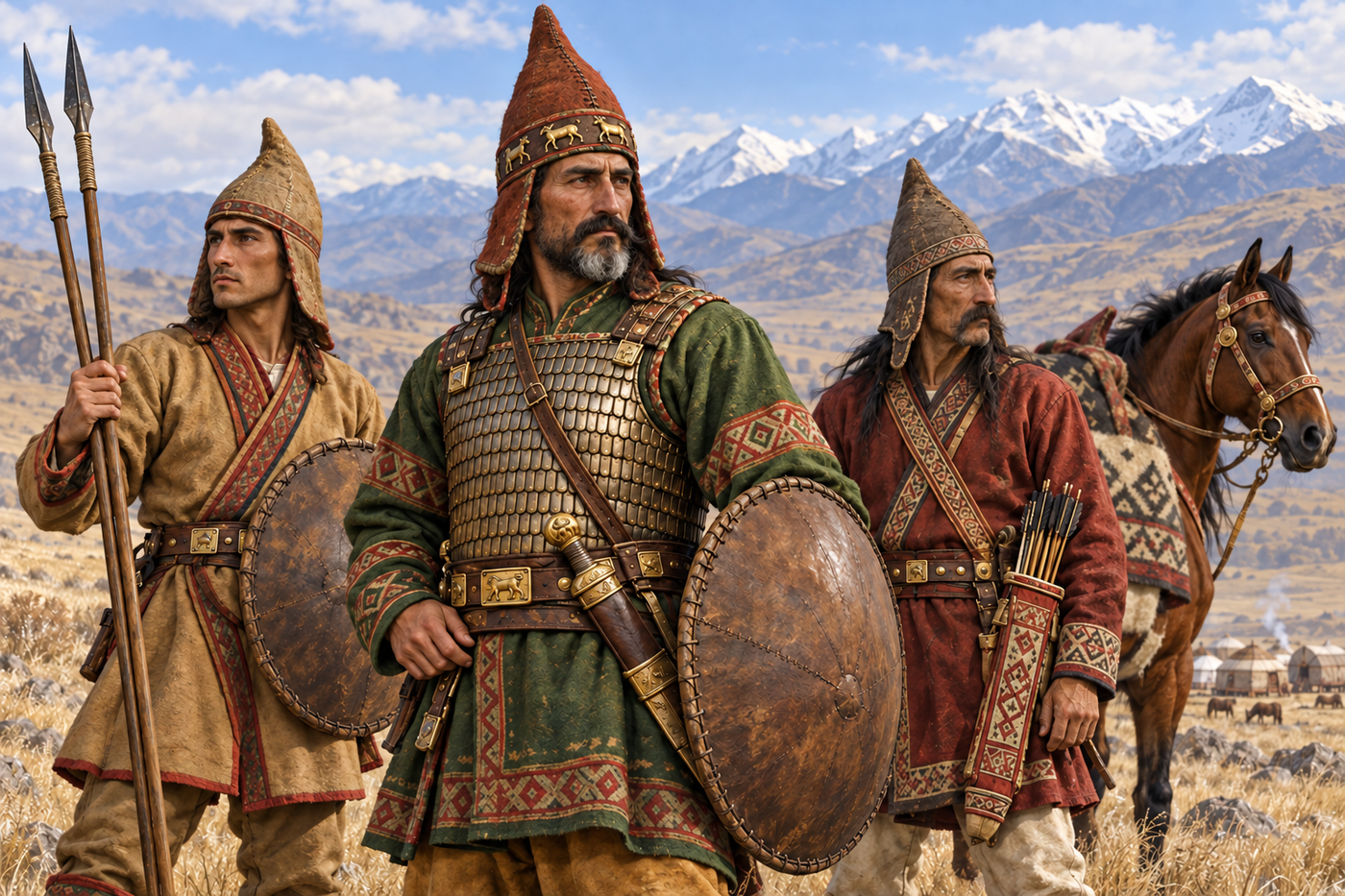
Saka
The riders Darius called allies
Among the forces gathered against Alexander at Gaugamela were mounted archers led by Mauaces. Arrian makes their position distinctive: these Saka had come as allies of Darius, rather than as subjects commanded by the satrap of Bactria. Their presence placed men from beyond the settled provinces inside the Great King's last great army.
That relationship captures a recurring strength of the Central Asian steppe. A Persian ruler might fight one Saka leader and negotiate with another; a community might provide cavalry without surrendering every claim to its own authority. The armies that emerged from these agreements joined the resources of a great monarchy to riders whose freedom of movement and local connections remained valuable.
Pastures, rivers and the edges of the oases
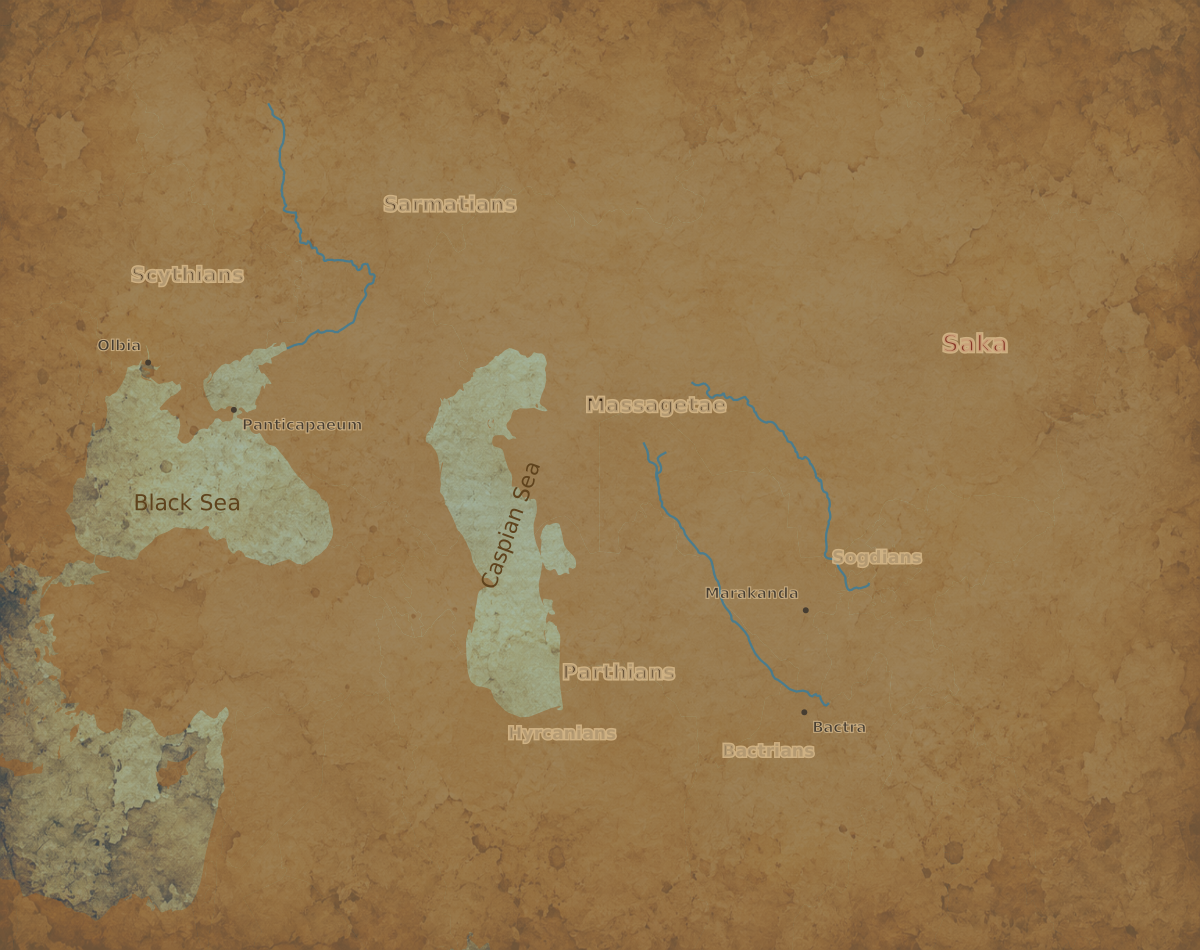
Saka communities inhabited a broad Central Asian world extending through grasslands, foothills and river corridors. Seasonal movement connected pasture and water, while contact with cultivated settlements brought markets and opportunities for exchange. The routes followed by animals and households could also carry armed men towards the frontiers of imperial rule.
Different groups occupied different parts of this country. Persian inscriptions distinguished Saka through descriptions associated with dress, ritual or geographical position. Those royal names reveal the effort to identify peoples whose relationships with the empire varied. The king's claim to command them had to be made effective through campaigning and agreements on the ground.
Mobility gave leaders choices unavailable to a governor tied to the defence of a town. Riders could gather, cross a frontier and withdraw into country difficult for an enemy to occupy. Their households still depended on familiar water, animals and seasonal routes. The freedom to move was sustained by knowledge and resources that could be threatened.
The pointed cap before the Persian king
At Behistun, Darius I placed a defeated Saka leader among the captives displayed before him. Skunkha wears the high pointed headgear that makes him immediately recognisable on the relief. The royal inscription tells of the king's campaign, the capture of the leader and the installation of another man in his place.
The monument turns a frontier struggle into a declaration of order. Darius acts with the favour of Ahuramazda, defeats opposition and appoints a ruler who will answer to him. The captive's distinctive appearance allows the viewer to see a distant people brought beneath royal power.
For the Saka, the event meant a change in leadership imposed by an invading king. It also shows that the Persian answer could be to preserve a local ruler's position under new obligations. Conquest did not require the whole community to become a settlement resembling those of the Iranian interior. It required someone able and willing to make the relationship work.
Weapons for a rider
Herodotus describes Saka serving in Xerxes' army with pointed caps, trousers, bows, daggers and battle-axes. His account gives a vivid form to soldiers whose equipment differed from the shield-bearing infantry of many Greek cities. A rider needed weapons and clothing that could be used while moving and carried over long distances.
The bow made it possible to attack without immediately committing to a close fight. A spear or sidearm provided another answer when the distance closed. The value of each weapon depended upon the rider's judgement, the condition of his horse and the support of others. Mobility could create an opportunity, but a badly timed attack could still leave a man isolated.
Prominent households could obtain better protection and more elaborate fittings. Equipment displayed standing as well as serving practical needs. Precious metal attached to dress or horse gear placed wealth where companions and opponents could see it. The same person might appear as a working rider, a follower in war and a participant in ceremony.
The gold of Issyk
The rich burial at Issyk, in the foothill country of southeastern Kazakhstan, gives one of the most striking surviving images of Saka elite display. Thousands of gold ornaments accompanied the deceased, allowing a splendid costume to be reconstructed. Animals and other carefully worked forms covered clothing intended to make exceptional status visible.
The grave belonged to a wider landscape of burial mounds. Such monuments demanded labour and decisions by survivors about the objects and ceremonies appropriate to the dead. A community able to move through the year could still invest heavily in a lasting place of remembrance.
The finds reveal a world in which craftsmanship, weapons and ritual presentation met. They also show the reach of connections carrying materials and ideas across Central Asia. A leader's standing could be expressed through objects whose making required skills and exchanges extending well beyond a single camp.
Divine favour on the frontier
Religion entered the relationship between the Persian court and the Saka in the language of royal victory. At Behistun, Darius explained opposition and punishment through the order protected by Ahuramazda. The defeated people appeared within the king's account of how rightful rule had been restored.
Local ritual life had its own settings and practices. The Persian description of the haoma-related Saka associates one group with a sacred preparation important in Iranian religious traditions. Clothing and offerings placed in graves give another view of how communities represented status and the passage into death.
These sacred connections belonged to decisions about leadership, loyalty and danger. A ruler had to preserve the confidence of followers whose expectations included more than the distribution of plunder. Ceremony and memory could support authority, while defeat exposed the limits of a leader's claims.
Mauaces at Gaugamela
In 331 BC, the Saka allied to Darius rode into a campaign that threatened the whole Persian monarchy. Their commander Mauaces brought them into an army assembled from many provinces and partners. They stood within a coalition whose great strength required coordination across different traditions of service.
Mounted archers could harass an enemy, threaten flanks and exploit disorder. At Gaugamela, those possibilities formed part of the pressure placed on Alexander's smaller army. The Macedonian command had to protect its movements while finding an opportunity to attack the Persian centre.
The defeat of Darius ended the immediate coalition without bringing every supporting people under Alexander's control. Riders who had fought in the royal army could return towards lands where the conqueror still had to establish his reach. The war was moving east into a setting where holding cities would be only one part of the problem.
Across the Jaxartes
In 329 BC, Alexander established a new position on the Jaxartes, the modern Syr Darya. Beyond the river, steppe opponents watched and challenged his army. The frontier offered both sides a visible obstacle, but it could not guarantee that either would remain safely behind it.
Alexander used artillery to drive riders back from the opposite bank while his troops crossed. He then had to prevent mounted opponents from simply circling an exposed detachment and avoiding the stronger body behind it. The fighting required cavalry and missile troops to cooperate, bringing the enemy within reach of a coordinated attack.
The Macedonians won, and one of the steppe leaders, Satraces, was killed. Pursuit nevertheless encountered the limits imposed by heat, thirst and the king's illness after drinking bad water. Victory did not give the army unlimited freedom to continue across unfamiliar country.
Messages after the fighting
Envoys followed the clash, carrying explanations and proposals that allowed a ruler beyond the river to distance himself from the attack. Alexander received them and sought a workable relationship. The same frontier that had produced battle now demanded diplomacy.
His army also faced continuing resistance in Sogdiana, where local leaders could seek support from mounted peoples outside the main occupied centres. The conqueror had to decide where to fight, where to negotiate and how much force could be spared for each new danger. A steppe alliance might prolong a revolt that the capture of towns had failed to end.
The Saka world therefore remained a place of political choices throughout the age of conquest. Skunkha's captivity, Mauaces' alliance and the fighting on the Jaxartes show different relationships with imperial power. Their common setting was a country whose riders could make themselves indispensable or dangerous, and whose leaders retained opportunities to bargain over the terms on which outsiders entered it.
Sources
Ancient accounts and royal monuments
- Darius I, Behistun inscription, column V, campaign against the Saka and capture of Skunkha.
- Herodotus, Histories VII.64.
- Arrian, Anabasis of Alexander III.8, IV.1–5 and IV.15.
Archaeology and historical studies
- Gylym Ordasy Museum of Archaeology, Issyk and the reconstructed Golden Man costume.
- British Museum, cylinder seal 1959,0214.3 and comparative Saka dress.
- “Clothing ii. In the Median and Achaemenid Periods”, Encyclopaedia Iranica.
- E. V. Cernenko, The Scythians 700–300 BC, Osprey Men-at-Arms 137.