






Part I – Heirs of Tetrapolis
The Lioners trace their lineage directly to Tetrapolis, ancient Earth, and few clans invoke that heritage with greater pride. In their own chronicles they are not merely nobles of the Supreme Empire, but custodians of an unbroken civilizational flame carried across the stars through ages of war, migration, and imperial expansion.
Their culture is shaped by court ritual, dynastic memory, and the conviction that hierarchy is the natural architecture of any enduring society. Rank determines speech, posture, access, marriage, military command, and even the right to stand close to power. Nothing important is informal, and informality itself is often seen as a symptom of decline.
Unlike more pragmatic or frontier-born clans, the Lioners do not justify authority through utility alone. They believe legitimacy has moral weight. A lawful ruler may be imperfect, but rebellion opens the door to barbarism, opportunism, and endless fragmentation. This belief explains both their prestige and their inflexibility.
Across the Empire, they became known as defenders of order, patrons of high culture, and masters of ceremonial governance. They also became known for pride, distance, and a tendency to mistake obedience for loyalty.
When Damocles entered their history, the Lioners did not see a distant world to exploit. They saw a fractured realm in need of structure—and a stage worthy of imperial greatness.
Part II – Rule, Nobility, and Imperial Technologies
Lioners society is ruled by an aristocracy whose privileges are immense and carefully guarded. Great houses compete for influence through marriages, appointments, military distinction, and access to the highest offices of the clan. Beneath them stand lesser noble lines, professional officers, merchant dependents, and the vast common population that sustains the state.
What most separates the upper elite from all others is access to Imperial life-extension technology. Senior rulers and strategically valuable bloodlines may receive regenerative treatments capable of restoring youth, healing catastrophic wounds, and extending active life for centuries. The side effects can be dramatic: altered metabolism, unusual stature, and a growing physical distance from ordinary humanity.
For the highest tier of leadership, an even rarer privilege exists: clone-reset succession protocols. In carefully controlled circumstances, a damaged or dying ruler may preserve continuity through prepared biological vessels and memory transfer systems. The process is costly, politically sensitive, and consumes resources on a scale that could sustain entire provinces.
These technologies reinforce the existing order. Experience accumulates in the same hands for generations. Old rivalries never fully die. Long memories shape policy. So do long grudges.
To admirers, this creates stability guided by seasoned statesmen. To critics, it creates a fossilized elite too removed from the lives of those it governs.
Part III – The Three Tribuns and the Landing on Damocles
When the Imperial invasion of Damocles began, few expected the Lioners to emerge as its principal winners. Yet among all the great expeditionary forces, theirs suffered the least during the catastrophic opening phase. While many regular transport fleets were destroyed and rival clans scattered, the three Lioners Tribuns made planetfall with much of their command structure intact.
This alone changed history. Where others landed leaderless, isolated, or panicked, the Lioners arrived with hierarchy, logistics, and clear chains of command. Their armies could regroup, distribute supplies, and exploit success before their enemies understood what had happened.
The three Tribuns each embodied a pillar of Lioners power: dynastic authority, military discipline, and administrative command. Though often rivals in private, they understood that survival required cooperation. Their banners therefore advanced not as three broken fragments, but as a functioning coalition.
That advantage proved decisive in the chaotic first years of conquest. While lesser Imperial houses were annihilated or absorbed, the Lioners secured territory, allies, and legitimacy with astonishing speed.
The invasion of Damocles shattered many ambitions. For the Lioners, it created an empire within the empire.
Part IV – Alliance with the Voltrmens
The Lioners landed in the lands of the Voltrmens, a northern people whose culture had long stood apart from the Celestial order. They revered the mountain dwarves of ancient legend, honored the Dragon God of the Forge, and preserved martial traditions older than many coastal states. To them, the priestly systems of the Celestial Peace were foreign chains rather than sacred inheritance.
Physical resemblance also mattered. The Voltrmens shared features associated with the old northern peoples of Wanyue, making the newly arrived Lioners appear less like strangers and more like distant kin returned with the strength of the stars. In an age where symbolism could decide wars, that resemblance carried immense power.
Many Voltrmen chiefs therefore welcomed the Lioners as liberators and allies. Others submitted once it became clear resistance would isolate them from richer trade networks and modern arms. Only a minority remained fully independent in the harsher northern reaches, where they continue under loose Lioners tutelage rather than direct rule.
This alliance gave the Lioners manpower, food, forge capacity, and secure depth from which to expand. In return, the Voltrmens gained prestige, markets, and a place inside the Imperial order without being culturally erased.
From this union emerged the Lioners Triumvirate: not merely an occupation zone, but a durable western power built on conquest and consent in unequal measure.
Part V – Conquest of the West and Wars on Two Fronts
The Lioners preferred a policy of minimal assimilation whenever possible. If local elites accepted Imperial sovereignty, paid taxes, and preserved order, they were often allowed to keep customs and subordinate authority. The successful integration of Xian strengthened their belief that controlled autonomy could be more efficient than endless repression.
Elsewhere, reality proved harsher. In the northern mountains, traditionalist clans resisted for years through raids, fortified passes, and blood feuds that no treaty could end. Every valley required a separate campaign, and victory in one district often triggered revolt in another.
The greatest disaster came in the south. Seeking to impose protocol upon the New Empire of the Setting Sun, one of the three Tribuns gravely insulted a court that valued ceremonial sovereignty as fiercely as the Lioners themselves. The response was immediate and unforgettable: the offending Tribun was executed.
Total war followed. Lioners armies now faced enemies on two fronts while Massaloï already consumed Imperial forces elsewhere. Supply lines stretched, casualties mounted, and the prestige of invincibility began to crack.
Yet the Lioners did not retreat. Cornered powers can become most dangerous when they believe defeat would destroy their entire future.
Part VI – Debt, Industry, and the Guilds
To survive the widening war, the Lioners turned to the West Guild for resources on a scale never before seen on Damocles. Loans of staggering magnitude financed weapons, roads, fortifications, transport columns, ammunition stockpiles, and industrial expansion across the western territories.
The forges of the Voltrmens roared day and night. Armor plates, artillery pieces, engines, rifles, shells, and replacement machinery poured from mountain foundries fueled by iron discipline and ancient metallurgical skill enhanced by Imperial methods.
But the guilds served profit before loyalty. While enriching themselves through Lioners contracts, guild merchants also armed their enemies wherever margins justified the risk. Thus the same commercial system that sustained the Lioners also prolonged the war against them.
The immediate result was survival. The longer result was dependency. Interest, obligations, political concessions, and strategic vulnerability became embedded within Lioners statecraft.
Even today, long after the great campaigns ended, the shadow of those debts remains. The Lioners won their empire with steel—but much of that steel was borrowed.
Part VII – Tenkyo, Atomic Fire, and the End of Conquest
After stabilizing their western and southern fronts, the Lioners pushed eastward into Massaloï, determined to break the last great centers of organized resistance. The campaign was long, costly, and unlike the wars they had already fought. In Massaloï, no victory remained secure for long, and every road had to be conquered repeatedly.
The capture of Tenkyo marked the highest point of Lioners military glory. Taking the sacred city proved that even the holiest fortress of the old order could fall before disciplined Imperial arms. Across Damocles, many believed the conquest was effectively complete.
They were wrong. The fall of Tenkyo shattered institutions but not belief. Sect fighters retreated into tunnels, mountain refuges, ruined districts, and scattered strongholds. New rebellions rose faster than old ones could be crushed. What had been a campaign became an endless war of attrition.
Faced with mounting losses and unwilling to accept strategic stalemate, the Lioners chose total escalation. Nuclear bombardments were unleashed against rebel centers, hardened zones, and territories deemed permanently hostile.
The immediate resistance was broken, but the price was monstrous. Irradiated survivors became the ancestors of the Naxjabas. Poisoned battlefields helped awaken the Fukai in its most aggressive forms. The Lioners won the war for the map—and lost control of what that victory had created.
Part VIII – Lioners Power Today
In the current age, the Lioners are the foremost clan of Damocles. Their voice carries the greatest weight within the Council of Clans, their diplomatic protocols shape inter-clan politics, and the first channels reopening toward the Supreme Empire pass primarily through their authority.
This prestige rests on more than ceremony. The Lioners inherited the broadest territorial network, major ports, industrial zones, and deep administrative experience. They remain the faction most capable of thinking in continental terms rather than provincial ones.
They also command the Common Imperial Force on Damocles, a coalition army drawn from multiple major clans. Its mission is to secure unstable regions such as Massaloï and Botai, suppress large-scale threats, and preserve the wider Imperial order.
Yet leadership does not mean freedom. Coalition forces are politically constrained, chronically underfunded, and dependent on cooperation from rivals who often prefer Lioners weakness to shared success. Every decision must balance military necessity against fragile alliances.
The Lioners sit at the summit of Damoclean power—but it is a summit exposed to storms from every direction.
Part IX – Threats and Rivalries
The most visible external threat comes from Taiping. Once broken by war, it has regained strength and memory. Its rulers speak openly of historical grievances, and their first demand remains the return of Fragrance Island, whose strategic harbors control routes toward the north and enrich whoever governs them.
Debt remains another battlefield. The South Guild and other financial interests exert pressure through credit, supply contracts, and commercial leverage. A proud aristocracy now finds itself negotiating with powers that wear ledgers instead of crowns.
Within the frontier zones, unrest never fully ends. Hidden Naxjabas cells strike at symbols of Lioners authority. Celestial fanatics continue to inspire uprisings. Peripheral subjects obey when watched and test limits when attention shifts elsewhere.
Above all looms the Fukai. Unlike political enemies, it cannot be bribed, ceremonially appeased, or defeated by prestige. Its spread threatens trade, population centers, and long-term continental stability. Among the great powers, the Lioners are one of the few who grasp the scale of that danger.
Thus the clan faces a paradox: stronger than any single rival, yet surrounded by problems no battlefield triumph can permanently solve.
Part X – Military Power and Orders Militant
The Lioners military machine is built on discipline, professionalism, and the belief that war must remain an instrument of state rather than a tribal feud. Their armies favor structured chains of command, combined-arms doctrine, careful logistics, and overwhelming force applied at decisive points.
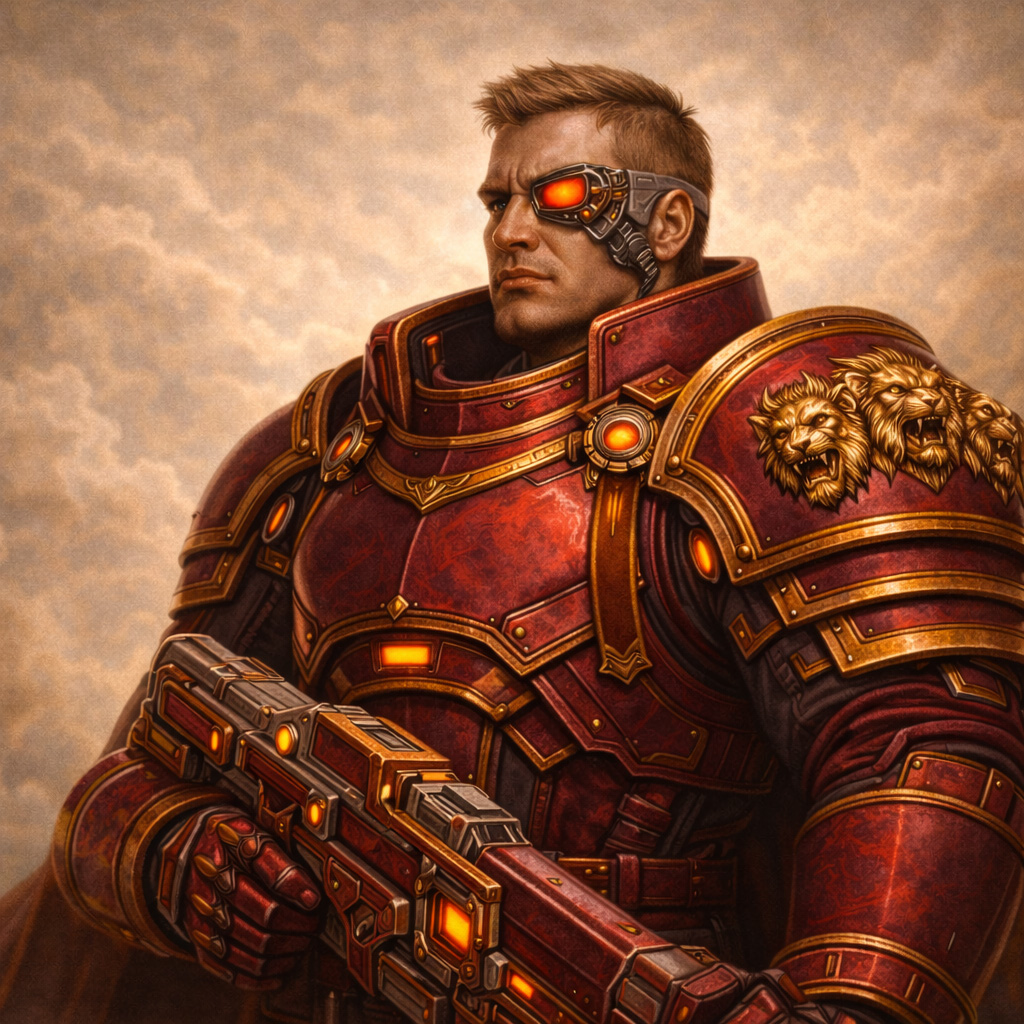
Core formations include heavy infantry in advanced armor, mechanized columns, artillery regiments, and elite household guards drawn from loyal noble lines. These forces are slower and more formal than the raiding armies of some rivals, but exceptionally dangerous once deployed with preparation.
Voltrmen auxiliaries remain vital to this system. Hardened by mountain climates and industrial frontiers, they serve as line infantry, engineers, scouts, and fortress troops. Many Lioners victories depended as much on Voltrmen endurance as on aristocratic command.
To confront ideological enemies, the Triumvirate also shelters Imperial military monastic orders. These brotherhoods combine religious devotion, strict martial training, and access to rare equipment. They are deployed against Celestial fanatics, relic cults, insurgent strongholds, and threats considered too dangerous for conventional policing.
Even so, the Lioners army is stretched thin. Garrisons must hold vast territories, support coalition operations, guard trade routes, and monitor multiple fronts at once. Their strength is real—but never infinite.
Part XI – Economy, Society, and Daily Life
The Lioners realm contains wealthy ports, productive estates, mining routes, fortified industrial towns, and major roads linking west to center. On paper it is one of the richest powers on Damocles. In practice, much of that wealth is already claimed by debt service, military upkeep, and the cost of maintaining prestige.
Urban life in core provinces can be refined and prosperous. Public squares are orderly, markets well regulated, and architecture designed to project continuity rather than extravagance. Noble patronage supports academies, gardens, orchestras, and institutions devoted to law or historical memory.
Farther from the capitals, life is harsher. Frontier communities carry the burden of taxation, conscription, and periodic unrest. Merchants profit from imperial roads while farmers and workers absorb the shocks of every new campaign or trade disruption.
Etiquette shapes everyday interaction. Titles matter. Proper dress matters. Ceremony matters. To outsiders this can appear theatrical, but for Lioners society these rituals reduce friction by making hierarchy visible and predictable.
The result is a realm of contrasts: cultivated courts and exhausted borderlands, inherited grandeur and practical strain, genuine order sustained at ever-rising cost.
Part XII – Named Figures
High Tribun Alaric Vane-Lionhart is the effective ruler of the Triumvirate and the most influential statesman on Damocles. Towering in stature due to centuries of regenerative treatment, he combines aristocratic distance with formidable charisma. Admirers see the perfect guardian of order. Enemies see a magnificent tyrant who mistakes endurance for destiny.
Lord Commander Cedric Lionhart, his three-hundred-year-old son, governs the garrison of Fragrance Island. Unlike many Lioners nobles, he is widely loved by civilians and soldiers alike for his visible presence, measured justice, and willingness to share danger. His popularity has made him both an asset and a concern within court politics.
Marcellus Valeon is the descendant of the Tribun executed during the southern diplomatic disaster. Lacking immortality and burdened by ancestral shame, he holds little formal power. Yet many lesser houses quietly rally around him as a symbol that blood alone should not determine destiny.
Tribun Octavian Draegor rules nothing beyond the walls of his own immense fortress—or so it is said. Consumed by paranoia, he trusts machines more than courtiers and communicates through layers of intermediaries. Some call him broken. Others suspect he sees dangers the rest of the realm refuses to face.
Lady Eleanor Ashcombe is one of the sharpest minds of the Lioners court. Mistress of protocol, patron of alliances, and architect of several dynastic marriages, she has advanced her faction through diplomacy more effectively than many generals through war. She smiles rarely and forgets nothing.
Grand Master Severin Holt commands one of the Imperial military monastic orders stationed in Lioners territory. Stern, incorruptible, and feared by zealots of every creed, he believes faith must serve order or be broken by it.
Part XIII – Legacy and Future
The Lioners stand today as the grandest success of the Damoclean conquest and perhaps its most dangerous illusion. They built the strongest state on the continent, imposed systems where chaos once ruled, and preserved a functioning bridge to the wider Empire when others descended into regional ambition.
Yet every pillar of that greatness carries a crack. Their victories created the Fukai frontier. Their wars created debt. Their hierarchy breeds resentment. Their allies need them but do not trust them. Their enemies fear them but grow stronger each generation.
If communications with the Supreme Empire fully return, the Lioners may become indispensable governors of a restored order. Or they may discover that distant masters have little gratitude for expensive provincial dynasties grown too independent.
If the Empire does not return, they must survive in a world where prestige cannot stop spores, loans cannot buy loyalty forever, and old banners cannot march without flesh beneath them.
The Lioners remain magnificent, disciplined, and powerful. Whether they are the guardians of Damocles—or the last elegant rulers before a wider collapse—has not yet been decided.