






Parthians
The satrap who changed kings
At Gaugamela in 331 BC, Phrataphernes led horsemen from Parthia and neighbouring lands in the army of Darius III. He remained with the Great King during the retreat east. When Darius was murdered by men who had served him, the satrap faced a choice that no battlefield formation could settle. He eventually surrendered to Alexander and found a place in the new order.
His subsequent career made Parthia part of the machinery sustaining Macedonian conquest. The same provincial authority that had gathered men for Darius could supply troops, arrest opponents and send animals to an army returning from India. The province's story in Alexander's lifetime is therefore one of an Iranian country whose leaders had to decide how to preserve power and service when the king at the centre changed.
Where the Iranian roads met the steppe
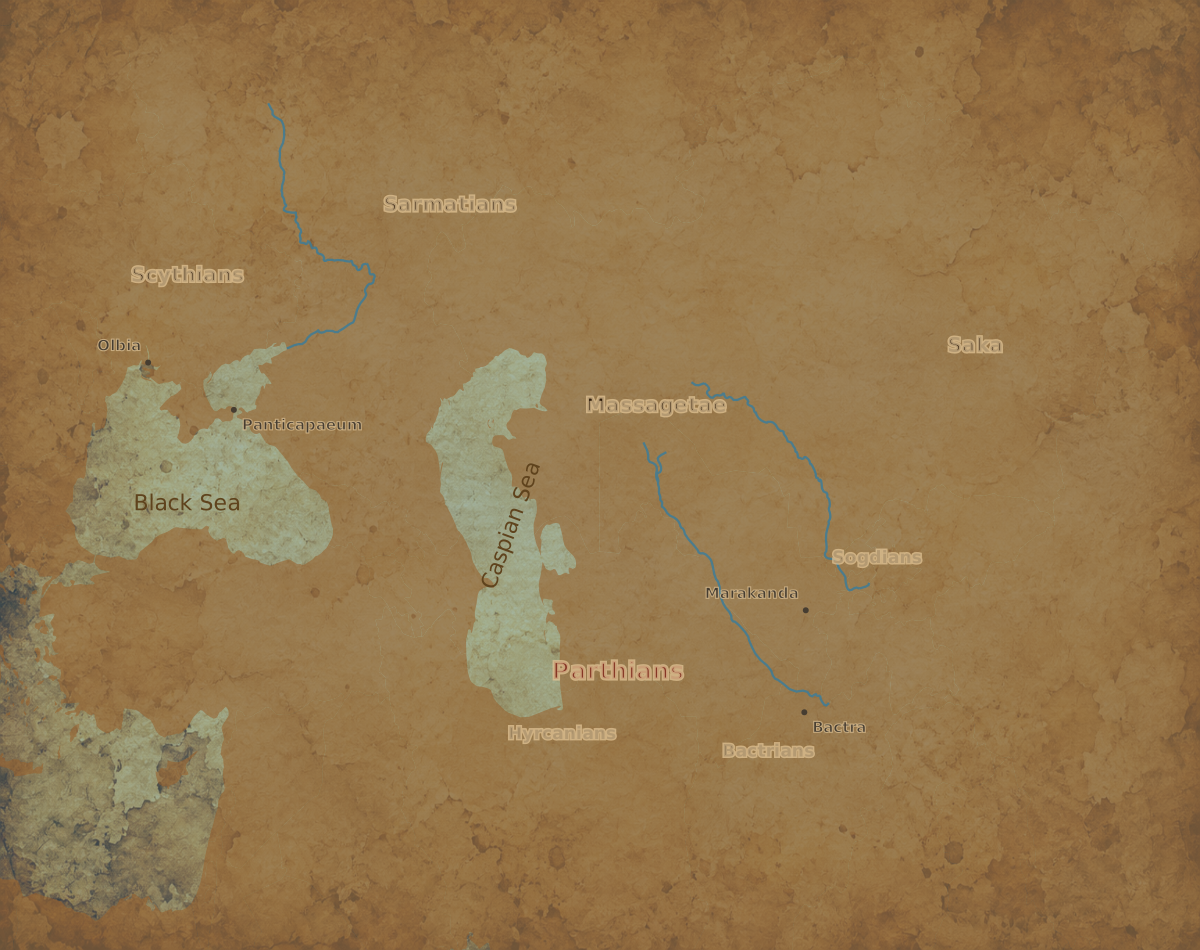
Parthia lay in northeastern Iran, adjoining the approaches to Hyrcania and the routes leading east towards Aria and Central Asia. Mountain country and cultivated settlements stood near much drier ground. Travel depended on passages and access to water, making the connection between places as important as the area controlled around them.
The region faced both the Iranian interior and the mobile communities beyond its northern approaches. People, animals and goods could move between settled districts and the steppe. That position exposed the province to pressure, but also supplied rulers with useful connections. A satrap needed to understand local households and the routes through which an army could be raised and maintained.
Hyrcania towards the Caspian offered a different landscape of wooded slopes and productive lowlands. The two regions could be joined under one command while retaining their particular conditions. Their association in the careers of imperial governors reflects the need to coordinate neighbouring territories rather than the disappearance of their differences.
A place in the Achaemenid kingdom
Parthia appears among the countries named in Achaemenid royal inscriptions. Its relationship with the Persian monarchy was old by the time Alexander arrived. Local resources and people belonged within an imperial structure whose demands included tribute, military service and obedience to officials acting for the king.
The early reign of Darius I shows how that authority could be contested. His inscription at Behistun records revolt in Parthia and Hyrcania while his father Hystaspes was in the region. The struggle formed part of the wider crisis through which Darius established his throne after 522 BC.
Hystaspes gathered the forces available to him and fought the rebels. Reinforcements sent from the west helped bring the country back under royal control. In Darius' account, the victories belong to the restoration of an order protected by Ahuramazda. For the people fighting within the province, they were also struggles over which claim to authority would prevail.
Service, rank and the Iranian household
A satrap governed through relationships as well as commands issued from above. Prominent families could provide followers, knowledge and access to resources. Their standing was sustained by land, service and connections at court. A successful provincial ruler needed the king's confidence and enough local authority to make royal demands effective.
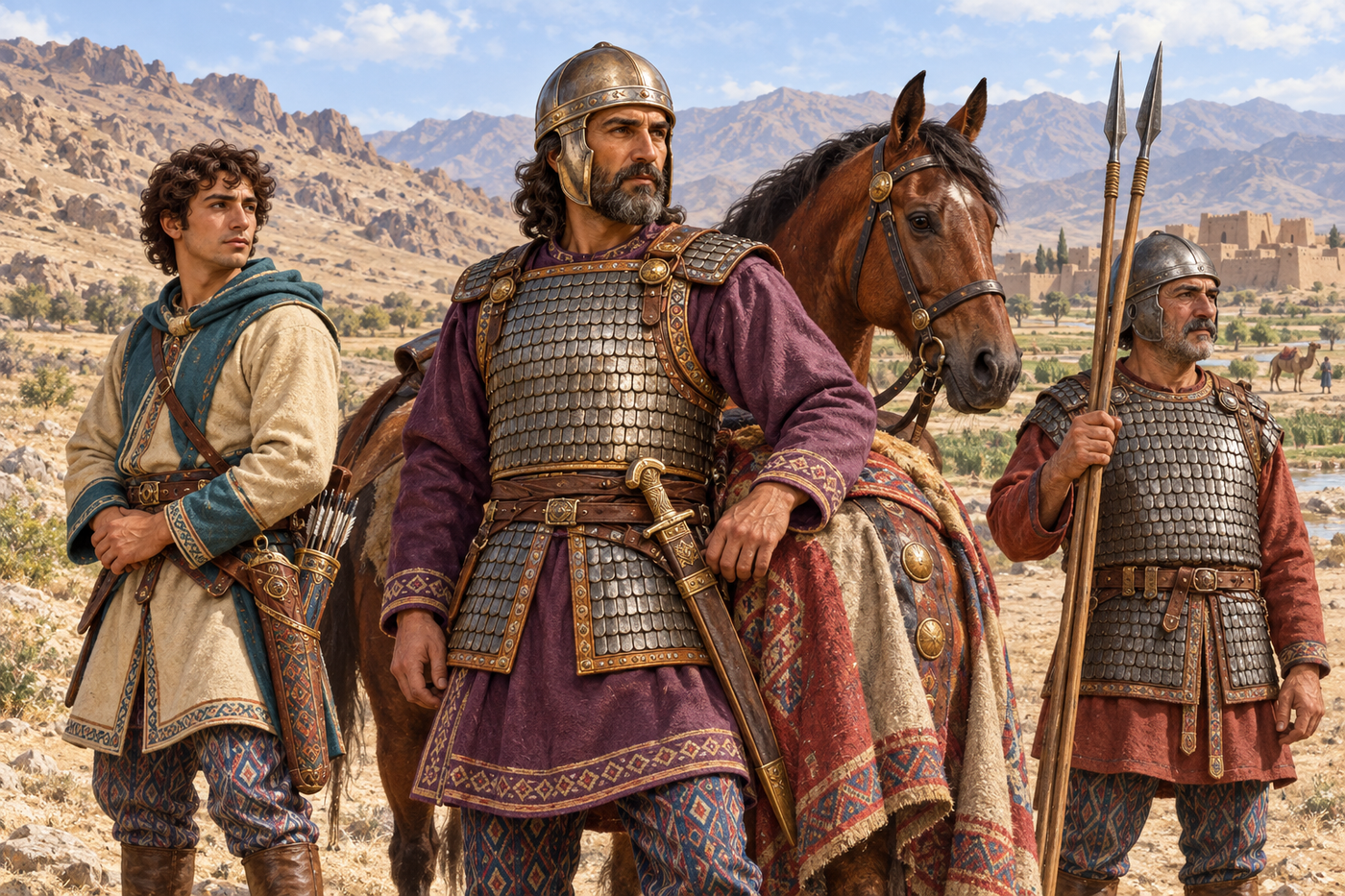
The military importance of horses helped give mounted service prestige. Men able to maintain animals and acquire protective equipment could appear conspicuously among a province's fighting strength. Bows, spears and sidearms served different needs, while belts, headgear and the quality of clothing made rank visible outside battle.
The wider Achaemenid world supplied models of Iranian riding dress and elite display. Sleeved garments and trousers were practical for mounted movement and recognisable within the empire's visual language. Equipment could be adapted to means and purpose. The army gathered by a governor drew together people whose resources were unequal.
Under Darius at Gaugamela
When Darius assembled his great army in 331 BC, Phrataphernes brought Parthian, Hyrcanian and Tapurian cavalry. Arrian lists these contingents among the forces summoned from the eastern and northern parts of the empire. Their presence shows the reach of a royal mobilisation that connected distant provinces to the king's immediate danger.
Gaugamela demanded that those different forces work together on a vast battlefield. Cavalry could threaten flanks, attack exposed troops and exploit a failure in the enemy's formation. The battle nevertheless turned against Darius. Once the king fled, the army's resources could no longer be directed towards a common decision.
Phrataphernes followed Darius eastward. Loyalty to the person of the king now existed alongside the need to defend the remaining provinces and find another army. The retreat carried the court towards men who possessed their own commands and ambitions. In 330 BC, Bessus and fellow conspirators seized Darius, then left him dying as Alexander closed in.
Alexander needs a province that works
The death of Darius removed the ruler Phrataphernes had served without ending the political importance of his office or family. He joined other prominent Persians in surrendering to Alexander during the advance into Hyrcania. The conqueror received men whose cooperation could help him turn military victory into government.
Alexander had initially assigned Parthia and Hyrcania to Amminapes, an Iranian who had assisted his entry into Egypt. Provincial appointments rewarded earlier service and addressed the immediate needs of conquest. Phrataphernes soon reappears with authority in Parthia, showing how quickly the arrangements could be adjusted when an experienced governor proved useful.
The new king still needed supplies, information and men able to enforce orders beyond the marching army. Replacing every local relationship would have made those tasks harder. Keeping or restoring an Iranian noble could preserve the connections required to govern, while making his future dependent on continued loyalty.
Against the men of Bessus
Phrataphernes' service became visible during the resistance in the eastern provinces. Alexander ordered him to support operations against Satibarzanes in Aria. The command joined an Iranian satrap to Persian and Macedonian officers acting against a former royal official who had resumed resistance with help from Bessus.
The struggle did not divide neatly between conquerors and conquered. Men who had served Darius now pursued different answers to the collapse of his monarchy. Some supported Bessus' claim; others accepted Alexander and used their authority to defeat his opponents. Personal decisions within the old imperial elite shaped the course of the new campaigns.
At Alexander's winter court, Phrataphernes and Stasanor brought captured officials associated with Bessus, including a man appointed to command Parthia. The act demonstrated control over rivals who might otherwise claim the province. Delivering prisoners was a public declaration of which king's authority the satrap intended to uphold.
Help for the army returning from India
The usefulness of provincial government became especially clear during Alexander's return from India. The march through Gedrosia inflicted terrible losses and left the army in need of transport and supplies. Phrataphernes and Stasanor anticipated those needs and sent or brought large numbers of camels and other pack animals.
Arrian emphasises the timeliness of the assistance. Animals could restore the ability to carry equipment and provisions, helping exhausted formations recover movement. The service lacked the spectacle of a cavalry charge, but answered an immediate crisis the king's own ambition had helped create.
Members of Phrataphernes' family also entered Alexander's close military circle. Their admission placed an Iranian household within the king's effort to build a broader ruling elite. The arrangement could provoke resentment among Macedonians, yet it offered prominent families a future tied to the monarchy that had replaced their former master.
The next dynasty beyond the frontier
After Alexander's death, Parthia remained a prize within the contests of governors and successor kings. Its routes and resources continued to matter to rulers trying to hold eastern Iran. During the third century BC, Arsaces and the movement associated with the Parni established a new power in the region, beginning the dynasty that would eventually make the Parthian name famous across the Near East.
That later kingdom emerged from the same broad meeting of Iranian provinces and steppe connections, but under new leaders and circumstances. In Alexander's generation, the most clearly visible figure is Phrataphernes: a servant of Darius who found a place beside the conqueror and kept his province useful through the change.
His career reveals the authority required between a royal order and its practical result. Horsemen had to be gathered, rivals arrested and transport delivered across great distances. Parthia supplied more than a name in an imperial list. Its people and leaders helped determine whether power arriving from the west could become durable government in the east.
Sources
Ancient accounts and royal inscriptions
- Darius I, Behistun inscription, §§35–37; continuation.
- Arrian, Anabasis of Alexander III.8, III.22–23, III.28, IV.7, IV.18, VI.27 and VII.6.
Historical studies and reference works
- Ernst Badian, “Phrataphernes”, Encyclopaedia Iranica.
- A. Sh. Shahbazi, “Arsacids i. Origins”, Encyclopaedia Iranica.
- “Clothing ii. In the Median and Achaemenid Periods”, Encyclopaedia Iranica.
- François Sabbathier, Dictionnaire pour l'intelligence des auteurs classiques grecs et latins, notice “Parthie”.