






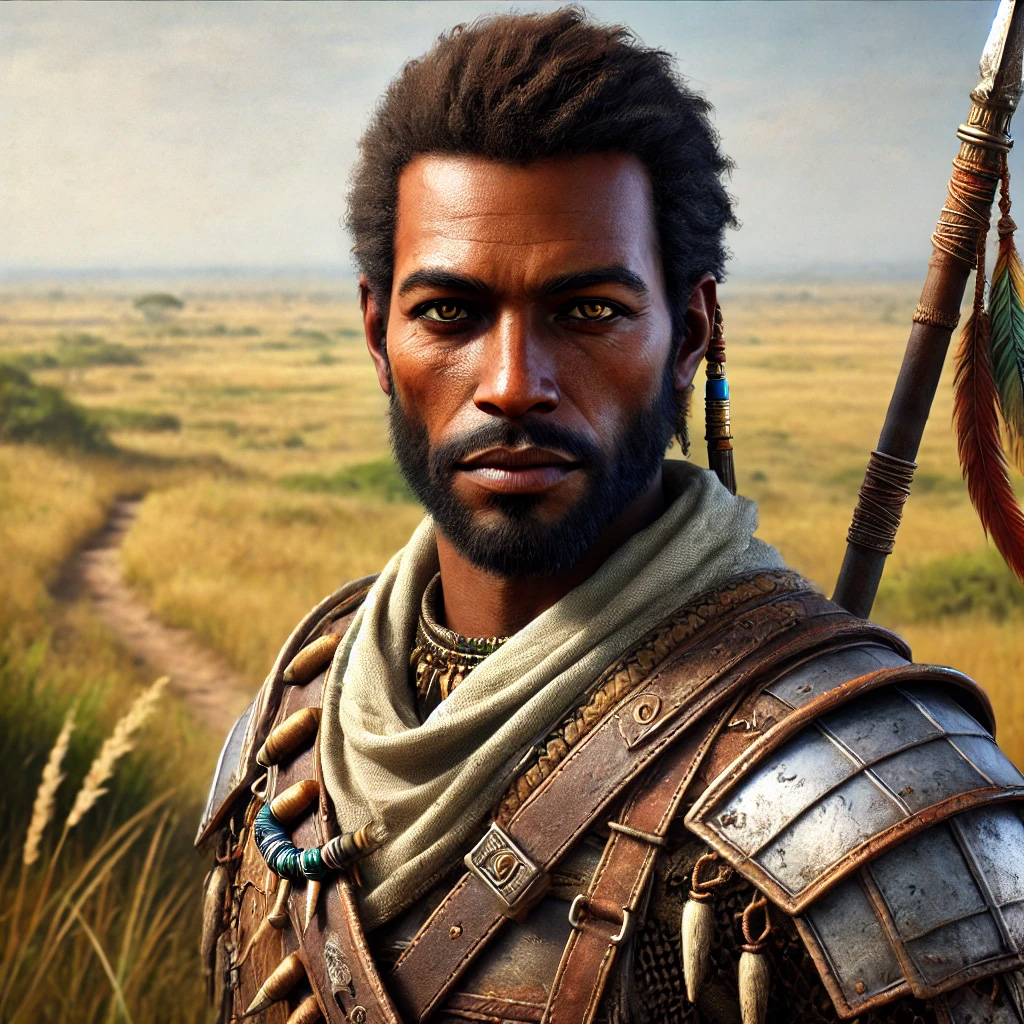
Far Qarath, the Untamed Wilds
Far Qarath is a land where nature reigns without compromise, a vast and untamed expanse where survival depends not only on strength, but on a deep and instinctive understanding of the wild. Stretching far beyond the borders of the more structured Dunes of Qarath, this region is not defined by cities or centralized power, but by its raw, ever-changing environment. It is a place where life flourishes in extreme conditions, and where death is never far from those who fail to adapt.
The land itself defies control. Scorching deserts give way to dense jungles, while vast savannahs stretch endlessly beneath open skies. Each of these environments demands a different way of life, shaping the people of Far Qarath into some of the most adaptable and resilient inhabitants of the known world. To outsiders, it is a hostile frontier, a place of danger and unpredictability. To those who belong to it, it is home, a living force that must be respected rather than conquered.
Unlike the kingdoms and empires that surround it, Far Qarath has never been unified under a single authority. It is a land of tribes, each fiercely independent, bound by ancient traditions and a shared connection to the earth. These clans have endured for millennia, their ways of life shaped by the demands of the environment and preserved through generations of oral history, ritual, and experience.
Leadership within these tribes is not inherited blindly, but earned. Chieftains rise through strength, wisdom, and their ability to protect and guide their people. They are not merely rulers, but guardians of a fragile balance between survival and tradition. Their authority is constantly tested, both by external threats and by the expectations of their own people, ensuring that leadership remains a burden as much as a privilege.
This decentralized structure has allowed Far Qarath to endure where more rigid societies might have fallen. Without a single point of control, the land cannot easily be conquered. Invaders who attempt to impose their will upon it find themselves facing not a unified army, but countless smaller forces, each intimately familiar with the terrain and capable of striking with precision before vanishing into the wild.
Yet this strength is also a limitation. The same independence that protects Far Qarath from external domination prevents it from acting as a unified force against larger threats. As the influence of foreign powers grows, and as neighboring regions become increasingly organized and aggressive, the question of unity becomes more pressing. The tribes must decide whether their survival lies in preserving their independence, or in forging a new path that may require them to abandon part of what has always defined them.
Far Qarath stands as one of the last places in the world where nature, not civilization, holds dominion. It is a land of fierce beauty and relentless challenge, where every day is a test, and where only those who truly understand the wild can hope to endure.
The Land of Extremes
Far Qarath is defined by its extremes, a region where radically different environments coexist, each imposing its own rules upon those who dare to inhabit it. These lands are not merely geographical distinctions, but living forces that shape the cultures, tactics, and identities of the tribes who call them home.
To the south stretches the Dune Sea, an endless expanse of shifting sands where the sun dominates every aspect of existence. The heat is relentless, the terrain unstable, and survival requires an intimate knowledge of the desert’s rhythms. Here, nomadic tribes move with precision, navigating invisible paths across the dunes, guided by memory, instinct, and the stars. Their warriors ride into battle atop camels bred for endurance and agility, striking swiftly before vanishing back into the desert. These riders are masters of mobility, relying on speed, ambush, and the environment itself to overcome stronger or more numerous foes.
To the north lies the Savanna of Winds, a vast and open land where golden grasses ripple beneath constant currents of air. This region serves as the cultural and strategic heart of Far Qarath, a place where tribes gather, compete, and reaffirm their identity through ritual and combat. Life here is shaped by openness and visibility, favoring warriors who excel in precision and coordination. Spears, javelins, and bows dominate the battlefield, allowing fighters to control distance and strike with deadly accuracy.
Among the most feared weapons of the savanna is the blowpipe, deceptively simple yet lethally effective. Its darts, coated in toxins derived from jungle flora and fauna, can incapacitate or kill with the smallest wound. This weapon reflects the philosophy of Far Qarath, where knowledge of the environment becomes a decisive advantage, and where even the smallest tool can be transformed into something deadly in the right hands.
The Jungle of Shadows and the Gorathians
Deeper within Far Qarath, beyond the open lands of the savanna, lies the Jungle of Shadows, a dense and suffocating wilderness where light itself struggles to penetrate. Humidity clings to the air, vegetation grows thick and aggressive, and every step carries the risk of unseen danger. This jungle is home to some of the deadliest lifeforms in the region, poisonous serpents, predatory beasts, and plants capable of killing through venom or entrapment. Survival here demands more than skill, it requires constant awareness and respect for a world that offers no forgiveness.
Within this environment dwell the Gorathians, a race of beings whose presence embodies the raw power of the jungle. Descended from ancient bloodlines tied to the earliest ages of the world, they possess immense strength and resilience, their bodies built to endure the harsh conditions of their surroundings. Though often described by outsiders as primitive or brutal, this perception fails to capture their true nature. The Gorathians are not merely creatures of instinct, but inhabitants of a complex ecosystem, living in small, isolated communities and maintaining their own forms of structure and survival.
Physically imposing, they are capable of overwhelming force, yet their relationship with the other inhabitants of Far Qarath is not defined solely by violence. While some Gorathian groups raid nearby settlements, taking what they need through strength, others coexist with the tribes, forming alliances based on mutual benefit. Their power makes them valuable allies in times of war, particularly in the construction of large structures or in battles where brute strength can shift the tide.
To the people of Far Qarath, the Gorathians are neither enemies nor allies by default, but part of the natural order. They are respected, feared, and understood as one more force within the balance of the wild. To destroy them would be to disrupt that balance. To ignore them would be to invite destruction.
In the Jungle of Shadows, survival is not about domination, but about coexistence. Those who fail to recognize this truth rarely live long enough to learn it.
The Great Tusks, the Tushkoron
Among the many forces that define Far Qarath, none embody its raw power more visibly than the Tushkoron, known as the Great Tusks. These colossal war elephants, raised across the savannah and along the jungle’s edge, stand as both weapons of war and symbols of prestige. Their immense size and strength allow them to shatter enemy lines, crush fortifications, and dominate battlefields with a presence that few forces can withstand.
Yet the Tushkoron are far more than instruments of destruction. To the tribes of Far Qarath, they represent a living connection to the land itself, creatures whose strength reflects the vitality and resilience of the wild. The raising and training of these beasts is considered a sacred duty, passed down through generations, requiring patience, knowledge, and respect. Only the most skilled and honored warriors are entrusted with riding them into battle, a distinction that marks not only martial ability, but spiritual worth.
The bond between rider and Tushkoron is profound, built over years of trust and shared experience. These creatures do not simply obey commands, they respond to presence, intent, and familiarity. In battle, this connection transforms them into extensions of their riders, capable of coordinated movements that amplify their already devastating impact.
Beyond warfare, the Tushkoron serve as one of Far Qarath’s most valuable resources. The tribes have long traded these magnificent beasts with neighboring regions, including the Dunes of Qarath and distant foreign powers. As living siege engines, they command immense value, bringing wealth and influence to those who breed them. Yet such trade is never taken lightly. The tribes remain protective of their herds, ensuring that the Tushkoron are not given to those who would misuse them or disrupt the balance of the land.
Spirituality and the Wind Speakers
At the heart of Far Qarath’s culture lies a deep and enduring spirituality, one rooted not in temples or doctrine, but in the living world itself. The people of this land do not separate the natural from the divine, they see them as one and the same. The wind, in particular, holds a central place in their beliefs, regarded as a living force that carries the voices of ancestors and the will of unseen powers.
The Wind Speakers serve as interpreters of this force, acting as guides, advisors, and spiritual leaders within the tribes. They listen to the patterns of the wind, observe the movements of the land, and translate these signs into meaning. Their words are not commands, but interpretations, shaping decisions in matters of war, diplomacy, and survival.
Their influence extends across every aspect of tribal life. They lead ceremonies marking the passage of seasons, invoking balance between the people and their environment. They offer guidance before battles, warn of unseen dangers, and provide a framework through which the tribes understand their place within the world. Even the most powerful chieftains defer to their counsel, recognizing that strength alone is not enough to navigate the complexities of Far Qarath.
Unlike the structured religions of other lands, the spirituality of Far Qarath does not impose rigid authority. It flows, adapts, and evolves, much like the wind itself. This flexibility allows it to remain deeply connected to the realities of the land, ensuring that belief is not separated from survival, but integrated into it.
The Raiders, Protectors, and the Balance of Power
The tribes of Far Qarath exist within a delicate balance, one defined by independence, mutual respect, and constant tension. They are not a unified nation, but a loose confederation of clans, each maintaining its own identity, territory, and leadership. This structure allows for resilience, but also creates internal divisions that can weaken their collective strength.
In the face of external threats, however, the tribes become something else entirely. Raiders from distant lands, drawn by the wealth of the Tushkoron and the resources of the jungle, often attempt to exploit Far Qarath. These incursions are met with swift and decisive resistance. Tribal warriors, mounted on camels or Great Tusks, strike with speed and precision, using their knowledge of the terrain to overwhelm enemies who cannot adapt to the environment.
Their methods are not those of conventional warfare. They do not seek prolonged engagements or rigid formations. Instead, they rely on mobility, ambush, and the ability to disappear as quickly as they strike. This approach transforms the land itself into a weapon, turning every dune, every patch of grass, and every stretch of jungle into an advantage.
Yet while they are united against outsiders, the tribes remain divided among themselves. Rivalries persist, alliances shift, and leadership is constantly contested. This internal fragmentation is both a strength and a vulnerability, protecting their independence while limiting their ability to act as a single force.
Chief Zahrak’s Vision
Among the many leaders of Far Qarath, Chief Zahrak stands apart as one of the most influential and ambitious. A warrior of immense strength and a tactician of considerable skill, he has built his reputation through a series of successful campaigns that have repelled invaders and extended his influence across the region. His leadership has earned him both loyalty and respect, positioning him as a central figure in the evolving future of the tribes.
Zahrak’s vision is one of unity, a departure from the long-standing tradition of independence that defines Far Qarath. He believes that the growing threats from external powers, particularly the expansion of the Dunes of Qarath and the influence of Agramon, cannot be resisted by fragmented clans. To survive, the tribes must come together, forming a confederation strong enough to stand against any force that seeks to dominate them.
Under his guidance, this vision has begun to take shape. Alliances have been forged, coordinated defenses established, and a sense of shared purpose has started to emerge among certain tribes. Yet this progress is fragile. Many chieftains remain unwilling to surrender their autonomy, viewing unity not as strength, but as submission.
Zahrak’s challenge is not only external, but internal. He must convince a people defined by independence that their survival depends on cooperation. He must balance authority with respect, strength with diplomacy, and vision with tradition. His success or failure will determine not only his own legacy, but the future of Far Qarath itself.
The land watches, the tribes wait, and the winds carry the question that no one can yet answer, whether Far Qarath will remain free through division, or endure through unity.
Chief Zahrak, the Unyielding Lord of the Savanna
Chief Zahrak stands as one of the most formidable figures in all of Far Qarath, a leader whose presence alone commands respect among the tribes. His body bears the marks of countless battles, his skin hardened by years beneath the relentless sun, and his strength forged through survival in one of the harshest environments in the world. Yet it is not his physical power alone that defines him, but his vision, a belief that the future of Far Qarath depends on unity rather than division.
Unlike many chieftains who rule solely through tradition or dominance, Zahrak combines strength with strategic insight. He understands the shifting balance of power beyond the borders of his land, recognizing the growing threat posed by the Dunes of Qarath and the expanding influence of Agramon. Where others see distant conflicts, he sees approaching danger, and his actions reflect a determination to prepare his people for what is to come.
He rides into battle atop Stormbreaker, his personal Tushkoron, a creature of immense size and power whose bond with him has become legendary. Together, they move as one, their coordination so precise that it appears almost instinctive. Under his command, the tribes that follow him have achieved victories that few believed possible, repelling invasions and securing territories that reinforce his influence.
Yet despite his successes, Zahrak’s greatest challenge lies not on the battlefield, but within his own people. The tribes remain divided, their independence deeply ingrained, their trust difficult to earn. He must lead without imposing, unite without dominating, and inspire without breaking the very spirit he seeks to preserve. His path is one of balance, and its outcome remains uncertain.
Koral of the Scorched Dunes, the Camel Warlord
Koral is a chieftain shaped by the desert itself, his body marked by the wind and sun, his mind attuned to the subtle rhythms of the dunes. As leader of the Dune Riders, he commands one of the most mobile and elusive forces in Far Qarath, a cavalry of camel-mounted warriors capable of striking with speed and vanishing before retaliation can take form.
His warriors are masters of desert warfare, navigating the shifting sands with precision that few outsiders can comprehend. Their tactics rely on movement, deception, and timing, transforming the vast emptiness of the desert into a battlefield of endless possibility. Under Koral’s command, even the harshest terrain becomes an ally.
Yet Koral is more than a war leader. There is a mysticism to him, a connection to the desert that borders on the spiritual. He listens to the wind, reads the patterns of the sand, and makes decisions guided by instincts that others struggle to understand. Some believe his strength lies not in his spear, but in this connection, a bond with the land that grants him insight beyond ordinary perception.
Though aligned with Zahrak, Koral remains cautious. His loyalty is not given lightly, and his allegiance is ultimately to the desert itself. He supports unity, but not at the cost of losing the identity that defines his people.
Zaedra of the Winds, the Fearless Shamaness
Zaedra is one of the most revered Wind Speakers in Far Qarath, a figure whose presence bridges the physical and spiritual worlds. Her movements carry a quiet authority, and her gaze reflects a depth of understanding that few can match. She is not only a guide to her people, but a force capable of shaping events through insight and influence.
Her connection to the winds is profound. She listens to their whispers, interprets their shifting currents, and transforms these signs into knowledge that guides tribes through moments of uncertainty. Her visions have altered the course of battles, saved countless lives, and shaped decisions that continue to echo across the region.
Yet Zaedra is not defined solely by her spiritual role. She possesses a sharp and calculating mind, one that understands the political landscape as clearly as the spiritual one. As one of Zahrak’s closest advisors, she helps him navigate the fragile alliances between tribes, offering guidance that balances vision with realism.
Despite her loyalty, Zaedra is not without her own ambitions. She envisions a Far Qarath united not through force or hierarchy, but through a deeper spiritual cohesion. To achieve this, she is willing to influence events in subtle ways, guiding outcomes without revealing the full extent of her intentions.
Volrik Bloodhorn, the Beast Master of the Jungle
Volrik Bloodhorn is a figure of immense physical presence, his strength matched only by his unusual connection to the creatures of Far Qarath. Known as the Beast Master of the Jungle, he commands the great herds of Tushkoron that roam the boundaries between savannah and jungle, guiding them with a calm authority that contrasts sharply with their destructive potential.
Where others see war beasts, Volrik sees living beings that must be understood and respected. He moves among them without fear, his bond with these colossal creatures built on trust rather than dominance. In battle, this connection transforms the Tushkoron into devastating forces, their movements directed with precision that turns chaos into controlled destruction.
Despite his fearsome reputation, Volrik is not driven by ambition. He avoids the politics of the tribes, preferring the company of the beasts and the quiet of the jungle. His loyalty to Zahrak stems not from allegiance to power, but from a shared commitment to protecting Far Qarath from external threats.
Yet he remains aware of the growing tensions within the tribes. He understands that unity may be necessary, but also recognizes the risks it carries. For Volrik, the balance between strength and harmony is as important among people as it is within the natural world.
Lyra of the Whispering Sands, the Silent Sentinel
Lyra stands apart from the ambitions and conflicts that define much of Far Qarath, a figure shaped not by conquest or vengeance, but by duty. Once the daughter of a powerful tribe, she was destined for leadership, her skill and wisdom marking her as a future pillar of her people. That destiny was shattered by betrayal, an internal conflict that destroyed her tribe and left her as its sole surviving guardian.
Rather than seeking revenge, Lyra chose a different path. She became the keeper of her tribe’s legacy, a solitary protector who ensures that their history is not erased. Her presence within the desert is almost spectral, her movements silent, her actions precise. She appears when needed, intervening to protect those who still honor the old ways, and vanishes before recognition can take hold.
Her mastery of the desert is unparalleled. She knows every hidden path, every concealed oasis, every shifting danger. In combat, her skill is both elegant and lethal, her twin blades moving with a fluidity that mirrors the wind itself. Yet it is not her strength alone that defines her, but her purpose, a quiet, unwavering commitment to something greater than herself.
Though many believe she could unite the tribes or claim power, Lyra refuses such roles. Even Zahrak’s offers have not swayed her. She walks her own path, guided by a sense of duty that transcends the politics of the present. Whether she will one day step from the shadows to shape the future of Far Qarath remains unknown.
Gorak the Silent, the Half-Troll Warlord
Gorak is a being born between worlds, a half-troll whose existence bridges the divide between the Gorathians and the tribes of Far Qarath. Towering and powerful, he possesses the raw strength of his lineage, yet unlike most of his kind, he also wields a sharp and calculating mind. This combination has allowed him to rise as a leader in his own right, commanding a force that reflects both sides of his heritage.
He leads a mixed warband of humans and Gorathians, uniting them through strength, strategy, and shared purpose. His warriors embody both brutality and cunning, capable of overwhelming force and coordinated tactics. Within the jungle, they move with a deadly efficiency, striking from the shadows before retreating beyond pursuit.
Gorak’s ambitions extend beyond simple survival. He seeks to carve out his own domain within the Jungle of Shadows, a territory where he can establish a new order, one that merges the strengths of both his lineages. His alliances are pragmatic, including occasional cooperation with Zahrak, but his loyalty ultimately lies with his own vision.
In a land defined by balance and tradition, Gorak represents something different, a force of change that challenges the boundaries between species, culture, and power. Whether he becomes a unifier, a conqueror, or a destabilizing force remains uncertain, but his presence ensures that the future of Far Qarath will not remain unchanged.