






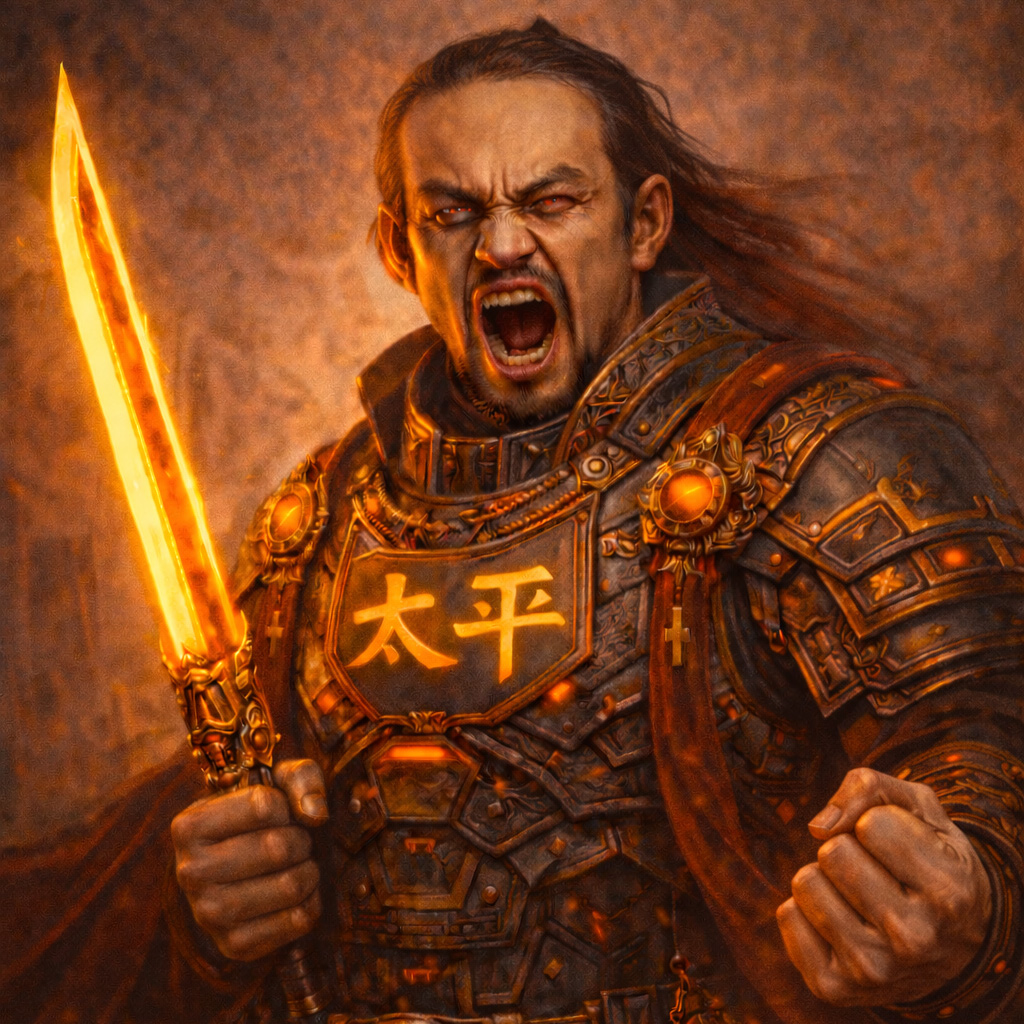
Part I – Heirs of the Setting Sun
The Taiping Confederation claims inheritance from the ancient Empire of the Setting Sun, one of the great southern powers of Damocles before the age of Lioners dominance. Though the imperial throne itself is gone, its symbols, language of authority, ceremonial traditions, and civil ideals still shape Taiping identity.
In their own historical memory, they were never a peripheral realm. They were a refined maritime civilization facing the western seas, guardian of prosperous coasts and crossroads of long-distance commerce. Their ports welcomed merchants, scholars, mercenaries, and pilgrims from across the world.
Taiping culture prizes education, administration, etiquette, and disciplined ambition. Public life is expected to appear orderly even when private rivalries are fierce. Prestige is expressed less through brute display than through control, refinement, and visible competence.
At the same time, the memory of lost sovereignty runs deep. The destruction of the old empire did not erase its legitimacy in the minds of many citizens. It transformed that legitimacy into a historical wound passed from generation to generation.
Modern Taiping therefore sees itself in two ways at once: as a successful present-day power and as an unfinished restoration of something greater that was taken by force.
Part II – The Old Southern Empire
Before the wars with the Lioners, the southern empire was among the most organized states on the continent. Its strength rested on a combination of fertile agricultural basins, wealthy coastal cities, disciplined bureaucracy, and the ability to project power by land and sea.
Provincial governors collected taxes, maintained granaries, supervised irrigation, and enforced law in the name of the central court. Records mattered. Census mattered. Logistics mattered. Where many rival realms relied on personal loyalty alone, the southern empire relied on institutions that could outlast individual rulers.
Its ports connected internal production to international trade. Rice, metals, ceramics, textiles, and luxury goods moved through harbors protected by capable fleets and regulated customs systems. Merchant fortunes grew under state protection, even as the court carefully watched any family that became too powerful.
Diplomacy was conducted through strict protocol and elaborate hierarchy. Respect between states was not cosmetic—it was considered essential to peace itself. This belief would later turn a political dispute into catastrophic war.
Though far from free of corruption or factional struggle, the old empire possessed what many neighbors lacked: the confidence of a state that expected to endure for centuries.
Part III – Insult, Execution, and the Lioners War
The war that reshaped the south began not with a border raid, but with humiliation. During a diplomatic encounter with the old southern empire, one of the three Lioners Tribuns displayed a level of arrogance and disrespect the imperial court considered intolerable. In a political culture where protocol embodied sovereignty itself, the offense was more than personal—it was existential.
The response was swift and shocking. The offending Tribun was executed. What might have been contained as a crisis instead became a declaration that neither side could ignore without losing face before allies and subjects alike.
Total war followed. Lioners armies, sustained by western industry and guild financing, launched campaigns of increasing scale. The southern empire answered with disciplined armies, naval resistance, fortified cities, and fierce determination to defend its autonomy.
The conflict consumed treasure, generations of soldiers, and entire provinces. Victories on one front were canceled by reverses on another. Trade suffered. Internal rivalries deepened. The machinery of state, once a source of strength, struggled under the pressure of prolonged catastrophe.
Though the Lioners did not simply sweep the south aside, they proved able to endure losses longer than their enemy could sustain unity. By the time the war ended, both sides had been transformed—but only one retained the image of triumph.
Part IV – Collapse and Birth of the Confederation
The old empire did not fall in a single dramatic moment. It fractured gradually under the combined weight of military exhaustion, economic disruption, regional ambition, and the loss of confidence in centralized rule. Provinces that once obeyed the court began acting independently. Powerful families secured local militias, ports, and tax networks in their own name.
Yet complete disintegration would have invited conquest and chaos. Rather than destroy one another, the strongest houses negotiated a new political order: the Taiping Confederation. It preserved collective strength while accepting that the age of unquestioned imperial centralism had ended.
Under this arrangement, major families retained control over their territories, wealth, and patronage systems, while common institutions handled diplomacy, strategic defense, and the outward obligations owed to the wider Imperial order on Damocles.
Formally, Taiping acknowledged submission where necessary. In practice, it had reinvented sovereignty in a more flexible form. What the old empire could no longer command, the confederation could coordinate.
Thus defeat became adaptation. The throne was gone, but power survived—redistributed into many hands instead of one.
Part V – Rule of the Rich Families
The Taiping Confederation is governed not by a sacred monarch or hereditary emperor, but by the heads of its wealthiest families. In theory, this system prevents tyranny by distributing authority among several great houses. In practice, it ensures that power follows capital with remarkable consistency.
The leading families dominate councils, appoint ministers, finance fleets, sponsor officers, and shape law through networks of obligation that reach from the highest chambers to provincial marketplaces. Public offices may appear institutional, but few are untouched by patronage.
Competition between houses is constant. They sabotage one another commercially, form temporary marriage alliances, leak scandals, and bid for influence over strategic ports or grain basins. Yet when an outside threat rises, they are usually disciplined enough to close ranks before their rivalries become fatal.
This plutocratic order has undeniable strengths. Its rulers understand trade, logistics, investment, and the practical mechanics of wealth creation. They can mobilize resources quickly when profit or survival demands it.
Its weaknesses are equally clear. Regions without commercial value are neglected, justice bends toward donors, and many citizens suspect the language of patriotism is often a polished cover for private enrichment.
Part VI – Propaganda, Revenge, and Social Control
No modern Taiping government can rule by wealth alone. Too many citizens remember inequality, corruption, and the privileges of merchant dynasties. For this reason, the confederation relies heavily on a second pillar of power: national resentment carefully cultivated through propaganda.
The humiliation of the Lioners war, the loss of former sovereignty, and the continued dominance of Imperial structures are presented as living injustices requiring vigilance, sacrifice, and unity. Schools, public ceremonies, veterans’ festivals, and state media all reinforce the same message: Taiping has not been defeated, only delayed.
This narrative serves strategic purposes. It prepares society psychologically for a future confrontation with the Lioners and sustains military investment over generations. But it also serves domestic purposes just as important.
When public anger turns outward, it turns less often toward oligarchic privilege, monopolies, labor exploitation, or the concentration of land and trade in a few hands. External enemies become a convenient mirror in which internal predators disappear.
Many citizens understand this manipulation perfectly—and still embrace the message. In Taiping, propaganda works not because it is wholly false, but because it binds genuine historical pain to present political convenience.
Part VII – Economy, Trade, and Maritime Power
The true foundation of Taiping strength is economic rather than ideological. Its fertile lowlands produce major food surpluses, its workshops support large urban populations, and its merchant fleets connect southern markets to the wider seas of Damocles. Wealth moves through Taiping with a scale few rivals can ignore.
Ports are the beating heart of this system. Customs duties, warehousing, shipbuilding, insurance contracts, bonded trade zones, and licensed monopolies generate fortunes that feed both private dynasties and public institutions. Every harbor is a marketplace, fortress, and political arena at once.
Trade policy is pragmatic. Taiping merchants negotiate with rivals, smugglers, neutral powers, and even enemies whenever profit outweighs symbolism. Public speeches may condemn foreign oppression while private cargo manifests tell a more complicated story.
No grievance is more politically useful—or strategically real—than Fragrance Island. Located off the Taiping coast yet held by Lioners authority, it controls key northern maritime routes and serves as a constant reminder that commercial freedom can be limited by military geography.
As long as others hold the chokepoints of the sea, Taiping prosperity will always feel incomplete.
Part VIII – Armed Forces and Strategic Doctrine
Modern Taiping armed power is built on patience, discipline, and preparation. Unlike more impulsive rivals, its leaders understand that revenge pursued too early becomes another national disaster. Their doctrine therefore favors long-term readiness over theatrical gestures.
The army fields organized infantry, artillery batteries, engineers, logistics corps, and reserve systems capable of expanding rapidly in crisis. Officers study past defeats closely, especially the campaigns in which endurance failed before enemy industry and financing.
Naval strength is equally important. Fleets protect trade lanes, escort convoys, deter piracy, and rehearse operations relevant to future conflict in contested waters. Coastal missile systems, fortified ports, and marine units give the confederation leverage beyond simple ship counts.
Morale is sustained through historical memory. Veterans are honored publicly, fallen cities remembered ceremonially, and military service framed as participation in a generational duty rather than mere employment.
Taiping does not seek constant war. It seeks the moment when war can be won—and spends every quiet year preparing for it.
Part IX – Named Figures
First Speaker Liang Zhenwei is the current chairman of the Council of Houses and the most powerful civilian in the confederation. Calm, urbane, and relentlessly strategic, he presents himself as servant of national renewal while ensuring his own family profits from nearly every major policy.
Grand Admiral Mei Rong commands the fleets tasked with challenging Lioners maritime influence. Brilliant in logistics and feared for her patience, she believes blockades and commerce warfare may achieve what heroic land campaigns never could.
Marshal Han Guotai is the most popular military figure among ordinary citizens. A veteran of frontier operations and defender of neglected provinces, he is admired for plain speech and visible loyalty to soldiers rather than financiers.
Matriarch Su Linhua controls one of the richest merchant consortiums in the south. Her ships move grain, metals, weapons, and secrets in equal measure. She funds patriotic causes generously—especially when they increase dependence on her networks.
Scholar-Minister Qiao Wen is chief architect of the confederation’s historical narrative. Through education, monuments, and public ritual, he transformed collective resentment into a durable civic identity. Some call him visionary. Others call him the most elegant liar in Taiping.
Heir Jian Kessaro is a young aristocrat whose fiery speeches demand immediate war against the Lioners and full rejection of imperial constraints. Popular with students and veterans, he alarms elders who remember what impatience once cost the nation.
Part X – Taiping Today
Today the Taiping Confederation is wealthy, disciplined, and politically sophisticated. It fulfills the formal obligations expected of a subordinate power within the Damoclean imperial order while quietly preparing for a future in which that order can be renegotiated—or broken.
Its rulers must balance competing realities. Prosperity depends on trade stability, yet legitimacy depends on sustaining the dream of revanche. The rich houses need unity against external rivals, yet fear one another almost as much. Citizens demand pride, but also fairness and opportunity.
The confederation has grown stronger precisely because it learned from defeat. It no longer trusts singular thrones, impulsive honor, or symbolic gestures unsupported by resources. It invests, plans, remembers, and waits.
Whether Taiping becomes the architect of a new southern ascendancy or remains a brilliant prisoner of its own grievances will depend on timing. Its leaders know this well.
The sea is patient. So is Taiping.