






Massagetae
Tomyris answers the conqueror
Cyrus first approached Tomyris with an offer of marriage. The queen understood the proposal as a claim upon her kingdom and refused it. In the story told by Herodotus, the founder of Persian imperial power then prepared to cross the river and take by force what his courtship had failed to obtain. The confrontation would end with Cyrus dead and Tomyris seeking his body among the fallen.
The account made the Massagetae the people who stopped a conqueror whose victories had remade the Near East. It gave them a ruler able to judge an offer, endure the loss of her son and bring her forces into battle. Nearly two centuries later, mounted men identified as Massagetae would again appear in resistance to an invading king, this time during Alexander's campaigns in Central Asia.
The country beyond the cultivated frontier
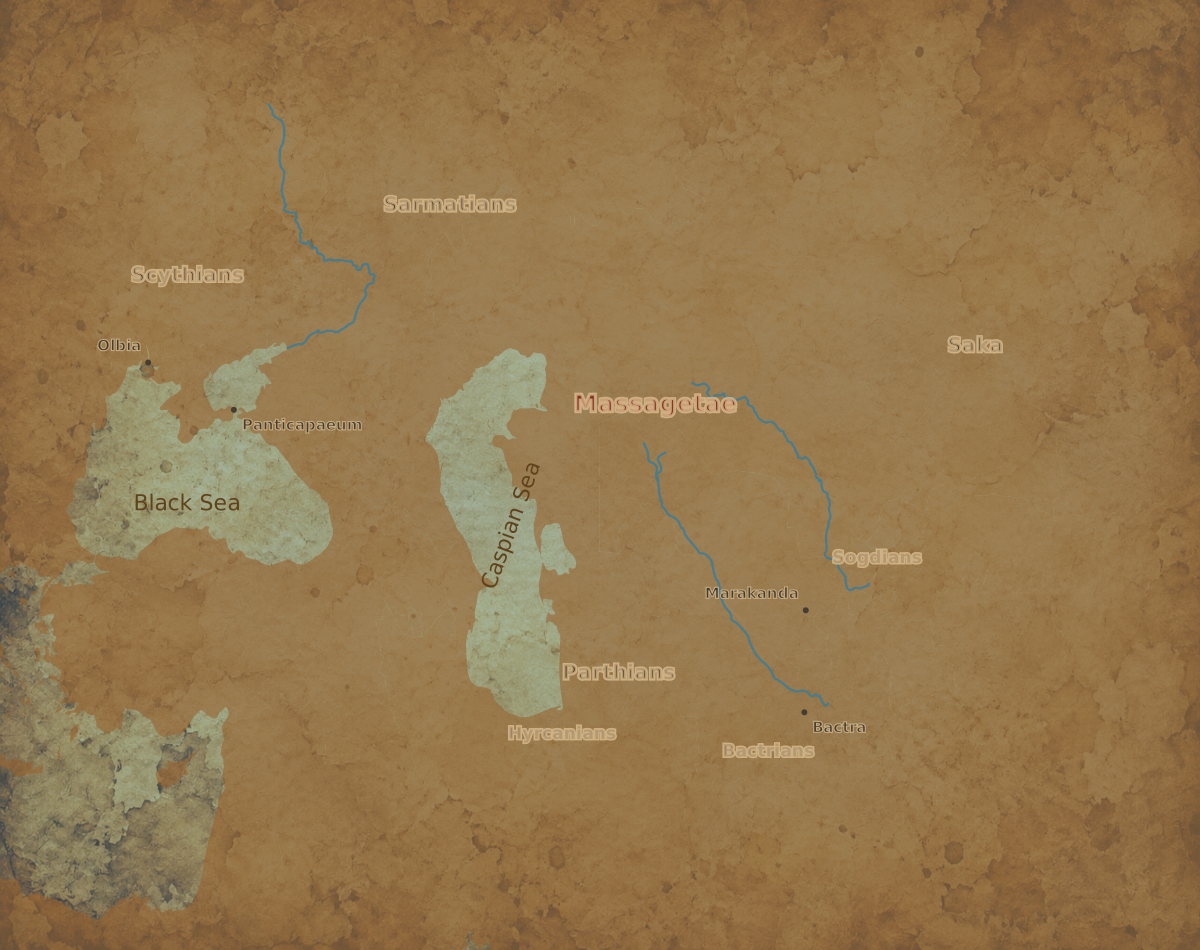
The Massagetae belonged to the broad steppe and lowland world east of the Caspian, towards the Aral Sea and the great Central Asian rivers. Waterways, pasture and desert margins shaped the routes available to people and animals. Beyond the irrigated fields and settlements lay country in which a moving community could be difficult for an imperial army to reach.
This landscape created contact as well as separation. Herding communities needed access to water and seasonal grazing, while the settled regions offered markets and goods. Armed men could cross between these worlds as allies, raiders or hired followers. Leaders who understood those connections could draw upon resources unavailable within a single town or oasis.
The reach of Persian rule made the frontier a continuing political problem. A king might claim authority over distant peoples, but enforcing it required expeditions, agreements and local cooperation. The ability to withdraw beyond the immediate grasp of an army gave steppe leaders room to preserve their own decisions.
The horse and the armed household
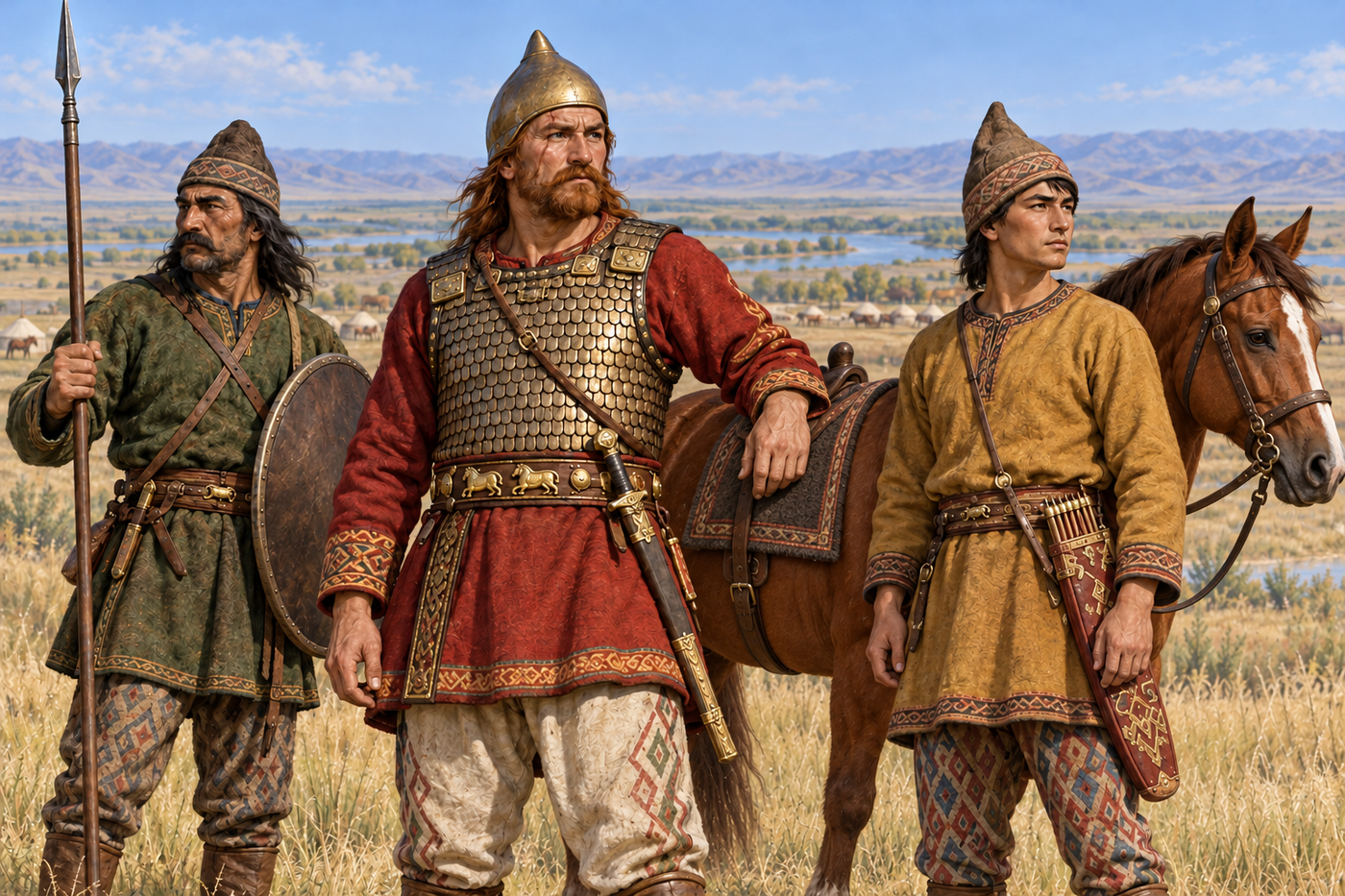
Herodotus describes Massagetae fighting both mounted and on foot. Bows, spears and battle-axes appear in his account, giving the army several ways to meet an opponent. The horse supplied movement and the means to concentrate strength, while a close fight could still require men willing to remain within reach of an enemy's weapons.
He also remembers rich decoration on belts and headgear, and fittings that made the horses of prominent warriors conspicuous. Protection for the front of an animal recognised its vulnerability as well as its value. A warrior's ability to continue fighting depended upon the mount that carried him.
Such display belonged within communities whose survival required continuous practical work. Animals had to be tended, camps supplied and equipment kept usable. A leader gathering men for war also drew upon households that had to keep living while those men were away. Mobility could sustain resistance only if the people behind it retained the means to move.
The sun and the swiftest gift
In Herodotus' description, the Massagetae honoured the sun and offered horses in sacrifice. He explained the choice through speed: the swiftest mortal animal was given to the swiftest divine power. The image joins worship to the animal upon which so much of life and warfare depended.
The ritual carried a real cost. A horse sacrificed could no longer carry a rider, breed or serve a household. Giving it away made devotion visible through something valuable. For a leader preparing to confront danger, the offering could place ambition and anxiety before a power whose daily movement crossed the whole visible world.
Tomyris' story gives that religious setting a human voice. Her response to Cyrus' stratagem invokes the sun as witness to a threat. The queen's resolve is expressed through the divine order she recognises, joining the anger of a mother to the authority of a ruler defending her people.
Cyrus prepares a trap
The campaign began with negotiations about where the armies would meet. Herodotus places Croesus among the advisers urging Cyrus to cross into Massagetan territory. The former Lydian king proposed a stratagem that depended on the contrast between Persian provisions and the habits of the people they intended to defeat.
Cyrus left a weak force in a camp furnished with abundant food and wine, then withdrew his stronger troops. A Massagetan detachment attacked, overcame the defenders and feasted upon what it found. The Persians returned when their enemies were asleep and captured many, including Spargapises, the son of Tomyris.
The victory had been purchased through a deliberately exposed body of men and the exploitation of an apparent success. It deprived Tomyris of troops and placed the heir within Cyrus' power. The queen demanded his release and warned the invader to leave. Cyrus continued the campaign.
The death of Spargapises
When Spargapises recovered from the effects of the wine and understood his position, he asked to be freed from his bonds. Cyrus allowed it. The young man then killed himself. What might have become a negotiation over a royal prisoner became a loss that could not be reversed.
Herodotus makes the resulting battle one of exceptional determination. The armies first exchanged arrows and then fought at close quarters after their missiles were spent. Neither side readily yielded. The Massagetae eventually prevailed, and Cyrus died among his defeated soldiers.
Tomyris sought his body and placed his head in a skin filled with blood, fulfilling the terrible image of her earlier warning. The scene became one of antiquity's most powerful stories of a conqueror punished through his own appetite for more. The queen had survived and won, but victory could not return her son.
That double outcome gives the narrative its force. Tomyris appears as an effective ruler and a bereaved mother at once. Her triumph does not cancel what Cyrus' cunning had taken from her. The story remembers the resistance of a people through a leader whose personal grief and public duty had become inseparable.
Spitamenes seeks the steppe
During Alexander's campaigns in 329–328 BC, resistance in Sogdiana drew strength from the country beyond the settled centres. Spitamenes needed allies able to strike, move and escape pursuit. Mounted steppe forces offered a way to continue the war even after the Macedonians had occupied important towns and installed garrisons.
Massagetan support made the struggle harder to contain. Raiders could threaten vulnerable places and disappear before a large army arrived. The boundaries between a local revolt and a wider frontier war became difficult to secure. Alexander had to distribute commanders and selected forces across a region whose distances worked against a single decisive victory.
Arrian describes a Massagetan attack that reached the Bactrian region and caused severe trouble for Macedonian troops. The action showed how men operating from the steppe could exploit an opportunity in the settled country. Holding royal centres did not prevent an enemy from threatening the routes and smaller forces upon which occupation depended.
Coenus turns the fighting
Spitamenes later joined another mounted force and moved against the troops commanded by Coenus. The Macedonian commander brought his men into battle and won. Defeat strained the coalition that had allowed resistance to continue. Local followers looked for a way out, while the steppe allies withdrew with Spitamenes.
In Arrian's account, fear of further pursuit helped turn his companions against him. They killed him and sent his head to Alexander. The leader whose connections had prolonged the war became a burden once those connections seemed likely to bring the conqueror upon them.
The episode ends through a political decision within the opposing camp as well as through Macedonian victory. Steppe allies had supported Spitamenes because his war could serve their purposes. When the risks changed, they chose their own survival. Their participation was a source of strength whose limits he could not command away.
A frontier that demanded judgement
The stories of Tomyris and Spitamenes belong to different generations, but both place the Massagetae in the difficult relationship between imperial ambition and mobile power. Cyrus attempted to obtain a kingdom through marriage and war. Spitamenes attempted to sustain resistance through allies who retained their own freedom of action.
In each case, a leader had to judge the intentions of people beyond an immediate following. An offer could conceal a claim, an apparent victory could be bait, and an ally could decide that continued loyalty had become too costly. The distances of Central Asia enlarged those choices. They did not make their consequences less personal for the people who lived and fought there.
Sources
Ancient accounts
Historical studies and reference works
- Rüdiger Schmitt, “Massagetae”, Encyclopaedia Iranica.
- E. V. Cernenko, The Scythians 700–300 BC, Osprey Men-at-Arms 137.
- François Sabbathier, Dictionnaire pour l'intelligence des auteurs classiques grecs et latins, notice “Massagètes”.