






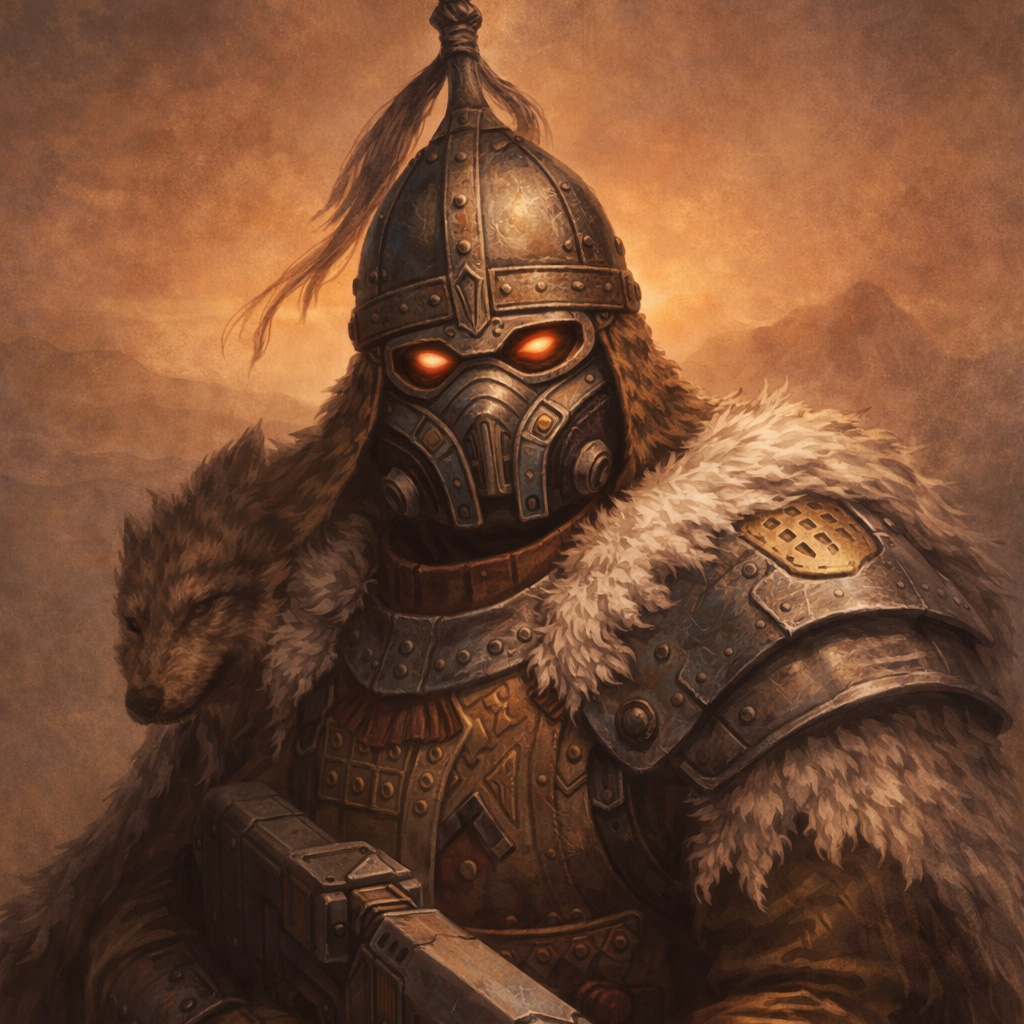
Part I – Children of the Red Men
The peoples of Botaï trace their oldest ancestry to the Red Men of Wanyue, ancient human populations whose descendants spread across several lands of Damocles after the age of portals and migrations. In blood, they share distant kinship with many communities of northern Massaloï, though centuries of separation forged very different destinies.
Those who became the Botaï did not settle in rich river valleys or fortified coasts. They adapted instead to open lands where distance was as dangerous as war and where survival depended more on movement than walls. Herds mattered more than monuments. Horses mattered more than palaces.
Life on the steppe favored traits that later outsiders would call harsh: endurance, caution, memory, and the ability to judge risk quickly. A clan that misread the weather, trusted the wrong ally, or chose the wrong battle might disappear within a season.
Because of this, Botaï identity never centered on grand temples or universal kingship. It grew from kinship, mobility, and practical honor earned through competence. Prestige belonged to those who could feed followers, protect caravans, survive winters, and return alive from dangerous roads.
To richer neighbors, Botaï long appeared poor and backward. To the Botaï themselves, they were simply free in a world where many prosperous peoples lived at the mercy of walls they did not control.
Part II – Land Between Mountain and Sea
Botaï occupies one of the least glamorous yet most necessary regions of the continent. It lies between the Western Guild and the Southern Guilds, touching mountain approaches in one direction and coastal routes in another. Few celebrate the land, but many depend on crossing it.
The interior is a world of broad plains, dry grasslands, exposed roads, sparse settlements, and horizons so wide that danger can be seen for hours—or hidden completely in dust and distance. Water, pasture, and shelter determine movement as much as politics does.
The western edges feel the influence of mountains and trade corridors descending from the Guild territories. The coastal zones open toward maritime exchange and foreign visitors. Between them stretches a difficult heartland where authority weakens with every mile from the nearest stronghold.
This geography explains Botaï’s paradox. It is strategically vital because it links markets, armies, and continents. Yet it is politically neglected because ruling it costs more than many powers wish to pay.
Those who call it empty usually say so only because they do not understand what emptiness can hide.
Part III – Riders of the Interior
The inland clans of Botaï live through a mixture of herding, seasonal agriculture, caravan service, and opportunistic raiding. No single model fits every tribe. Some move constantly with their animals. Others keep semi-permanent settlements and cultivate fields when weather allows.
Clan politics are fluid. Alliances form through marriage, tribute, revenge, and necessity, then dissolve when circumstances change. Leadership depends less on sacred blood than on the ability to distribute spoils, judge threats, and keep followers alive.
Many outsiders see contradiction in the fact that one Botaï clan may escort a caravan while another attacks it. To the steppe mind, there is no contradiction at all. Protection and predation are both services shaped by leverage, reputation, and opportunity.
Their most famous cultural trait is pragmatism in war. Botaï riders do not worship glorious death. They strike when terrain, speed, numbers, or surprise favor them. When those advantages vanish, they withdraw without shame and wait for a better moment.
This has earned them both mockery and fear. Armies that laugh at caution often do so shortly before discovering why the Botaï survived where bolder peoples did not.
Part IV – Ports of Many Bloods
Along the coasts of Botaï, the rhythm of the steppe gives way to the rhythm of tides, markets, and foreign tongues. Here stand the trading posts and harbor towns where caravans meet ships, and where no single people can honestly claim to be the only owners of the streets.
These settlements grew from necessity. Goods crossing the plains needed access to sea routes, while merchants arriving by water needed guides, guards, animals, translators, and warehouses. Profit built communities faster than conquest ever could.
The population is strikingly mixed. Eldrakars from southern routes, humans from neighboring lands, guild agents, smugglers, sailors, refugees, mercenaries, and wandering craftsmen all leave traces in local culture. Faces, languages, cuisines, and customs blend more freely here than in the interior clans.
This diversity creates energy and instability in equal measure. Ports are centers of opportunity, vice, espionage, debt, and sudden violence. Alliances are signed in the morning, broken by evening, and renegotiated before dawn.
To inland traditionalists, the coast can seem corrupt and rootless. To coastal traders, the steppe can seem poor and stubborn. Yet both need one another, and Botaï survives through that uneasy partnership.
Part V – Orc Reserves and Forgotten Wars
In the central lands of Botaï lie the reserves of the Gotoz and Smogu, orc and goblin peoples who evolved independently on Damocles before the arrival of humanity. Their presence is a reminder that the world was never empty, no matter what later conquerors claimed.
Today they exist in uneasy semi-freedom. Within the reserves they maintain their own customs, rivalries, and ways of life. Beyond them, survival becomes far more uncertain. Bands that stray too far are often hunted down by riders, militias, or frightened settlers.
Officially, many neighboring powers describe the system as containment. In practice, it is neglect interrupted by periodic massacres. Few outside the region care enough to improve matters, and fewer still would risk resources to do so.
Older generations of Botaï remember harsher wars, when clashes with Gotoz and Smogu tribes shaped migration routes, destroyed clans, and hardened frontier identities. Those conflicts survive mostly in songs, curses, and place names now forgotten by outsiders.
For now, the reserves remain one more unresolved wound in a land built from unresolved things.
Part VI – Empire on the Caravan Roads
Because so much trade must cross Botaï, outside powers repeatedly tried to impose order on its roads. The most ambitious effort came through the Imperial system, which scattered forts, depots, signal towers, and patrol bases across the region to secure caravan movement.
On maps, the network appears impressive. In reality, distance devours authority. Garrisons are expensive to supply, officers are tempted by bribes, local allies shift loyalties, and raiders need only patience to strike where patrols are absent.
Some forts became useful market hubs where merchants, soldiers, and clans negotiated under guarded walls. Others decayed into isolated outposts whose commanders controlled little beyond bowshot. A few survive only because abandoning them would admit failure too publicly.
Even when functioning well, these installations cannot truly govern Botaï. They can protect stretches of road, punish the careless, and raise the cost of disorder—but not erase the geography that makes disorder profitable.
Every empire learns the same lesson there: roads may be built through the steppe, but the steppe is never fully conquered by roads.
Part VII – Nergeï and the Last Companions
Among all the names spoken around Botaï campfires, none carries more weight than Nergeï. To some he is a hero, to others a liar, a mercenary, a saint of survival, or the last true free rider of the old world. To all, he is a living legend.
Centuries ago, Nergeï was already a renowned clan chief and wanderer when he and a chosen band of companions vanished during an expedition into lands few dared cross. They returned changed. Their wounds healed strangely, age slowed to a crawl, and death no longer claimed them as it claims ordinary men.
The stories say they faced an elf of immense magical power and seized near-immortality through courage and cunning. Only Nergeï and his companions know the truth, and they have never agreed to tell it plainly. Perhaps secrecy is the final price of what they gained.
Yet their gift became a burden. Eight centuries of war, betrayal, adventure, and chance have killed most of them one by one. No miracle protects against every arrow, every ambush, every collapsing fortress, or every foolish decision repeated over generations.
The few who remain understand one another in ways no younger warrior can. They share memories of ages now forgotten, victories no one believes, and the growing dread of the day when only one of them will still ride beneath the sky.
Part VIII – Warfare, Reputation, and Society
Botaï warriors are feared less for brute strength than for discipline in choosing when to fight. They do not chase battle for glory, nor waste lives to satisfy pride. They attack when terrain, speed, surprise, fatigue, or numbers make victory efficient. Otherwise, they disappear.
To enemies raised on heroic ideals, this can seem dishonorable. To the Botaï, it is simple wisdom. Dead heroes do not defend herds, feed children, or avenge old debts. Survival is the first duty of any warrior.
This military mindset shapes society beyond the battlefield. Leaders are judged by results more than rhetoric. Promises matter only when backed by capacity. Generosity is admired, but only if it does not weaken the clan. Even hospitality carries an undercurrent of calculation: guests are welcomed, watched, and measured.
At the same time, Botaï life is not without warmth. Loyalty within kin groups can be fierce, friendships forged in hardship run deep, and shared memory is treasured in a land where monuments are rare and stories travel farther than stone.
Those who mistake pragmatism for emptiness rarely understand the people they are facing until it is far too late.
Part IX – Named Figures of Modern Botaï
Khan Temür Arslan is the most aggressive rising warlord of the eastern plains. Young by the standards of steppe leadership, he has already absorbed weaker clans through a mixture of fast campaigns, tribute demands, and calculated generosity toward those who submit early. He believes Botaï can only survive once united under one ruthless hand—his own.
Prince Jorun Valek rules one of the wealthiest coastal port confederations. Half merchant prince, half pirate patron, he controls warehouses, caravan taxes, escort contracts, and discreet smuggling fleets. Rather than conquer the tribes directly, he intends to buy their loyalty until resistance becomes economically irrational.
Matriarch Sarai Khulan is an elder stateswoman whose authority rests on marriages, mediation, and memory. She has ended blood feuds that younger chiefs thought eternal and bound rival houses together through patient diplomacy. Many dismiss her because of age—usually only once.
Qadan the Unfading is one of Nergeï’s last surviving companions and now chief of a small but fiercely loyal clan. After centuries of battle, he has become convinced that endless division is the true curse of Botaï. Using the experience of eight lifetimes, he seeks to unite the tribes before death finally remembers him.
Part X – Botaï Today
Botaï remains poor by the standards of richer kingdoms, divided by clan rivalries, and frequently ignored in grand diplomatic speeches. Yet every merchant league, invading army, and continental strategist eventually rediscovers the same fact: roads matter more than prestige, and many of those roads cross Botaï.
Its people are underestimated because they lack monumental cities and polished courts. But hardship has given them strengths wealthier societies often lose—mobility, realism, adaptability, and the instinct to endure when larger systems fail.
At present, no single banner rules the whole region. Tribal ambition, coastal wealth, foreign interference, and old habits of independence keep unity just out of reach. Still, the dream of unification returns in every generation.
Should one leader ever bind the ports, the riders, and the caravan roads together, the powers that long treated Botaï as empty space may discover they have spent centuries sleeping beside a future empire.
Until then, the horizon stays open—and somewhere beneath it, riders are already choosing their moment.