






Sarmatians
The riders beyond the Don
Herodotus began the story of the Sauromatians with women who refused to live as their new companions expected. In his account, a band of Amazons, carried far from the country in which Greeks had fought them, reached the northern Black Sea world. Young Scythian men approached them, and hostility gave way to a shared life. When the men proposed returning to their own people, the women chose another future.
They crossed the Tanais, the modern Don, and established themselves farther east. Their descendants, the story explained, kept the memory of those women in customs that allowed daughters to ride, hunt and fight. The tale gave the Sauromatians a memorable ancestry. Beyond it lay a real world of mounted communities whose graves reveal weapons, wealth and women of striking public standing.
The eastern grasslands
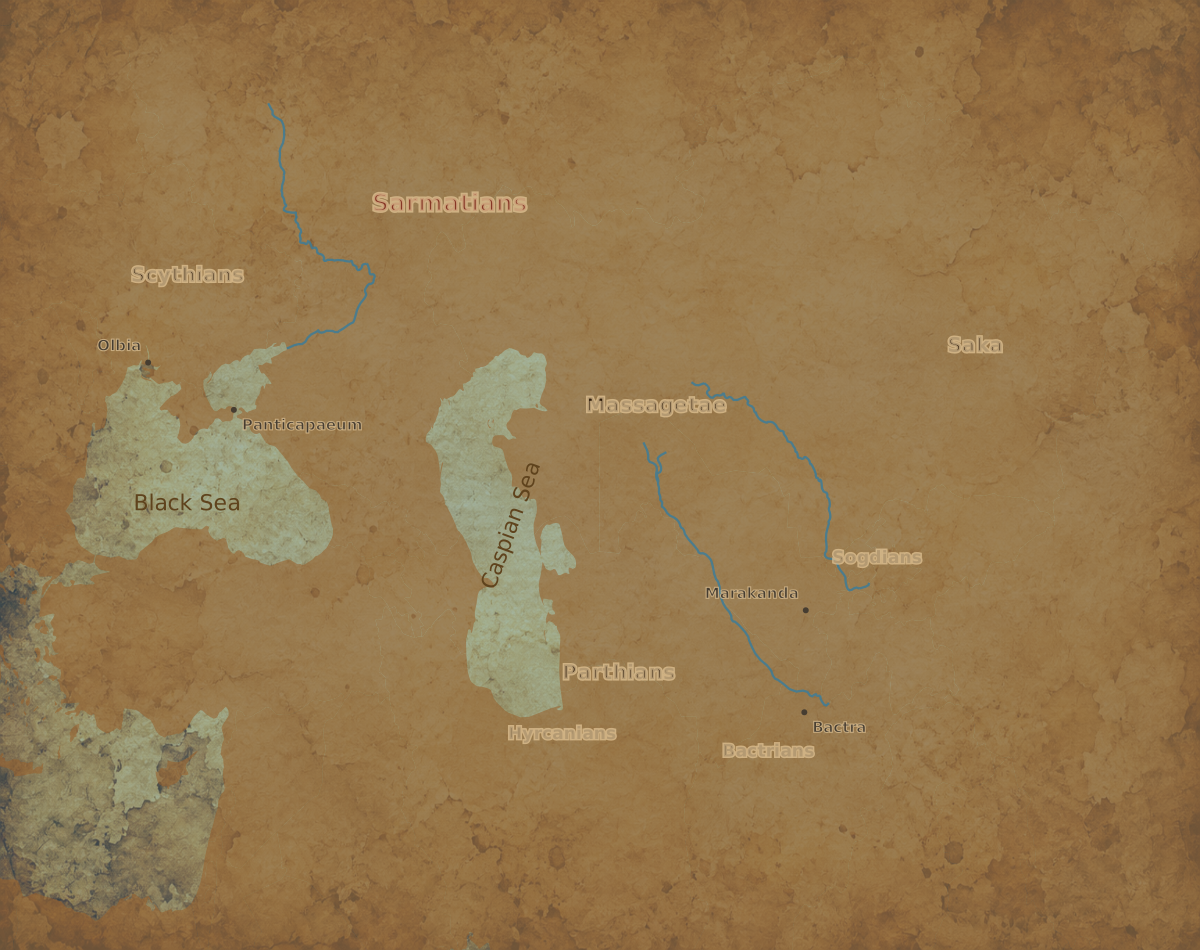
The country east of the Don opened towards the lower Volga, the southern Urals and the steppes of western Kazakhstan. Rivers and seasonal pastures gave shape to movement across spaces that could appear boundless to an outsider. Water, grazing and the needs of animals determined where a household could remain and when it had to move.
These communities belonged to the wider Iranian-speaking steppe world. Their connections extended towards the Black Sea, the Caucasus and Central Asia. Neighbouring groups could share equipment and artistic habits while maintaining separate relationships and leaders. A route useful to herders could also carry traders, gifts or armed followers.
During the fifth and fourth centuries BC, the burial landscapes associated with Sauromatian and early Sarmatian communities display this combination of mobility and rooted memory. A household might travel through the year, while the dead remained beneath mounds that marked a continuing claim upon the country.
The camp and the following
Life depended on more than riding to battle. Animals had to be tended, food prepared, equipment repaired and belongings carried. Wagons and portable possessions allowed households to move without abandoning everything that sustained them. The skills of the camp supported the freedom of the warrior.
A leader's strength rested on people willing or obliged to follow. Wealth could take the form of animals, precious objects and the ability to reward others. The most imposing burials reveal differences of status substantial enough to organise labour and obtain materials from far away. Steppe society contained powerful households whose influence was visible even when no city enclosed it.
Exchange connected those households with other centres of wealth. Imported vessels, precious metal and unfamiliar techniques could be incorporated into local forms of display. The people who commissioned or received such objects made choices about how authority should look. A foreign object could acquire a new place in a ceremony or burial far from the workshop where it began.
Filippovka and the golden deer
The burial mounds at Filippovka, in the southern Ural region, preserve an extraordinary expression of that elite world. Among their finds are wooden deer covered with precious metal, their bodies and branching antlers transformed into elaborate works of art. The creatures join a recognisable steppe animal to a display requiring exceptional craftsmanship and resources.
The assemblages bring together weapons, vessels, ornaments and objects connected with the wider networks of Eurasia. Their magnificence belongs to the late fifth and fourth centuries BC, close to the age in which Macedonian power was growing far to the southwest. They make visible a centre of wealth that Greek campaign narratives scarcely describe.
The mounds also speak through their construction. A rich burial required decisions by survivors about the deceased's status, the people who would attend and the objects that should accompany the body. The resulting monument preserved a public statement about a household and its place among the living.
Women with weapons
Archaeological work in the southern Ural steppe has revealed female burials containing weapons as well as ornaments and objects used in daily life. At Pokrovka, excavators found women accompanied by iron swords or daggers, bronze arrowheads and whetstones. Such finds give substance to a world in which armed activity was not confined to men.
The combinations vary. Some graves emphasise weapons, others ritual objects, adornment or several forms of standing together. The material allows individual lives to emerge with different responsibilities. Riding, protecting a moving household and participating in violence could overlap with work that a visitor might have expected to belong elsewhere.
Herodotus' account gave this difference a dramatic explanation through the Amazons. The women in his story reject the proposal that they should settle among Scythian wives because they do not share those women's way of life. Their decision to move east becomes the foundation of a community preserving another set of expectations.
The narrative's force lies in that choice. The women act, bargain and determine where the new households will live. The men accept a future away from their own people. It is a founding story built around the terms on which companions could make a common life.
A richly dressed woman beneath the mound
A remarkable female burial at Filippovka has also brought the appearance of elite costume into closer view. Its surviving decoration allowed conservators to reconstruct the placing of ornaments and the relationship between imported goods and local traditions. Precious fittings belonged to a body dressed for a role others recognised.
The assemblage has been interpreted as that of a woman with religious authority. Whatever the precise balance of her responsibilities, the burial shows the resources invested in presenting her standing. Ceremony could require distinctive objects, and the people who used them could hold an important place within the community.
Such a figure adds another dimension to the armed riders of ancient stories. Authority could be expressed through ritual knowledge, household position and the ability to mediate with powers beyond ordinary experience. The camp needed people who could explain danger and uncertainty as well as those who could meet an enemy with weapons.
War across open country
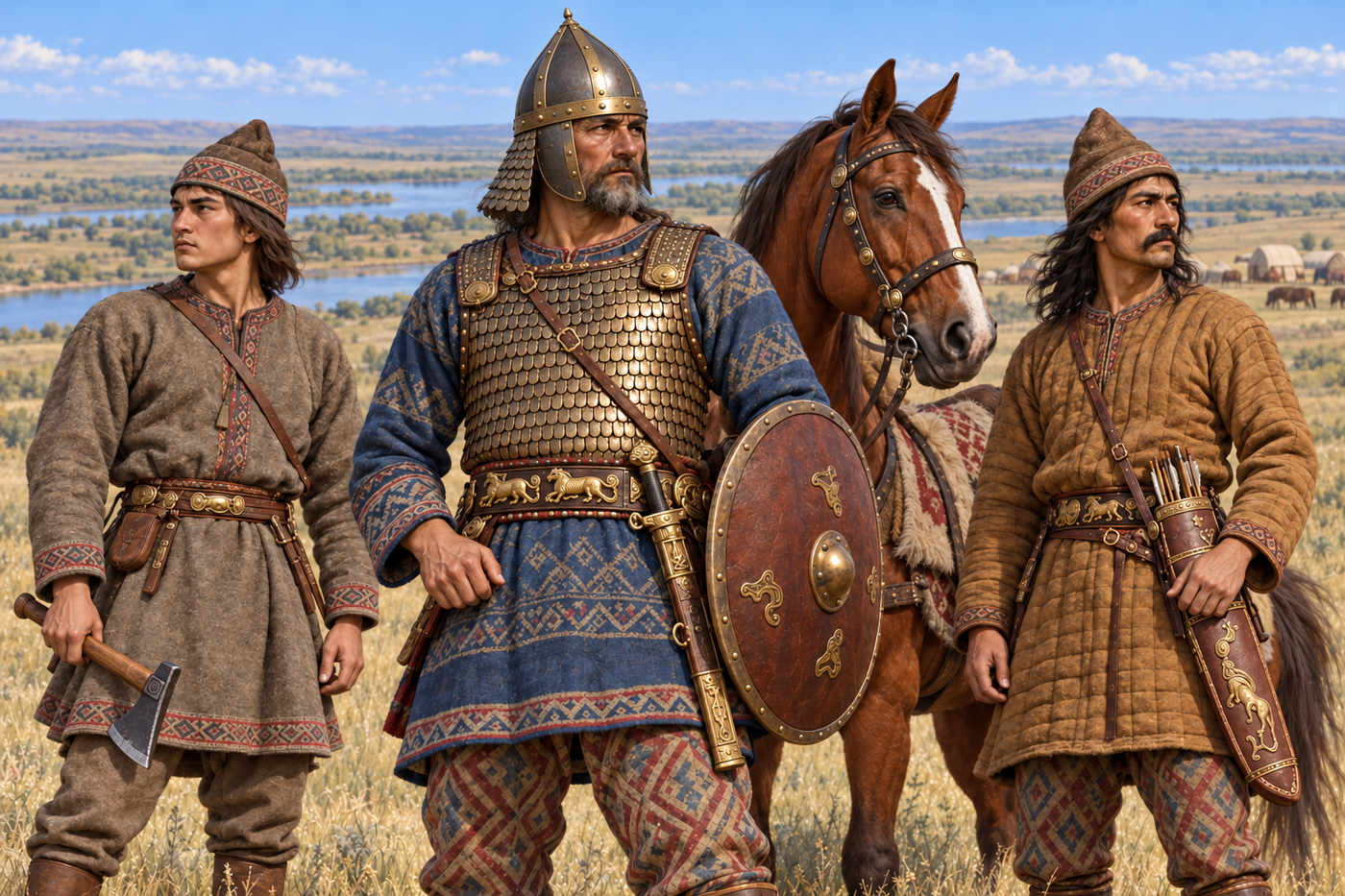
The early mounted warrior carried weapons suited to several distances. A bow could harass an opponent while preserving movement; a spear and sidearm allowed a closer fight. Clothing and equipment had to remain usable over long journeys. Wealthier fighters could obtain better protection without removing the importance of the horse's speed and endurance.
Cooperation mattered as much as an individual's skill. Riders needed to gather, respond to a leader and avoid exposing companions when an attack turned into withdrawal. The same familiarity with routes and water that sustained daily life could shape a campaign. An enemy who advanced too far might discover that keeping men and animals supplied was harder than finding room to march.
Armed women belonged within this setting of households, animals and sudden danger. The archaeological evidence gives them a place in the military life of the steppe without making every woman or every community identical. The surviving graves preserve distinctions in the people whom their companions chose to honour.
Beyond Alexander's campaigns
Alexander's armies fought steppe opponents in Central Asia, but their campaigns did not encompass the whole world east of the Don. Sauromatian and early Sarmatian communities lived beyond the main sequence of Macedonian victories. Their own routes connected them to people whose histories continued outside the conqueror's immediate reach.
In later centuries, Sarmatian groups would become prominent farther west, along the northern Black Sea and eventually the frontiers of Rome. The famous armoured riders of that later world grew from a long history of movement and changing relationships. In the fourth century BC, the most compelling witnesses are the earlier graves, weapons and extraordinary objects of the Volga–Ural steppe.
They reveal a society capable of combining practical mobility with lavish ceremony. Riders could travel widely while families preserved their dead beneath lasting monuments. Women could be remembered with arms or ritual authority. Wealth passed across great distances and took forms recognisable to local people. The result was a world whose power did not need the walls and palaces through which Greek writers usually described a state.
Sources
Ancient accounts
Archaeology and historical studies
- Metropolitan Museum of Art, The Golden Deer of Eurasia: Scythian and Sarmatian Treasures from the Russian Steppes.
- “Unusual New Findings at Filippovka-1 Burial Mound 1, Southern Urals”, Archaeology, Ethnology and Anthropology of Eurasia.
- Pushkin State Museum of Fine Arts, Burial Costume of a Sarmatian Priestess from the Filippov Burial Mounds.
- Jeannine Davis-Kimball, “Warrior Women of Eurasia”, Archaeology (1997).
- Ohio State University, Herodotos Project: Sarmatians.
- Richard Brzezinski and Mariusz Mielczarek, The Sarmatians 600 BC–AD 450, Osprey Men-at-Arms 373.