






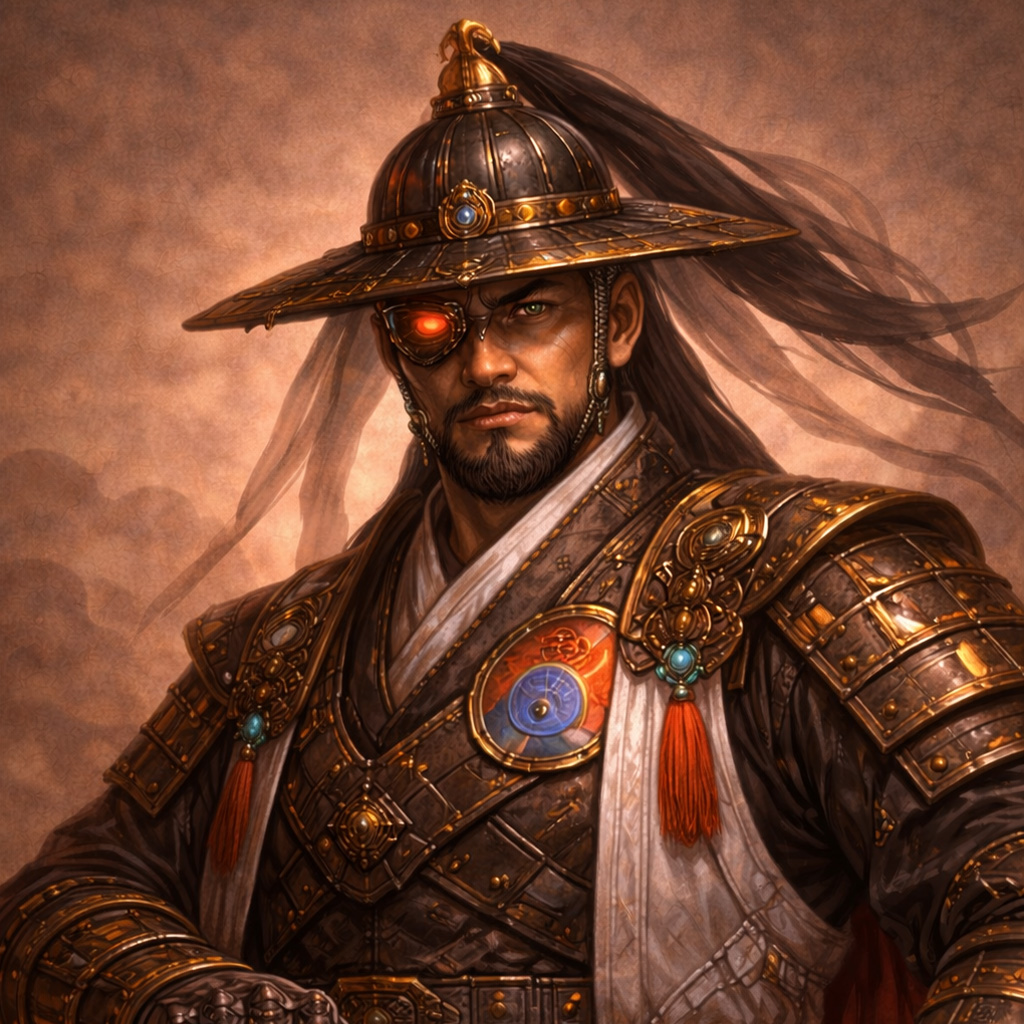
Part I – The Legend Before Kingdoms
Long before Haeguk, before Kento ruled the eastern plains, and before the peoples of Damocles carried their modern banners, the ancestors of Wind and Serpent still remembered themselves as branches of a greater people. In that distant age, the Confederation of the Wind and the Confederation of the Serpent had not yet fully become separate destinies.
It was an era of migrations, frontier wars, and endless struggle against the horrors of Wanyue. Among those trials rose many chiefs whose names survive in fragment and song: riders who defended the valleys, queens who forged alliances between hostile tribes, captains who crossed burning plains to save whole peoples, and warlords who held the line when kingdoms were already falling.
Foremost among them stood the great leader who united divided clans against an Agron Drakonox, one of the monstrous conquerors whose coming could erase nations. Where others saw only certain ruin, he forged discipline from chaos and brought rival peoples beneath a single command.
The victory became a sacred memory shared by many descendants. Yet Haeguk tradition does not honor one savior alone. It celebrates the countless Serpent warriors, generals, and household champions whose blood bought that triumph beside him. No single hero defeats darkness without an army willing to die at his side.
For the people of Haeguk, these ancient victories prove an enduring truth: greatness is born when proud clans stand together under worthy command.
Part II – Geom’a of Wanyue
If the first age gave Haeguk its ancestral heroes, the second gave it its most beloved name: Geom’a. To foreign chroniclers he is sometimes identified with Kenji of Kento legend, but in Haeguk memory he is something more intimate and more national—a wandering prince whose life belongs to all who dream beyond the place of their birth.
Born into a noble line destined for leadership among the peoples of the Wind, Geom’a was expected to inherit command. Instead, he chose the road. He traveled across the lands of Wanyue, crossing courts, battlefields, monasteries, ports, ruins, and wild frontiers where lesser nobles would never have dared to go.
These journeys made him famous. He learned from scholars, fought beside mercenaries, judged disputes among strangers, and stood shoulder to shoulder with common soldiers. To warriors he became the model of courage tested in hardship. To commoners, proof that nobility need not be distant. To dreamers, the man who refused the narrow future prepared for him.
When he returned home, he found the succession already passed to another. In many traditions, this loss defines him more than any victory. Denied a throne, he became greater than a king.
For Haeguk, Geom’a represents honor without crown, glory without office, and the freedom to shape destiny through deed rather than inheritance.
Part III – The Romance of Wind and Serpent
Among all the tales of Geom’a, none is more famous than his love for a princess of the Serpent Confederation. Their union seemed to promise more than personal happiness. It offered the hope that old divisions between sister peoples might finally be healed.
The princess herself is no passive figure in Haeguk tradition. She is remembered as intelligent, politically astute, and descended from the war chiefs of the Serpent clans whose fleets, cavalry, and disciplined hosts had carved their own place in history. Through her flowed not only beauty and grace, but the authority of conquerors and state-builders.
How the lovers met changes with each retelling: at court, during diplomacy, amid war, or while Geom’a traveled in disguise. But every version agrees their bond became powerful enough to alarm those who benefited from inherited rivalry.
The story ends in sorrow. Duty, betrayal, factional fear, or cruel chance separated them before peace could be born from their union. Yet tragedy did not end the line.
A son was born of Wind and Serpent blood. Through him, the strengths of both peoples endured together. Generations later, his descendants would gather the Serpent lands and found the ancestral kingdom of Haeguk, transforming lost love into living dynasty.
Part IV – Founding of Haeguk
The descendants of Geom’a and the Serpent princess did not inherit a united realm. They inherited rival ports, ambitious clan chiefs, merchant enclaves, inland fortresses, and old grudges that had survived generations. Blood alone could inspire loyalty, but it could not command obedience forever.
What their line possessed was legitimacy unlike any other. In them, the memory of Geom’a joined the prestige of the Serpent war houses. They embodied both heroic wandering virtue and the disciplined strength of southern state-builders. In a fractured age, that symbolism carried real power.
Through marriage alliances, selective conquest, naval supremacy, and careful patronage, they gradually gathered the Serpent Federation beneath a single crown. Some clans joined willingly for stability and profit. Others resisted until defeat made wisdom easier to recognize.
The kingdom that emerged became known as Haeguk. It was never a simple continuation of older tribes, nor a mere imitation of neighboring empires. It fused martial honor, commercial pragmatism, and dynastic prestige into a new political order suited to changing times.
Thus Haeguk was founded not only by conquest, but by the successful union of memories once thought impossible to reconcile.
Part V – Between Three Civilizations
Over the centuries, Haeguk became a realm shaped by accumulation rather than replacement. Each great age added a new layer to society while older foundations remained visible beneath it.
From the old Empire of the Setting Sun came administrative discipline, literary culture, ceremonial etiquette, wooden palaces, formal education, and a sophisticated model of governance that deeply influenced Haeguk courts and noble life.
The era of the Celestial Peace brought circular sanctuaries, philosophical schools, advanced irrigation, industrial methods, and sacred technologies that transformed agriculture, trade, and urban development. Even after the decline of that order, its monuments and habits endured.
Later Imperial contact and Lioners influence introduced steel architecture, military academies, modern finance, mechanized industry, and new systems of state management tied to continental power politics.
Nowhere is this layering more visible than in Haeguk cities, where ancient shrines stand beside Celestial domes and modern towers of glass and metal. To outsiders this may seem contradictory. To Haeguk, it is civilization itself: the art of preserving identity while mastering change.
Part VI – The Choice Without War
When the Imperial invasion of Damocles began, many assumed Haeguk would become one of the fiercest defenders of the old order. Its warrior reputation was formidable, its people proud, and its lands still marked by the institutions of the Celestial Peace.
Instead, the kingdom changed sides with startling speed.
This was not cowardice, though enemies called it so. The court judged that resistance would devastate ports, burn trade networks, and sacrifice generations for a cause already collapsing elsewhere. A glorious defeat might satisfy honor, but it would destroy the future.
By accepting Imperial authority early, Haeguk preserved its cities, industries, merchant fleets, and population. While stronger realms bled themselves white, the kingdom accumulated stability, opportunity, and influence.
The decision reshaped the balance of power. A once secondary state emerged from the war richer and more important than many former giants.
Yet the memory remains contested. Some praise the wisdom that saved the nation. Others still ask whether a people famed for valor surrendered too easily. Haeguk lives with both judgments—and prospers despite them.
Part VII – Rise to Great Power
Haeguk entered the age of invasion as a respected but secondary kingdom. It emerged from it as one of the decisive powers of the continent. While many rivals lost cities, dynasties, and generations of soldiers, Haeguk preserved the foundations on which long-term strength is built.
Peace allowed continuity. Administrators remained at their posts, ports kept functioning, roads were repaired instead of cratered, and merchant families reinvested wealth rather than burying it from advancing armies. Stability became the kingdom’s greatest weapon.
The crown used these advantages intelligently. Tax systems were modernized, state workshops expanded, shipyards enlarged, and foreign specialists invited when useful. Rather than worship tradition blindly, Haeguk selected what worked from every civilization it had encountered.
Diplomatically, the kingdom positioned itself as a reliable partner in an unreliable age. Powers that distrusted one another could still do business in Haeguk harbors. This reputation multiplied influence far beyond what raw military size alone would suggest.
Its rise therefore did not come from one glorious campaign, but from something rarer: the discipline to grow stronger while others destroyed themselves.
Part VIII – Wealth of the Southern Gate
Few realms on Damocles enjoy geography as favorable as Haeguk. Situated south of the Western Guild, southeast of Taiping, southwest of Botai, and separated from Akasuna only by a narrow sea, the kingdom sits astride major routes linking two continents and several competing markets.
Every passing convoy creates opportunity. Merchant fleets require safe harbors, repairs, storage, escorts, brokers, translators, and financiers. Haeguk provides them all—for a price carefully measured and efficiently collected.
Its prosperity no longer depends on trade alone. Industrial districts refine imported raw materials into high-value goods, naval yards build commercial and military vessels, and financial houses profit by insuring cargoes too valuable to travel unprotected.
Tourism adds another layer of wealth. Travelers come seeking elegance, entertainment, sacred heritage, culinary refinement, fashionable modernity, or simply the pleasure of spending coin in a nation built to welcome it.
For this reason, Haeguk’s treasury is fed by movement itself. Wherever ships cross the southern seas, some share of their wealth tends to reach Haeguk shores.
Part IX – Saehae, Capital of Pleasure
Saehae, capital of Haeguk, is known across Damocles as the Capital of Pleasure. The title is not mere decadence, though decadence is plentiful there. It reflects a city designed to satisfy nearly every desire wealth can name.
Grand boulevards lead to luxury districts of theaters, bathhouses, gardens, casinos, galleries, and houses of refined entertainment. Nearby stand academies, archives, and philosophical salons where scholars debate beneath lantern light until dawn.
Older quarters preserve wooden mansions, ancestral shrines, hidden courtyards, and markets whose recipes and crafts descend from forgotten centuries. Elsewhere rise towers of steel and glass filled with investors, designers, diplomats, and visitors chasing the newest fashions.
Saehae’s genius lies in contrast. A pilgrim seeking ancient serenity, a merchant seeking contracts, a noble seeking excess, and an engineer seeking innovation may all believe the city was built for them personally.
Yet beneath the beauty lies calculation. Pleasure is an industry, elegance a strategy, and hospitality one of the most profitable weapons Haeguk has ever forged.
Part X – Politics, Rivals, and Armed Forces
Haeguk is formally a kingdom, but royal authority exists within a dense web of noble lineages, merchant interests, military institutions, and court ministries. The crown reigns from the center, yet wise rulers govern by balancing forces that are too important to ignore and too proud to dominate openly.
Great houses compete for influence through marriages, patronage, regional loyalties, and access to profitable trade corridors. Merchant consortiums finance ports, industry, and public works, then expect policy in return. Ministers defend the machinery of state, often with agendas of their own.
The armed forces reflect the same layered identity as the nation itself. Traditional royal guards preserve elite martial forms and ceremonial prestige. Modern army formations field advanced firearms, armored vehicles, artillery, and coastal defenses. The navy remains especially vital, protecting sea lanes and ensuring that prosperity cannot be strangled from offshore.
Relations with the Lioners are generally pragmatic and beneficial, built on shared interest in stability and commerce. Relations with Taiping are colder. Old territorial gains made during the collapse of the southern empire remain a living grievance, and both sides watch one another carefully.
Haeguk does not seek war lightly. But any power that mistakes elegance for weakness is likely to learn otherwise.
Part XI – Named Figures
King Geom’a IX is the current sovereign and living symbol of dynastic continuity. Cultured, disciplined, and politically cautious, he understands that a prosperous kingdom can be lost as easily through vanity as through invasion. He rarely speaks in anger and almost never without purpose.
Crown Princess Min-Seora is heir to the throne and champion of selective reform. Admired by younger generations, she seeks cleaner institutions, technological leadership, and broader civic opportunity without severing the traditions that legitimize the crown.
Grand Admiral Park Jinhwan commands the southern fleets that secure Haeguk’s maritime lifelines. A strategist of calm temperament and ruthless precision, he believes sea control is the true foundation of national independence.
Minister Han Doyeon oversees commerce, customs, and strategic investment. Publicly a servant of the state, privately a master broker whose influence reaches noble houses, foreign merchants, and industrial magnates alike. Many fortunes begin or end with a meeting in her office.
Part XII – Haeguk Today
Today Haeguk is admired across Damocles as a realm of wealth, beauty, discipline, and opportunity. Its cities shine, its markets thrive, and its culture attracts both traditionalists seeking continuity and modernists chasing the future.
Yet beneath that success lies an enduring question of identity. Is Haeguk the faithful guardian of an ancient heroic legacy, or the ultimate pragmatist state that changes allegiance whenever history rewards flexibility?
Its supporters answer that survival is the first duty of any nation, and that preserving the people matters more than dying beautifully for lost causes. Its critics reply that prosperity purchased too cheaply can hollow the spirit that once made greatness possible.
For now, such debates remain philosophical luxuries. The kingdom is strong, respected, and richer than ever. But in an age of rising rivalries and shifting powers, even Haeguk may one day be forced to choose between comfort and conviction.
When that day comes, all Damocles will watch.