






Scythians
The king who would not offer a battle
When Darius led his army beyond the Danube, he expected the power of Persia to compel a decision. The Scythians gave him distance instead. Their riders moved ahead, denied him an easy target and made pursuit a problem of supplies and endurance. In Herodotus' account, King Idanthyrsus answered the demand to stand and fight by pointing to what would truly oblige his people to defend a place: the tombs of their ancestors.
The story expresses a form of power unsettling to rulers accustomed to taking cities. Scythian communities could move, draw upon immense grasslands and choose when to expose themselves. Yet their world also contained farms, markets, wealthy courts and monuments raised over the dead. The country north of the Black Sea joined mobility to possessions and relationships worth protecting.
Grasslands crossed by great rivers
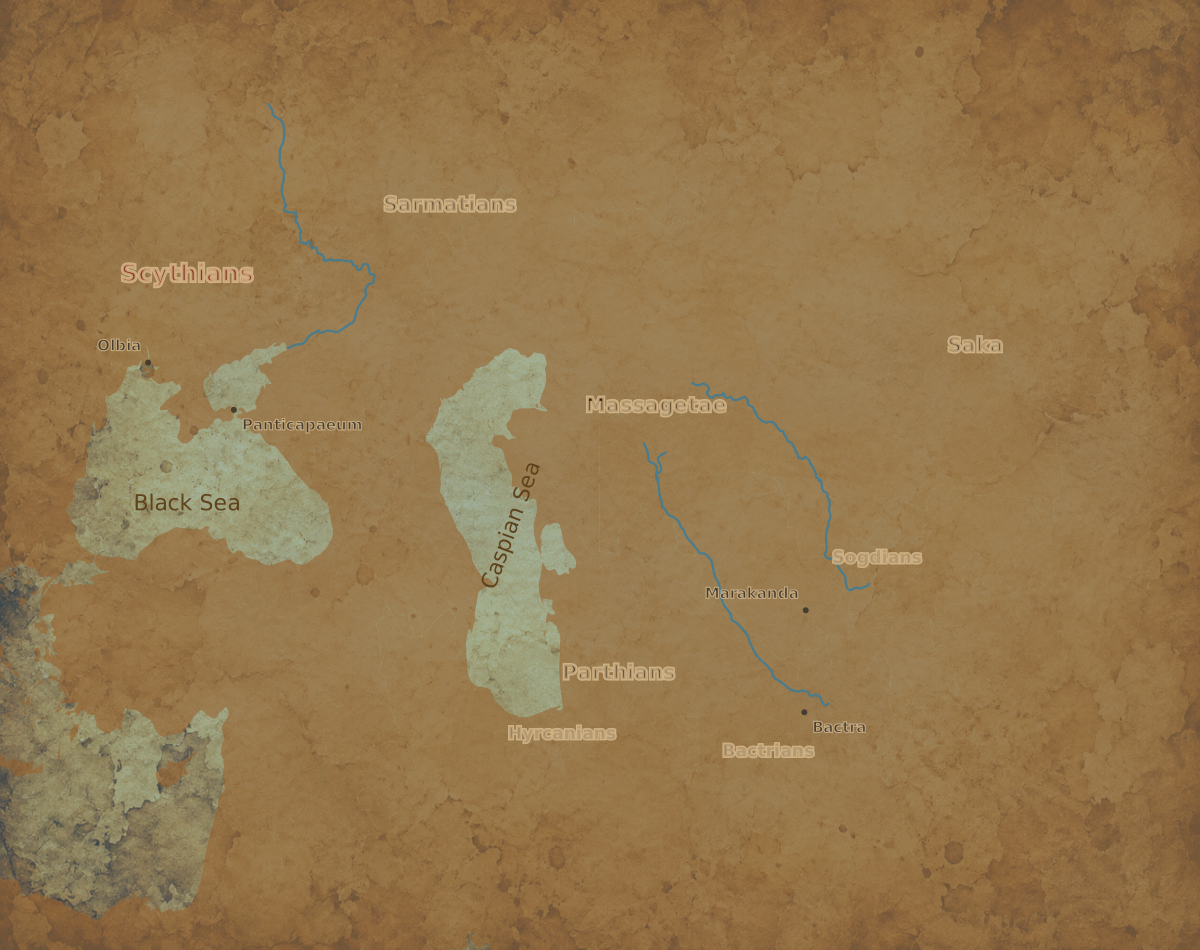
The northern Black Sea steppe was traversed by rivers that connected the interior with the coast. The Dnieper, known to Greeks as the Borysthenes, and the other great waterways offered pasture, fishing, movement and access to exchange. Communities living in different parts of this landscape did not all follow the same balance of herding, cultivation and travel.
Herodotus distinguishes several populations and ways of life, including cultivators and the powerful Royal Scythians. His descriptions reveal a political world larger than a single wandering camp. Leading groups could claim authority over others, and rulers had to preserve relationships among people whose resources and immediate interests differed.
The Greek cities on the coast supplied another set of connections. Olbia and the settlements of the Cimmerian Bosporus brought traders, craftsmen and political neighbours close to Scythian power. Grain, animals, manufactured goods and prestige objects moved through those relationships. A frontier between different communities could become a place of intimate cooperation as readily as conflict.
The horse, the bow and the household
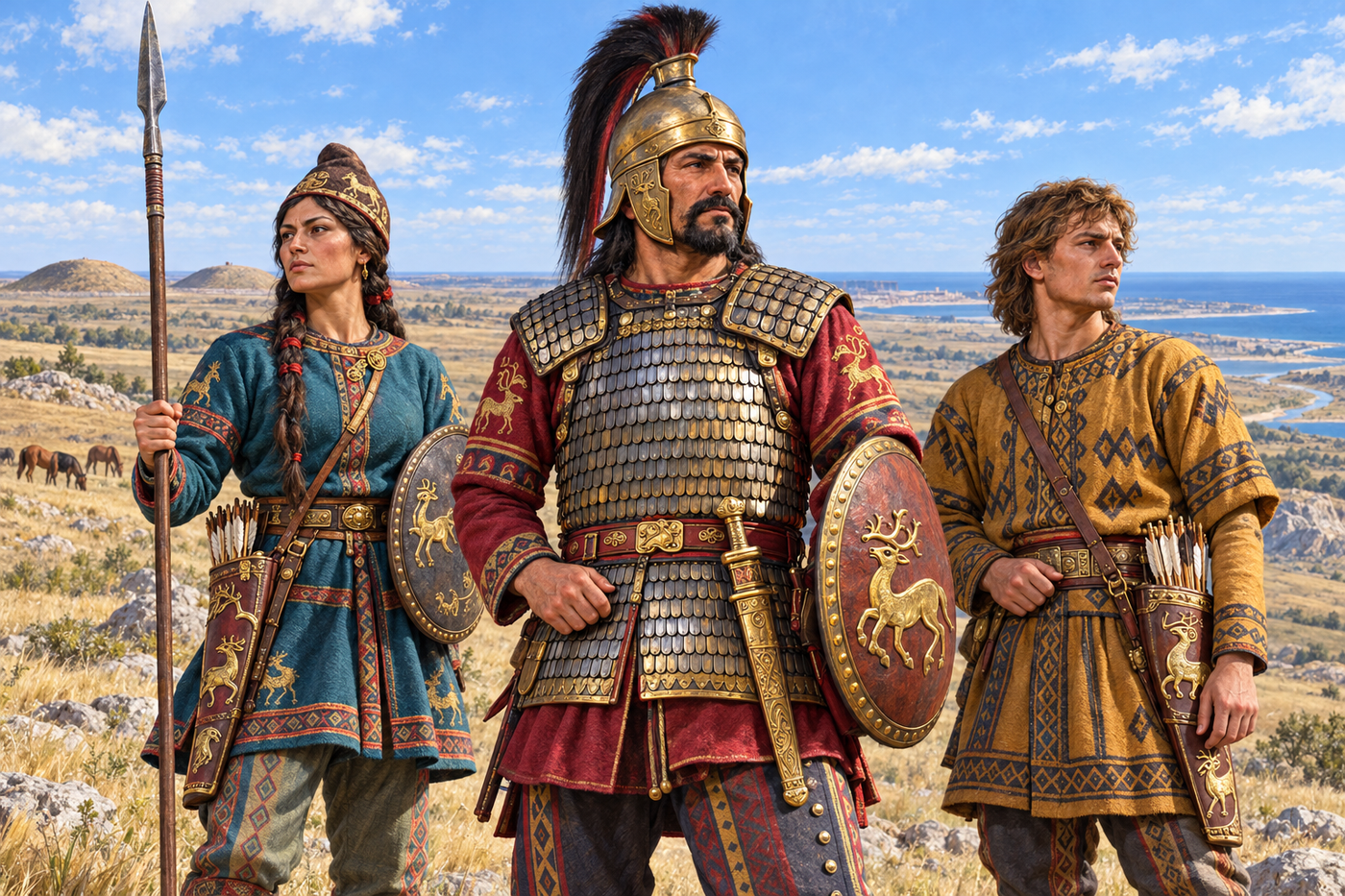
Horses gave steppe communities the ability to travel, tend herds and concentrate armed men over great distances. Riding was bound to ordinary work as well as warfare. The skills required to control an animal, judge ground and move with companions could become military resources when a leader called followers together.
The composite bow allowed a rider to threaten an opponent without immediately accepting close combat. Spears and short swords supplied other means of fighting, and wealthier warriors could obtain substantial protection. Scale armour, helmets and prestigious metalwork belonged to a world in which some men displayed far more resources than others.
Clothing suited to riding included belted garments, trousers and boots. Finds and ancient representations preserve details of that practical world alongside elaborate decoration. A finely worked fitting could belong to equipment used in daily movement, while also proclaiming the standing of its owner. Utility and display were often carried on the same body.
Gold above the buried king
The great burial mounds gave royal authority a lasting place in a landscape of movement. Building and furnishing them demanded labour, materials and the participation of followers. The dead ruler's position was made visible through the mound, the objects placed within it and the ceremonies that accompanied burial.
Animal imagery gave much Scythian metalwork its extraordinary force. Deer, predators and creatures locked in combat appear on ornaments, fittings and weapons. Gold could transform the surface of clothing or equipment into a declaration of power. Objects made in contact with Greek workshops also carried stories and visual forms from another artistic tradition.
Fourth-century sword-scabbard decoration shows how closely those worlds could meet. Craftsmen could work for customers whose political identity and way of life differed from their own, creating objects suited to elite display on the steppe. A ruler's wealth therefore connected burial ritual and armed prestige with exchanges reaching the coastal cities and beyond.
Tabiti, the ancestors and the sacred sword
Herodotus places Tabiti, whom he compares with Hestia, at the head of the Scythian gods he describes. He also records names for divine powers associated with the sky, earth and other aspects of life. His account gives worship a setting different from the monumental temples familiar in Greek cities.
For the war god, whom he calls Ares, he describes a sacred sword raised upon an altar of brushwood. Oaths and sacrifices gave relations among the living a divine witness. Diviners and ritual specialists could be drawn into matters of royal health and loyalty, making religious authority part of the dangers surrounding a king.
The ancestors supplied another focus of obligation. Idanthyrsus' response to Darius made their graves the place where evasion would end. A mobile people could still possess sacred ground whose violation demanded battle. The story gives the defence of memory a force equal to the defence of walls.
Scyles passes through the gates
Contact with Greek cities created opportunities that could become politically dangerous. Herodotus tells of Scyles, a king whose mother came from Istria and taught him Greek language and letters. When he visited the city of the Borysthenites, he left his followers outside and entered a different life within the walls.
There he wore Greek clothing, moved about the marketplace and maintained a house and a wife. His interest extended to worship. The king's ability to cross between these worlds depended on keeping control over who saw him and how his conduct would be judged.
When participation in Dionysiac rites became known, his opponents used it against him. The resulting revolt cost him his position and eventually his life. Herodotus makes the story one of foreign customs and their dangers. It also reveals a royal household shaped by mixed connections, and subjects able to turn a ruler's private choices into a public crisis.
Darius discovers the cost of pursuit
The Persian invasion belonged to an earlier generation than Alexander, but it remained the great account of a conqueror frustrated on the European steppe. Darius crossed the Danube with an army whose needs could not be suspended by royal command. The Scythians sought to stretch his movements and make every advance increase the difficulty of returning.
Herodotus gives the campaign a series of confrontations conducted through messages as well as weapons. The Great King demanded submission or battle; his opponents refused to accept the choice on his terms. Their strength lay in preserving the freedom to move while preventing him from obtaining a decisive result.
Darius eventually withdrew. The account celebrates an enemy who had denied a vast expedition the conditions it required for success. For later readers, the lesson was memorable: entering a country and compelling its people were different achievements.
Ateas confronts Philip
In the fourth century, Scythian power reached into the contests around the lower Danube. Ateas became the ruler most closely associated with that expansion. His dealings with Philip II began through requests, intermediaries and claims about assistance. Justin's narrative turns their relationship into a quarrel over promises, payment and the recognition due to a king.
Once Ateas no longer needed the help requested in his name, he rejected the obligations Philip believed followed from it. The Macedonian king sought a contribution to his own campaign expenses. Refusal sharpened the dispute. Both rulers treated the exchange as a question of standing as well as material resources.
In 339 BC, Philip defeated Ateas, who died in the battle. The victory brought captives and animals into Macedonian hands, but the journey home remained dangerous. An encounter with the Triballi cost Philip much of the immediate profit and left him wounded. Success against one northern power did not place the whole region under secure control.
Alexander and the northern horizon
Alexander's Balkan campaign of 335 BC brought Macedonian forces to the Danube again, this time against the Getae and other opponents on the approaches to his kingdom. The expedition secured his immediate position before the invasion of Asia. The Scythian world remained part of a wider northern horizon whose rulers and communities had their own diplomatic choices.
As Alexander advanced deep into Asia, Greek writers also used Scythian names for steppe peoples far to the east. His fighting beyond the Jaxartes belonged to that Central Asian setting. The northern Black Sea communities continued to live among coastal cities, rival leaders and changing routes of exchange.
Their fourth-century history combines impressive royal wealth with the practical strength of mounted followers. A king could bargain with Philip, buy the work of Greek craftsmen or lose his authority through a dispute over worship. The steppe's distances enlarged the possibilities of action, but its rulers still depended on loyalty, judgement and the willingness of others to ride with them.
Sources
Ancient accounts
- Herodotus, Histories IV.17–82 and IV.118–142.
- Justin, Epitome of Pompeius Trogus IX.2–3.
- Arrian, Anabasis of Alexander I.1–4 and IV.1–4.
Archaeology and historical studies
- Askold Ivantchik, “Scythians”, Encyclopaedia Iranica.
- Anatoly Grablevsky, “Gold, Griffins, and Greeks: Scythian Art and Cultural Interactions in the Black Sea”, Metropolitan Museum of Art.
- Metropolitan Museum of Art, gold sword-scabbard decoration, ca. 340–320 BC.
- E. V. Cernenko, The Scythians 700–300 BC, Osprey Men-at-Arms 137.
- François Sabbathier, Dictionnaire pour l'intelligence des auteurs classiques grecs et latins, notice “Athéas”.