






Aetolians
The army that could not be caught
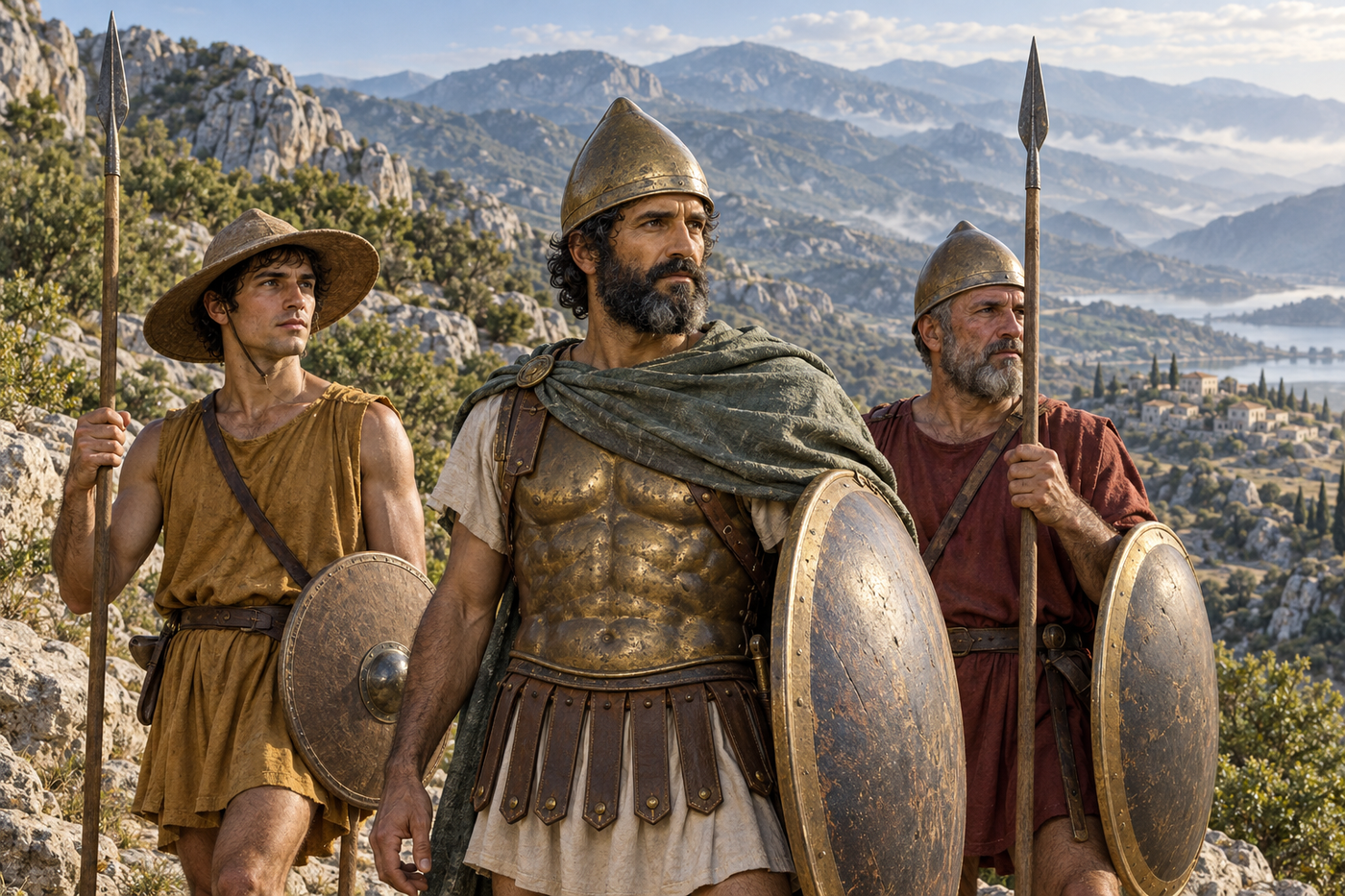
In 426 BC, the Athenian general Demosthenes advanced into Aetolia expecting a campaign that speed and determination could settle. His local advisers encouraged him to strike before the scattered communities could gather. Instead, the defenders came together, occupied the heights and attacked with javelins. When the heavier soldiers tried to close, their opponents withdrew. When the pursuit stopped, the missiles came again.
The defeat that followed became one of the clearest ancient demonstrations of what knowledge of the ground and effective light troops could achieve. Aetolia's defenders had turned the invader's expectations against him. The same qualities would matter in the age of Alexander, when a growing regional community faced powers able to bring far larger armies into its country.
Country between the mountains and the gulf
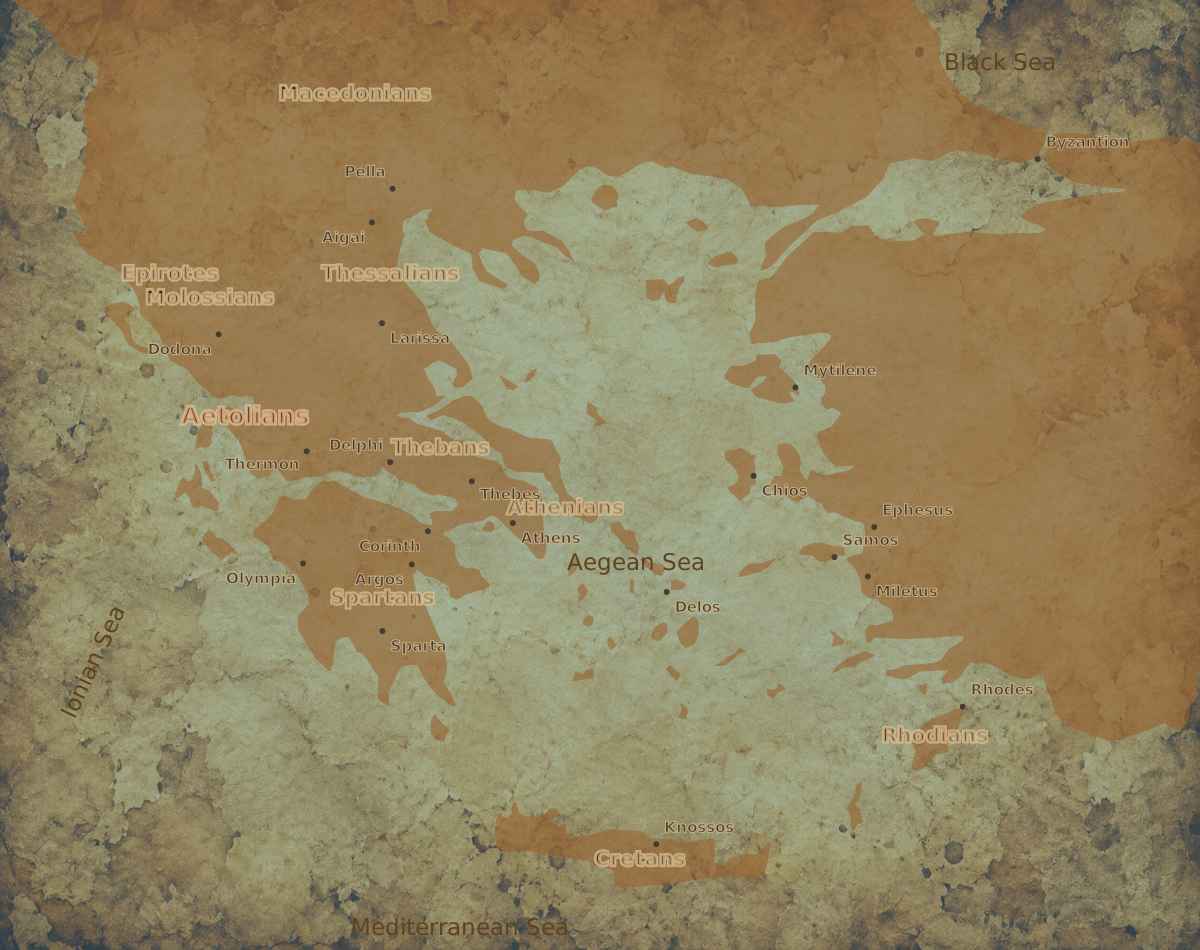
Aetolia occupied western central Greece, north of the Gulf of Corinth and east of Acarnania. Rivers, lakes, wooded slopes and mountain approaches created a varied landscape. The Acheloos marked one of its great western connections, while routes towards Naupactus and the gulf linked the interior to coastal activity.
Settlement took different forms. Communities in the uplands could be separated by difficult journeys yet gather quickly when a familiar route or common danger brought them together. Productive basins and lakeside country supported life beneath the mountains. The ability to move between these settings was a source of strength for people defending their own homes.
An outsider who saw dispersed settlements might underestimate the political relationships joining them. Demosthenes' campaign exposed that mistake in military form. In the fourth century, an Athenian inscription would reveal Aetolians acting through a common body capable of receiving a diplomatic protest. The region had means of collective action that did not require every community to become part of one enormous city.
Artemis, the boar and the heroes of Calydon
Aetolia's heroic past belonged to the stories of Calydon and Meleager. Artemis sent the great boar after a slight to her honour, and famous hunters gathered to face it. The killing of the beast did not bring a simple happy ending. Rival claims to the prize and the violence that followed made the hunt a story about honour, anger and the dangers within a heroic household.
The tale gave the region a place in a past shared across the Greek world. Its heroes appeared in poetry and art far beyond Aetolia. They also connected divine anger to the misjudgements of powerful people. A victory over a monster could be undone by the human quarrel that followed it.
At Thermon, the sanctuary of Apollo Thermios provided a more enduring setting for common religious life. Offerings and buildings accumulated around a place whose importance grew with the political community. Worship gave people from different settlements reasons to meet, recognise common obligations and display achievement before others.
Demosthenes takes the wrong gamble
The Athenian expedition of 426 BC arose within the wider struggle for control around Naupactus and western Greece. Local allies encouraged Demosthenes to attack the Aetolians, promising that the campaign would remove a threat and open further opportunities. He accepted advice that made the enemy's dispersed settlement appear to be a decisive weakness.
Demosthenes advanced without waiting for all the light troops whose support would have been valuable. The early movement seemed to justify confidence. Settlements were taken, and the Athenians reached Aegitium. But the inhabitants had withdrawn, and Aetolian forces were gathering around the invaders rather than offering the close battle their equipment favoured.
The defenders attacked from the surrounding ground with javelins. Their movement imposed repeated decisions on the Athenians: stand and receive missiles, or charge opponents who could escape and return. The archers initially helped keep the attackers back. When their resistance failed and their commander was killed, the balance worsened rapidly.
The retreat became a disaster. Men lost their way in unfamiliar country, were pressed into difficult ground and struggled against fire as well as pursuit. What had begun as a campaign intended to exploit scattered communities ended with those communities using the landscape to destroy the cohesion of the invading force.
The result was an achievement of mobilisation and judgement. The Aetolians had concentrated in time, avoided the enemy's preferred fight and maintained pressure when retreat exposed weakness. Their victory depended on people understanding how to use familiar ground together.
A common voice in the fourth century
An inscription from 367/6 BC brings Aetolia into view through a very different dispute. Athenian representatives announcing the sacred truce for the Eleusinian Mysteries had been imprisoned by the Trichonians. Athens resolved to send a herald to the common body of the Aetolians and demand their release.
The document shows a political community expected to answer for an incident involving one locality. Religious obligations supplied the language of protest: the detention violated the protections Athens claimed for the messengers. Diplomacy joined sacred custom, local action and a wider authority whose response mattered.
Relations with stronger Greek powers continued to change. Theban success after Leuctra offered one setting for cooperation; Macedonia's expansion created another. Aetolian leaders had to consider how an alliance might strengthen their position against neighbours and what a powerful partner could demand later. The region was connected to the politics of Greece through choices its people made, not merely through armies sent against them.
What light troops could do
Aetolian military strength was especially effective where movement and missiles could frustrate a more cumbersome opponent. Javelinmen could threaten an approach, withdraw before a charge and return while the enemy was recovering. Such fighting required nerve as well as speed. A retreat that lost control could become a rout; a return made too late might leave comrades exposed.
Local knowledge helped commanders judge paths, crossings and places where an enemy's formation would stretch. It also helped a community move provisions, families and livestock away from immediate danger. Defence could begin before the first clash, by denying an invader the supplies and easy targets needed to make his presence decisive.
The region also possessed men with horses and the resources to equip themselves more heavily. Different capabilities could be gathered for different operations. The most famous accounts emphasise fighting on broken ground because that was where Aetolian choices most visibly overturned an outsider's advantages.
Alexander's death opens the struggle
In 323 BC, Aetolians joined the coalition fighting Macedonian authority after Alexander's death. The war offered the possibility of weakening the power whose commanders controlled so much of Greece. Athens supplied a leading political centre, while Leosthenes gathered experienced soldiers and allies into an army capable of immediate success.
Antipater was defeated and confined at Lamia. The early advantage encouraged hopes that a broad coalition could force a different settlement. Yet the war also required communities to maintain men in the field while attending to obligations at home. A coalition's strength had to be renewed through decisions made in several places at once.
The death of Leosthenes, Macedonian reinforcements and defeat in the naval struggle gradually reversed the position. After Crannon in 322, the allies could no longer impose a common victory. Athens accepted a settlement that transformed its political life. The Aetolians still had to defend their own country against commanders now able to turn towards them.
The mountains against Antipater and Craterus
Diodorus describes the defence against Antipater and Craterus as a collective withdrawal into strong country. People removed their households and possessions from exposed places and assembled fighters in the mountains. The invaders could enter the region, but bringing an army in was different from compelling its people to accept the desired terms.
The Macedonian commanders considered how to force the defenders out through continuing pressure, including the difficulties of the approaching winter. The Aetolians faced the possibility that a stronger enemy would remain long enough to turn refuge into exhaustion. Their decision required endurance from families as well as soldiers.
The wider contest among Alexander's successors intervened. New dangers in Asia drew the Macedonian leaders away, relieving the immediate pressure. Aetolian resistance had preserved the opportunity to benefit from that change. The invaders' greater resources had not produced submission before another war demanded their attention.
The defence of a later generation
In 279 BC, the Gallic invasion brought another crisis. Aetolians contributed to the defence of the approaches to central Greece, but an attack upon their own country forced an urgent return. Pausanias describes the destruction of Callium and a mobilisation driven by the fear that other communities would suffer the same fate.
His account gives women a place beside men in the attacks on the returning invaders. Missiles followed the enemy along the roads, and pursuit brought little relief because the defenders could escape and renew the assault. The story again makes knowledge of country and shared desperation the basis of resistance.
Success against the Gauls strengthened the league's prestige and its place around Delphi. The Aetolians had moved from defending their own settlements to a larger role in central Greek affairs. Their history across these generations shows how collective action, sacred centres and military experience could turn a region repeatedly underestimated by outsiders into a power those outsiders had to reckon with.
Sources
Ancient accounts
- Thucydides, History of the Peloponnesian War III.94–98.
- Diodorus Siculus, Library of History XVIII.9–13 and XVIII.24–25.
- Pausanias, Description of Greece X.19–23.
Inscriptions and archaeology
- Agora XVI 48 / RO 35, Athenian protest to the Aetolian League, 367/6 BC.
- Hellenic Ministry of Culture, Archaeological Museum of Thermos.
Historical reference works
- François Sabbathier, Dictionnaire pour l'intelligence des auteurs classiques grecs et latins, notice “Étolie”.
- Nicholas Sekunda, The Ancient Greeks, Osprey Elite 7.