






Part I – The Isles of Namshim
Namshim is a vast maritime archipelago stretching across the warm eastern seas of Damocles. Its main island, fertile and mountainous, dominates a chain of lesser islands, reefs, jungle coasts, and narrow straits that connect the southern oceans to the trade routes of the continent. Whoever masters these waters can influence commerce between Akasuna, the Tohei coast, the Free Islands, and the eastern sea lanes.
The region is rich in fish, tropical woods, medicinal plants, salt, pearls, and protected natural harbors. Seasonal winds shape both agriculture and navigation, and for centuries Namshim captains built their calendars around monsoon currents and tidal passages. Maritime knowledge is considered as valuable as noble blood elsewhere on Damocles.
Yet the islands are older than the Namshim people themselves. Long before human sailors ruled these waters, the entire archipelago was inhabited by the Bastets: towering feline humanoids, often reaching three meters in height, whose civilization once dominated the jungle coasts and sacred heights. Their colossal stone roads, stepped temples, tidal docks, and weathered statues still stand across Namshim, half-swallowed by roots and vines.
Today the Bastets have nearly vanished from the archipelago. Most disappeared through migration, war, disease, or gradual decline over forgotten ages. Only scattered communities survive in remote forests and isolated mountain sanctuaries. Their last recognized territory is a small southern island maintained as a protected reserve, where Bastet clans preserve fragments of their ancient traditions far from the ambitions of human powers.
For the Namshim, these ruins are both inheritance and warning. Ports are built beside Bastet foundations, fortresses rise over Bastet walls, and merchant houses display relics taken from Bastet vaults. The islands feed the future, but they never let their inhabitants forget the weight of the past.
Part II – Origins of the Namshim People
The Namshim descend from the same ancient human migrations that gave birth to the peoples of Taiping and Xian. Their oldest bloodlines trace back to the Red Men of Wanyue and to settlers linked to the legendary Empire of the Setting Sun. Across immense spans of time, these migrants adapted to island life and became something distinct from their continental cousins.
Where Taiping favored large territorial states and Xian developed along western routes, the ancestors of Namshim became sailors, brokers, navigators, and coastal builders. Sea travel shaped their temperament: patient in adversity, flexible in negotiation, and quick to seize opportunity when the tide turned.
Later centuries of commerce brought new influences. Eldrakar merchants from Akasuna established lasting contact with the islands, trading luxury goods, navigational knowledge, medicines, and rare technologies. Unlike many outsiders, the Eldrakars were welcomed and often integrated into local society through marriage, contracts, and patronage.
This long mixing left a visible mark. Many Namshim lineages carry traces of Eldrakar ancestry, contributing to their unusual vitality and long lifespan. Reaching one hundred and twenty years is not exceptional among prosperous families, and elders often remain active in commerce or politics far longer than in most neighboring lands.
From these layered origins emerged a people known for composure, elegance, and commercial instinct. In daily life, Namshim society values calm speech, measured behavior, and social harmony. But beneath that serenity lies intense competitiveness whenever trade, contracts, or strategic advantage are at stake.
Part III – Before the Buccaneers
Before the rise of the Buccaneers, Namshim was not a single state but a mosaic of micro-realms scattered across the islands. Some were merchant republics governed by councils of wealthy families. Others were dynastic kingdoms ruled from river deltas or fortified hill capitals. A few were temple polities where priests oversaw granaries, calendars, and maritime rites.
War existed, but it was usually limited and practical. Conflicts were fought over tariffs, fisheries, inheritance claims, harbor rights, or access to fresh water. Alliances shifted constantly, yet outright annihilation was rare. Trade was too valuable for endless destruction.
As their fleets expanded, Namshim merchants established settlements beyond the main island. Their language and customs spread northward across the lesser islands, where they mixed with populations linked to the Tohei. In many places hybrid communities emerged, speaking blended dialects and combining island mercantile habits with continental warrior traditions.
Namshim influence even reached the southern coast of the Tohei mainland, where trading enclaves and counting houses were founded near strategic anchorages. These early outposts helped channel goods between island markets, Akasuna caravans, and inland clans. Centuries later, some of these same locations would fall under Buccaneer control and become key ports of the southern sea.
Though politically divided, the old Namshim world was prosperous, outward-looking, and deeply interconnected. It lacked unity—but it possessed ships, silver, networks, and time. For many generations, that was enough.
Part IV – The Southern Trading Network
Long before the age of conquest, Namshim prosperity rested on one simple truth: the sea connected everything. Their merchants built one of the oldest and most resilient trade networks in eastern Damocles, linking island ports to Akasuna, the Tohei coast, and distant continental markets.
From Akasuna came spices, ritual goods, rare medicines, exotic beasts, and Eldrakar luxuries coveted by noble houses across the region. From Namshim sailed rice, salt fish, timber, ceramics, rope, lacquerware, navigators, and financiers willing to fund risky expeditions for the right return.
Namshim counting houses became famous for their precision. Contracts were copied three times, debts recorded across generations, and cargoes insured through family alliances rather than formal institutions. Trust was not based on morality, but on reputation and the certainty of retaliation against betrayal.
The southern mainland coast—where the Buccaneer Confederation now stands—was once dotted with Namshim warehouses, fortified docks, and mixed merchant towns. These enclaves never formed a true empire, but they gave Namshim enormous influence over customs, maritime law, and regional pricing.
Even rival states within the archipelago depended on these networks. A prince might hate a neighboring city, yet still rely on its brokers to sell pepper or secure iron. Commerce did not erase division—but it made division profitable.
Part V – Arrival of the Buccaneers
The first Buccaneers did not arrive as conquerors. They came as smugglers, free captains, mechanics, translators, and opportunists seeking safe harbors beyond the reach of Imperial law. At first, Namshim rulers welcomed them as they welcomed many foreigners: as useful partners who brought silver, news, weapons, and access to distant markets.
The newcomers proved exceptionally adaptable. They married locally, learned the languages of the ports, and inserted themselves into routes already built by Namshim merchants. Where local elites argued over tariffs and precedence, the Buccaneers moved quickly, accepting risk and violence as normal business tools.
Over generations, their presence transformed the outer islands and southern mainland settlements. In frontier ports, mixed communities emerged where old Namshim customs survived only in fragments. Buccaneer speech, habits, and armed brotherhoods became dominant. Some towns still used Namshim coinage while no longer answering to Namshim rulers.
This was not a sudden invasion but a slow displacement. Many island princes failed to grasp the danger because profits remained high. By the time concern became widespread, foreign captains controlled key shipyards, grain depots, and strategic anchorages.
The greatest wound was demographic. In several territories the descendants of settlers and corsairs became the majority population. Namshim elites realized that wealth without political unity had placed their own maritime world at risk.
Part VI – The Great Unification
Fear achieved what diplomacy never could. Rival island states that had competed for centuries began to accept a shared reality: divided, they would be absorbed one harbor at a time. The answer was unification under a single authority based on the main island.
The process was neither peaceful nor purely voluntary. Some princes joined through negotiation, receiving rank within a new hierarchy. Others were defeated by naval coalitions, commercial embargoes, or internal coups funded by pro-unity factions. In a single generation, the political map of Namshim was redrawn.
A central court emerged to coordinate taxation, diplomacy, and war production. Harbor dues were standardized. Shipbuilding was expanded. Coastal beacons, signal towers, and naval arsenals were constructed. Merchant guilds were tied directly to state needs, while noble houses were required to contribute ships or revenue.
The unification also created a new civic identity. People who had once called themselves only by island, city, or dynasty increasingly began to call themselves Namshim first. Shared memory of foreign encroachment forged a nationalism stronger than old rivalries.
This new state was wealthier, more disciplined, and far more dangerous than the fractured archipelago that preceded it. It had not abandoned commerce—but it had learned that trade without power invites predators.
Part VII – The Blockade and the War of the Southern Sea
The rise of a unified Namshim alarmed the Buccaneer powers. What had once been a divided marketplace was becoming a disciplined maritime state capable of contesting their dominance. Rather than wait, the Buccaneers chose coercion. Their fleets imposed a blockade on the main island, seeking to strangle the new kingdom before it could fully mature.
The blockade became one of the defining traumas of Namshim history. Imports collapsed, luxury goods vanished, and coastal trade communities faced sudden hardship. Families who had grown rich on overseas exchange were forced to rediscover local production, rationing, and agricultural discipline.
Yet the strategy failed to break the island. The main landmass was fertile, well-watered, and capable of feeding itself when properly organized. Rice terraces expanded, fisheries were militarized, and merchant vessels were converted into convoy craft. What had been an economic society became, under pressure, a mobilized one.
Skirmishes at sea escalated into open war. Namshim captains favored patience, ambushes, and attritional campaigns against supply lines, while Buccaneer flotillas relied on speed, boarding actions, and surprise strikes. Neither side won quickly, but the islands were changed forever.
Most importantly, the blockade taught a lasting lesson repeated in Namshim councils to this day: dependence is a chain, and chains are meant to be broken before they tighten.
Part VIII – The Imperial Landing
When the Imperial invasion of Damocles began, the forces that reached the main island were small compared to the armies deployed elsewhere. But to the Namshim leadership, numbers mattered less than opportunity. Here was an organized military power with advanced weapons, hostile to the same Buccaneer networks that had long threatened their survival.
The Imperial contingent was therefore received not as occupiers, but as useful allies. Ports were opened, supplies provided, and political loyalty sworn with remarkable speed. The alliance was pragmatic from the beginning. Namshim rulers did not embrace Imperial faith or culture—they embraced the chance to win.
Imperial engineers and officers helped modernize local arsenals. Traditional fleets were reinforced with heavier artillery, improved armor, precision optics, and industrial methods of maintenance. Coastal fortifications were redesigned, command systems standardized, and selected Namshim units trained in combined maritime warfare.
This cooperation shifted the balance of power in the southern seas. Buccaneer captains who had once preyed on divided islands now faced organized resistance backed by superior technology and disciplined logistics. Several strategic ports changed hands, while others were burned rather than surrendered.
The Namshim never forgot that the Empire had arrived for its own interests. But they also understood that history rewards those who use stronger powers before stronger powers decide to use them instead.
Part IX – Religion, Society, and Values
Unlike many regions of Damocles, Namshim never fully surrendered its spiritual identity to the Celestial Peace or later Imperial orthodoxy. The old island faiths endured beneath every foreign era. Ancestor shrines, sea spirits, household rites, and seasonal ceremonies remained central to daily life.
This religion is less concerned with dogma than with balance: harmony within the family, respect for the dead, gratitude toward the sea, and proper conduct in moments of prosperity or grief. Temples often function as community centers, archives, and places of arbitration as much as sacred spaces.
In temperament, Namshim society is famously calm. Public anger is considered a sign of weakness, and dignity under pressure is admired more than dramatic displays of emotion. Outsiders often mistake this composure for softness.
That misunderstanding usually ends when money is involved. Trade, negotiation, and competition awaken a very different side of the culture. Contracts are pursued relentlessly, market advantages defended with precision, and insults in commerce remembered for generations.
Age carries particular prestige. Thanks in part to ancient Eldrakar bloodlines and favorable living conditions, long lives are common among prosperous families. Experienced elders remain active in business and politics well past the age where most other societies would retire them. In Namshim, wisdom is not ornamental—it is expected to produce profit.
Part X – Economy and Power Today
Modern Namshim is one of the wealthiest maritime powers in the eastern seas. Its strength does not come from vast land armies or rich metal deposits, but from movement, finance, and control of exchange. Ships, warehouses, credit networks, fisheries, and port taxation generate more power than many inland kingdoms gain from conquest.
The main island exports rice, preserved food, ceramics, ship components, medicines, dyes, and luxury crafted goods. Its outer waters provide fish, pearls, shell products, and rare marine resources harvested from deep reefs. Merchant families invest across the region through discreet partnerships rather than open domination.
Permanent conflict with the Free Islands has also militarized the economy. Civilian shipyards can be converted rapidly to war production. Merchant convoys sail under armed escort. Insurance guilds, reserve grain systems, and emergency naval levies are all embedded into normal commerce.
Politically, Namshim walks a narrow line. It remains aligned with Imperial-descended powers when useful, especially against Buccaneer threats, yet resists becoming dependent on the Tohei or any continental bloc. Trade agreements are signed generously, but strategic autonomy is guarded with near paranoia.
Its rulers understand that wealth attracts both allies and predators. The art of Namshim statecraft is to ensure others need its prosperity more than they desire to seize it.
Part XI – Military Forces of Namshim
The armed forces of Namshim are built for maritime endurance rather than spectacular conquest. Their doctrine is based on sea denial, convoy protection, selective raids, and exhausting stronger enemies through logistics, distance, and attrition.
The fleet forms the heart of national defense. Modern war-junks, missile corvettes, armored transports, fast torpedo cutters, and refitted merchant cruisers patrol the archipelago. Many vessels combine traditional silhouettes with layered composite armor and Imperial-derived weapon systems adapted to humid island conditions.
Namshim marines are highly respected across Damocles. Trained for boarding actions, amphibious assaults, urban port fighting, and jungle warfare, they operate in compact disciplined units supported by drones, portable shields, and precision naval fire control.
Coastal defense is equally formidable. Hidden artillery batteries, minefields, sensor towers, anti-ship launchers, and fortified harbors make direct invasion costly. Even small islands are often far better defended than they appear.
In prolonged war, merchant auxiliaries become a decisive advantage. Civilian captains, fishermen, dock workers, and transport guilds can be integrated into national mobilization with remarkable speed. Enemies may defeat a fleet in battle, yet still fail to break the system sustaining it.
Part XII – Relations with Other Factions
The Free Islands: The oldest and most emotional rivalry. Seen in Namshim memory as descendants of the forces that once blockaded and displaced them. Warfare ranges from naval battles to espionage, smuggling wars, and proxy conflicts.
The Buccaneer Confederation: A more complex enemy. Though also of Buccaneer origin, it operates under Swolf influence and is treated as both threat and possible negotiating partner depending on circumstances.
The Tohei Powers: Cooperation and suspicion coexist. Namshim may coordinate attacks against piracy or share intelligence with factions of the Tohei, yet never forgets that continental powers could one day seek dominance over the islands.
Akasuna: Old commercial ties remain valuable. Trade with southern markets, especially luxury goods and specialist products, continues whenever war conditions allow.
Taiping and Xian: Cultural cousins and distant mirrors. Shared ancestry creates occasional goodwill, but commerce and regional ambition ensure competition never fully disappears.
Namshim’s diplomacy reflects its history: courteous in tone, meticulous in calculation, and always prepared for the moment when trade gives way to cannon fire.
Part XIII – Six Named Figures
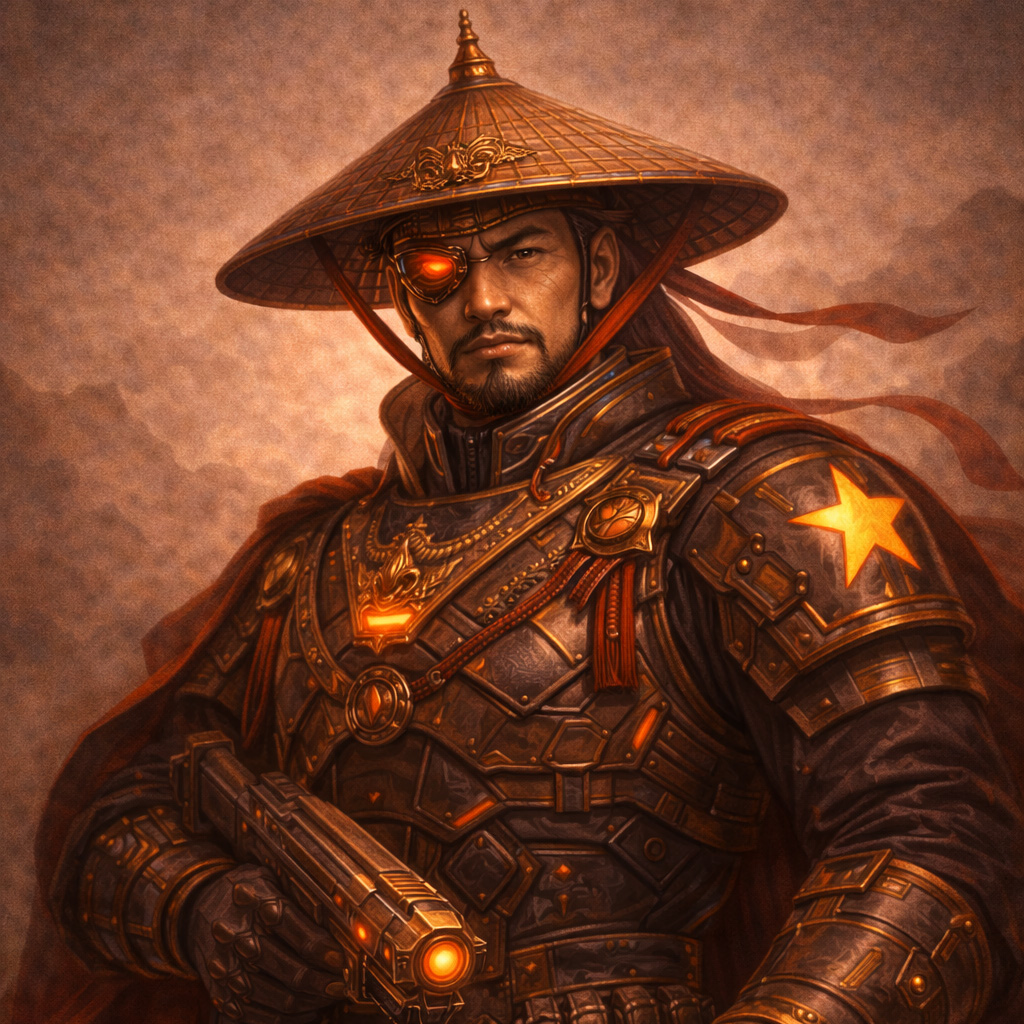
High Sovereign Trần Hải Minh rules from the Jade Harbor Palace on the main island. Calm, elegant, and famously difficult to read, he embodies the modern Namshim state: outwardly courteous, inwardly relentless. He favors prosperity through controlled strength, believing that wars should be won first through supply, alliances, and timing. Critics accuse him of caution. Admirers note that Namshim has grown richer and safer under his reign.
Grand Admiral Vũ Thanh Long commands the oceanic war fleets. A veteran of countless anti-piracy campaigns, he transformed coastal patrol forces into a permanent professional navy. He advocates aggressive pressure on the Free Islands, arguing that every generation allowed to grow in raiding culture creates the next war. Sailors trust him because he is known to share danger at sea rather than rule from a distant map room.
Madame Lê Sương Mai is the most powerful merchant matriarch in the archipelago. Her consortium finances ports, shipyards, grain reserves, and overseas ventures across half the eastern sea. She speaks softly, remembers every debt, and has ruined rivals without raising her voice. Many treaties survive because she profits from peace. Many wars begin when she no longer does.
Venerable Phạm Ngọc Tâm serves as guardian of the Old Shrines and keeper of ancestral records. More respected than feared, he reminds rulers that wealth without harmony rots from within. Though he avoids open politics, his words can legitimize reforms or quietly destroy them. Even generals lower their tone in his presence.
Shadow Director Đặng Kỳ Vinh oversees intelligence, covert finance, and foreign operations. Smugglers disappear, pirate coalitions fracture, and suspicious governors suddenly face scandals when his hand moves. Officially he does not exist. Unofficially many enemies of Namshim suspect he exists everywhere.
Envoy Aiko Trần-Moriyama was born from a Namshim trading line and a northern Tohei noble house. Fluent in several court traditions, she manages the dangerous relationship between the islands, the Tohei powers, and Imperial-descended states. To some she is the future of diplomacy. To others she is proof that borders are weaker than blood and commerce.
Prince Kharem-of-the-Tides is the most ambitious Bastet warlord of the southern reserve island and a living reminder that the first masters of the archipelago have not vanished. Towering even among his own people, he descends from one of the ancient temple lineages that once ruled the great islands before the coming of men. Where many Bastet elders seek only preservation, Kharem dreams of restoration. He commands a hard-bitten company of Bastet mercenaries who sell their strength, discipline, and fearsome reputation to foreign patrons, storing coin, weapons, and ships for a greater purpose. Publicly, he offers contracts and limited loyalty. Privately, every campaign is training for the day he lands on one of the lost islands, raises the old standards above its ruins, and proves that Bastet civilization was interrupted—not ended.
Part XIV – Namshim Today
Namshim stands today as a wealthy island civilization shaped by memory, discipline, and tides. It remembers the age of division, the humiliation of blockade, the usefulness of empire, and the cost of relying on outsiders. Those lessons define every harbor wall, naval budget, and trade treaty it signs.
Its people are known for courtesy, patience, and measured speech, yet behind that calm lies a society that calculates constantly. Profit is pursued with intensity, sovereignty guarded with suspicion, and weakness studied only to avoid repeating it.
The Free Islands remain an enemy. The continental powers remain both partners and threats. Foreign markets remain irresistible. Ancient Bastet ruins still watch over modern docks where missile frigates anchor beside merchant junks and temple barges.
Namshim does not seek to rule all Damocles. It seeks something more durable: to remain too useful to destroy, too prepared to conquer, and too united to be broken again.
In the eastern seas, smiles are sincere, tea is warm, contracts are precise—and every harbor is ready for war.