






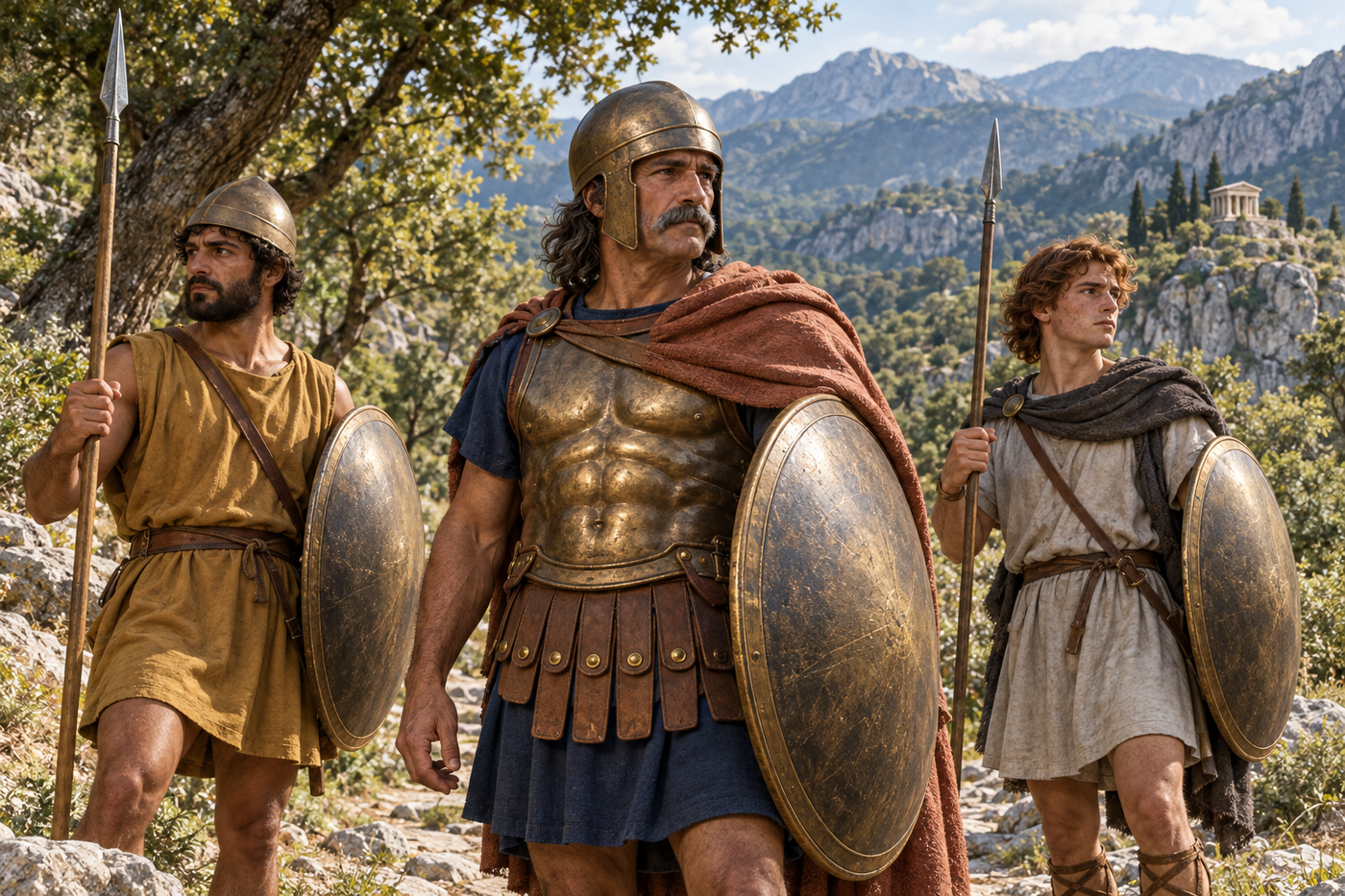
Epirotes
The other Alexander
As Alexander of Macedon carried his army into Asia, another Alexander crossed the sea towards Italy. The Molossian king was his uncle and the brother of Olympias. Summoned by Tarentum to fight its enemies, he sought an opportunity on the western side of the Greek world. For a few years, two members of the same royal network pursued victories in opposite directions.
The western expedition ended in disaster near Pandosia. Heavy rain separated the Molossian army's positions, enemies closed around the king, and a desperate withdrawal brought him to a flooded river. Livy tells how an oracle's warning returned to him at that moment. The names he had tried to avoid in Epirus had found him in Italy. His death left a story of ambition, courage and misunderstood fate within a dynasty that claimed descent from Achilles.
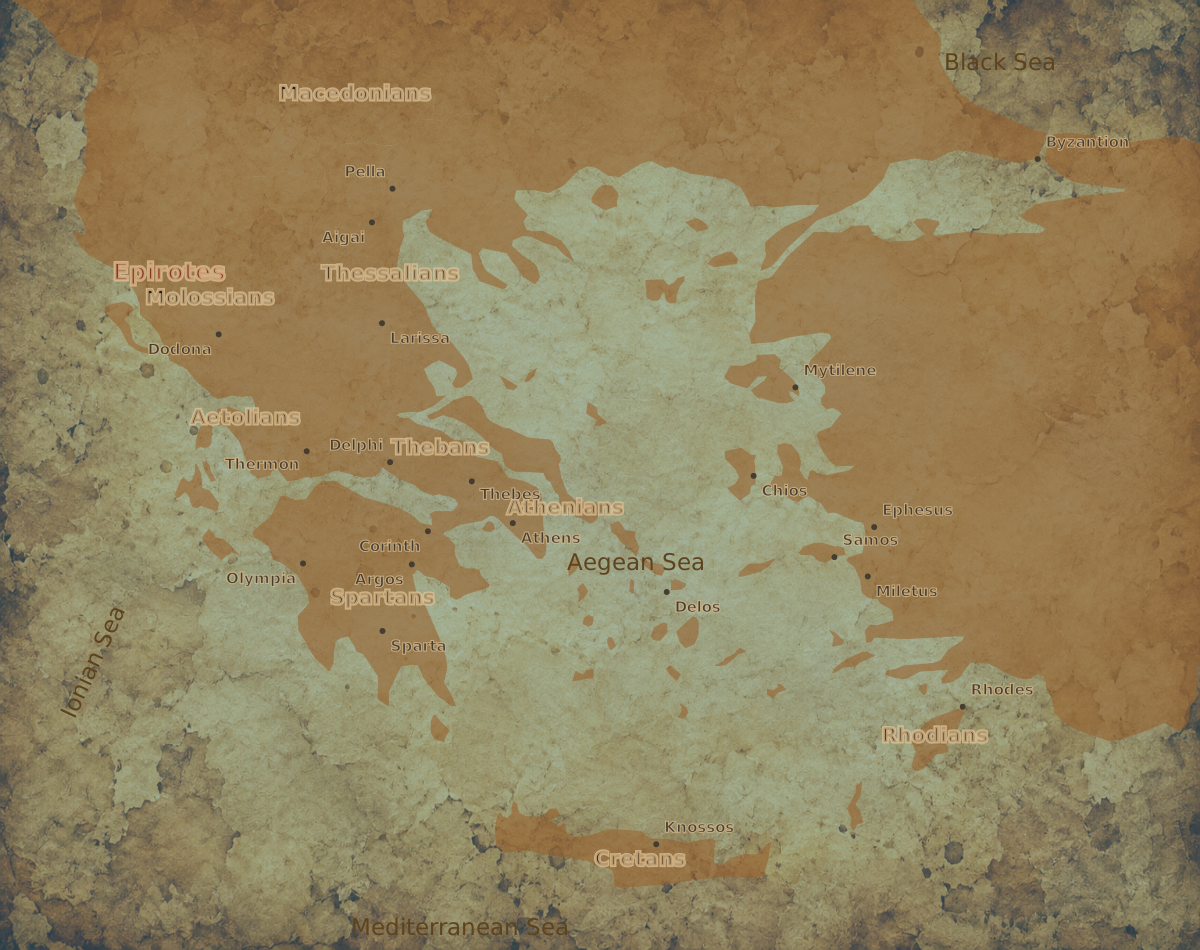
Beyond the mountain passes
Epirus lay between the Pindus and the Ionian and Adriatic shores. High country, river valleys and coastal approaches created different settings for settlement and movement. Pastures and cultivated basins supported communities whose connections crossed the mountains and reached the sea. The region was close to the Greek cities of the northwest and to the powers of the western Balkans.
Molossians, Thesprotians and Chaonians were among its most important peoples. Their histories did not begin as a single monarchy ruling every part of Epirus. Communities and leading families maintained their own positions, while cooperation could place wider resources behind a successful ruler. The growing prominence of the Molossian royal house gave that process a powerful centre during the fourth century.
Routes mattered as much as distance on a map. A pass could connect a king to allies or expose him to invasion. The coast offered departure points for expeditions and contact with communities across the water. Epirus could therefore be a refuge for people displaced elsewhere and a homeland from which leaders sought a much larger career.
The descendants of Achilles
The Molossian royal house traced its ancestry through Neoptolemus, son of Achilles, and the Aeacid line. The claim brought Trojan epic into the identity of living rulers. A king could present himself as heir to a heroic family whose courage and sufferings were known throughout the Greek world.
This ancestry also gave marriage alliances a particularly resonant setting. Olympias' union with Philip II joined the Molossian and Macedonian courts. Their son Alexander inherited a maternal connection with Achilles alongside his father's claim to Heracles. The stories were more than ornaments to be recited at a feast. They offered models of glory, vengeance and the exceptional obligations of a royal life.
The dynasty nevertheless depended on the support of people who could withdraw it. Royal authority existed within relationships with leading men and communities. The language of ancestral honour had to be made credible through protection, success and the treatment of followers. A king with heroic forebears could still lose his country.
The questions beneath the oak
At Dodona, Zeus and Dione received questions from people confronting uncertain futures. The sanctuary lay beneath Mount Tomarus in an inland valley, its sacred oak joining the voice of the god to a particular living landscape. Visitors sought guidance on affairs that ranged from public decisions to the anxieties of a household.
Lead tablets preserve an unusually close encounter with those concerns. People asked about marriage, children, property, work, travel and the proper way to honour the gods. The questions bring religion into decisions for which the answer could determine a family's future. A ruler wondering about a campaign and an individual wondering whether to undertake a journey belonged to the same world of uncertainty and consultation.
Dedications and offerings gave gratitude a lasting form. Bronze objects and other finds reveal the attention paid to the sanctuary over many generations. Its fame reached beyond the communities nearest to it, while its position within Epirus made it part of the region's political and sacred geography. Later royal building would enlarge the monumental setting, but the authority of the oracle was much older.
Olympias and the Macedonian marriage
The marriage of Olympias to Philip drew Molossian affairs closely into Macedonia's rise. It created opportunities for her family and exposed them to the dangers of the Macedonian court. Philip's power could support a ruler in Epirus, while changes in his household could threaten the position of a wife and son.
Alexander the Molossian benefited from the connection as he established himself in the kingship. In 336 BC, he married Cleopatra, the daughter of Philip and Olympias and sister of the future conqueror. The celebrations at Aigai were intended to display the strength of these dynastic relationships. Philip's assassination transformed the occasion into a succession crisis.
The family ties survived, but their meaning changed as the younger Alexander became king and departed for Asia. Olympias retained ambitions and influence of her own. Cleopatra's marriage placed her in the Molossian royal house. The decisions of these women helped connect the politics of two countries whose armies and courts could not be understood in isolation.
An army built from a wider following
The military strength available to a Molossian king came from his own people and from allies gathered around his leadership. Leading households could provide mounted men and better protected fighters, while other infantry answered the demands of local warfare. The terrain rewarded troops able to move through difficult approaches, but expeditions beyond Epirus required the ability to fight on very different ground.
The Italian campaign demonstrated the reach of that organisation. Transporting an army overseas demanded ships, supplies and agreements with the people who had called it. Winning a battle was only part of the task. The king had to hold positions, manage local partners and decide how far the enterprise should serve his own authority.
Alexander's successes brought cities and hostages within his power. They also changed his relationship with the Tarentines, whose interests were not identical to those of a successful foreign king. A protector capable of defeating an enemy could become an uncomfortable neighbour. The expedition joined Greek civic politics to the ambitions of a monarch and the resistance of Italic peoples.
Pandosia and the warning fulfilled
Livy's account makes the final disaster turn on circumstances that broke the army's mutual support. The king had established positions on separate heights near Pandosia. Continuous rain flooded the intervening country, allowing enemies to overwhelm isolated bodies of troops. Alexander was left to force a way out with a selected following.
The narrative also gives a role to Lucanian exiles serving with him. Their hopes of returning home created an opportunity for the king's enemies. After earlier victories and the taking of hostages, personal loyalties remained capable of changing the campaign's outcome. Command over territory did not guarantee the fidelity of the men close to the ruler.
At the river crossing, the story of the oracle supplied the catastrophe with its remembered meaning. Warned to beware of Pandosia and the Acherusian water, Alexander had believed distance from the familiar Epirote places would keep him safe. He met the same names in Italy. The account preserves the ancient conviction that the difficulty could lie in understanding a warning rather than obtaining one.
The king was killed during the attempt to cross. His remains eventually returned across the sea to Cleopatra and Olympias. The western venture had not created a realm comparable with the conquests in Asia, but it had shown that the Molossian monarchy could project substantial power beyond its own country.
A dynasty caught in the successors' wars
Alexander the Great's death in 323 BC drew Epirus into the struggles over his family and inheritance. Olympias returned to Macedonia and became a central figure in a conflict that ended with her defeat and death. Supporting her could expose an Epirote king to enemies at home as well as abroad.
Aeacides, the father of Pyrrhus, lost his position amid these upheavals. The infant prince was carried out of danger by followers and taken to Glaucias, king of the Taulantians. Plutarch's account gives a human centre to the political collapse: a child whose future depended on whether another ruler would protect him despite the risk.
Glaucias raised Pyrrhus within his household and later helped return him to Epirus. The refugee would become one of the great commanders of the next generation, again carrying an Epirote army to Italy. His survival linked royal ambition to the personal loyalty of people who acted when the dynasty had little power left to reward them.
The road from refuge to expedition
Epirus in Alexander's age was a country through which royal fortunes moved with unusual intensity. Marriage could bring the support of Macedonia; a court crisis could turn that advantage into danger. The sea offered an army another field of ambition, while the mountain routes could carry fugitives towards a protector.
The sacred oak at Dodona, the memory of Achilles and the relationships among living households gave those choices their setting. Kings sought glory and security within a world that made both uncertain. Their people supplied the armies, support and endurance through which a dynastic hope could become a campaign. The result was a regional power whose reach repeatedly exceeded the bounds of its own valleys.
Sources
Ancient accounts
- Livy, History of Rome VIII.17 and VIII.24.
- Plutarch, Life of Pyrrhus 1–5; Life of Alexander 2–10.
- Diodorus Siculus, Library of History XIX.49–51.
Sanctuaries, inscriptions and historical studies