






Part I – Arrival Before the Empire
Long before the banners of the Supreme Empire darkened the skies of Damocles, other outsiders had already found the world. They were not conquerors, missionaries, or noble expeditionary houses. They were smugglers, deserters, free captains, bankrupt merchants, fugitives, and ambitious criminals searching for a place too distant to be controlled and too valuable to be ignored.
Damocles was exactly that place.
Its fractured political order, rival clans, remote coastlines, and abundance of strange artifacts made it a paradise for men and women willing to live outside the law. The newcomers established hidden anchorages, fortified coves, and discreet ports where cargo could change hands far from official scrutiny. They learned local customs quickly, bribed where needed, fought where necessary, and married into coastal communities when it proved profitable.
Unlike later invaders, they did not attempt immediate domination. They came to trade, extract value, and survive. That patience allowed them to root themselves deeply.
Over generations, their descendants ceased to be mere foreigners. They became a new people of the southern waters: sailors shaped by danger, merchants raised among contraband ledgers, warriors born on decks rather than in castles. Their speech blended old off-world tongues with local influence. Their loyalties attached more to crews, captains, and profit than to bloodline or sacred soil.
From those rough beginnings emerged the first Buccaneers of Damocles.
Part II – Rise of the Confederation
At first, the Buccaneers were little more than competing fleets and rival ports. Crews raided each other as often as they raided outsiders. Smuggling routes were defended violently, captains rose and fell in months, and alliances lasted only until the next profitable betrayal.
Yet trade has its own logic. Disorder enriches the bold for a season, but stability enriches them for generations.
Gradually, the strongest captains understood that shared rules could make everyone richer. Harbors were declared neutral zones. Disputes between major crews were settled by councils rather than endless blood feuds. Sea lanes were patrolled collectively when foreign threats appeared. Tribute systems were established across smaller islands and strategic coastal settlements.
Thus was born the Buccaneer Confederation: not a centralized state, but a league of ports, fleets, merchant houses, and warrior captains bound by mutual advantage.
Their greatest strength was geography. They controlled approaches between the southern seas, the desert land bridge, and the richer regions of the continent. Anyone wishing to move goods discreetly, quickly, or illegally often found that Buccaneer cooperation was cheaper than opposition.
No emperor had founded them. No prophet had united them. Coin, necessity, and the sea had done the work instead.
Part III – The Age of Celestial Trade
The arrival of the Celestial Peace transformed the Buccaneers from successful smugglers into regional powers. As new technologies, relic devices, industrial tools, and sacred curiosities spread across Damocles, demand exploded beyond the planet itself. Nearby Imperial worlds hungered for artifacts linked to a mysterious frontier civilization enriched by alien knowledge.
The Buccaneers were perfectly placed to satisfy that hunger.
Official channels were slow, taxed, and watched. Buccaneer routes were fast, discreet, and flexible. They purchased relics from sects, bribed officials, robbed careless convoys, copied devices in hidden workshops, and moved cargo through networks no formal authority fully understood.
Fortunes were made overnight. Southern ports grew into crowded trade cities where priests, mercenaries, engineers, nobles, spies, and thieves drank in the same taverns. Shipyards expanded. Coastal fortresses were rebuilt with imported materials. Private armies gained access to weapons generations ahead of what most local clans could field.
The Confederation also became culturally distinct during this golden age. Wealth bred pride. Captains dressed like princes, merchant dynasties sponsored festivals and monuments, and famous crews became legends sung from dock to dock. Freedom was celebrated loudly, though often financed by exploitation hidden below deck.
By the time the Supreme Empire finally came in force, the Buccaneers were no longer parasites feeding on Damocles.
They had become one of its great powers.
Part IV – The Saurians
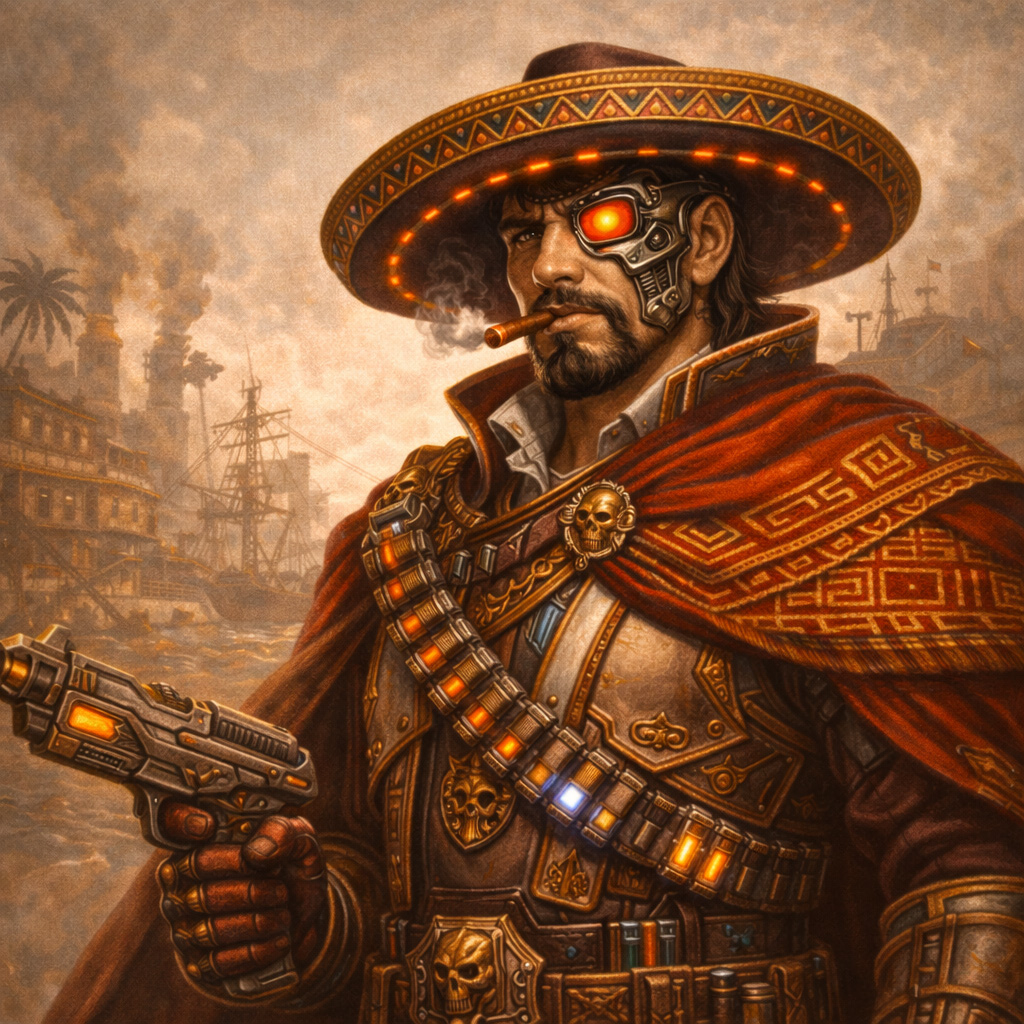
Among all the forces fielded by the Buccaneers, none inspired more fear or admiration than the warriors known as the Saurians. Originally the title belonged to veteran captains and bodyguards who mastered warfare in the burning south, where desert crossings, ruined fortresses, and sudden ambushes killed the careless faster than any enemy blade.
Over time, the name became an elite tradition.
Saurians were chosen from the hardest survivors of naval raids, boarding actions, convoy wars, and land campaigns across the southern land bridge. They trained constantly, fought with captured and modified relic weapons, and learned to operate aging war machines kept alive through generations of improvisation. Where ordinary troops broke, Saurians adapted.
Their equipment varied from company to company, but certain traits became famous: layered armor built from salvaged advanced materials, compact heavy weapons, disciplined small-unit tactics, and a refusal to abandon wounded comrades if recovery remained possible. Many also wore trophies taken from defeated enemies, both as intimidation and as proof that survival was earned, not granted.
To outsiders, they were pirates dressed in stolen glory. To the Confederation, they were the iron memory of a people who had survived through skill rather than inheritance.
Even after defeat, the title endured. On both sides of the Buccaneer divide, veterans still claim the name with pride.
Part V – The Great War and the Swolf Conquest
When the Great War engulfed Damocles, the Buccaneers initially believed distance and mobility would preserve them as they had preserved them through earlier crises. They were wrong.
After securing much of Tohei, the coalition led by the Swolfs turned south. Their objective was clear: break the maritime power controlling the strategic passage between continent and desert, seize the trade routes, and end any independent force capable of threatening their rear.
The campaign was long and bitter. Buccaneer fleets struck supply lines, vanished into reefs and hidden coves, then reappeared where least expected. Coastal strongholds changed hands repeatedly. Veteran Saurian formations launched brutal counterattacks that inflicted losses far beyond their numbers.
But courage could not fully compensate for isolation. The coalition possessed deeper reserves, more manpower, and growing control of surrounding territories. One port after another fell. Old rivalries inside the Confederation reopened under pressure. Some captains fought to the death. Others negotiated survival.
The last major resistance in the south became legend. Outnumbered many times over, Saurian veterans held ruined lines with repaired vehicles and dwindling ammunition until fuel, shells, and hope were exhausted alike.
When final surrender came, many warriors and families were deported into Swolf-controlled lands. Others escaped by sea into island redoubts beyond easy reach. The Confederation was broken, but not erased.
Part VI – The Two Buccaneer Worlds
The defeat of the old Confederation created two very different Buccaneer societies.
The first is the Buccaneer Confederation under Swolf domination. Its ports still trade, its fleets still sail, and its people retain many old customs, but sovereignty is limited. Governors answer upward, taxes flow north, and major military decisions are watched carefully. The Swolfs prefer profitable obedience to pointless repression, so local elites are tolerated so long as they remain useful.
Life there is paradoxical: safer than in the old days, richer in some districts, yet marked by resentment and the constant memory of lost independence.
The second world is that of the Free Islands. Scattered, stubborn, and proudly autonomous, these enclaves survived through hidden harbors, fast ships, private alliances, and a willingness to live dangerously. Trade and piracy exist side by side. One harbor may host diplomats and merchants in daylight, then launch raiders by night.
The Free Islands celebrate the old myth of Buccaneer freedom far more loudly than the mainland ports. Yet freedom comes at a cost: unstable politics, sudden violence, uneven wealth, and perpetual vulnerability to stronger neighbors.
Families are often divided between both spheres. A merchant may pay Swolf taxes in one city while funding an outlaw cousin in another. A Saurian veteran may serve officially in a coastal garrison while secretly training island militias. Blood, profit, and memory still cross borders faster than fleets can stop them.
Thus the Buccaneers remain one people, but no longer one power.
Part VII – Economy and Technology
The Buccaneer economy has always rested on movement. Others draw wealth from fields, mines, or taxation. The Buccaneers draw it from routes, exchanges, commissions, salvage, and the ability to deliver what should not be delivered.
Legal commerce, smuggling, escort contracts, piracy, ransom, customs duties, ship repair, intelligence brokerage, and mercenary hiring all feed their ports. In prosperous years the difference between trade and crime becomes almost philosophical.
What truly distinguishes them, however, is their mastery of reused technology. No other maritime culture on Damocles has exploited the legacy of the Celestial Peace so thoroughly. Ancient drones are rebuilt as dock servitors or combat auxiliaries. Broken reactor cores power hidden workshops. Sensor arrays are mounted onto coastal watchtowers. Sacred relics become navigation systems, targeting devices, or bargaining chips.
Buccaneer engineers are rarely purists. Their machines are patched, hybridized, and sometimes dangerous. Elegant original designs are routinely merged with improvised hull plating, local metallurgy, or stolen components from newer enemies. The result may offend scholars, but it often works.
The Free Islands rely more heavily on salvage, raiding, and opportunistic innovation. The Swolf-controlled Confederation possesses better infrastructure, more predictable revenues, and larger repair facilities. Each side envies what the other has.
Wherever a forbidden device, lost weapon, or valuable wreck appears in the south, Buccaneer buyers are never far behind.
Part VIII – Warfare and Military Doctrine
Buccaneer warfare favors speed, surprise, and selective brutality. They rarely seek symmetrical battle unless terrain or desperation leaves no alternative. Instead they strike where enemies are exposed: supply ships, isolated garrisons, harbor depots, command relays, and convoys that believed distance was protection enough.
Naval raids remain central to their identity. Fast attack craft, disguised merchant vessels, amphibious boarding teams, and coastal artillery hidden among cliffs allow them to transform familiar waters into killing grounds. A superior fleet can still be bled if forced to guard everything at once.
On land, their forces mix regular militia, marines, hired guns, mechanized raiders, and veteran cadres. They excel in broken terrain, urban ports, dunes, and littoral battlefields where mobility matters more than parade-ground discipline.
The elite Saurians serve as shock troops, reserve spearheads, and symbols of continuity. When committed, they are expected to break deadlocks or hold impossible ground long enough for others to escape.
Their arsenals are as diverse as their methods: relic beam weapons, refurbished heavy armor, compact fusion charges, naval guns repurposed for siege use, and improvised systems no formal quartermaster would ever approve.
To conventional generals, Buccaneer warfare appears chaotic. To survivors, it feels carefully personal.
Part IX – Society and Culture
Buccaneer culture is loud, proud, competitive, and deeply maritime. Reputation matters almost as much as wealth. A captain known for courage, cunning, or impossible escapes may command loyalty beyond what titles alone can purchase.
Family is important, but family is flexible. Blood relatives, adopted deckhands, old comrades, and sworn crew-brothers may all belong to the same household network. Alliances are often sealed through marriage, partnership, or shared profit rather than formal feudal custom.
Their society prizes initiative. Children grow up hearing that fortune favors those who dare first, move faster, and never show fear at the negotiating table. Even failure can be forgiven if it was bold enough.
Faith among them is practical and layered. Old off-world saints, local sea spirits, fragments of Celestial rites, ancestor cults, and personal superstitions coexist comfortably. A merchant may bless cargo with three contradictory rituals if all three might help.
Celebration is equally serious. Victories, profitable voyages, successful escapes, and family unions are marked by music, feasts, gambling, and public displays of generosity or vanity. Status is not only held, it is performed.
Yet beneath the flamboyance lies a harder truth: life has always been uncertain. Storms, betrayal, war, debt, and sudden violence shaped their world. Joy became a discipline because tomorrow was never guaranteed.
Whether under Swolf governors or in the Free Islands, the Buccaneers remain united by one conviction: no distant power truly understands the sea, and therefore no distant power deserves to rule it.
Part X – Relations with Other Powers
Swolfs: Masters, partners, occupiers, and customers depending on whom one asks. The Swolfs rely on Buccaneer ports, sailors, taxes, and southern reach. The Buccaneers rely on Swolf protection from larger predators. Neither side trusts the other, and both know they still need the arrangement.
Kento: Respected by many traditional captains and warrior houses, especially those who value honor over administration. Kento influence in the south often grows through alliances, garrisons, and anti-Ritolia security policy, though merchant factions frequently resent such supervision.
Kumaguchi: Natural commercial counterparts and occasional rivals. Smuggling networks, private investors, and discreet shipping agreements tie many southern interests together. Where laws become inconvenient, Kumaguchi pragmatism and Buccaneer flexibility often understand each other well.
Ritolia: Feared and hated by most Buccaneers. Their rigid ideology, expansionism, and hostility to mixed frontier cultures make them a natural enemy. At the same time, any threat from Ritolia helps justify military unity among otherwise divided islanders.
Palter: Supplier, contractor, and strategic observer. Buccaneer captains respect Palter engineering even when they dislike Palter discipline. Arms and machine parts from Palter workshops often travel farther south than official records admit.
Free Islands and Mainland Confederation: Their most intimate rivalry. They share blood, songs, grudges, and business ties, yet accuse each other of betrayal. Many conflicts with outsiders matter less emotionally than disputes between cousins on opposite sides of the divide.
Foreign Buyers: A permanent category rather than a single faction. Anyone with credits, weapons, secrets, or cargo may find a listening ear in the southern ports, provided they understand that every transaction creates future leverage.
Part XI – The Six Named Figures
Governor Mateo de Vargas is the official head of the Swolf-supervised Buccaneer Confederation. Cultured, disciplined, and outwardly loyal, he balances northern demands with southern realities. Some call him a collaborator. Others note that without his compromises, harsher rulers would already have replaced him.
Admiral Isabela Roja is the most feared leader of the Free Islands. Captain, queenmaker, pirate, and patriot in equal measure, she has united rival island fleets more than once when outside threats grew too dangerous. Her enemies call her a bandit empress. Her followers call her freedom given human form.
General Rodrigo Saurio is a living legend among the Saurians. Scarred by the last campaigns of the Great War, he fought in defeat, survived deportation, and later escaped back south. Old veterans rally to his name, and younger warriors study him as proof that endurance can outlive empire.
Doctor Lucía Serrano is the greatest relic engineer of the southern seas. Half scientist, half scavenger priest, she restores Celestial devices others consider dead forever. Her laboratories are said to contain machines even she does not fully understand, which has never stopped her from improving them.
Captain Esteban Valez is a merchant prince of shadows whose ships carry whatever the age most urgently forbids. He finances rebellions, rescues debtors, bribes governors, and occasionally starts wars by delivering cargo to both sides. He insists this is merely efficient diversification.
Lady Mariko de la Cruz was born of a Kento mother and a southern trading dynasty. Serving as negotiator between warrior clans and maritime houses, she has become one of the few figures trusted in both courts and taverns. Many believe that if the south is ever reunited, it will begin through voices like hers rather than through cannons.
Part XII – The Buccaneers Today
Today, the Buccaneers are divided, diminished, and still impossible to ignore. They no longer command a single confederation stretching proudly across the southern seas, yet no power has truly replaced them as masters of movement, gray trade, and maritime improvisation.
The Swolf-controlled ports generate wealth but simmer with memory. The Free Islands proclaim liberty but survive on constant risk. Veterans dream of reunification, merchants profit from division, and younger generations inherit both pride and unfinished grievances.
Their fleets are smaller than in the old golden age, but more elusive. Their cities are fractured, but still connected by blood and contraband. Their politics are chaotic, yet outsiders repeatedly underestimate how quickly southern rivals can unite when threatened.
Most of all, they remain heirs to a truth older empires never fully grasped: coastlines cannot be ruled the same way as inland fields, and people raised by tides rarely stay obedient for long.
They lost their confederation. They did not lose the sea.