






Rhodians
The island that kings wanted as a friend
In 305 BC, Demetrius brought an extraordinary concentration of ships, soldiers and siege equipment against Rhodes. The city stood between the ambitions of his father Antigonus and its valuable relationship with Ptolemy in Egypt. Its people had tried to preserve friendships without becoming servants of another ruler's war. Now they had to defend that choice behind their own walls.
The siege would become one of the great military spectacles of the age after Alexander. Its meaning for Rhodes was more immediate. Harbours, homes and the freedom to trade were at stake. Magistrates had to maintain order, soldiers had to resist repeated assaults, and crews and allies had to keep help arriving across the sea. The island's independence depended on the combination of all those efforts.
Three cities and a new beginning
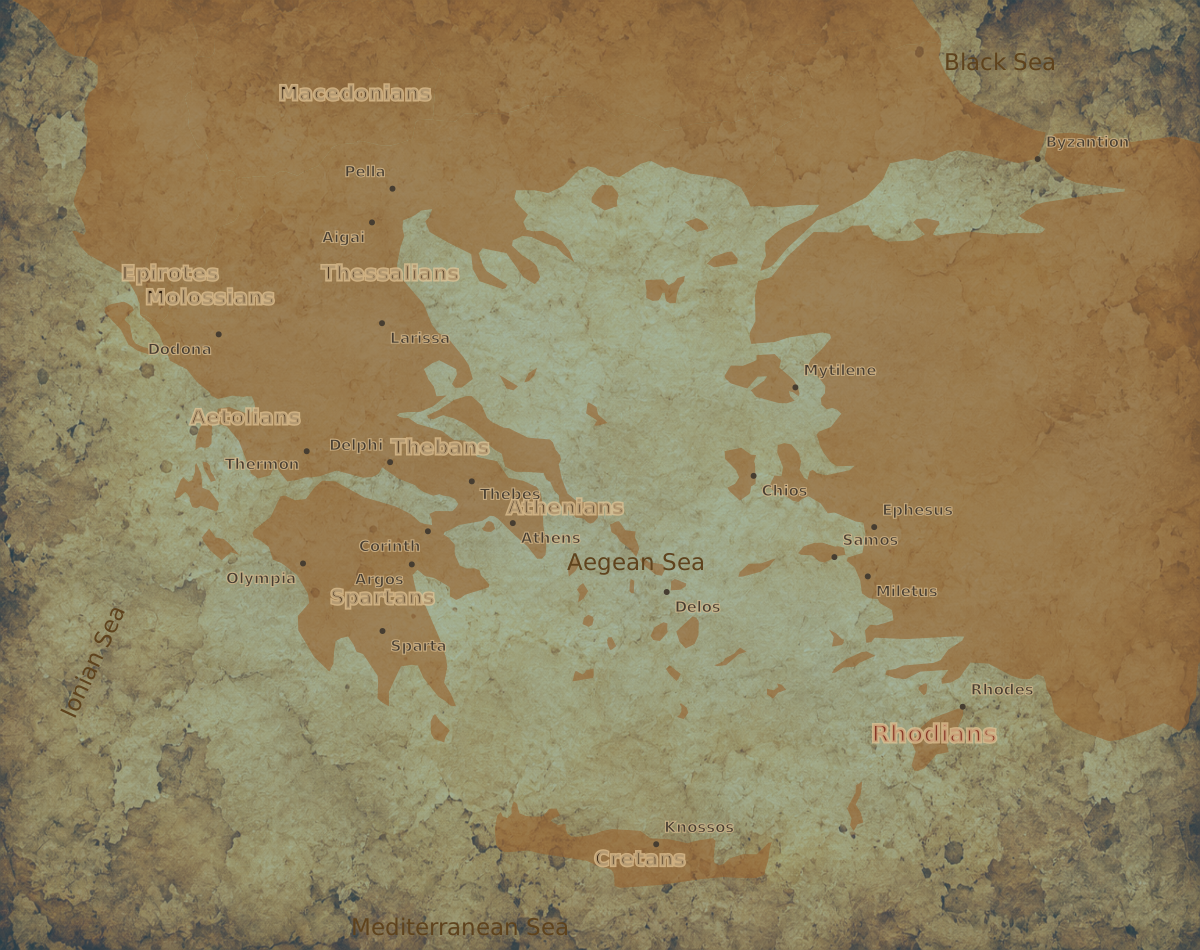
Rhodes lay close to the southwestern coast of Asia Minor, where routes between the Aegean and the eastern Mediterranean met. Lindos, Ialysus and Camirus possessed long histories before the creation of the city of Rhodes in 408/7 BC. Their union established a new urban centre at the island's northern end and gave common political life a commanding maritime position.
The older communities retained local identities and sacred traditions. Their past could be brought into the new arrangement rather than simply erased. A shared city needed institutions, space and a public identity strong enough to join people whose attachments had grown around different places. The benefits included a stronger concentration of resources and a clearer voice in dealings with external powers.
The location rewarded those who could maintain ships and secure passage. Trade connected the island with the coast opposite, the Aegean cities and Egypt. Prosperity depended on relationships reaching farther than the territory a citizen could see from the walls. An interruption at sea could quickly become a problem of provisions, revenue and political choice.
Helios and the rose
Helios, the sun god, supplied Rhodes with one of the most recognisable divine images in Greek coinage. His face appeared opposite the rose that played upon the island's name. The pairing joined sacred protection and civic recognition in silver that travelled through markets and payments across the region.
Rhodian tradition told how the island emerged from the sea and became the portion of Helios. The story made the sun's attention part of the land's beginning. Other cults, including the important sanctuary of Athena at Lindos, preserved the depth and variety of religious life within the united state. Common identity developed alongside the particular gods and ceremonies of older communities.
Worship was also a way of remembering deliverance. After the siege of Demetrius, the Rhodians would dedicate the great bronze image of Helios known as the Colossus. Its fame grew from survival in war and the desire to honour the god who watched over the city. The monument belonged to the generation after Alexander, when the island had successfully faced the siege weapons of his successors.
Between Athens, Sparta and Caria
The new city entered a Greek world of competing naval powers. During the late Peloponnesian War, Rhodes broke from Athens and joined the Spartan side. The victory of Sparta did not settle the island's future. Changes of government and foreign alignment continued as local factions judged which outside power could help them retain control.
In the fourth century, Rhodes again participated in an Athenian-led naval alliance, then joined the revolt known as the Social War. Resistance to Athenian demands brought the island into a different balance of power. The influence of the Carian rulers across the water, especially Mausolus and his dynasty, gave Rhodian politics a powerful regional setting.
Those struggles were fought through embassies, fleets, money and relationships with prominent individuals. A faction might seek protection that its opponents regarded as domination. The island's strategic value made it desirable to outsiders, but also gave its leaders something to bargain with. The difficulty was preserving the benefits of support without allowing the supporter to determine every future decision.
Men whose skills travelled
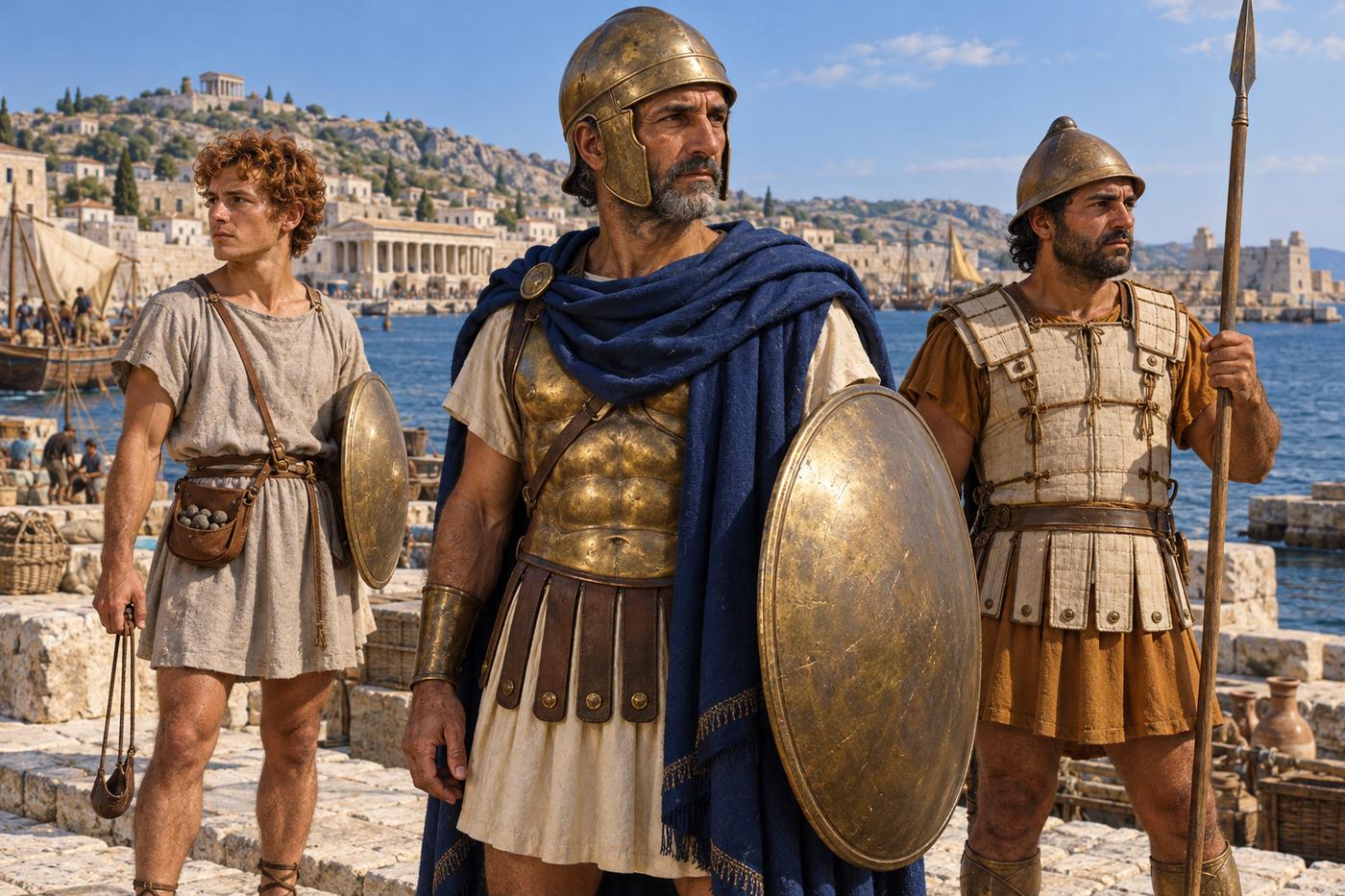
Rhodian military experience extended well beyond the island. Xenophon's account of the Ten Thousand preserves a revealing episode from the retreat after Cunaxa in 401 BC. The Greek army was suffering from enemy missiles and lacked the mounted and ranged forces needed to answer effectively. Among its soldiers were Rhodians who knew how to use the sling.
The officers organised a body of slingers from men already present in the force. The use of lead projectiles and experienced hands helped them contest the enemy's attacks at a distance. It was an adaptation made under pressure, joining a recognised regional skill to an army's immediate need. The soldiers' value came from what they could do when the existing formation was insufficient.
The episode helped preserve the reputation of Rhodian slingers. It also shows how military identities were carried abroad by individuals. A man serving in one capacity might possess another skill acquired at home; a capable commander could discover and organise it. An army's resources included experience that was not always visible in its original arrangement.
Mentor and Memnon in the service of Persia
The careers of Mentor and Memnon reveal another Rhodian connection with the wider wars of the fourth century. These brothers entered the world of Persian commanders, hired Greek troops and powerful satrapal households. Their relationship with Artabazus tied them to a family whose fortunes shifted between revolt, exile and royal favour.
Mentor gained a major position through service to the Great King. Memnon became one of the most dangerous opponents Alexander faced at the beginning of the Asian campaign. His experience joined knowledge of Greek warfare to the resources of Persian rule. The invasion was therefore confronted by a commander who understood both sides of the military world it was entering.
At the Granicus, Memnon argued for a strategy that would deny the invader supplies instead of immediately accepting battle. The satraps chose to fight. After their defeat, he continued resistance and helped defend Halicarnassus. Later naval operations threatened to carry the war back towards the Aegean and the Greek cities behind Alexander.
His death in 333 BC interrupted that danger. The campaign illustrates how much could depend on one experienced leader's judgement and connections. Rhodian service to Persia was not a contradiction to be explained away: the eastern Mediterranean offered careers in which ability, patronage and family alliance could matter more than a simple division between Greek and Persian interests.
Ships at Tyre
Alexander's victory at Issus changed the choices facing the naval communities of the region. As he gained control of the Phoenician coast, ships joined him from cities and rulers whose earlier service had supported Persia. Rhodes contributed ten triremes during the siege of Tyre in 332 BC.
The arrival mattered because Tyre could not be reduced easily while its defenders retained freedom at sea. The growing fleet allowed Alexander to combine operations from the mainland with pressure against the island's harbours and walls. Rhodian ships belonged to the practical assembly of naval strength through which a difficult siege became possible.
The island's position under Alexander formed part of a rapidly changing order. Its leaders had to preserve local interests while acknowledging a conqueror whose authority now extended across the lands surrounding the eastern Mediterranean. The king's death would reopen those calculations on a larger and more unstable scale.
Demetrius attacks
During the wars of the successors, Rhodes sought workable relations with competing rulers. Its commercial connection with Egypt made a demand to act against Ptolemy particularly difficult to accept. Antigonus and Demetrius wanted cooperation on their terms. The attempt to avoid full commitment brought the Rhodians into the very war they had hoped to keep at a distance.
Demetrius first pressed the city from the sea and then expanded operations on land. His siege became famous for immense machines, including the tower called the Helepolis. Such equipment concentrated resources, labour and technical skill. The defenders answered through their own engineering, repairs, sorties and the determined use of limited space.
The city had to organise people as carefully as weapons. Work on fortifications, the supply of fighters and the reception of assistance demanded cooperation under constant pressure. The danger reached households whose survival depended on keeping the enemy outside. Religious vows and public promises gave collective endurance a language that went beyond the immediate calculation of supplies.
The value of friends
Help arrived from rulers who had reasons to prevent an Antigonid victory. Ptolemy supplied men and provisions, while other powers also contributed. The sea that exposed Rhodes to attack allowed these relationships to sustain resistance. The siege tested the network of friendships the island had cultivated before the fighting began.
Demetrius failed to force the complete submission he wanted. In 304 BC, a negotiated settlement preserved Rhodian autonomy while defining obligations towards Antigonus, with an exception protecting the relationship with Ptolemy. Survival required both the ability to fight and the willingness to end the struggle on terms the city could bear.
The victory became a foundation for Rhodes' later standing. Its people had withstood one of the age's most celebrated besiegers and emerged with their political community intact. The dedication to Helios gave that achievement a monumental form. Behind the bronze god stood a much less visible achievement: citizens, soldiers, crews and allies keeping a city alive through a year when its freedom could have been lost.
Sources
Ancient accounts
- Xenophon, Anabasis III.3–4.
- Arrian, Anabasis of Alexander I.12–23, II.1–2 and II.20.
- Diodorus Siculus, Library of History XX.81–100, the siege of Rhodes.
Religion, coinage and historical studies
- Center for Hellenic Studies, “Local Pantheons in Motion: Synoecism and Patron Deities in Hellenistic Rhodes”.
- Metropolitan Museum of Art, Rhodian silver didrachm with Helios and rose.
- “Le siège de Rhodes par Démétrios et ‘l'apogée’ de la poliorcétique grecque”, Revue des Études Anciennes 105 (2003).
- François Sabbathier, Dictionnaire pour l'intelligence des auteurs classiques grecs et latins, notice “Rhode”.