






Part I – Origins of a Southern Power
The Kumaguchi rose in the southern reaches of Tohei, far from the oldest northern centers of prestige. Their lands stood near the approaches to the Buccaneer Confederation and along the commercial arteries linking inland plains, coastal markets, and maritime routes. For generations they were not counted among the greatest houses. They lacked the ancient aura of Kento, the later military machinery of Palter, or the imperial leverage of the Swolfs.
What they possessed instead was position. While older clans measured greatness in heroic ancestry and battlefield reputation, the Kumaguchi understood the value of crossroads, tariffs, escorts, storage, and controlled passage. Grain, timber, ore, contraband, mercenaries, pilgrims, and information all moved through territories they could tax, protect, delay, or redirect.
From this geography emerged their political character: practical, opportunistic, and deeply aware that wealth can become power long before power becomes legitimacy.
They were never the soul of Tohei, nor its sword. They became its marketplace, and later its broker.
Part II – Wealth Under the Celestial Peace
The arrival of the Celestial Peace transformed the Kumaguchi more than many rival clans understood. Where others debated doctrine or resisted foreign influence, the Kumaguchi saw systems to be exploited. The new priesthood required supplies, transport, labor coordination, and dependable intermediaries between inland authorities and less obedient coastal actors.
The Kumaguchi stepped forward eagerly. They traded with sects, administered contracts, financed caravans, and managed distribution networks tied to the new order. Most importantly, they became valuable intermediaries for the Buccaneers, whose southern maritime networks connected worlds, goods, and interests that official channels could not always handle openly.
Through these arrangements the clan accumulated immense wealth. Their ports expanded, merchant houses multiplied, roads improved, and private armed escorts became permanent institutions. Even when politics shifted, debts remained, and debt often outlives ideology.
By the eve of the Imperial invasion, the Kumaguchi were no longer a secondary clan enriched by circumstance. They were one of the great economic powers of southern Tohei.
Part III – The Invasion and the Age of Opportunity
The Imperial invasion shattered old certainties, but for the Kumaguchi it also opened doors. Ancient borders collapsed, rival houses lost heirs, trade routes were disrupted, and frightened populations sought protection wherever it could be found. The Kumaguchi adapted faster than many older powers.
They seized abandoned lands, absorbed weaker neighbors, and converted commercial militias into field armies. Their granaries fed refugees and soldiers alike, earning loyalty where fear alone could not. While fanatics died for lost causes and radicals burned resources they could not replace, the Kumaguchi accumulated territory, manpower, and leverage.
During the struggle for Tohei they briefly imagined themselves as the future masters of the region. Their rulers attempted to gather dissatisfied clans into a counterweight against Kento influence and the growing imperial alliances. For a moment, such ambitions were plausible.
But timing failed them. The coalition around Kento and the Swolfs proved stronger than expected. After failed maneuvers and several costly clashes, the Kumaguchi were forced to submit to the new balance rather than dictate it.
They survived, expanded, and grew richer, but they did not rule.
Part IV – Lord Daigo Kumaguchi, The Modernist Dream
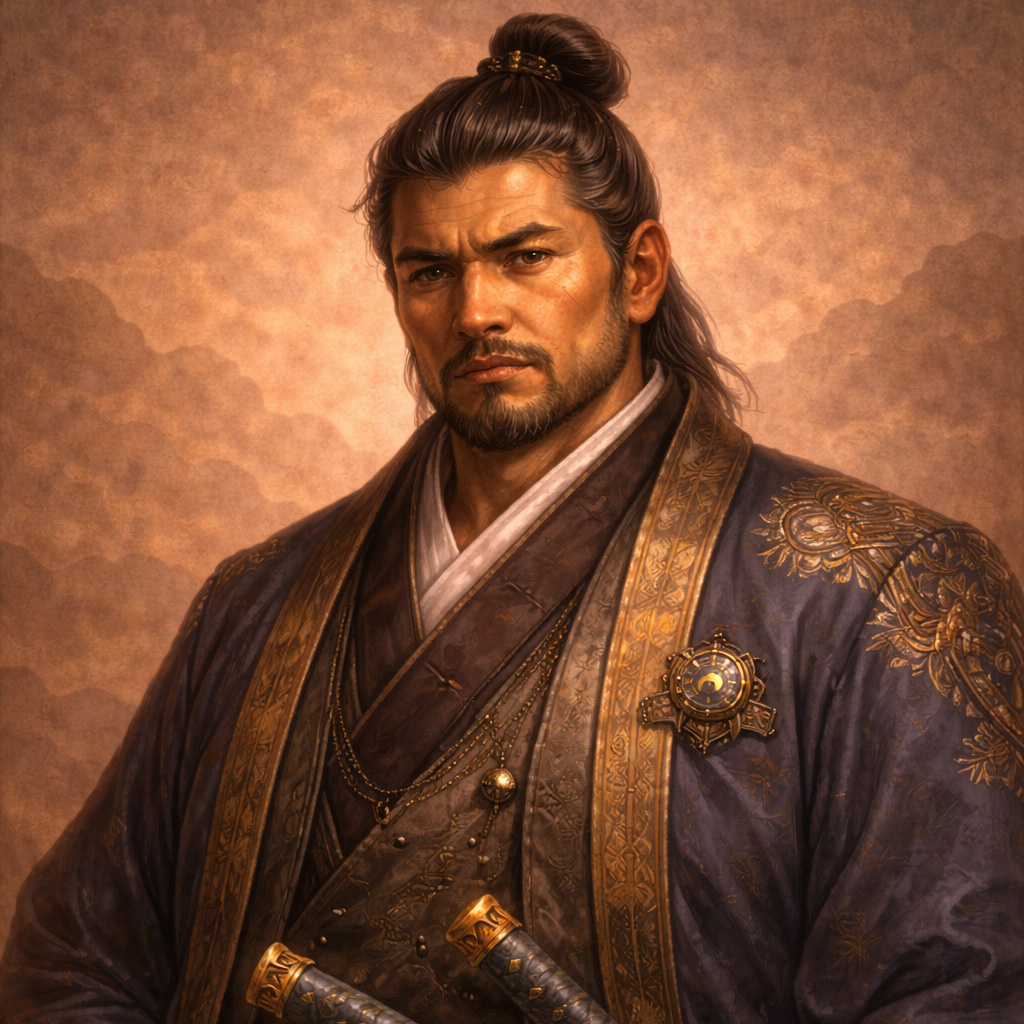
The current Daimyo, Lord Daigo Kumaguchi, inherited wealth and frustration in equal measure. Brilliant, disciplined, and outwardly reformist, he presents himself as a statesman of modernization: patron of industry, sponsor of technical schools, reformer of administration, and defender of southern prosperity.
He speaks the language of progress because he understands that old symbols alone cannot command the future. Under his reign, roads have been fortified, workshops expanded, officer training standardized, and state records reorganized with near obsessive precision. Younger elites admire him as the man dragging Kumaguchi into a new age.
Yet beneath the polished image lies a colder doctrine. Daigo believes Tohei’s present order cannot be peacefully inherited. Kento still possesses prestige, the Swolfs dominate diplomacy, Palter grows stronger through industry, and countless minor clans cling to outdated loyalties. As long as equilibrium survives, Kumaguchi can rise only slowly.
Therefore, he studies fracture. Rivalries are opportunities. Border incidents are investments. Economic pressure can be as useful as artillery. A region exhausted by conflict may one day beg for the very authority it once resisted.
To admirers, he is the architect of national renewal. To enemies, he is a man preparing to save Tohei only after helping set it ablaze.
Part V – Chaos as Strategy
The central principle of Kumaguchi grand strategy is simple: a stable Tohei favors established powers, while a shaken Tohei rewards those prepared to reorganize it. Lord Daigo and his inner circle therefore do not seek random destruction, but controlled disorder.
Tensions between rival clans are quietly encouraged. Old border disputes are reopened through intermediaries. Merchant blocs suddenly receive funding to resist tariffs. Mercenary companies find new employers at suspiciously convenient moments. Religious factions are given just enough room to agitate without becoming impossible to contain.
The objective is never immediate victory. It is exhaustion. A Kento forced into constant arbitration loses prestige through overextension. A Swolf order forced to intervene too often begins to look like occupation. A Palter economy strained by permanent mobilization slows its own ascent. A frightened minor clan becomes easier to absorb into Kumaguchi patronage.
When others spend blood preserving the present, the Kumaguchi intend to inherit what remains after the crisis.
This strategy is dangerous. Fire spreads unpredictably. Yet Daigo believes history favors those willing to risk the blaze rather than those waiting to be consumed by it.
Part VI – The Lioner Connection
Publicly, relations between the Kumaguchi and the Lioners are tense. Speeches denounce foreign arrogance, military posturing, and interference in regional affairs. Patriotic voices within Kumaguchi territory present the Lioners as a looming threat whose ambitions must be resisted.
Privately, the truth is more complex.
Both powers understand that managed instability can justify stronger rule. The Lioners benefit when eastern regions demand greater security and centralized military authority. The Kumaguchi benefit when southern Tohei seeks energetic leadership against external pressure. Neither side needs formal alliance to profit from the same climate of fear.
This hidden understanding does not mean trust. Each expects betrayal eventually. Each would gladly weaken the other if conditions allowed. But for now their interests often run parallel: strengthen their own spheres, marginalize weaker actors, and ensure that every crisis increases dependence on strong states.
Many in Tohei suspect something is wrong when enemies benefit so consistently from the same disasters. Few can prove it.
Part VII – Economy of the Kumaguchi
The Kumaguchi economy is among the most dynamic in Tohei. Fertile southern plains provide grain surpluses capable of feeding cities, armies, and export markets. Roads and river routes connect inland producers to coastal depots, while maritime access through southern networks links the clan to broader regional trade.
Centuries of brokerage during the age of the Celestial Peace created a sophisticated merchant class skilled in finance, storage, insurance, and long-distance contracting. Even after wars reshaped the map, those habits of commerce endured.
Modern workshops produce arms, vehicles, communications equipment, and civilian machinery in growing volume. The clan is especially strong in logistics: fuel movement, ammunition distribution, repair chains, ration systems, and wartime procurement. Kumaguchi planners understand that many battles are won before the first shot is fired.
They also profit from ambiguity. Smugglers, private brokers, mercenary recruiters, and politically inconvenient traders often find southern routes more accommodating than they expected, provided fees are paid and discretion maintained.
If Palter represents disciplined industry, the Kumaguchi represent movement, exchange, and the monetization of uncertainty.
Part VIII – Armed Forces of the Kumaguchi
Kumaguchi armed forces are built for adaptability rather than ceremony. Their officer corps rewards competence, technical literacy, and initiative more than noble pedigree alone. Veterans from trade escorts, border militias, and expeditionary forces are regularly absorbed into formal command structures.
Their armies favor mobile infantry, self-propelled artillery, mechanized support columns, and rapid concentration of force against local weaknesses. They are less aristocratically prestigious than Kento war hosts, less heavily specialized than Swolf elite formations, and less fortified than Palter defensive armies, but they can scale quickly and redeploy with impressive speed.
They make extensive use of mixed arsenals: inherited relic weapons from older eras, refurbished invasion technologies, domestically produced firearms and vehicles, and equipment purchased through indirect markets. Standardization remains imperfect, but quantity and availability often compensate.
Private military contractors and mercenary bands also play a major role. Some guard trade routes. Others perform deniable operations beyond official borders. The line between state soldier and hired force is sometimes intentionally blurred.
In war, the Kumaguchi seek not glorious duels but operational collapse: sever roads, isolate depots, break communications, then offer surrender before resistance can reorganize.
Part IX – Society, Culture, and Ideology
Kumaguchi society is more fluid than that of many rival clans. Birth still matters, old families still command prestige, and warrior lineages remain influential, but wealth, education, and service to the state can elevate newcomers in ways that would be harder elsewhere. This has made the clan attractive to ambitious merchants, officers, engineers, and administrators from across southern Tohei.
The ruling ethos celebrates discipline, achievement, and usefulness. A noble who fails repeatedly may keep his title yet lose real influence. A common-born quartermaster who keeps three armies supplied can become indispensable. In Kumaguchi lands, results speak loudly.
Traditional culture has not disappeared. Seasonal festivals, ancestral rites, martial ceremonies, and local identities remain alive. But they are increasingly reorganized into tools of cohesion. The state prefers heritage that unites rather than heritage that competes with authority.
Education has expanded under Lord Daigo. Technical academies train engineers and logisticians. Officer schools teach strategy beside mathematics and communications. Civic institutions promote the idea that every citizen has a role in the destiny of the clan, whether in the field, the factory, or the granary.
This has produced a rising patriotic ideology: the belief that Kumaguchi merit and modern energy should replace the tired prestige of older houses. To supporters, it is renewal. To critics, it is ambition wrapped in efficient language.
The younger generation is especially receptive. Many have little patience for inherited hierarchies and see in Kumaguchi power a chance to build something stronger than the fractured order they were born into.
Part X – Relations with Other Powers
Kento: The symbolic rival. Kento embodies ancient legitimacy, moral authority, and the memory of old Tohei unity. The Kumaguchi respect that legacy publicly while working to prove that history alone cannot govern the future.
Swolfs: The principal political obstacle. Their diplomatic network and ability to arbitrate regional disputes frustrate Kumaguchi ambitions. Direct confrontation is risky, so competition usually takes subtler forms: influence, alliances, succession games, and controlled crises.
Palter: Economic competitor and strategic concern. Palter’s industrial discipline and defensive military doctrine make it dangerous in prolonged conflict. At the same time, trade with Palter can be profitable when politics allows.
Ritolia: A threat, but also a useful one. Ritolian aggression justifies military spending, emergency powers, and southern mobilization. As long as Ritolia remains dangerous but contained, it serves Kumaguchi narratives well.
Lioners: Public enemy, private variable. Their overt strength is acknowledged, their intentions denounced, yet discreet understandings may exist whenever mutual advantage outweighs ideology.
Minor Tohei Clans: Future clients, buffers, or acquisitions. Some are cultivated through loans, marriages, and security guarantees. Others are weakened until they have little choice but to align.
Buccaneer Confederation: Longstanding commercial partner, occasional nuisance, constant opportunity. Smuggling, maritime trade, private warfare, and southern sea politics remain too profitable to ignore.
Thus the Kumaguchi do not view neighboring powers as fixed friends or enemies. They view them as pieces on a board that has not yet reached its decisive move.
Part XI – The Six Named Figures
Lord Daigo Kumaguchi is the current Daimyo and architect of the clan’s modern rise. Charismatic, elegant, and relentlessly calculating, he presents himself as a reformer devoted to prosperity and order. In truth, he believes only a shattered Tohei can be rebuilt under Kumaguchi leadership. Many admire his vision. Few understand its full cost.
Marshal Hirotada Senzaki commands the field armies and oversees military reform. A veteran of border campaigns and internal pacifications, he transformed merchant militias into a professional force capable of rapid regional war. He is loyal to Daigo, though some wonder whether loyalty to victory matters more to him than loyalty to any man.
Madame Élise Takamori is the financial genius of the southern court. Born from a mixed mercantile lineage, she controls credit networks, procurement syndicates, and discreet investment circles extending across Tohei. Rivals accuse her of buying entire councils before negotiations begin. She replies that efficiency should not be mistaken for corruption.
Shinbei Kuroda serves as master of intelligence and political security. Soft-spoken and nearly invisible in public life, he coordinates informants, covert funding, deniable militias, and rumor campaigns. Failed rebellions and convenient scandals often bear his signature only in retrospect.
Brother Genryu is the most influential nationalist ideologue among the youth academies and civic militias. Once a minor religious scholar, he reinvented himself as prophet of renewal, teaching that Kumaguchi destiny must replace the decayed prestige of older clans. Daigo finds him useful. Older ministers find him dangerous.
Lady Aiko de Montclair is the clan’s most delicate diplomatic instrument. Descended from a Kento maternal branch and raised in Kumaguchi service, she moves easily between courts that distrust one another. To some she is proof that reconciliation remains possible. To others she is simply another elegant weapon.
Part XII – The Kumaguchi Today
Today, the Kumaguchi stand as one of the most dynamic and ambitious powers in Tohei. They do not possess Kento’s ancient prestige, Swolf diplomatic supremacy, Palter’s industrial solidity, or Lioner brute force. Yet no other faction combines wealth, adaptability, political hunger, and strategic imagination in quite the same way.
Their lands are productive, their armies improving, their institutions modernizing, and their elites convinced that history has not yet assigned its final master to the region. Where older houses defend inherited positions, the Kumaguchi seek movement. Where others preserve balance, they search for leverage.
They are also dangerous precisely because they can appear reasonable. Trade agreements, infrastructure projects, educational reforms, and security guarantees often arrive before coercion becomes visible. By the time rivals realize influence has shifted, the shift is already embedded in roads, debts, officer corps, and patronage networks.
Still, their path is not assured. If chaos grows beyond control, they may be consumed by the fires they helped kindle. If Daigo falls too soon, competing factions could tear apart the system he built. If neighboring powers recognize the pattern in time, they may unite against the southern challenger.
For now, however, the Kumaguchi continue to rise.
They do not ask whether Tohei is ready for a new order. They intend to decide when it begins.