






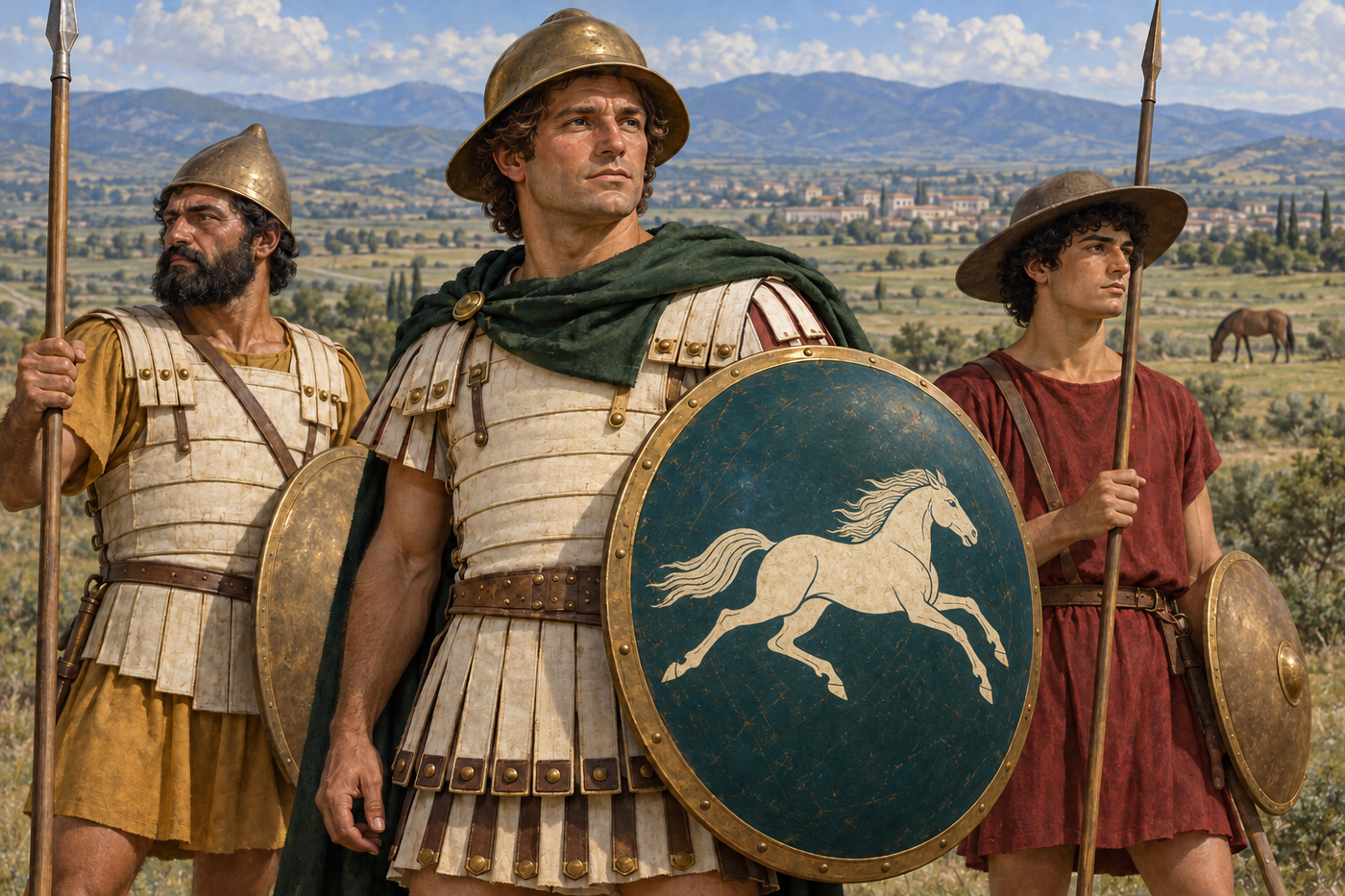
Thessalians
The horsemen on the left wing
At Issus and Gaugamela, Thessalian cavalry fought far from the plains that had made its reputation. While Alexander led the attack from the Macedonian right, the horsemen serving on the other wing faced pressures that could decide whether the army survived long enough to win. Their task demanded movement, cohesion and the ability to withstand repeated threats from an enemy rich in cavalry.
These soldiers came from a country with ambitions of its own. Thessaly had produced powerful families, formidable mounted forces and leaders who imagined a supremacy extending across Greece. Its relationship with Macedonia brought protection from some rivals and dependence on a greater power. The horsemen who accompanied Alexander therefore carried the military strength of a region whose political independence had been fought over for generations.
The country of the Peneius
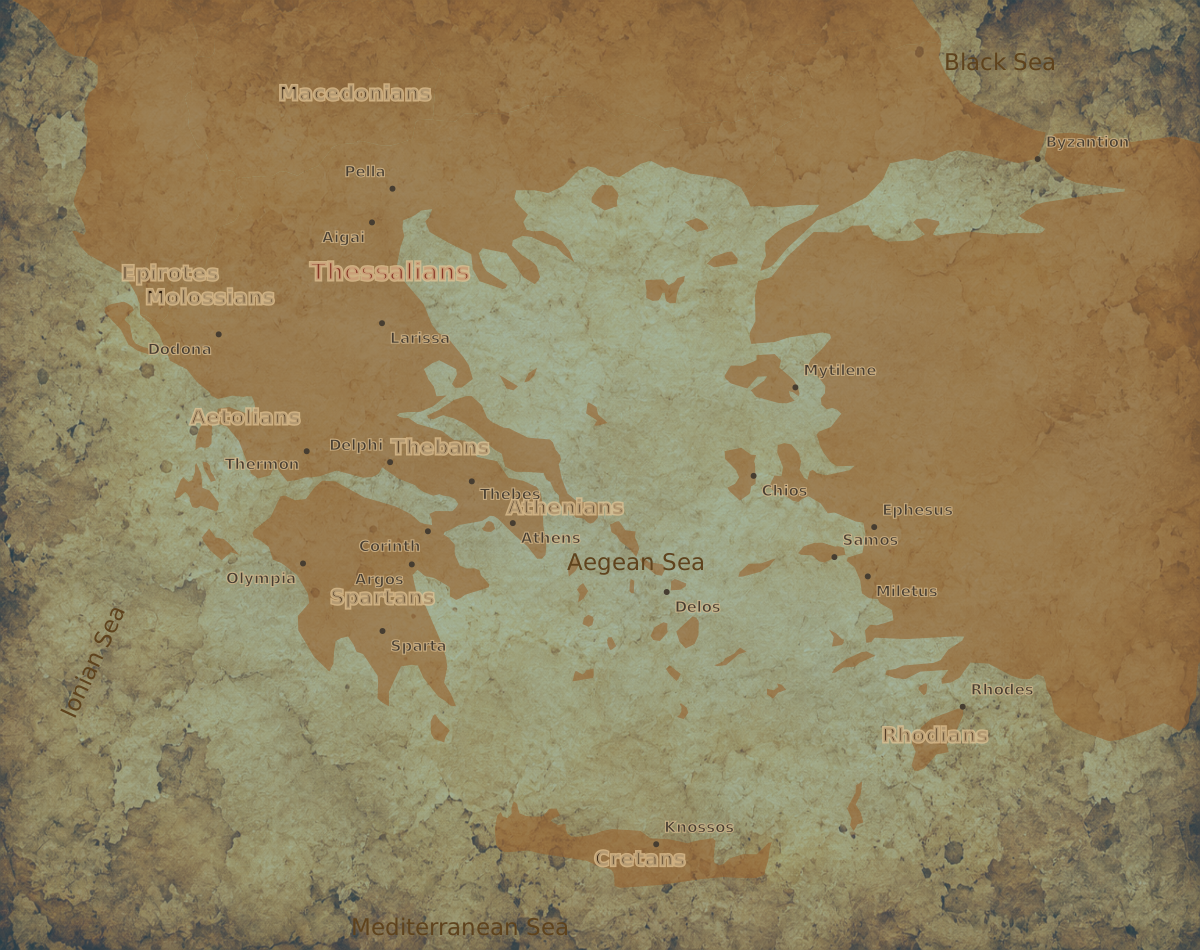
Broad basins set Thessaly apart from much of the more broken mainland to the south. The Peneius and its tributaries drained productive country enclosed by mountain ranges. Routes through those mountains connected the plains with Macedonia, central Greece and the coast. The narrow outlet towards the sea at Tempe gave a memorable form to the relationship between open land and guarded approaches.
Larissa, Pharsalus and Pherae belonged to a landscape of important cities and influential households. Wealth from the land supported the keeping of horses and the standing of families whose power could reach beyond an urban centre. Dependent agricultural workers, the penestai, formed part of the social order beneath that elite. The resources displayed by a noble rider rested upon a much larger population's labour.
The region's capacity to act together was a political question. Cities and families could cooperate under a common leader, then resist an arrangement that threatened their position. Military potential did not automatically create unity. The leader who could gather Thessaly's resources gained an exceptional opportunity; the neighbours who feared him had reason to seek assistance elsewhere.
A heroic landscape
Thessaly possessed a rich place in the heroic imagination. Achilles belonged to its southern world, while the stories of Jason and the Argonauts connected departure for distant lands with the coast around Iolcus. Mount Pelion and the centaurs gave the region another association with horses, strength and the boundaries between discipline and violence.
Such traditions formed part of the landscape through which historical armies moved. They also offered families and communities a language of ancestry and distinction. Honour could be displayed in athletic victory, religious dedication and military service. A successful household sought recognition before its neighbours and before the wider Greek world.
The great sanctuary at Delphi supplied an especially prestigious stage. In the age of Philip and Alexander, Daochus II of Pharsalus dedicated a sculptural group celebrating members of his family. Athletes and political figures appeared together in a monument that made accumulated achievement visible. Family memory, sacred favour and public ambition occupied the same space.
Jason of Pherae thinks beyond Thessaly
In the early fourth century, Jason of Pherae came close to turning regional strength into a much larger power. Xenophon's account introduces him through the anxiety of Polydamas of Pharsalus, who understood both Jason's resources and the danger of refusing his friendship. Jason commanded experienced hired soldiers and had the personal energy to keep them effective.
He offered cooperation backed by the possibility of compulsion. Pharsalus could join an arrangement in which its leading men retained honour, or face a ruler capable of imposing his wishes. Polydamas sought Spartan assistance, but Sparta was unable to provide the strength needed to make resistance credible. Local choices depended on what distant allies could actually deliver.
As common leader, or tagos, Jason could draw upon Thessalian cavalry and infantry on an impressive scale. His ambitions reached towards the leadership of Greece and the possibilities of war against Persia. The country that later supplied cavalry to Alexander had briefly seemed capable of providing the centre of a great expedition itself.
Jason was assassinated in 370 BC. His death removed the individual around whom that power had gathered and opened a period of violent succession. The resources remained, but their direction changed. The question of who would lead Thessaly became entangled with the interventions of Thebes, Athens and, eventually, Macedonia.
Alexander of Pherae and the Theban challenge
The ruler Alexander of Pherae established a position that other Thessalian communities feared. Pelopidas intervened on behalf of opponents and became personally involved in the struggle. At one point he was seized and held captive. His release did not end the conflict or his determination to return against the tyrant.
Plutarch's account brings political violence into the household of Pherae. Alexander's wife Thebe appears as a participant whose own circumstances and decisions mattered. The same ruler who could threaten neighbouring cities also depended on the loyalties of people close enough to reach him. His eventual assassination arose within that intimate circle of power.
Pelopidas died fighting against Alexander's forces in 364 BC. The Thessalians honoured him for his service, but his death also showed the cost of relying on an exceptional outside protector. The region's conflicts could not be settled permanently by one successful intervention. Another strong neighbour would soon find reasons to enter them.
Philip arrives as an ally
Philip II's involvement developed through Thessaly's existing divisions. Opponents of the rulers at Pherae sought his assistance, while the wider Sacred War gave the fighting a religious and interstate setting. Onomarchus of Phocis inflicted serious defeats on Philip before the Macedonian king recovered the initiative.
At the Crocus Field in 352 BC, Philip won the decisive battle. Thessalian cavalry contributed substantially to the force that defeated Onomarchus. The result strengthened Philip's claim to act as defender of Apollo and gave him a commanding position within the region. Assistance against a local enemy had become the basis of lasting authority.
Philip's position brought Thessaly into the larger military structure of the Macedonian monarchy. Local families still mattered, and cities continued to possess their own public life. Yet the ability to gather the region's strength increasingly served a king whose ambitions extended far beyond it. The relationship offered rewards and security while narrowing the freedom to choose another course.
With Alexander into Asia
After Philip's death, Alexander moved rapidly to secure recognition of his leadership. Thessalian support was valuable politically and militarily. When the expedition crossed into Asia in 334 BC, the cavalry from the plains formed a major component of its mounted strength.
At Issus, Alexander transferred the Thessalians to reinforce the wing under Parmenion, opposite a dangerous concentration of Persian cavalry. Their deployment required the king to recognise where his own attack needed support elsewhere. The battle would not be won safely if the other wing collapsed before the decisive movement achieved its purpose.
At Gaugamela in 331 BC, Thessalian cavalry again faced severe pressure on the left. Arrian's narrative preserves the difficulty of that struggle alongside Alexander's advance towards Darius. Holding and responding under such conditions was an achievement in its own right. The celebrated charge on one part of the field depended on other men refusing to be broken on another.
The horsemen's contribution reveals a partnership formed from unequal powers but real military value. Thessaly supplied troops whose capabilities the Macedonian command repeatedly needed. Their service brought honour and reward, while carrying them into a war whose distances and objectives kept expanding.
Returning from the king's war
At Ecbatana in 330 BC, Alexander released the allied Thessalian cavalry and other Greek contingents from their original service, providing pay and rewards. Some men chose to continue under new terms. Others could begin the journey home with the experience of campaigns that had overthrown the Great King.
Returning soldiers came back to a country still bound to the political fortunes of Macedonia. Service abroad did not settle how every future crisis would be answered. The death of Alexander in 323 created another opening, and Thessalian cavalry became important to the Greek coalition fighting Antipater.
Their defection from the Macedonian side strengthened the allies in the Lamian War. In the fighting against Leonnatus, mounted troops under Menon helped defeat the relief force, and Leonnatus was killed. The same regional military strength that had supported Alexander could now threaten the authority of the men holding his European inheritance.
Power that others needed
Thessaly's history in the fourth century turns repeatedly on the effort to direct its considerable resources. Jason sought a leadership built around his own energy and army. Rival cities called in protectors. Philip converted intervention into supremacy, and Alexander drew the region's horsemen into an expedition of unprecedented reach.
Behind those choices stood the land, households and communities that made the cavalry possible. Their prestige was real, but so were the costs of maintaining and deploying it. Thessalian leaders had to judge when cooperation preserved their position and when resistance offered a better future. The plains supplied strength; the fortunes of the people who commanded it determined where that strength would ride.
Sources
Ancient accounts
- Xenophon, Hellenica VI.1 and VI.4.
- Plutarch, Life of Pelopidas.
- Diodorus Siculus, Library of History XVI.35; XVIII.12–17.
- Arrian, Anabasis of Alexander II.8–11, III.12–15 and III.19.
Archaeology
Historical studies and reference works