






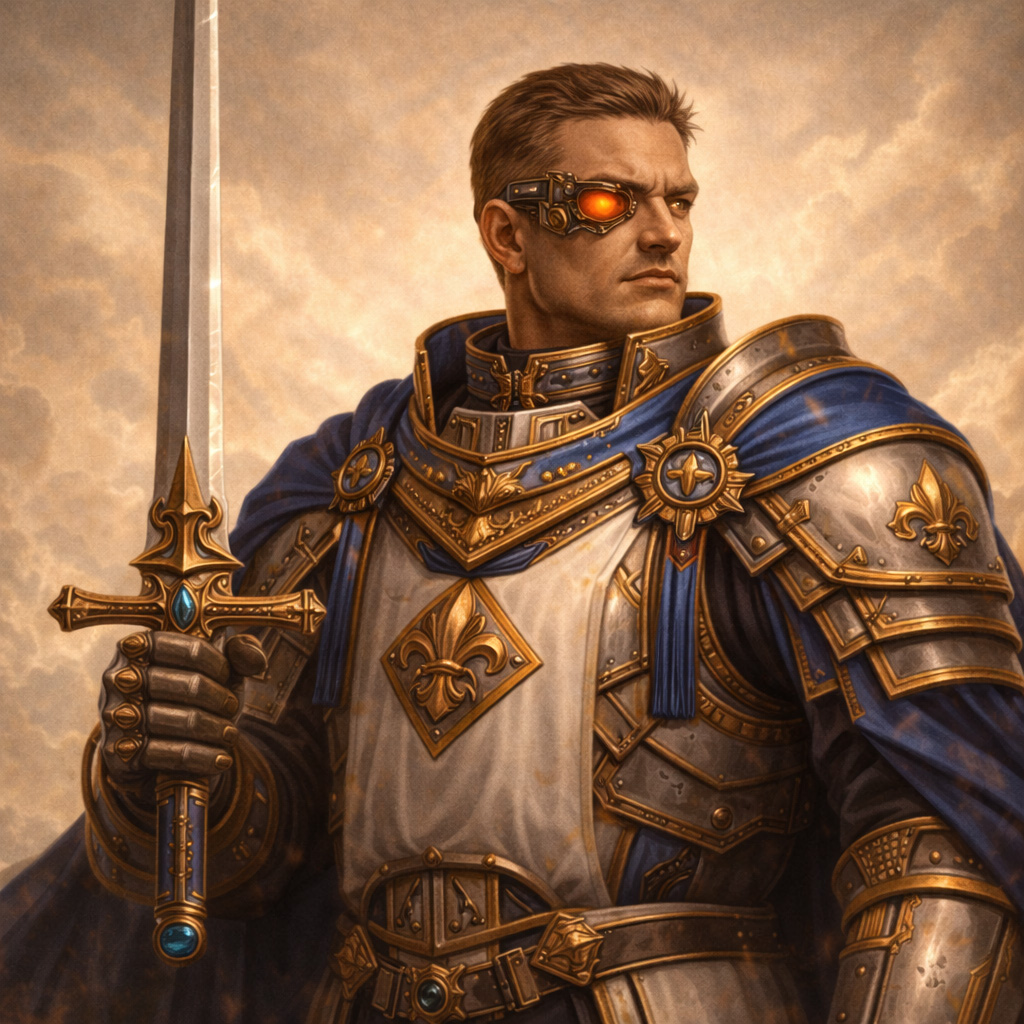
Palter, Brotherhood and Progress
Among the invading clans of Damocles, none is more difficult to judge than Palter. To some, they are enlightened conquerors, proof that strength and refinement can coexist. To others, they are simply imperial domination wrapped in velvet and reason. Both views contain truth. For while the Palters speak readily of progress, cooperation, and mutual prosperity, they have never forgotten that power must ultimately rest on force.
At an intergalactic scale, Palter is no minor house but one of the great clans of the Supreme Empire, with influence stretching across multiple worlds, trade corridors, military contracts, and research enclaves. Their banners are known far beyond Damocles, and their administrators have governed systems whose populations exceeded that of entire continents. Even cut off from the wider Empire, the Damoclean branch of the clan still carries itself with the instincts of a civilization-sized power. Their ambitions are therefore often larger than their immediate means.
Unlike most invading clans, the Palters did not discover Damocles through war. Long before the invasion fleets arrived, they had already established discreet ties with the clans of Tohei. Through smugglers, merchants, private envoys, and unofficial protectors, they traded tools, medicines, crafted luxuries, and fragments of foreign knowledge in exchange for ores, local goods, and political influence. Such commerce was officially forbidden under imperial law, but profitable exceptions have always existed for those clever enough to create them.
These early contacts changed both sides. Certain Tohei elites came to admire Palter discipline, engineering, and statecraft. Certain Palter nobles developed a lasting fascination for the codes of honor, artistry, and social complexity of Damocles. What began as commerce slowly became familiarity. Protection pacts were signed in secret. Young heirs were educated abroad under false names. Mercenaries entered private service. By the time the invasion began, the Palters were not strangers stepping onto hostile soil. They were already players in a political game that many rivals had not yet understood.
This is why their conquest differed from that of harsher clans. Where others massacred first and governed later, Palter often sought to preserve what could be used. Cities were occupied with their workshops intact. Local bureaucrats were retained under supervision. Noble families willing to cooperate found themselves protected rather than exterminated. Even defeated enemies were sometimes integrated into auxiliary commands instead of being erased. None of this came from softness. It came from calculation. A living province pays taxes, builds roads, fills regiments, and produces inventions. A dead one inspires only rebellion.
Yet the Palters were never harmless idealists. Resistance judged irreconcilable could be crushed with exemplary violence. Entire lineages disappeared when they threatened supply lines or inspired insurrection. The difference was not mercy, but selectivity. They preferred measured brutality to wasteful fury, and this distinction has shaped their reputation ever since.
Two centuries later, Palter remains one of the most unusual powers of Damocles: an imperial clan that became partly native, a conquering force that learned to negotiate, and a republic of soldiers whose language, customs, and bloodlines are now deeply intertwined with the land they once came to rule.
Origins and Imperial Philosophy
Like many of the great interstellar clans, the Palters trace their origins to ancient dynasties of Tetrapolis, one of the old centers of imperial civilization. Whether every branch of that genealogy is true matters less than the identity built upon it. From childhood, Palter nobles are taught that they descend not merely from rulers, but from organizers of worlds, architects of order, and patrons of useful knowledge. Their legitimacy rests as much on competence as on blood.
This tradition gave the clan a political philosophy distinct from many of its peers. Where some imperial houses celebrate conquest through spectacle, terror, or rigid dogma, the Palters prefer absorption. They believe the Empire grows strongest not by flattening every local identity, but by extracting what is valuable from each conquered society and weaving it into a larger whole. Languages, techniques, legal customs, artistic forms, military habits, agricultural methods, all can become imperial assets if handled correctly.
Such ideas have often placed them in uneasy relation with stricter defenders of orthodoxy. To hardliners, the Palters are dangerously tolerant, too willing to compromise with provincial elites, too curious about foreign traditions, too eager to experiment beyond accepted limits. Yet emperors have repeatedly found them useful. Worlds subdued by Palter governors tend to become productive quickly. Rebellions are often isolated rather than generalized. Local talent is converted into imperial service instead of wasted in purges.
The same mindset shaped their scientific culture. Palter laboratories earned renown for applied engineering, military systems integration, regenerative medicine, adaptive logistics, and controlled cloning technologies. They were rarely the most mystical researchers nor the most reckless innovators, but they excelled at transforming rare breakthroughs into scalable state power. If another clan invented a wonder, Palter often found a way to manufacture it, improve its reliability, and field it across an army.
That legacy suffered greatly on Damocles. The destruction of key assets during the invasion and the long planetary isolation severed the Damoclean Palters from the great research networks of the Empire. Entire branches of advanced regenerative science were lost with ships, archives, and specialist lineages. What survives today are fragments, partial doctrines, degraded procedures, and stubborn ambition.
Modern Palter science on Damocles therefore pursues a humbler but vital goal: reconstruction. Their researchers seek to recreate simpler, less effective local versions of former imperial technologies while preserving enough knowledge to reconnect with the wider tradition should communications with the Empire ever be restored. This applies especially to regenerative treatments, battlefield recovery systems, cloning support methods, and advanced targeting solutions.
For the Palters, this is more than technical necessity. It is a matter of identity. They do not merely want to survive on Damocles. They want to remain recognizably Palter, heirs to a civilization larger than the world that trapped them.
A Place in Tohei
The Palter landing on Damocles should have been decisive. Had their full expeditionary strength reached the surface intact, the conquest of Tohei might have been swift and overwhelming. Instead, catastrophe struck before the campaign had truly begun. The clan’s mother ship, carrying command reserves, strategic assets, and much of the force meant to anchor long-term occupation, was destroyed by secret weapons unleashed by the old priesthood during the chaos of the invasion.
What should have been a dominant army became a wounded spearhead. The surviving Palter forces were still dangerous, disciplined, and technologically superior in many respects, but no longer capable of subjugating the whole region through brute strength alone. They would have to earn their position the hard way, through campaigns, diplomacy, and endurance.
Fortunately for them, the groundwork had already been laid. Many local clans had entered covert protection agreements with Palter agents long before open war began. Some sought access to foreign goods. Others wanted allies against rivals. Others simply preferred a distant but rational patron to the fanaticism of competing powers. When the invasion shattered the old order, these hidden ties became open roads, supply bases, intelligence networks, and recruitment pools.
The wars that followed lasted generations. In that time, the elites of several local houses merged naturally with those of the Palters through marriage, service, and shared interest. A new ruling layer emerged, neither fully imperial nor fully native. Their households blended customs. Their officers studied both military traditions. Their children inherited names from both worlds.
Even language changed. In many urban centers under Palter influence, the common vernacular became a living mixture of local speech and imperial terminology. Administrative words, military ranks, commercial formulas, and technical expressions entered daily life, while native idioms and social codes reshaped the language of the occupiers in return. What began as command speech became the voice of a new society.
This integration did not erase violence. Traditionalist clans that resisted too stubbornly were sometimes broken with extreme severity. In several conquered regions, male warrior castes were slaughtered or dispersed so that veterans loyal to Palter authority could be settled in their place. Other clans kept their lands only by accepting a carefully staged assimilation, preserving outward honors while real authority passed elsewhere.
Thus the Palter settlement of Tohei became a distinctive mixture of imperial hardness and genuine respect for local civilization. Roads were rebuilt. Workshops expanded. Schools for officers and engineers opened beside old noble estates. Taxation became more regular. Law more predictable. But behind every reform stood barracks, arsenals, and the certainty that order would be defended by force.
Two centuries later, that legacy still defines the clan. Palter is no longer merely an occupying force on Damocles. It is one of the pillars of northern Tohei, shaped by conquest, transformed by coexistence, and bound forever to the land it once intended only to govern.
The War with Ritolia and the Militarized Border
No rival has shaped modern Palter identity more than Ritolia. Other enemies have threatened trade, challenged influence, or disrupted internal stability, but Ritolia became something deeper: the frontier against which generations of Palters measured sacrifice, discipline, and national purpose.
During the age of conquest, Ritolia gathered around itself several radical imperial clans and uncompromising war factions who rejected the slower, integrative methods favored by Palter. Where Palter spoke of managed assimilation and productive order, Ritolia answered with mobilization, ideological purity, and open domination. The collision between the two powers was therefore never merely territorial. It was a struggle between rival visions of what imperial rule on Damocles should become.
The war lasted years and consumed entire regions. Fortified towns changed hands repeatedly. Industrial districts were stripped bare to feed artillery lines. Agricultural zones became military corridors crossed by columns, refugees, and scavengers. In the end, Palter and its local allies succeeded in pushing the front back through superior organization, resilient logistics, and the ability to turn captured ground into defensive depth almost overnight.
Yet victory remained incomplete. At the very moment when some Palter generals believed Ritolia could be broken for good, the broader political balance intervened. The Swolfs, unwilling to see a victorious ally emerge stronger than themselves, favored a settlement that preserved equilibrium rather than decisive triumph. Territories were redistributed, offensives halted, and the frontier hardened into the line that still exists today.
Two centuries have passed, but peace never truly followed. The border is one of walls, bunkers, artillery nests, buried sensors, armored roads, reserve depots, and towns built around barracks. Patrols vanish in bad weather. Observation posts exchange fire over disputed ridges. Supply convoys are ambushed and officially denied. Local commanders test reactions through limited raids while diplomats speak of stability. Every generation grows up hearing that war may resume in earnest tomorrow.
This permanent tension has shaped Palter society. Frontier service is a rite of passage for many officers. Engineers design for siege conditions as naturally as others design for comfort. Political debates always return to readiness, reserves, and strategic depth. Even citizens far from the line know that the prosperity of the republic rests beneath the shadow of guns pointed eastward.
To outsiders, the frontier may seem frozen. To those who live there, it is a war paused between breaths.
Relations with the Other Powers of Tohei
Although the Ritolian border dominates military thought, Palter’s true challenge lies in navigating the wider balance of Tohei. The republic is too powerful to ignore, too entrenched to uproot easily, yet not strong enough to impose its will alone upon the region. Its survival therefore depends as much on diplomacy as on steel.
Relations with the Swolfs are the most important and the most ambiguous. Publicly, both powers often defend a similar vision of gradual integration, practical governance, and resistance to ideological extremism. In many crises, they have stood on the same side. Yet beneath official language remains an old bitterness. Many Palters have never forgotten the moment when Swolf strategy denied them total victory over Ritolia. To them, the Swolfs are valuable allies who smile while ensuring no partner rises too high.
The Swolfs, for their part, respect Palter competence while distrusting its independence. They know that Palter engineers arm half the north, that Palter administrators can stabilize difficult provinces, and that Palter officers are dangerous in both war and politics. Cooperation is therefore constant, but so is mutual caution.
The relationship with Kento is colder, though rarely openly hostile. Both factions broadly favor a flexible order rather than fanatic domination, and both understand that civil war in northern Tohei would benefit only their enemies. Yet they differ in temperament and legitimacy. Kento carries ancient prestige, moral symbolism, and the memory of native leadership. Palter embodies institutions, technical modernity, and the logic of state power. Each sees something useful in the other, and something unsettling as well.
This tension appears most clearly in the island question. Palter has long maintained discreet ties with buccaneer groups and maritime intermediaries who resist renewed Kento influence. Sometimes this support takes the form of trade, intelligence, or sanctuary rather than open arms, but the effect is the same: to prevent any single power from dominating the sea lanes. Kento is fully aware of the game, and deeply unimpressed by it.
Beyond these great rivals and partners, Palter also cultivates lesser clans, merchant houses, guilds, and border authorities. It offers contracts, technical advisors, weapons access, arbitration, and protection guarantees. The republic understands that alliances need not always be glorious. Sometimes a secured road, a repaired bridge, or a governor who owes you a favor is worth more than a battlefield triumph.
Thus Palter’s place in Tohei is neither that of a master nor of a subordinate. It is the position of a central hinge, resented, courted, feared, and needed in equal measure.
Political Organization of the Republic
Palter on Damocles is governed not as a hereditary monarchy, but as a military republic. This does not make it democratic in the sentimental sense, nor tyrannical in the crude sense. Like most durable Palter institutions, it is a system built to produce discipline, continuity, and capable leadership under pressure.
The territory is divided into nine regions, each administered by an elected governor. These governors wield broad authority over taxation, infrastructure, internal order, industrial quotas, and local defense. Their legitimacy depends not only on elections, but on visible competence. A governor who cannot maintain roads, secure borders, or feed cities soon loses allies, prestige, and eventually office.
Each region also maintains its own national guard. In peacetime, these forces function as police, customs enforcement, engineers, and emergency reserves. In wartime, they become the first layer of mobilization, reinforcing frontier commands, protecting logistics hubs, and holding strategic positions until the regular army concentrates. This regional military structure gives the republic unusual resilience. Even if central command is disrupted, local authority can continue to function and fight.
Civic rights are tied to service and contribution. Traditionally, men who have completed a minimum period of military duty gain full political rights, while women who have raised at least two children are recognized as having fulfilled a foundational civic role. Though debated by reformers and conservatives alike, these principles reflect the old Palter belief that citizenship must be earned through sacrifice rather than granted abstractly.
When existential war threatens the republic, the normal balance of institutions can be suspended. The governors may convene in emergency council and appoint a Generalissimo for a fixed term. During that period, extraordinary powers over strategy, mobilization, requisition, and military coordination are centralized in a single office. The mechanism is feared as much as respected, for it has saved the republic before, but any concentration of power carries its own dangers.
The cost of this system is immense. Frontier militarization, constant readiness, and advanced military research weigh heavily on the budget. Palter offsets part of that burden through efficient administration, integrated industry, and above all its state monopoly on arms production. Weapons exports, maintenance contracts, and military licensing help finance the very machine that produces them.
For two centuries this republic has endured because it offers something rare on Damocles: not peace, but organized endurance.
Economic Power, Arms Industry, and Lost Technologies
If Palter has remained a major power despite isolation, war, and demographic limits, it is because its strength was never based on numbers alone. The republic survives through organization, industry, and the ability to transform scarcity into leverage. Even cut off from the wider Empire, the Palters continue to think in strategic scales larger than most Damoclean states. Where others manage provinces, Palter plans systems.
The foundation of this power is economic discipline. Roads, depots, ports, armored rail corridors, foundries, machine yards, and regulated market cities form the skeleton of the republic. Civil administration and military logistics are deeply intertwined. A bridge is not only a bridge, but a future supply route. A school is not only a school, but a place where engineers, clerks, and officers are identified early. A harbor is not only a commercial asset, but a node of intelligence and mobilization.
Unlike many rival factions, Palter does not allow private warlords or great noble houses to dominate weapons production. The manufacture of arms remains a monopoly of the state. Officially, this prevents corruption, fragmentation, and private armies. In practice, it also ensures that political authority and military force remain inseparable. Whoever governs the republic governs the arsenals, and whoever governs the arsenals shapes the future.
This monopoly has made Palter the arsenal of much of northern Tohei. Their workshops produce rifles, artillery systems, armored components, communications gear, field engineering tools, and replacement parts used far beyond their own borders. Some contracts are public. Others pass through intermediaries, deniable brokers, or allied clans that prefer discretion. Many powers criticize Palter influence while quietly depending on Palter steel.
Yet beneath this industrial confidence lies an old wound. During the invasion, the destruction of major strategic assets and the long severing of communication with the Empire cost the Damoclean branch of the clan an immense technological inheritance. Entire archives vanished. Specialist bloodlines were extinguished. Prototype systems were lost before they could be replicated locally. Among the most painful losses were the advanced regenerative sciences for which the wider Palter domains had once been famous.
The republic can no longer perform the highest forms of restoration once available to imperial elites and elite military cadres. The miraculous therapies of old Palter worlds now survive only in fragments, myths, and damaged technical doctrines. Modern research therefore follows a more modest path: rebuilding simplified, less effective versions adapted to local constraints. Current programs focus on accelerated healing, battlefield tissue repair, prosthetic integration, limited organ regrowth, and reduced-risk cloning support for medicine and industry.
These efforts are not acts of nostalgia alone. Palter leaders know that if contact with the Empire is ever restored, technological inferiority could reduce them from respected frontier branch to provincial embarrassment. Every recovered method, every stabilized process, every rediscovered formula is therefore also an investment in future status.
Thus the economy of Palter is more than commerce. It is preparation, memory, and quiet ambition cast in iron.
Military Doctrine and Forces
The armies of Palter are rarely described as glorious. They are described as relentless, disciplined, and extraordinarily difficult to move once entrenched. No reputation is more feared among their enemies than this: if the Palters have taken the ground, you may never truly take it back.
Their doctrine is built on durable conquest rather than dramatic shock. A successful offensive does not end when the first trench line breaks. It begins there. Engineers move behind assault elements within minutes. Firing nests are dug before celebrations begin. Supply markers are placed before banners are raised. Armor is repositioned not for parade, but for counterattack. Roads are repaired while the smoke still hangs in the air. Every gain is immediately transformed into a problem for the enemy.
This philosophy explains why Palter has held a hostile frontier for generations despite limited manpower. Their officers are trained to think in layers: reconnaissance, seizure, fortification, sustainment, attrition. They do not merely ask how to win a battle, but how to make the next five battles easier because this one was won correctly.
The regular army is supported by several auxiliary structures. The most common are Brotherhood formations recruited across Tohei. These mercenary companies are comparatively cheap, numerous, and politically expendable. They are used for escort duties, secondary garrisons, convoy security, raids of opportunity, urban sweeps, and campaigns where preserving citizen troops matters more than elegance. Their quality varies greatly, but their utility is undeniable.
Very different is the republic’s own contracted elite force, often known simply as the Legion. These mercenaries are selected harshly, trained to Palter standards, and paid on long professional terms rather than short plunder contracts. They serve as shock reserves, difficult-terrain specialists, strategic guards, and deniable expeditionary assets. Where Brotherhoods provide mass, the Legion provides certainty.
Artillery remains central to Palter warfighting, but the symbol of their armed power is the medium battle tank widely considered the finest of the continent. It is not the largest machine nor the most extravagant, but it embodies everything Palter values: balance, reliability, and efficiency. Its hybrid cannon combining laser and fusion principles allows it to threaten armor and fortified positions alike, while its stabilized targeting system gives accurate fire on the move where many rivals must halt to shoot effectively.
Supported by disciplined crews, strong maintenance doctrine, and integrated logistics, these tanks are less often lost to enemy action than to deliberate withdrawal after missions already accomplished. On the frontier, enemy soldiers have learned a bitter saying: if you see one Palter tank, the ground was chosen days ago.
Ultimately, Palter military power does not rest on heroics alone. It rests on systems, preparation, and the refusal to waste what has already been paid for in blood.
The Three Political Currents
Beneath the outward unity of the republic, Palter is divided by a strategic question that no election, victory, or treaty has yet resolved: what should the clan become on Damocles? A loyal pillar of a larger northern order, an independent military hegemon, or a prosperous state secured through influence rather than conquest? From this question emerge the three great political currents of the age.
The first current, strongest in administrative circles and among those who fear overextension, argues for close alignment with the Swolfs. Its supporters believe history has already delivered its lesson. Palter cannot dominate the continent alone, and any attempt to rival the Swolfs directly would end in isolation. Better, they say, to become indispensable: the arsenal, laboratory, and institutional backbone of a Swolf-led equilibrium. Through loyal service, careful bargaining, and strategic patience, Palter would gain influence without bearing the full cost of supremacy.
The second current rejects this logic as elegant surrender. Rooted in frontier provinces, veteran networks, and harder military circles, it sees the current order as a trap built on hesitation. Ritolia remains undefeated. Rival powers continue to arm. Demographic and industrial balances shift each decade. To wait is to weaken. Its followers demand deeper mobilization, stronger executive power, and preparation for a decisive lightning war that would break the eastern threat before new coalitions can form. They accuse moderates of confusing comfort with peace.
The third current has grown steadily in ports, commercial cities, younger officer schools, and among exhausted citizens who have known nothing but permanent readiness. It argues that both previous visions are trapped in military thinking. The republic’s greatest danger, they claim, is not foreign invasion but internal exhaustion. Endless frontier spending, demographic strain, rigid civic structures, and dependence on emergency politics could hollow the state from within. Their answer is controlled reform: stronger infrastructure, higher living standards, broader alliance networks, selective détente, and an economy built for generations rather than campaigns.
These currents are not clean ideological parties. Families divide between them. Governors borrow from all three when convenient. Generals change language depending on audience. Merchants fund patriots and reformers alike. Yet every major decision of the republic, from military budgets to foreign treaties, is shaped by their rivalry.
So far, none has triumphed completely. Perhaps that is why Palter endures. It remains balanced between ambition, caution, and adaptation, never fully at peace with itself, and therefore never fully asleep.
The Named Figures
Governor Étienne Vauren is the leading voice of the pro-Swolf current. Administrator of the central industrial region of Valcendre, he is known for discipline, restraint, and an almost austere devotion to institutional stability. To him, Palter’s future lies not in chasing solitary greatness but in becoming indispensable to the northern order shaped by the Swolfs. He advocates deeper military coordination, dynastic marriages, harmonized logistics, and strategic loyalty in exchange for lasting influence. His enemies call him a servant in governor’s robes. His supporters answer that he is the only man willing to choose survival over vanity.
Governor Maëlle Dracourt rules the frontier province of Vaurne, where artillery thunder is more common than festival bells. Raised among fortresses, reserve depots, and veterans’ households, she believes the republic has mistaken delay for prudence. In her eyes, Ritolia is not a neighbor but an unfinished war. Every year of hesitation allows hostile powers to rearm, reorganize, and wait for better conditions. She calls for accelerated mobilization, strategic fuel reserves, command reform, and a doctrine of rapid armored penetration designed to end the eastern threat in a single brutal campaign. Among border officers she is admired. In calmer cities she is feared.
Governor Lucien Aérois governs the maritime and commercial region of Solcarre. Elegant, patient, and dangerously intelligent, he represents the reformist current that seeks prosperity before glory. Though he completed his military service with distinction, he is more comfortable discussing shipping tonnage, food prices, and alliance architecture than battlefield maps. Lucien argues that a wealthy, connected, and diplomatically protected Palter would be stronger than any exhausted fortress-state. He favors infrastructure, selective social reform, expanded trade, and quiet agreements with secondary powers. Critics dismiss him as a merchant prince. Those who know him better note that he never proposes weakness, only sustainability.
General Armand Tolèque is the most respected battlefield commander of his generation and a living symbol of Palter endurance. His legend was forged during the long frontier wars, where he held an isolated salient for weeks against repeated assaults, turning rubble, trenches, and broken vehicles into a defensive machine. Unlike more theatrical officers, Tolèque is famous not for charges but for never yielding ground once taken. He speaks rarely, despises vanity, and avoids formal political alignment, which only increases the weight of his opinion. Every faction seeks his approval. None can fully claim it.
Doctor Célestine Marot directs the strategic laboratories of Axion. Heir to the Palter tradition of applied science, she oversees programs in battlefield medicine, prosthetic integration, reduced regenerative therapies, targeting systems, and armored combat interfaces. It was under her authority that the republic perfected its renowned medium battle tank and restored several degraded technologies once thought lost forever. She openly admits that modern Palter science no longer matches the highest achievements of the interstellar clan, but insists that disciplined reconstruction can close the gap. Admirers call her the mind of the future. Detractors call her proof that engineers now rival governors.
Lady Ysoria Kenzai occupies no formal throne, command, or ministry, yet few figures are more useful to the republic. Born of a union between a Palter house and a cadet branch of Kento nobility, she was raised in both traditions and understands the language, etiquette, fears, and ambitions of each side better than most diplomats ever will. She serves as intermediary, unofficial envoy, and crisis-breaker whenever relations with Kento grow tense. To some Palters she is too native. To some Kento she is too imperial. In truth, she embodies what two centuries on Damocles have created: identities no longer pure enough for old certainties.
The future of Palter
Thus stands Palter in the current age of Damocles: neither mere occupier nor fully native kingdom, neither fading imperial remnant nor ordinary regional state. It remains one of the great clans of the wider Empire in memory, ambition, and institutional instinct, yet it has been transformed by two centuries of life on a world that refused to be ruled simply.
Its cities produce weapons used far beyond its borders. Its schools train officers and engineers who think in systems rather than moments. Its frontier soldiers still watch Ritolia through gunsights and storm haze. Its merchants build dependencies where armies would bleed. Its scientists rebuild fragments of a lost inheritance. Its governors argue over whether the future belongs to loyalty, conquest, or reform.
Palter’s greatest strength may be that it never became one thing entirely. It is disciplined but flexible, ambitious but cautious, pragmatic yet proud. It can negotiate with rivals in the morning and fortify against them by night. It can absorb foreign customs without surrendering its own sense of superiority. It can endure frustration longer than many enemies can endure war.
Yet this same complexity is also its danger. A republic balanced between three strategic visions may one day fail to choose in time. An economy built for readiness may tire of permanent mobilization. A society shaped by service may resist the reforms needed to preserve itself. And if contact with the Supreme Empire is ever restored, Palter may be forced to answer a question it has postponed for generations: is it still a frontier branch of a greater civilization, or has it already become something else entirely?
For now, the answer remains unwritten. The banners still fly over fortified walls, the factories still burn through the night, and the governors still debate beneath maps marked with old fronts and future roads. Whether Palter rises, stagnates, or fractures, no serious power in Tohei can ignore the republic any longer.
It came to Damocles as an arm of conquest. It may yet become one of the architects of the world to come.