






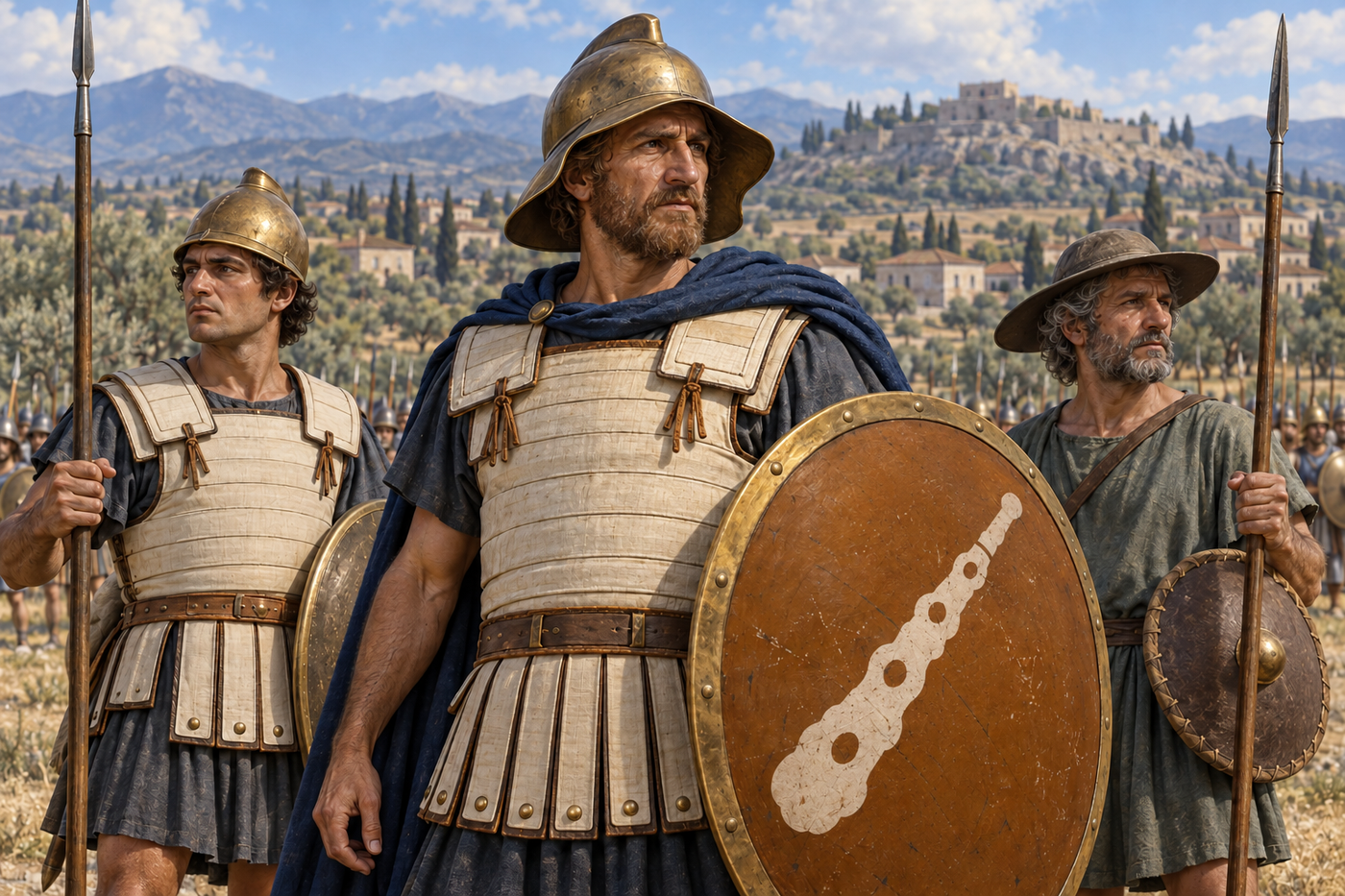
Thebans
The city that broke Spartan power
At Leuctra in 371 BC, Theban soldiers attacked the position where a Spartan king stood with the men whose reputation upheld his state's supremacy. Epaminondas had concentrated his strength for that encounter. When Cleombrotus fell and the Spartan line broke, the result changed what Greece believed possible. Thebes had defeated the power that had occupied its citadel only a few years earlier.
The achievement belonged to a generation of remarkable leaders, above all Epaminondas and Pelopidas. They recovered their city, made it the centre of a stronger Boeotian union and carried its armies deep into the Peloponnese. Their success was brief enough to acquire the intensity of a lost golden age. Within four decades of Leuctra, Alexander destroyed the city whose soldiers had overturned the military order of Greece.
The country around the Cadmeia
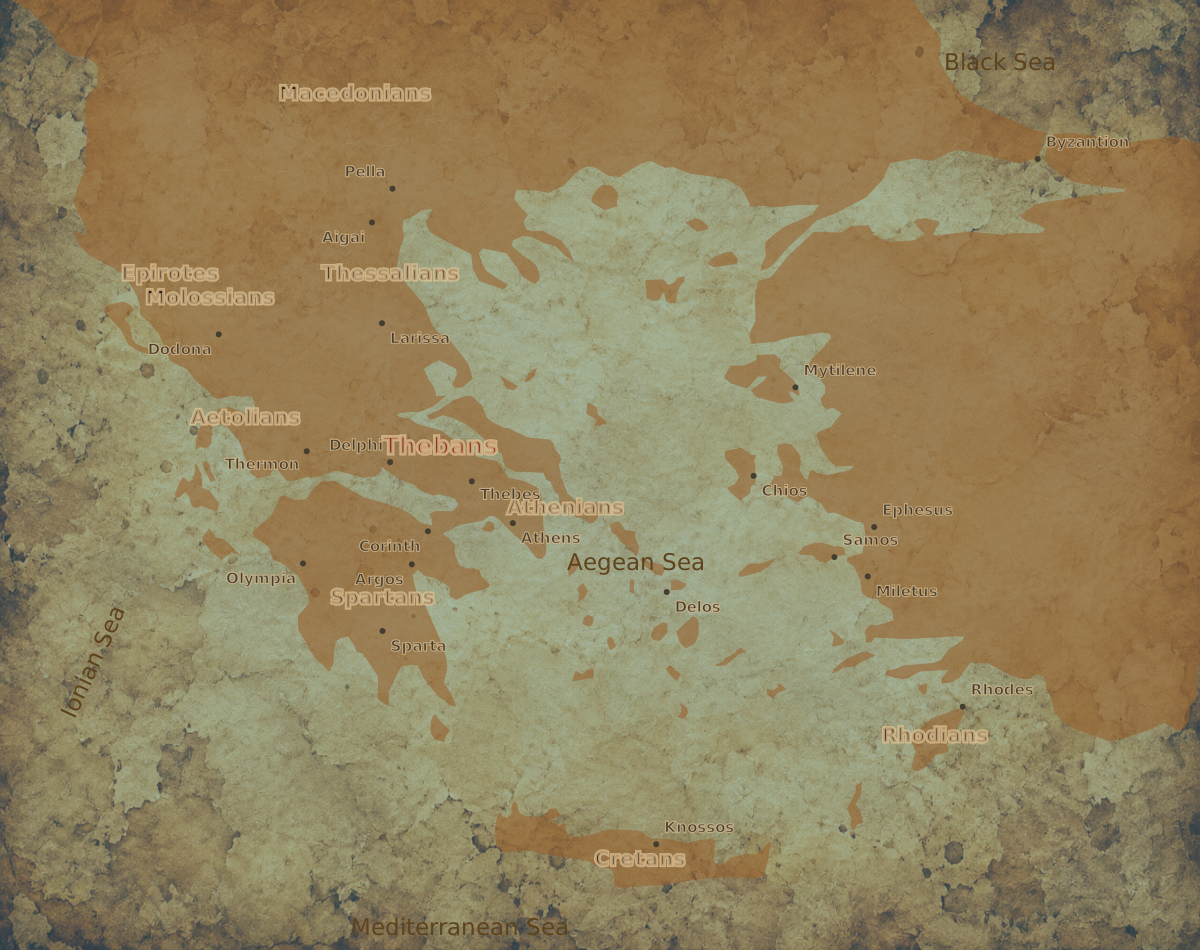
Thebes occupied a commanding place in Boeotia, amid roads linking central Greece with Attica and the northern approaches. Productive land and access to routes supported a city whose ambitions extended beyond its walls. The elevated Cadmeia formed its ancient stronghold. Whoever held it possessed a position from which to protect the city or dominate its inhabitants.
Boeotia contained other communities with their own identities and interests. Thebes sought leadership within a regional political structure, but its neighbours did not all welcome the same arrangement. Cooperation could create military strength; coercion could leave grievances that survived for generations. The fate of Plataea and the struggles with other Boeotian cities would eventually matter when enemies were invited to judge defeated Thebes.
The regional identity had a memorable visual language. Boeotian shields appeared on coins, while Theban issues also carried the club of Heracles and the drinking cup associated with Dionysus. These images placed shared stories and local loyalties into the silver that passed through people's hands. The gods and heroes of Thebes belonged within its public life as surely as its magistrates and soldiers.
Cadmus, Heracles and a dangerous inheritance
The city's oldest stories began with Cadmus, the wanderer who founded the Cadmeia. Other traditions told of the warriors sprung from the dragon's teeth and of the walls raised by Amphion and Zethus. Thebes was a place where the heroic past seemed to press closely upon the living city. Its names, springs and sanctuaries gave those stories a local geography.
Heracles and Dionysus were sons of Zeus whose births connected divine power with Theban ground. The house of Oedipus supplied another inheritance: family disaster, rival claims and wars remembered in tragedy throughout the Greek world. A Theban could belong to a city celebrated for heroic strength and haunted by the consequences of disastrous choices.
That background made later reversals especially resonant. Greek writers could place the fall of Thebes beside the sufferings of its legendary houses. Yet the men of the fourth century also created new memories. The recovery of the city from occupation and the victory at Leuctra offered achievements through which living citizens could measure themselves against the past.
The night Pelopidas came home
In 382 BC, a Spartan force occupied the Cadmeia with the help of a Theban political faction. Opponents fled, and the city's government rested under the protection of a foreign garrison. Among the exiles was Pelopidas. Recovery required more than an open battle: the men who controlled Thebes had allies, guards and the advantage of being inside.
In 379, a small group returned secretly. Plutarch describes the conspirators entering in humble clothing as worsening weather kept people indoors. Friends within the city prepared the opportunity. The plot depended on concealment, timing and the willingness of a few men to expose themselves before they knew whether wider support would follow.
The pro-Spartan leaders were killed, and the movement became a public liberation. The garrison eventually surrendered the citadel. Thebes had regained control of its own centre, but could expect Spartan retaliation. The courage of the return therefore had to be followed by the work of building a military and political position strong enough to survive.
The Sacred Band
The Theban revival gave an enduring place to a selected body of soldiers remembered as the Sacred Band. Plutarch describes three hundred men and connects their cohesion with pairs of lovers. Affection, pride and the fear of disgracing oneself before a beloved companion gave the unit a powerful place in his account of courage.
The military value of selected troops also depended on preparation and concentration. Pelopidas came to employ the Band together, making it a force available for the difficult point of a battle. At Tegyra in 375 BC, his men encountered a larger Spartan force and fought their way through. The action strengthened the belief that Spartan soldiers could be beaten by opponents who held their nerve and acted decisively.
The Sacred Band's fame should not obscure the rest of the army that made Theban success possible. Infantry formations, cavalry and lighter troops answered different demands. A commander had to bring them into a common operation, maintain support and choose the conditions in which his strongest soldiers could make their effort count.
Epaminondas at Leuctra
The campaign of 371 BC brought a Spartan army into Boeotia under Cleombrotus. The Thebans faced pressure to accept a settlement that would weaken their regional position. Epaminondas chose to fight. That decision exposed the recovered city's future to a single confrontation against an enemy still carrying the prestige of long military dominance.
The Theban concentration on the left brought exceptional depth and strength against the Spartan right. Cavalry fighting helped unsettle the ground before the infantry struggle. Pelopidas and the selected soldiers belonged to the force committed where the decision would be sought. The attack killed Cleombrotus and broke the part of the enemy army whose defeat had the greatest political meaning.
The victory was also a liberation of expectations. Allies and subjects of Sparta could now imagine acting against a power that had suffered an unmistakable defeat. Epaminondas had won a battle; he still had to decide how far to carry its consequences. The answer took Theban armies into the Peloponnese and brought an enemy close to Sparta's own homes.
A new Messenia and the cost of leadership
The establishment of an independent Messenia struck at the foundations of Spartan power. Epaminondas helped turn liberation into a defensible political settlement, with the new city of Messene giving it walls and a visible centre. Former dependants of Sparta now possessed a future the old masters bitterly opposed.
Thebes had to sustain allies, manage campaigns and defend its expanding responsibilities. Its leaders also faced judgement at home. Pelopidas intervened in Thessalian affairs and became entangled with Alexander of Pherae. Captivity and release did not end his determination to confront the ruler. He later died in the fighting at Cynoscephalae in 364 BC, after committing himself personally against the enemy.
Epaminondas died two years later at Mantinea. His army had again fought a great battle, but his mortal wound deprived Thebes of the leader most closely associated with its strategy and authority. Xenophon ended his account of the Greek wars by observing that the battle had left uncertainty rather than a clear new order. Victory could no longer supply the leadership that had made it possible.
The choice to face Philip
Macedonia's rise changed the dangers facing Boeotia. Philip II combined a stronger army with opportunities created by disputes among Greek states. Thebes had reasons to cooperate with him at some moments and reasons to fear him at others. By 339/8 BC, the prospect of Macedonian dominance helped bring it into alliance with Athens.
At Chaeronea in 338 BC, the allied army failed to stop Philip. The Sacred Band was remembered as fighting to destruction. Its end gave the defeat a human focus: the selected soldiers who had embodied Theban revival lay on a battlefield won by the next great military power.
The settlement placed a Macedonian garrison in the Cadmeia. Thebes had returned to a situation with a terrible resemblance to 382. Its citadel again contained foreign troops, and the possibility of liberation depended on a wider change in the balance of power. Philip's death offered hope, but Alexander moved quickly to prevent his inheritance from dissolving.
The revolt of 335 BC
Rumours that Alexander had died in the Balkans helped encourage a new revolt. Thebans challenged the garrison and appealed for support. The opportunity they believed they had found vanished when Alexander arrived with his army. The city now faced the consequences of resistance before the expected coalition could protect it.
The defenders fought outside their walls and around the approaches while families sought help from the gods. Macedonian troops forced their way in, and the garrison in the Cadmeia attacked from its own position. Once resistance lost cohesion, the fighting became slaughter and capture. Thebes' enemies among the Greeks helped determine the punishment that followed.
The destruction broke the city as a political community and scattered its people. Survivors carried a memory of homes, sanctuaries and public life that could not be reduced to the king's warning. The fate of Thebes also frightened other cities into caution. Alexander could leave for Asia with a terrible demonstration of what revolt might cost behind him.
People return to the seven gates
The story did not end with the ruins. In 316 BC, Cassander undertook to restore Thebes and gather its surviving people. The rebuilding served his position in Greece and offered a claim to lasting honour. Other communities and individuals contributed, leaving a record of assistance preserved in an inscription displayed in the archaeological museum.
A city could be rebuilt because people still wished to return and others believed its restoration mattered. Thebes had lost the generation that made it supreme and suffered a catastrophe that seemed final. Yet its name, sacred places and memories remained powerful enough to support another beginning. The achievements of Pelopidas and Epaminondas belonged to that inheritance, beside the older stories of Cadmus and Heracles.
Sources
Ancient accounts
- Plutarch, Life of Pelopidas.
- Xenophon, Hellenica V–VII.
- Diodorus Siculus, Library of History XVII.11–14; XIX.53–54.
- Arrian, Anabasis of Alexander I.7–9.
Archaeology and coinage
- Archaeological Museum of Thebes, museum guide.
- R. D. Milns Antiquities Museum, hemidrachm with Boeotian shield, C.003.
Historical studies and reference works