






Thracians
Kings, mountain peoples and soldiers beyond the northern Aegean
In the spring of 335 BC, men waiting above a mountain road prepared to send wagons crashing into Alexander's army. They had chosen their ground carefully. The Macedonians would have to climb towards them, crowded into a passage where a broken formation might become a catastrophe. Before he could cross into Asia, the new king had to prove that the peoples on his northern frontier could not dictate where he marched.
The defenders were Thracians, but Thrace also supplied men who would march beside Alexander. Its rulers could be enemies, employers, allies or subjects of Macedonia. Across the mountains and river valleys behind the northern Aegean, political allegiance was made by particular leaders and communities. The name Thrace embraced a country much larger than any one king's following.
Origins and territory: the lands behind the Greek coast
Greek writers knew Thrace as a world of numerous peoples stretching from the northern Aegean towards the Danube and the Black Sea. The Haemus range divided routes through the interior; farther south, the Rhodopes and the valleys of the Hebrus and its tributaries created other centres of settlement and power. A coastal city and a mountain community might stand within the same broad geographical description while facing different neighbours and living under different authorities.
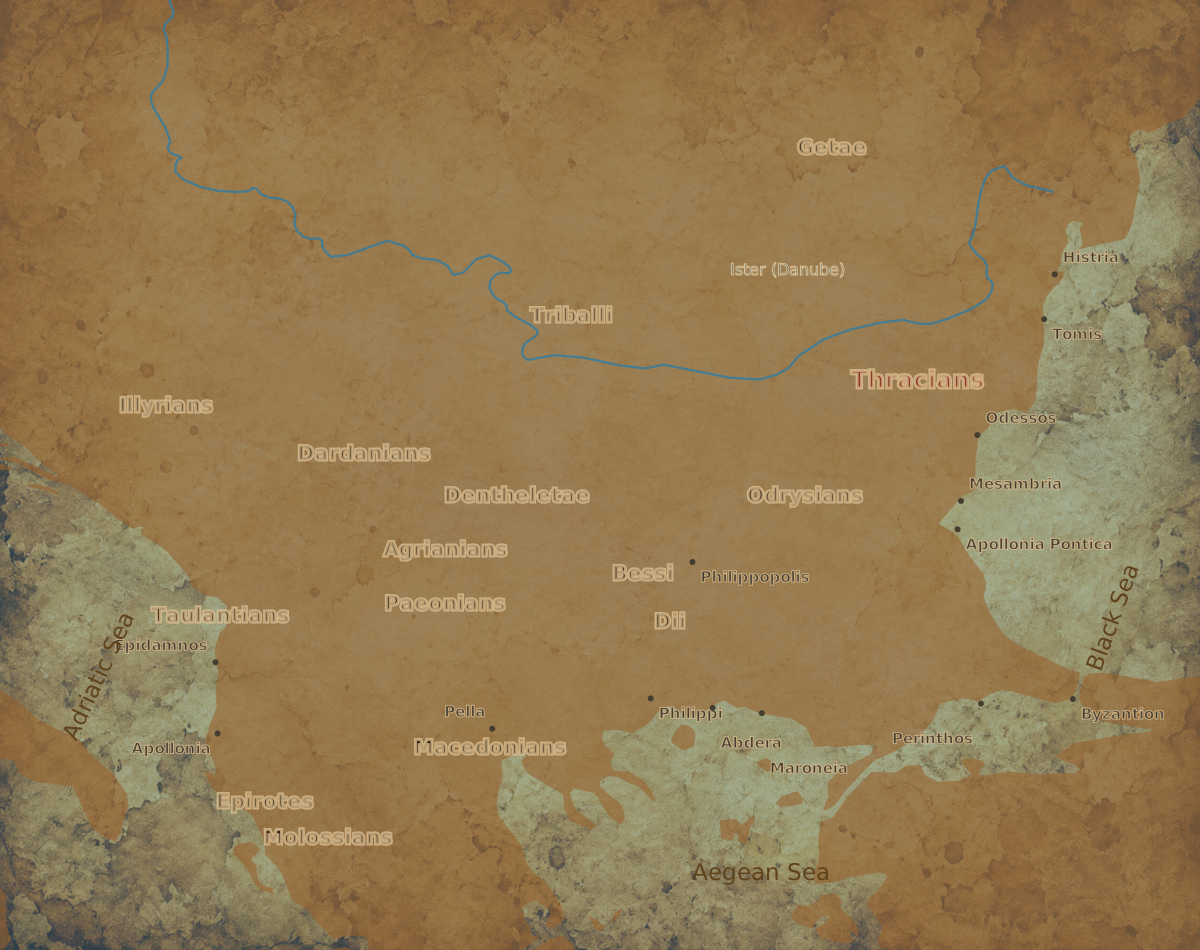
Herodotus was struck by the size of the Thracian population. He imagined that, if its peoples could unite under one ruler, they would be extraordinarily powerful. Their divisions prevented it. The observation became one of the enduring Greek ways of describing Thrace: formidable numbers and martial strength, frustrated by the independence of the groups possessing them. In practice, rulers did build extensive kingdoms, but their authority depended on relationships that had to be maintained.
Along the Aegean, Greek settlements connected the interior with maritime trade, diplomacy and war. Timber, agricultural produce, metalwork and the resources of the hinterland gave outsiders reasons to seek influence. The inhabitants of inland Thrace were participants in these relationships. The great tombs and precious objects associated with their elites reveal men capable of acquiring skilled workmanship and displaying wealth on a scale that commanded attention.
Society: the king's table and the power to give
The Odrysian monarchy became the most powerful Thracian royal formation of the Classical period. Teres and Sitalces gathered authority across many communities. Thucydides describes tribute and gifts reaching their successors in substantial quantities. Royal power could be measured in the men a ruler summoned, the wealth he received and the rewards he could return to important followers.
Xenophon offers a close view of that political society during his service with Seuthes II around 400 BC. At a royal feast, gifts were expected from men who possessed the means to give them. Honour, hospitality and military usefulness met at the same table. Xenophon offered himself and his soldiers as loyal friends. Seuthes rose, drank with him and accepted the relationship in a public exchange that mattered to everyone watching.
Friendship did not remove hard bargaining. The Greeks helped Seuthes recover territory, but their pay became a source of anger. Xenophon was pressed by his men and resented by the ruler because he continued to demand what had been promised. Service rested on trust, yet trust had to survive disputes over the proceeds of campaigning. A king's generosity was a political instrument; failure to deliver could turn useful soldiers into hostile accusers.
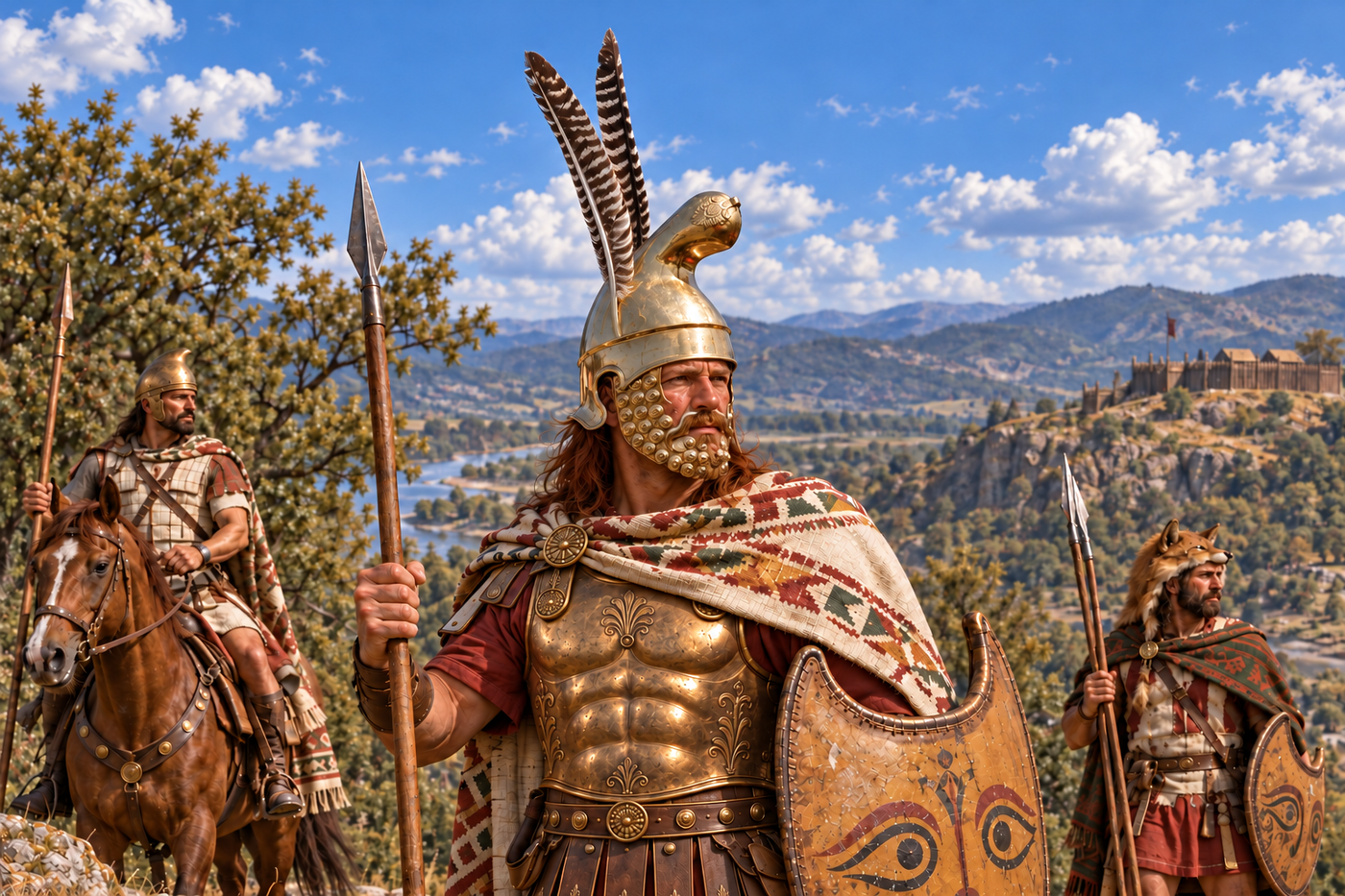
The wealth visible in surviving Thracian silverwork belongs to this world of display. Drinking vessels and elaborate horse equipment could proclaim rank as clearly as a fine weapon. A warrior approaching a royal gathering carried more than the tools of battle: his dress, horse and possessions helped establish his place among other ambitious men.
Beliefs: divine ancestry and dangerous knowledge
Herodotus associated Thracian worship with gods he called Ares, Dionysus and Artemis, while describing a particular royal attachment to Hermes. Kings claimed descent from him and invoked him in their oaths. Divine ancestry gave a ruling house a language through which it could distinguish itself from other men and justify exceptional honour.
The mountain sanctuary of Dionysus among the Satrae adds another religious landscape. Herodotus names Bessi as interpreters of its oracle and describes a prophetic woman delivering responses. Here sacred authority belonged to a particular place and to those able to mediate its power. A ruler might command followers, but an oracle could speak with an authority understood to come from beyond ordinary command.
Stories of Orpheus also attached Thrace to the Greek imagination as a country of extraordinary song and sacred knowledge. These traditions gave its mountains a presence very different from the battlefield stereotypes found elsewhere in Greek literature. The country could inspire fear, admiration and religious fascination at once. Its inhabitants were neighbours familiar enough to employ, yet distant enough for outsiders to fill their landscape with marvels.
Warfare: mobility, service and the cost of violence
Thracian peltasts became familiar soldiers in the wars of the Greek world. A light shield and javelins allowed a man to move, threaten and withdraw without the weight of a heavily equipped hoplite. Broken ground offered opportunities to such troops. Cavalry and better-protected retainers supplied other forms of strength, particularly where a king could support men and horses from the resources of a wider territory.
The diversity of fighting men mattered. Thucydides' account of Sitalces' expedition distinguishes mounted troops from independent, sword-bearing men recruited from the mountains. A royal army assembled different capabilities and loyalties. Its size could intimidate an enemy, while its continued effectiveness depended on supplies, weather and the willingness of its components to stay in the field.
Mercenary service carried Thracian soldiers far from home. In 413 BC, a force of Dii arrived at Athens too late for the expedition it had been hired to join. Maintaining the men was expensive, and the Athenians sent them back. Their commander, Diitrephes, was instructed to damage enemy territory on the return voyage.
The result was the attack on Mycalessus in Boeotia. The town was taken by surprise, its houses and temples plundered and its inhabitants killed. Thucydides singles out the deaths of children in a school. His account preserves the horror of an undefended community struck by soldiers passing through a wider war. The episode also shows responsibility extending beyond the men who entered the town: they were operating under an Athenian commander on an Athenian assignment.
Before Alexander: Sitalces, Philip and the struggle for the coast
In 429 BC, Sitalces brought a great army against Macedonia during the Peloponnesian War. Athens hoped his intervention would put pressure on its enemies. The expedition demonstrated how deeply a Thracian king could intrude into the affairs of his southern neighbours. Yet the force eventually withdrew, with winter, provisions and negotiations limiting what numbers alone could accomplish.
By the fourth century, the balance was changing. Philip II of Macedonia sought the resources and strategic positions of Thrace, while Thracian rulers sought allies against him. An Athenian inscription from 356/355 records an alliance involving the Thracian Cetriporis, the Paeonian Lyppeius and the Illyrian Grabus. Their cooperation placed three royal interests alongside Athens in opposition to Macedonian expansion.
Philip's campaigns gradually pushed Macedonian authority farther east. Control of settlements, routes and revenues narrowed the freedom of rival dynasts. The transformation was personal as well as territorial: a ruler who had once negotiated from strength might find his family, followers and future dependent on accommodation with the Macedonian court. The northern frontier inherited by Alexander contained the consequences of his father's victories and the possibility that those victories might be challenged.
Alexander: the road over Haemus
The wagons above the mountain passage were intended both as a barrier and as a weapon. Alexander ordered his men to open lanes where space allowed. Where they could not move aside, they were to crouch or lie down with their shields locked over them. Arrian describes the vehicles passing over or through the formation without destroying it.
The Macedonians then advanced under covering missile fire. The defenders lost their position and fled, leaving their camp and dependants exposed. For Alexander, securing the passage opened the route towards the Triballi and the Danube. For the communities confronting him, it demonstrated the danger of relying on a prepared obstacle against an army whose commander could reorganise his men under pressure.
The campaign was not the end of Thracian participation in his wars. Thracian soldiers accompanied the expedition into Asia, and mounted contingents appear in the army's arrangements for major battles. They joined an imperial force in which language, origin and political relationship did not neatly coincide. A Thracian could serve Alexander while other Thracians remained beyond dependable Macedonian control.
Alexander's long absence also left opportunities in Europe. Holding Thrace required governors, garrisons and men prepared to enforce royal demands. The king's success at the far end of Asia did not make local ambitions disappear. The same country that had supplied soldiers could become a field of revolt when the balance of power shifted.
People and legacy: the survival of royal ambition
Seuthes III emerged as a major Thracian ruler in the closing years of Alexander's age and the conflicts that followed. His struggle with Lysimachus belongs to the next phase of Macedonian involvement in the region. Royal authority in Thrace had survived conquest strongly enough to confront a successor who possessed his own army and his own claim to rule.
The settlement associated with Seuthes, Seuthopolis, and the rich material culture of the period reveal a court engaged with the wider Hellenistic world. Greek forms of writing and architecture could serve a Thracian ruler's purposes. Exchange did not require the abandonment of royal identity; it offered additional ways to express it.
The history of Thrace around Alexander therefore runs through both defeat and participation. Men defended mountain roads, sought pay from kings, crossed the sea in foreign service and returned to communities with interests of their own. Cimon, Sitalces, Philip and Alexander belong to different moments in that story. None could make its many peoples cease to be political actors. A king's army might pass through Thrace; ruling the country demanded a continuing contest for the allegiance of the men within it.
Sources
Ancient accounts
- Herodotus, Histories 5.3, 5.7 and 7.111.
- Thucydides, 2.95–101 and 7.27–30.
- Xenophon, Anabasis 7.
- Arrian, Anabasis 1.1; Diodorus Siculus, Library 18.14.
Inscriptions, archaeology and historical studies
- AIO 816 / Rhodes and Osborne 53, alliance of 356/355 BC.
- “Thracians and Scythians”, The Cambridge Ancient History.
- “Le culte d'Hermès en Thrace et le témoignage d'Hérodote V, 7”, Mélanges de l'École française de Rome 103 (1991).
- F. Sabbathier, Dictionnaire pour l'intelligence des auteurs classiques grecs et latins, continuation by A. Sérieys, entries “Thrace” and “Thraces”.
- Christopher Webber, The Thracians 700 BC–AD 46, Osprey Men-at-Arms 360; British Museum, Middle East Newsletter 8 (2023), Thracian metalwork; Iskra Historical Museum, Kazanlak, “Antiquity”.