






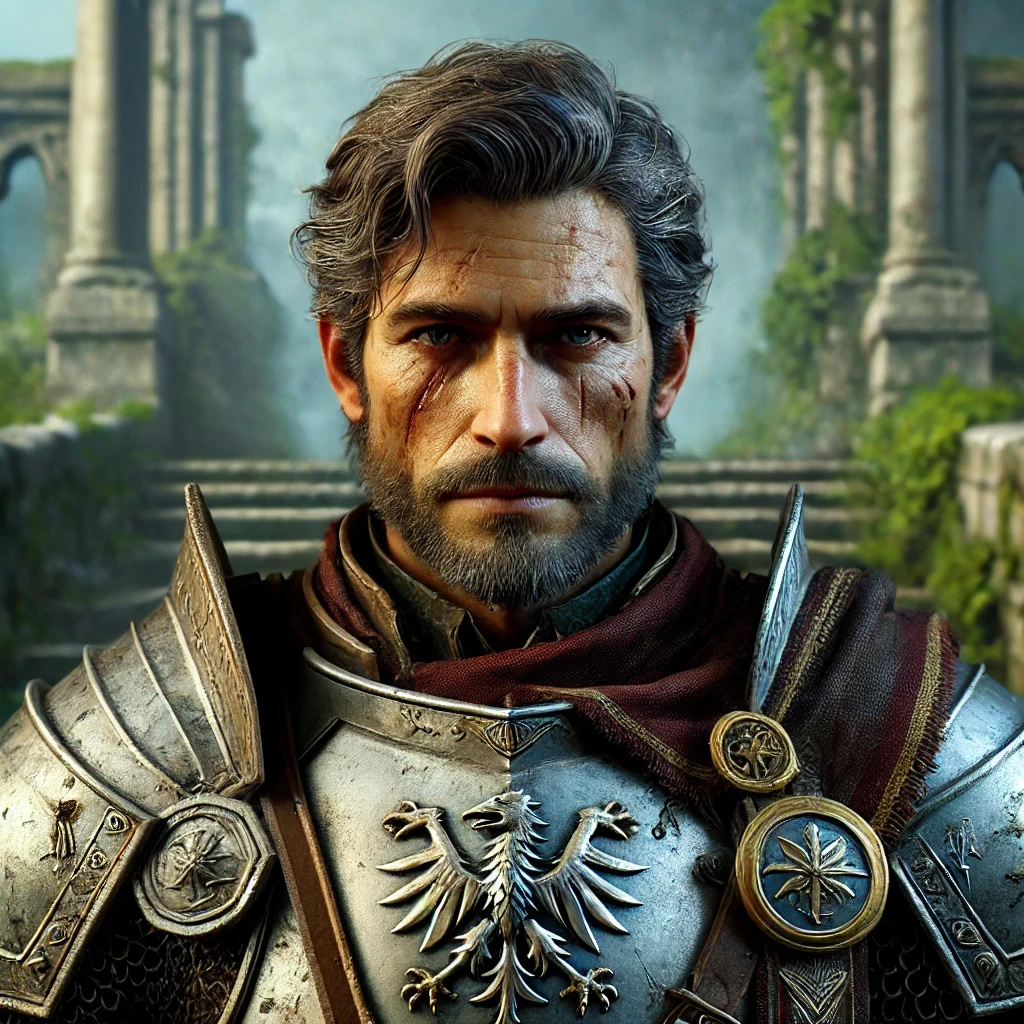
Vlandor, the Forgotten Kingdom
Vlandor is a land of contrasts, where towering fortresses stand amidst fertile plains, and harsh coastlines give way to bustling ports. It was once the beating heart of an empire, a realm forged by the Eldrakars of Velan, a race born from the union of elven settlers from Velan and the human colonists who came from the distant south. From this union emerged a people both gifted and feared, inheritors of arcane mastery and relentless ambition, who would reshape the destiny of entire continents. Today, however, Vlandor stands diminished, a kingdom in recovery, its borders reduced from their former glory, its authority fractured, and its people still living in the shadow of the Great War, a catastrophe that shattered not only its power, but its identity. :contentReference[oaicite:0]{index=0}
The Lands of Vlandor
Vlandor occupies a strategic position on the eastern continent, a land shaped as much by its geography as by the ambitions of those who ruled it. Its borders are defined by natural barriers and powerful neighbors, each of which has played a role in its rise and its fall. To the north lies Storrhold, the realm of the Horse Lords, separated from Vlandor by rolling hills and the Sacred Forest of Arboryn. This vast woodland, ancient beyond memory, is home to the Ancient Ones, enigmatic humanoid beings whose forms resemble living trees. They recognize no crown, no treaty, and no authority beyond their own. Their presence has long served as both a shield and a warning, forcing Vlandor to respect boundaries it cannot enforce.
Beyond the forest stretch the Ironwatch Plains, once a vital and prosperous part of Vlandor’s dominion. These lands, rich in resources and fertile soil, were lost in the aftermath of the Great War, seized by opportunists, warlords, and neighboring powers. Their loss was not merely territorial, but symbolic, marking the moment when Vlandor ceased to be an empire and became a kingdom struggling to retain what remained.
To the west, across the Sea of Hillfolk, lies the homeland of the Hillfolk, Vlandor’s most enduring trading partners. Known for their craftsmanship, their intricate trade networks, and their political adaptability, the Hillfolk have always navigated the shifting tides of power with remarkable skill. Even as Vlandor declined, they maintained strong economic ties, not out of loyalty, but because they understood that even a weakened Vlandor remained a key node in the world’s trade.
To the northwest, within the Velan Mountains, stands Velan itself, the ancestral homeland of the Eldrakars. Once a stronghold of Vlandor’s ruling elite, it has since become an independent, though allied, territory. Its peaks hide ancient fortresses, arcane sanctuaries, and the last true bastions of Eldrakar heritage. Beyond Velan stretches Thornwild, an immense and ancient forest inhabited by elves who share distant kinship with the Eldrakars. Yet this kinship has long since faded into estrangement, and the elves of Thornwild have withdrawn from the affairs of the wider world, especially since the devastation of the Great War.
To the south, Vlandor extends into a fortified peninsula, once the foundation of its naval supremacy. From these shores, fleets once sailed across the Ocean of Storms, carrying soldiers, settlers, and ambition to distant lands. Now, those same harbors stand as defensive bastions, guarding against the growing threat of the Corsairs of Draxis, whose raids have become increasingly bold in the absence of Vlandor’s former strength.
To the east, the Ocean of Storms stretches endlessly, a vast expanse that once represented opportunity and conquest. The Eldrakar rulers of Vlandor never saw it as a barrier, but as a bridge, a pathway to expansion. It was from these waters that they established colonies on distant continents, reshaping entire civilizations in their image. Today, however, the ocean serves as a reminder of a reach that can no longer be sustained.
The Heartlands of Vlandor
At the core of Vlandor’s remaining domain lie its cities, fortresses, and trade routes, each bearing the weight of history and the marks of a once-unified empire now fractured. These heartlands are not merely geographic centers, but the last cohesive remnants of a system that once spanned continents, a network of power that still functions, though no longer with the certainty it once commanded.
At the center of this network stands Nostara, the City of Kings, a monumental stronghold rising from the heart of the kingdom. Its towering stone walls and gleaming spires reflect both the ambition and the legacy of the Eldrakar rulers who founded it. Nostara is not simply a capital, it is a symbol, a reminder of what Vlandor was at its height. Within its walls reside the royal court, the remnants of the Eldrakar nobility, and the institutions that continue to govern a kingdom struggling to redefine itself. Though diminished in influence, the city remains the political and military heart of Vlandor, a place where decisions are made that will determine whether the kingdom endures or fades into irrelevance.
To the northwest, Velan stands as both a memory and a paradox. Once fully integrated into Vlandor’s power structure, it has since reclaimed its independence, yet it remains bound by ties of blood, history, and necessity. The mountains of Velan shelter ancient fortresses, hidden strongholds, and repositories of arcane knowledge that have survived even the devastation of the Great War. Its warriors are among the most elite in the world, its scholars among the most knowledgeable, and its mages among the most dangerous. Though no longer subordinate, Velan continues to support Vlandor, not out of obligation, but because its own survival remains intertwined with that of the kingdom.
To the south, the peninsula that once projected Vlandor’s naval dominance still stands, its fortified harbors and coastal defenses forming a defensive shield against external threats. These ports were once the launching points of great expeditions, where fleets departed to conquer distant lands and establish colonies across the Ocean of Storms. Now, they serve a different purpose, protecting what remains from the encroachment of the Corsairs of Draxis, whose raids have grown increasingly aggressive in the absence of a dominant naval power to oppose them.
To the north, the Ironwatch Plains remain a constant reminder of loss and unfinished ambition. Once a cornerstone of Vlandor’s prosperity, these lands provided both agricultural wealth and mineral resources essential to sustaining its empire. Their loss after the Great War has left a void that has yet to be filled. Now contested by neighboring powers and opportunistic warlords, the plains represent both a threat and a temptation, a region that Vlandor longs to reclaim, yet lacks the strength to fully secure.
Despite its diminished state, Vlandor remains a crossroads of commerce, its trade routes still active, though more fragile than before. The western trade route connects it to the Hillfolk, ensuring the flow of goods from distant lands. The Velan Road maintains the link between the heartlands and the mountains, allowing for the movement of troops, supplies, and knowledge. Along the coasts, maritime routes connect Vlandor to Mirelm Haven, Albian, and Brightkeep, though these lanes are increasingly threatened by piracy and instability. Even in decline, Vlandor’s position ensures that it cannot be ignored.
Natural Defenses and Strategic Vulnerabilities
The geography of Vlandor has always played a defining role in its history, shaping both its defensive strength and its inherent weaknesses. The Sacred Forest of Arboryn serves as a natural barrier against northern incursions, its ancient inhabitants ensuring that no army passes through without consequence. Yet this protection comes at a cost, for Vlandor holds no authority there, and must respect boundaries it cannot control.
The Velan Mountains form an almost impassable wall to the northwest, shielding the kingdom from threats beyond. However, this same barrier limits expansion and isolates Vlandor from potential allies or opportunities in that direction. To the north, the open plains offer no such protection. These wide, exposed lands leave Vlandor vulnerable to cavalry raids from Storrhold and incursions from hostile forces, making them both a strategic liability and a contested prize.
Thus, Vlandor exists in a constant balance between protection and exposure, its geography offering both security and danger, depending on how it is wielded.
The Rise of Vlandor: Founding, Expansion, and Conquest
The origins of Vlandor are inseparable from the rise of the Eldrakars of Velan, a people born from the union of early human settlers and the elves of the region. These Eldrakars were not merely a blend of two races, but something entirely new, inheriting the longevity, grace, and affinity for magic of the elves, while retaining the ambition, adaptability, and resilience of humanity. This unique combination made them exceptionally suited for both warfare and governance, and it was not long before they began to shape the fate of the lands around them.
In the early days, the human settlements of what would become Vlandor were fragmented and vulnerable, constantly threatened by warlords and external enemies. The Eldrakars did not immediately impose their rule through conquest. Instead, they entered these societies as protectors and advisors, offering stability in exchange for influence. Over time, this influence grew, becoming control. Human rulers were gradually replaced, either through political maneuvering or direct force, and the Eldrakars established themselves as the dominant power in the region.
This transformation reached its culmination under Vaelor the White, the greatest of the Eldrakar warlords, who declared himself King of Vlandor. Under his rule, the fragmented lands were unified into a single, disciplined, and expansionist state. What had once been a loose collection of territories became a kingdom with a clear hierarchy, a centralized authority, and a vision of dominance.
To maintain this supremacy, the Eldrakars established a rigid social structure that ensured their dominance remained unchallenged. Their bloodlines were carefully preserved, and strict boundaries were enforced between them and the human population. Humans were integrated into the system as soldiers, administrators, and laborers, but ultimate authority always remained in Eldrakar hands. In exchange, the population received stability, protection, and prosperity, creating a system that, while unequal, proved remarkably effective for centuries.
The Age of Expansion and Western Conquest
Once internal unity was achieved, Vlandor turned its attention outward. The Eldrakar kings, confident in their superiority, launched campaigns to bring order to the fractured kingdoms beyond their borders. Their armies, composed of disciplined human infantry, elite Eldrakar knights, and powerful spellcasters, proved unstoppable against the disorganized forces of neighboring realms.
The western continent, divided into numerous warring states, fell rapidly. Kingdom after kingdom was conquered, their rulers either executed or forced into submission. Yet not all conquests followed the same path. Mirelm Haven, a powerful city-state built on trade and naval dominance, resisted at first, but ultimately chose diplomacy over destruction. By becoming a vassal, it preserved its autonomy while aligning itself with Vlandor’s power.
Storrhold proved a far more difficult challenge. Its warriors, masters of cavalry warfare, resisted fiercely, refusing to submit despite repeated defeats. Recognizing the cost of full conquest, Vlandor imposed a treaty instead, binding Storrhold economically while allowing it to retain military independence. Halgaroth, however, remained beyond reach. Its harsh terrain and unyielding people made conquest impractical, and Vlandor’s rulers ultimately chose to leave it unconquered, establishing a tense and enduring rivalry.
At the height of this expansion, Vlandor had become an empire in all but name, its influence stretching across vast territories, its authority shaping the lives of millions. The Eldrakar elite tightened their control, ensuring that the rigid hierarchy of their society extended across all conquered lands.
The Eastern Expansion, The Colonization of a New World
With the western continent firmly under its control, Vlandor turned its gaze beyond the Ocean of Storms, toward lands yet unconquered. To the Eldrakars, expansion was not merely ambition, it was destiny. They saw themselves as the rightful rulers of mankind, and in their eyes, the human tribes of the eastern lands were little more than scattered and ungoverned peoples, awaiting the order that only Vlandor could impose. The ocean that separated the continents was not perceived as a barrier, but as a pathway, a challenge to be mastered and a bridge toward dominion.
The fleets that departed from Vlandor’s southern peninsula carried not only soldiers, but settlers, administrators, and nobles, all tasked with shaping new lands in the image of the empire. These expeditions were swift, disciplined, and ruthless when necessary. The local kingdoms of the eastern continent, lacking unity and organization, were unable to resist the coordinated might of Vlandor’s forces. Cities fell, territories were claimed, and new centers of power began to emerge under Eldrakar authority.
The Founding of Albian and Brightkeep
To secure its hold over the eastern continent, Vlandor established two major colonies, each reflecting a different vision of Eldrakar rule. Albian was founded as a strategic military outpost, designed to serve as both a foothold and a defensive anchor. Over time, however, it evolved into something more complex. Though its ruling class remained of Eldrakar descent, Albian developed a society where merit and achievement began to challenge the rigid importance of bloodline. This gradual shift created a culture that, while still influenced by Vlandor, began to diverge from its strict hierarchy. In time, this divergence would lead to tension, as Albian’s evolving identity clashed with the rigid traditions of its origin.
Brightkeep, by contrast, was conceived as the embodiment of Vlandor’s ideals. Established as a bastion for the purest Eldrakar bloodlines, it became a kingdom defined by discipline, tradition, and unwavering loyalty. Its society was deeply militarized, its nobility fiercely protective of their heritage, and its leaders committed to preserving the structure that had made Vlandor powerful. Where Albian adapted, Brightkeep remained constant, a living extension of the old order.
The colonization of the eastern lands was both rapid and transformative. Trade routes were established, cities were built, and the Eldrakar elite extended their influence across yet another continent. For a time, it seemed inevitable that Vlandor would dominate the known world, bringing all human societies under its control and enforcing a single, unyielding vision of order.
The Golden Age of Vlandor
At its peak, Vlandor stood as the most powerful and prosperous realm in the known world, a superpower whose influence extended across continents and whose authority was rarely questioned. Its armies were unmatched, composed of heavily armored infantry, disciplined men-at-arms, elite Eldrakar knights, and supported by advanced siege weaponry and devastating arcane warfare. These forces did not merely win battles, they defined the standard by which warfare itself was measured.
The kingdom’s economy flourished, driven by trade networks that connected distant lands and enriched its coffers. Merchants from Mirelm Haven and the Hillfolk brought goods from across the world, while the mines of the Ironwatch Plains provided a steady flow of gold and resources that fueled both expansion and stability. Wealth was not merely accumulated, it was transformed into power, sustaining the military machine and reinforcing the dominance of the ruling class.
At the heart of this dominance stood the Vhalan, an elite council of Eldrakar sorcerers whose mastery of magic ensured that Vlandor’s arcane knowledge remained unrivaled. Their influence extended beyond the battlefield, shaping policy, guiding rulers, and maintaining the delicate balance of power within the kingdom. Magic was not simply a tool, it was a pillar of Vlandor’s supremacy.
Despite the rigid caste system that defined its society, Vlandor offered stability, prosperity, and protection to its subjects. For many, especially in lands previously plagued by chaos and warlord rule, life under Vlandor, though restrictive, was preferable to the uncertainty that had come before. Order was enforced, laws were upheld, and the promise of security outweighed the cost of submission.
The Unchecked Ambition of the Eldrakars
Yet, within this golden age lay the seeds of decline. Power, once secured, bred confidence, and confidence gave way to arrogance. The Eldrakars began to see themselves not merely as rulers, but as beings destined to dominate. Their victories reinforced the belief that they were invincible, that no force could challenge their supremacy.
As their empire expanded, their perspective narrowed. Warnings were dismissed, dissent was ignored, and the idea of failure became unthinkable. When reports began to surface of a rising power in the dark lands beyond their borders, the Eldrakars did not see a threat to be studied or contained. They saw a rival to be crushed.
This rising force was Agramon, the Dark Forgemaster, a figure whose influence was growing rapidly in the shadowed realm of Dreadhold. Where once there had been scattered warbands of orcs, fragmented tribes, and isolated warlocks, Agramon brought unity, discipline, and purpose. His domain was no longer a chaotic wasteland, but an emerging empire built on dark sorcery, necromancy, and relentless militarization.
The Gathering Storm
The armies of Dreadhold, once dismissed as disorganized and primitive, were transformed under Agramon’s command into a cohesive and formidable war machine. Orcs, trolls, and drakoths were no longer mere beasts of war, but elements of a structured force guided by strategy and dark magic. The Clans of the Steppes, once independent raiders, were brought into his fold, their loyalty secured by promises of conquest and vengeance.
To the Eldrakar rulers of Vlandor, this development was not seen as a warning, but as an insult. The very idea that another power could rise to rival their authority was unacceptable. Their belief in their own superiority blinded them to the true nature of the threat.
Even as their vassals, including Albian, Brightkeep, and Storrhold, urged caution and advised preparation, the Eldrakars chose aggression. They called for a preemptive war, convinced that their legions would march into Dreadhold, crush Agramon’s forces, and absorb his domain into their ever-expanding empire.
In their minds, it was not a question of victory, but of how quickly it would be achieved.
This belief would mark the beginning of their downfall.
The Great War Begins
The decision to march against Dreadhold was made with confidence, not caution. To the Eldrakar rulers of Vlandor, the war was not a gamble, but a certainty. Their armies had never known true defeat, their strategies had always prevailed, and their belief in their own superiority had become absolute. When the order was given, it was not accompanied by doubt, but by expectation. This would be another conquest, another expansion, another confirmation of their dominance.
The initial campaigns seemed to validate this belief. Vlandor’s legions advanced into the territories of Dreadhold with precision and discipline, their formations unbroken, their command structure intact. Orc warbands were scattered, strongholds fell, and early victories reinforced the illusion that the war would be swift. Reports of success reached Nostara, strengthening the conviction that the Eldrakars had been right to act decisively.
Yet beneath these victories, something was wrong. The enemy did not collapse as expected. Their resistance was uneven, at times almost deliberately weak, as if conceding ground without true engagement. The deeper Vlandor’s armies advanced, the more stretched their supply lines became, the more isolated their forces grew. What had begun as a controlled expansion was slowly turning into overextension, though few within the high command were willing to recognize it.
Agramon’s Strategy Unfolds
Agramon had never intended to meet Vlandor’s strength head-on. He understood that direct confrontation would favor the disciplined legions of the Eldrakars. Instead, he allowed them to advance, drawing them deeper into hostile territory, forcing them to rely on extended supply chains and fragmented lines of communication. What appeared to be weakness was in truth design.
When the moment came, he struck with precision. Coordinated assaults were launched across multiple fronts, targeting supply routes, isolated divisions, and vulnerable flanks. Warbands that had once appeared disorganized now moved with purpose, guided by a unified command. Necromancers raised the fallen, ensuring that losses were never final, while drakoths descended upon formations that had never before faced such creatures.
The war changed in an instant. What had been a campaign of conquest became a struggle for survival. Units that had advanced too far found themselves cut off, surrounded, and overwhelmed. Messages failed to reach their destinations. Orders became confused, then irrelevant. The structure that had always guaranteed victory began to fracture.
The War Expands Beyond Control
As Vlandor struggled to regain control of the situation, the war expanded beyond anything the Eldrakars had anticipated. What had begun as a single-front campaign became a conflict that engulfed entire regions. Agramon’s influence spread, and with it came new threats that Vlandor had not prepared for.
Halgaroth, long a rival but never an active enemy, seized the opportunity. Seeing Vlandor weakened and overextended, it launched its own offensive, striking at vulnerable territories and forcing the kingdom to divide its forces further. At the same time, the Corsairs of Draxis intensified their naval assaults, targeting coastal cities and disrupting vital maritime trade routes.
In the north, the open plains that had once been a strategic asset became a liability. Without sufficient forces to defend them, they were overrun by hostile incursions, cutting off yet another layer of Vlandor’s logistical network. Allies who had once depended on Vlandor’s strength began to reconsider their position, some withdrawing support, others preparing to act in their own interest.
The war was no longer contained. It had become a cascade of failures, each new crisis compounding the last, each loss weakening the structure that had once held the empire together.
The Retreat to Velan
Faced with mounting losses and the collapse of their forward positions, the Eldrakar high command made a critical decision. The remaining forces would withdraw to Velan, regroup, and establish a defensive stronghold from which they could stabilize the war. Velan, with its natural defenses and fortified positions, was seen as the ideal refuge, a place where the tide could be turned.
The retreat itself was costly. Units were forced to abandon territory, leaving behind cities, resources, and civilians. Many did not make it back. Those who did arrived weakened, their numbers reduced, their confidence shaken. Yet within Velan, they found something they had not expected, resistance that was not merely defensive, but defiant.
The defense of Velan became one of the most intense and desperate chapters of the war. Eldrakar warriors, human soldiers, and arcane practitioners fought side by side, holding the mountain passes against waves of attackers. For a time, it seemed that the line would hold, that Vlandor could recover from its losses and reclaim its strength.
But even this victory came at a price. The defense of Velan drained the kingdom of its remaining reserves. Every soldier lost, every resource consumed, weakened the possibility of recovery. The war was no longer about victory. It had become a matter of endurance.
The Return to a Broken Kingdom
When the surviving forces of Vlandor finally returned from Velan, they did not return to the kingdom they had left behind. The heartlands were no longer secure. Cities had been burned, trade routes severed, and populations displaced. The structures of power that had once defined Vlandor’s authority had fractured under the strain of war.
The empire was gone. The territories that had once been controlled with absolute authority had broken away, claimed by new rulers, rebellious factions, or foreign powers. Even within the remaining borders, control was no longer absolute. The kingdom had survived, but it had been irrevocably changed.
The Eldrakars, once the undisputed rulers of a vast empire, now stood at the head of a diminished and wounded nation. Their certainty was gone, replaced by the realization that they had underestimated their enemy, and that the world they had sought to dominate would not so easily be controlled.
The Great War had not destroyed Vlandor.
It had ended what Vlandor had been.
The Aftermath of War
In the wake of the Great War, Vlandor did not find peace, but a fragile and uncertain survival. The kingdom still stood, its banners still flew above its remaining cities, and its rulers still claimed authority, yet beneath this appearance of continuity lay a reality that could not be ignored. The empire was gone. The structures that had once sustained its dominance had fractured, and the world it had shaped no longer existed in the form it once knew.
The immediate aftermath was marked by instability. The loss of territory had created power vacuums across the former borders, and these voids were quickly filled by forces that Vlandor could no longer contain. Orc warbands, once scattered and driven back, now established themselves within regions that had once been secure. These were no longer isolated threats, but persistent presences, carving out domains within what had once been imperial land.
The Ironwatch Plains, in particular, became a symbol of this collapse. Once a vital region of agriculture and resource extraction, they now lay beyond Vlandor’s full control, contested by warlords, raiders, and emerging factions that had no intention of submitting to a weakened crown. The loss of these lands was not only economic, but psychological, reinforcing the understanding that Vlandor’s reach had permanently receded.
The Emergence of the Kragars
Amid the chaos left by the war, a new and deeply unsettling phenomenon began to take shape. The Kragars, beings born from the blending of races and the corruption of war, emerged as a distinct and growing population. Neither fully human, nor orc, nor anything that the rigid classifications of Eldrakar society could easily define, they represented a challenge not only to Vlandor’s authority, but to its very worldview.
Their existence was a consequence of the war itself, a reflection of the mingling of bloodlines, the influence of dark magic, and the breakdown of established order. To some, they were a natural evolution of a changing world. To the Eldrakars, they were an abomination, a threat to the purity of the structure they had spent centuries building.
The Kragars did not remain scattered for long. Driven by shared identity and rejection, they began to gather, forming their own communities and, eventually, their own power base. They refused to accept the roles imposed upon them, refused to submit to Eldrakar rule, and refused to disappear.
The Purge
The response from Vlandor’s ruling elite was swift and uncompromising. The existence of the Kragars was declared unacceptable, not as a political problem, but as an existential one. Their presence threatened the very foundations of Eldrakar dominance, and so the decision was made to remove them entirely.
What followed was not a war in the traditional sense, but a campaign of eradication. Entire regions were targeted, settlements destroyed, and populations hunted without distinction. The purge did not differentiate between combatants and civilians, nor between those who resisted and those who merely existed. Even humans who had aligned themselves with the Kragars, whether out of sympathy or necessity, were condemned alongside them.
This campaign reshaped Vlandor as profoundly as the Great War itself. It restored a measure of control, but at a cost that could not be undone. The methods used, the scale of destruction, and the moral weight of the actions taken left scars that would endure long after the last fires had burned out.
Officially, the Kragars were annihilated. Their settlements erased, their presence denied, their memory suppressed. Yet in truth, they were not entirely gone. Survivors fled into hidden regions, into the margins of the world, carrying with them not only their bloodlines, but the memory of what had been done to them.
Rumon the Pale and the Breaking of Loyalty
Not all within Vlandor accepted what had been done. Among those who opposed the purge was Rumon the Pale, a figure whose loyalty to the kingdom had once been unquestioned. A warrior and leader of great renown, he had fought in the Great War and witnessed the cost of the kingdom’s ambition. What he saw in the purge, however, was something different, not a war for survival, but a descent into brutality that he could not justify.
Rumon refused to participate. His defiance was not quiet, nor was it subtle. He spoke openly against the actions of the Eldrakar elite, condemning the campaign and those who ordered it. In doing so, he crossed a line from which there could be no return.
Declared a traitor, he was forced to flee, taking with him those who shared his views, outcasts, survivors, dissidents, and those who had no place left within Vlandor. Together, they moved toward the Ironwatch Plains, a land already beyond the kingdom’s full control, where they began to build something new.
The Birth of Ironwatch
From exile came creation. In the contested lands of the Ironwatch Plains, Rumon and his followers established a new kingdom, one born not from conquest, but from rejection. Ironwatch became a refuge for those cast out by Vlandor, a place where former soldiers, Kragar survivors, and displaced peoples could find a new identity.
Unlike Vlandor, Ironwatch was not built on rigid hierarchy or bloodline purity. It was shaped by necessity, by survival, and by a shared opposition to the structures that had once defined their lives. This made it both unstable and resilient, a kingdom still forming, still evolving, but undeniably real.
To Vlandor, Ironwatch represented a failure that could not be ignored. It was a living reminder of the kingdom’s internal fractures, a symbol of rebellion, and a potential threat that lay just beyond its weakened borders. Though not yet powerful enough to challenge Vlandor directly, its very existence was a source of unease.
The Beginning of Internal Fracture
The consequences of these events extended far beyond the loss of territory or the rise of a rival state. Within Vlandor itself, divisions began to deepen. The authority of the Eldrakars, once absolute, was now questioned, not only by those outside their rule, but by those within it.
Humans, who had long occupied subordinate roles, began to rise in influence, filling gaps left by the diminished Eldrakar population. The army, once unified under a clear hierarchy, became a reflection of these shifting dynamics, its ranks divided not only by function, but by ideology.
The purge, though successful in its immediate objective, had undermined the moral foundation of the kingdom. It had demonstrated that the ruling elite would go to any lengths to preserve their dominance, even at the cost of their own people. This realization could not be undone.
Vlandor had survived the war, but it had not emerged unchanged.
It had begun to fracture from within.
A Kingdom in Decline
In the present age, Vlandor endures, but it no longer commands. The kingdom that once stood as the dominant power of the known world now exists in a state of fragile equilibrium, its authority diminished, its borders reduced, and its internal cohesion increasingly uncertain. Though its banners still fly and its institutions still function, the certainty that once defined its rule has faded, replaced by tension, adaptation, and quiet unease.
The Eldrakars, once the undisputed rulers of a vast empire, are no longer the unchallenged elite they once were. Their numbers have dwindled, their bloodlines thinned by time, war, and isolation. Where they once governed with unquestioned authority, they must now contend with a changing reality in which their dominance is no longer absolute. Their longevity remains, their knowledge endures, but their influence has begun to erode.
In contrast, the human population has grown in both number and influence. No longer confined to subordinate roles, humans now occupy positions of responsibility within the military, administration, and governance of the kingdom. This shift has not occurred through revolution, but through necessity. As the Eldrakar presence declined, gaps were filled, and with each generation, the balance of power has subtly shifted.
This transformation has not gone uncontested. Within the remnants of the Eldrakar nobility, there are those who seek to preserve the old order, to restore the hierarchy that once defined Vlandor. Others, more pragmatic, recognize that such a restoration may no longer be possible, and instead seek to adapt, to reshape the kingdom into something capable of surviving in a changed world.
The Fractured Army
The army of Vlandor, once a symbol of unity and dominance, now reflects the divisions within the kingdom itself. Where once there had been clarity of command and purpose, there is now tension between tradition and adaptation. Eldrakar officers, trained in the doctrines of the old empire, find themselves commanding forces that no longer fit the structure they were designed for. Human commanders, rising through merit and necessity, bring new perspectives that challenge established norms.
This does not mean that Vlandor’s military is weak. On the contrary, it remains one of the most formidable forces in the world. Its soldiers are experienced, its fortifications strong, and its strategic knowledge unmatched. Yet it is no longer unified in identity. It is an army in transition, caught between what it was and what it must become.
Along the borders, this tension is constantly tested. Raids from the Corsairs of Draxis continue to pressure the southern coasts. The Ironwatch frontier remains unstable, its territories contested and unpredictable. To the north, Storrhold watches, its cavalry ever ready to exploit weakness. Even former allies observe Vlandor with caution, aware that its decline creates both risk and opportunity.
The Weight of the Past
The greatest burden Vlandor carries is not its enemies, but its own history. The memory of the Great War, the loss of empire, and the brutality of the purge have left marks that cannot be erased. These events are not distant history, they remain present in the minds of those who lived through them and in the structures that were shaped by their consequences.
Among the population, these memories manifest in different ways. For some, they reinforce loyalty, a belief that the kingdom must endure at all costs. For others, they inspire doubt, a questioning of whether the system that led to such devastation deserves to continue. These tensions do not erupt openly, but they exist, beneath the surface, shaping decisions, influencing alliances, and defining the atmosphere of the realm.
The existence of Ironwatch serves as a constant reminder of these unresolved fractures. It stands not only as a rival power, but as a symbol of an alternative path, one that rejects the foundations upon which Vlandor was built. Its presence ensures that the past cannot be ignored, and that the choices made in its aftermath continue to have consequences.
A Throne Under Pressure
At the center of this uncertain kingdom stands King Valtherion, a ruler who embodies both the strength and the limitations of Vlandor itself. Forged in the fires of the Great War, he rose to power in a time of crisis, rebuilding what could be saved and imposing order where chaos threatened to take hold. His rule has been defined by resilience, discipline, and an unyielding determination to preserve the kingdom.
Yet time has begun to take its toll. Age weighs upon him, and with it comes the awareness that his reign cannot last forever. He sees the fractures within his realm, the shifting balance between Eldrakar and human influence, the ambitions of those who stand around him. He understands that Vlandor cannot endure another catastrophe on the scale of the Great War, yet he also knows that change, if mishandled, could lead to collapse just as surely.
His position is one of constant tension. He must maintain strength without provoking unnecessary conflict, preserve tradition without ignoring reality, and prepare for a future he may not live to see. His authority remains strong, but it is no longer absolute, and the question of succession looms as an unresolved and potentially destabilizing force.
The Balance of Power
Within the kingdom, power is no longer centralized in the way it once was. While the crown remains the ultimate authority, its influence is now shaped by the figures who surround it, individuals whose ambitions, loyalties, and visions for the future differ significantly. These forces do not openly challenge the king, but they position themselves, preparing for what comes next.
Some seek to restore the old order, believing that strength and tradition are the only paths to survival. Others advocate adaptation, recognizing that the world has changed and that Vlandor must change with it. Between these positions lies a fragile balance, one that holds for now, but may not endure indefinitely.
Beyond the borders, the world watches. Former colonies such as Albian and Brightkeep have grown into powers of their own, no longer mere extensions of Vlandor’s will. Mirelm Haven thrives through trade, adapting where Vlandor struggles. Ironwatch rises from exile, its identity forged in opposition. Even distant forces, from Dreadhold to Draxis, remain present in the calculations of those who would shape the future.
The Uncertain Future
Vlandor stands at a crossroads. It is no longer strong enough to dominate the world as it once did, yet it remains too powerful to be ignored. It has survived its fall, but survival is not the same as renewal. The structures that once ensured its supremacy have become sources of tension, and the choices that lie ahead will determine whether it declines further or finds a way to redefine itself.
The question facing Vlandor is not whether it will change, for change is already underway. The question is whether that change will be guided, controlled, and transformed into strength, or whether it will spiral into fragmentation and loss.
The kingdom still stands.
But what it will become remains uncertain.
The Figures Who Shape Vlandor
Though Vlandor still stands as a kingdom, its fate no longer rests solely upon its throne, but upon the individuals who move within its shadows and at its center. These figures, bound by loyalty, ambition, or conviction, represent not only the present state of the realm, but the possible futures that lie before it. Each carries a vision of what Vlandor must become, and each, in their own way, seeks to shape that outcome.
King Valtherion, The Unyielding
King Valtherion is the last great ruler of Vlandor in the image of its former glory, a monarch forged in the crucible of the Great War and hardened by the collapse of an empire. When he ascended to power, the kingdom stood on the brink of total dissolution, its armies shattered, its territories lost, and its people scattered. Through force of will, discipline, and uncompromising leadership, he rebuilt what could be saved, restoring order where chaos had taken root.
His rule has been defined by resilience. He is neither a visionary nor a reformer, but a stabilizer, a man who understands that survival sometimes demands rigidity rather than change. Under his command, the remnants of Vlandor were forged into a functioning state once more, its borders secured, its enemies contained, and its institutions preserved. Yet this strength comes at a cost.
Valtherion is a ruler of the old world, shaped by its certainties and bound by its principles. He believes in hierarchy, in discipline, and in the supremacy of the Eldrakar order that once defined the kingdom. However, the world around him has changed. The rise of human influence, the decline of Eldrakar dominance, and the emergence of new powers have created a reality that cannot be controlled through strength alone.
Age has begun to weigh upon him, and with it comes an awareness he cannot ignore. He sees the fractures within his kingdom, the tensions among his advisors, and the uncertainty of succession that looms ever closer. He understands that Vlandor cannot endure another great war, yet he refuses to abandon the identity that has sustained it for centuries.
He stands as both the kingdom’s greatest strength and its greatest limitation, a ruler who has preserved Vlandor, but who may not be able to guide it into the future that awaits.
Vaelthir Blackthorn, High Lord of the Legions
Vaelthir Blackthorn embodies the uncompromising will of Vlandor’s military tradition. As High Lord of the Legions, he commands the kingdom’s armed forces with absolute authority, his reputation forged through decades of warfare and unbroken loyalty to the crown. To his soldiers, he is a figure of unwavering strength, a commander who demands discipline and delivers victory.
Blackthorn is a man of clarity. He does not believe in compromise, nor in gradual change. To him, Vlandor’s decline is not the result of circumstance, but of weakness, weakness in leadership, weakness in resolve, weakness in adherence to the principles that once made the kingdom great. Where others see complexity, he sees a simple truth, that strength must be restored, and that only through strength can order be maintained.
His vision for Vlandor is one of restoration. He seeks to rebuild the army in the image of its former glory, to reassert control over lost territories, and to eliminate threats both internal and external. This makes him both a pillar of stability and a potential source of conflict. His loyalty to the king is unquestioned, but his patience is not infinite.
Should the moment come when decisive action is required, Vaelthir Blackthorn will not hesitate. Whether that action preserves Vlandor or drives it toward further conflict remains uncertain.
Lady Serathis, Mistress of the Obsidian Guard
Where Vaelthir Blackthorn represents visible power, Lady Serathis embodies the unseen forces that maintain control within Vlandor. As the leader of the Obsidian Guard, she operates in silence, her influence extending through networks of spies, agents, and enforcers who ensure that threats are dealt with before they can emerge into the open.
Serathis is a figure of precision and calculation. She does not rely on strength alone, but on knowledge, manipulation, and control. To her, power is not something to be displayed, but something to be exercised subtly, shaping events without drawing attention to their origin. Under her command, dissent is monitored, conspiracies are uncovered, and instability is contained before it can spread.
Her loyalty to Vlandor is unquestioned, but her methods are often feared. She understands that the kingdom’s greatest threats may come from within, from factions, ambitions, and ideologies that could fracture it beyond repair. Where others see political tension, she sees potential collapse, and she acts accordingly.
In a kingdom where power is no longer absolute, figures like Serathis ensure that control is never entirely lost.
Erlathion the Hollow
Erlathion the Hollow stands apart from the structures of power that define Vlandor. Once a figure of great influence, he now exists in exile, a relic of a past that no longer holds dominion over the present. His title, once spoken with respect, is now carried with a sense of unease, for he represents not only knowledge, but the consequences of that knowledge.
He has seen the rise of Vlandor, its expansion, its dominance, and its fall. Unlike others, he does not seek to restore what was lost, nor to reshape what remains. He understands that the past cannot be reclaimed, and that attempts to do so will only lead to further destruction.
From exile, he observes. He studies the shifting balance of power, the movements of those who seek to control the future, and the consequences of the choices being made. He is not without influence, though it is subtle, expressed through knowledge, guidance, and the occasional intervention that alters the course of events in ways few fully understand.
Erlathion is neither ally nor enemy, but something far more difficult to define, a witness to the unfolding fate of Vlandor, and perhaps, in ways yet unseen, a participant in it.
Anzareth the Silent
Anzareth the Silent stands as one of the last true guardians of Vlandor’s arcane legacy, a figure whose presence is felt more than it is seen. As one of the remaining masters of the ancient magical traditions upheld by the Eldrakars, he represents a continuity that has survived even the collapse of empire. Where others have adapted, fallen, or turned away from the past, Anzareth has remained constant, preserving knowledge that might otherwise have been lost to time and war.
His title, the Silent, is not merely symbolic. Anzareth does not engage in the political struggles that dominate the court, nor does he openly assert his influence. Instead, he operates with deliberate restraint, choosing his moments carefully, intervening only when the balance of power or the preservation of knowledge demands it. His understanding of magic extends far beyond its practical use in war. To him, it is a foundation of civilization, a force that must be protected, studied, and controlled, lest it fall into the wrong hands or fade into obscurity.
In a kingdom where the structures of authority are shifting and where the old order is under constant pressure, Anzareth serves as a stabilizing force of a different kind. He does not command armies, nor does he manipulate politics directly, yet his influence is undeniable. Those who understand the deeper workings of Vlandor know that as long as Anzareth endures, the arcane foundations of the kingdom will not be entirely lost.
However, even his position is not without uncertainty. As the number of Eldrakars continues to decline, and as new forms of power emerge, the question remains whether the knowledge he protects will continue to shape the future, or whether it will become a relic of a world that no longer exists.
Other Powers and Rising Figures
Beyond these central figures, Vlandor is filled with lesser-known individuals whose influence continues to grow. Commanders, nobles, scholars, and opportunists all navigate the shifting structure of the kingdom, each seeking to secure their place within it. Some align themselves with the old order, hoping to restore what has been lost, while others look toward a different future, one in which Vlandor evolves beyond its rigid past.
These figures do not yet shape the fate of the kingdom on the same scale as those who stand closest to the throne, but they represent the forces that will define its future. In a time of transition, it is often not the established powers, but the emerging ones, that ultimately determine the course of events.
A Kingdom Defined by Its People
Though Vlandor’s history is marked by kings, wars, and empires, its future will not be determined by legacy alone. The individuals who now inhabit its cities, command its armies, and shape its institutions carry with them the weight of what has come before, but they are not bound entirely by it. Each decision, each alliance, each act of defiance or loyalty contributes to the ongoing transformation of the kingdom.
The Eldrakars, once the architects of an empire, must now decide whether they will adapt or attempt to reclaim a past that may no longer be attainable. Humans, rising in influence, must determine what kind of role they will play in a system that was never designed for them to lead. And those who stand outside these structures, whether in Ironwatch, in exile, or in hidden corners of the realm, continue to exert pressure on a system that is no longer absolute.
The Future of Vlandor
The fate of Vlandor is no longer written in certainty. It is no longer a question of dominance, nor of inevitable expansion. Instead, it is a question of survival, adaptation, and identity. The kingdom has endured its fall, but it has not yet defined what it will become in the aftermath.
The forces that once made it great, discipline, hierarchy, arcane mastery, remain present, but they no longer function as they once did. They must either evolve or risk becoming the very things that lead to further decline. Those who hold power understand this, even if they do not all agree on the path forward.
In this moment, Vlandor stands not as a relic, but as a turning point. It is a kingdom caught between past and future, between preservation and transformation. The choices made now will not simply determine its fate, but the shape of the world around it.
Vlandor endures.
But what it will become remains unwritten.