




Dreadhold, Empire of Iron and Shadow
A Land Forged by Fire and War
South of Shadowspire, where the mountains rise like jagged teeth against a sky perpetually choked with ash, lies Dreadhold, a realm shaped not by peace or prosperity, but by fire, conquest, and survival. :contentReference[oaicite:0]{index=0} It is a land of towering peaks and deep, suffocating caverns, where the earth itself seems scarred by centuries of conflict and dark magic.
What was once a fertile and thriving region has long since been transformed under the influence of Agramon. The land now bears the marks of his dominion, rivers of molten rock cut through valleys, volcanic smoke blankets the horizon, and the air itself feels heavy, as though saturated with the residue of countless battles and rituals. In this environment, life does not flourish, it endures, and only through strength.
The mountains of Dreadhold serve both as fortress and prison. Their natural defenses make invasion nearly impossible, yet they also trap those who dwell within, binding them to a cycle of war and obedience. Every ridge, every ravine, and every cavern is both a strategic asset and a reminder that escape is neither easy nor often attempted.
And yet, within this hostile land, the orcs have not merely survived, they have adapted. Hardened by generations of conflict, they have carved homes into the mountainsides and deep within the caverns, building a society that reflects the brutality of its surroundings. Under Agramon’s rule, they have become both conquerors and captives, warriors whose strength defines them, yet whose loyalty is enforced through fear as much as devotion.
The Legacy of the Drakoth
Long before Agramon’s rise, before the forges burned and the mountains echoed with war, Dreadhold belonged to another power entirely, the Drakoth. These colossal beings, towering creatures of immense strength and savage intelligence, once ruled the region unchallenged. Their dominance was absolute, their presence shaping the very balance of power across the mountains.
The orc tribes that inhabited these lands lived in their shadow, often subjugated by their overwhelming force. The Drakoth were not merely beasts, they were rulers in their own right, capable of strategy, leadership, and a brutal form of order imposed through sheer physical superiority.
When Agramon rose to power, he did not seek to destroy them, he sought to control them. Through dark sorcery, he bound the mightiest of the Drakoth to his will, transforming them into living engines of war. During the Great War, these creatures became the vanguard of his campaigns, their massive forms tearing through fortifications, crushing defenders, and breaking the morale of entire armies.
The siege of Vandor remains one of the most infamous examples of their destructive power. It was the Drakoth who led the assault, smashing through walls that had stood for centuries, reducing defenses to rubble beneath their immense strength. Few who witnessed that battle forgot it, and fewer still survived it.
Yet even such power comes at a cost. The Great War diminished their numbers, and many of the strongest Drakoth fell in those brutal campaigns. With the independence of Grimstone, many of the remaining Drakoth now roam beyond Agramon’s direct control. Those who remain in Dreadhold are few, but their presence continues to define the identity of the region.
To the orcs, they are more than weapons or relics of the past.
They are a memory of what true dominance once looked like.
The Orcs of Dreadhold
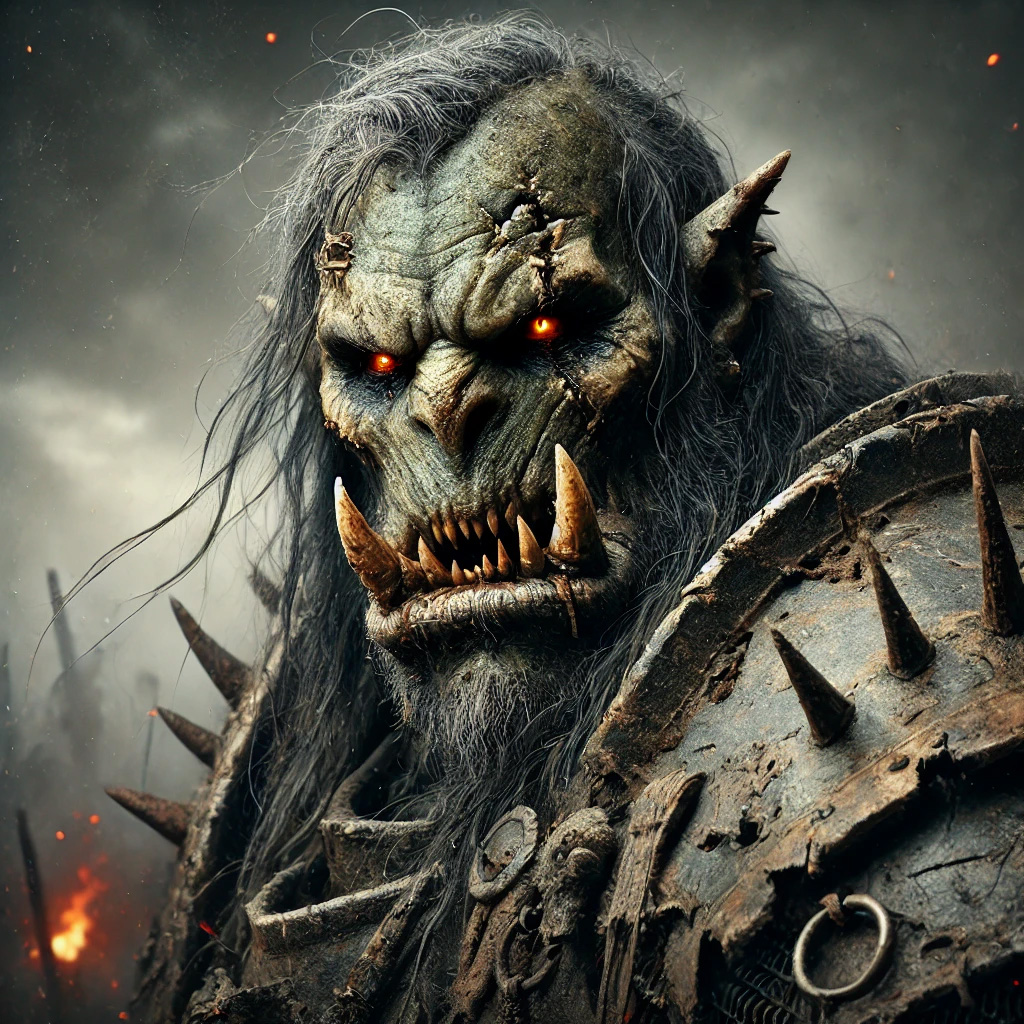
The orcs of Dreadhold are unlike any others in the world. Forged in an environment where weakness is quickly punished, they have developed into a society where strength, discipline, and loyalty determine one’s place. Survival is not guaranteed, it is earned, reinforced through constant training, battle, and competition.
At the heart of this society stands Steelfort, a massive citadel carved directly into the mountains, serving both as a military stronghold and an industrial center. Within its walls, the orcs forge the weapons and armor that sustain Agramon’s war machine, their labor as relentless as the conflicts they prepare for.
The warriors chosen to serve within Steelfort are the elite, those who have proven themselves through combat and endurance. They form the Iron Legions, disciplined forces capable of executing complex maneuvers as effectively as they engage in brutal close combat. Their reputation is built not only on strength, but on their refusal to retreat, choosing death over dishonor in a culture where failure carries consequences beyond the battlefield.
Alongside them fight the Grimfang riders, mounted on massive wolves bred within the mountains. These beasts are as much a part of Dreadhold as the orcs themselves, their bond with their riders forged through shared hardship and mutual dependence. On the battlefield, their speed and ferocity make them a terrifying force, capable of striking swiftly and retreating before the enemy can respond.
In Dreadhold, every warrior is both weapon and shield.
And every battle is a test that cannot be failed twice.
Commanders of Iron and Fire
Within Dreadhold, power does not rest solely in armies or fortresses, it resides in those who command them. Each leader embodies a different aspect of Agramon’s dominion, strength, fear, discipline, and control, forming a structure that is both formidable and inherently unstable. :contentReference[oaicite:0]{index=0}
At the forefront stands Korgath the Unyielding, supreme commander of the Iron Legions and one of the most feared warlords in Agramon’s service. Towering above his peers, clad in heavy black iron armor forged within Steelfort, Korgath is both a symbol and an instrument of war. His strength is unquestioned, but it is his discipline and tactical brilliance that have secured his position. Under his command, the Iron Legions have crushed armies far larger than themselves, advancing with relentless precision.
Yet Korgath’s greatest strength is also his greatest burden. He understands the nature of power within Dreadhold, that loyalty is fragile, and that even the strongest can fall if they fail to anticipate betrayal. His paranoia is not weakness, but survival instinct, sharpened by years of navigating a system where rivals are always watching, waiting for a moment of weakness.
Where Korgath represents military order, Gholmar the Sorcerer embodies the arcane terror that underpins Agramon’s empire. Twisted by years of experimentation, his body marked by burns, scars, and unnatural alterations, Gholmar is both revered and feared. His mastery of dark magic allows him to craft enchanted weapons, empower war machines, and manipulate forces that few dare to understand.
To the orcs, he is something unnatural, a figure who has stepped beyond the boundaries of flesh and sanity. Whispers surround him, tales of pacts made with entities older than Dreadhold itself, bargains struck at the cost of his own humanity. Yet his value is undeniable. Without Gholmar, much of Agramon’s arcane strength would falter.
The Masters of War and Industry
At the core of Dreadhold’s war machine lies Steelfort, and at its center stands Zogar the Fat, master of the forges. Cold, calculating, and utterly relentless, Zogar is responsible for ensuring that the Iron Legions never lack the tools of war. His domain is one of fire and iron, where weapons are not crafted, but produced in endless quantity, each blade, each piece of armor feeding the machinery of conquest.
Zogar’s authority extends beyond production. He enforces discipline with brutal efficiency, ensuring that every orc under his command fulfills their role without hesitation. Failure is not tolerated, and punishment is swift, serving both as correction and warning. Yet beneath his rigid exterior lies ambition. Zogar understands that power within Dreadhold is tied to usefulness, and as long as his forges remain indispensable, his position is secure. Should that ever change, he knows exactly what fate awaits him.
Beyond the walls of Steelfort, warfare takes a more primal form under the command of Skarn Bloodfang, master of the Grimfang riders. Scarred from countless battles, Skarn is a figure of raw brutality, his presence on the battlefield marked by speed, violence, and relentless pursuit. His connection to his Grimfang pack is more than practical, it is instinctive, a bond forged through shared survival in the harshest regions of the mountains.
Skarn’s role extends beyond open warfare. He is a hunter, a tracker, and an executioner, often tasked with pursuing traitors, rebels, and enemies who attempt to escape into the wilderness. Few can evade him for long, and fewer still survive once he finds them.
The Last Lords of the Drakoth
Among the fading giants of Dreadhold stands Grokal Bloodthirst, one of the last remaining Drakoth chieftains. Towering even over the largest orcs, Grokal is a living relic of a time before Agramon’s rule, a reminder that the mountains once belonged to another power entirely.
For centuries, Grokal has served Agramon, leading the Drakoth in battle and embodying the devastating strength that made his kind legendary. Yet his loyalty is not as simple as it appears. Beneath his obedience lies memory, and within that memory, a lingering desire to see his people restored to their former dominance.
The Drakoth are no longer rulers, they are weapons, bound by chains of iron and magic. Grokal understands this truth better than any, and while he continues to fight under Agramon’s command, he does so with a patience that borders on calculation. He does not resist, not yet, but neither does he forget.
In Dreadhold, even the strongest servants may one day become its greatest threat.
A Realm Held Together by Fear
Though Dreadhold appears as a unified war machine, its cohesion is an illusion maintained through constant pressure, fear, and manipulation. Beneath the surface, rivalries between orc chieftains, commanders, and warlords never truly cease. :contentReference[oaicite:0]{index=0} Power is contested not openly, but through calculated moves, shifting loyalties, and carefully hidden ambitions.
Agramon understands this better than any of his servants. He does not seek to eliminate conflict within Dreadhold, he cultivates it. By allowing tensions to grow while ensuring none escalate beyond his control, he prevents any single faction from becoming strong enough to challenge him. Every rising leader is counterbalanced by another, every alliance is fragile, and every ambition is monitored.
His greatest weapon is not his armies, but his network. Spies, warlocks, assassins, and informants operate across Dreadhold and beyond, gathering information, spreading doubt, and ensuring that no plan unfolds unseen. Paranoia is not a side effect of his rule, it is a tool deliberately maintained.
Trust is rare in Dreadhold.
And those who place it too freely rarely survive.
The Seeds of Rebellion
Yet even such control cannot fully suppress the desire for freedom. In the deepest caverns, along forgotten ridges, and within the shadows of even the greatest strongholds, resistance grows. It does not take the form of open war, for that would be suicide, but of quiet organization, hidden alliances, and long-term planning.
Among those who dare to oppose Agramon are Morgal Bloodspite and Talgor the Silent, figures whose names are whispered rather than spoken openly. They do not command vast armies, nor do they challenge Agramon directly. Instead, they build networks, forging connections between discontented clans, disillusioned warriors, and those who remember a time before Agramon’s rule.
Their strategy is not one of immediate victory, but of patience. They understand that Agramon cannot be defeated through strength alone. His power is too great, his control too deeply rooted. Instead, they seek to weaken the foundations of his rule, exploiting divisions, encouraging dissent, and waiting for the moment when the balance shifts.
They are not the only ones who dream of change. Even among Agramon’s most loyal forces, doubt exists. Some orcs serve out of fear, others out of habit, and a few out of genuine belief in his strength. But belief can change, and fear, once broken, can turn into something far more dangerous.
The Shadow of the Coast of Specters
Beyond the mountains lies the Coast of Specters, a place that serves both as warning and consequence. There, the remnants of the Drelkar who have lost themselves completely wander in endless torment, stripped of identity, driven only by hatred and instinct.
Even the orcs of Dreadhold avoid this region. It is a reminder of the ultimate cost of Agramon’s power, a fate worse than death, where existence continues without purpose or control. For many, the Coast of Specters is not just a place, it is a symbol, proof that the path Agramon offers leads not to greatness, but to oblivion.
And yet, despite this knowledge, they continue to serve.
Because the alternative is often more immediate, and far more certain.
A Kingdom Surrounded by War
Dreadhold does not exist in isolation. Its presence shapes the balance of power across the world, and its actions influence regions far beyond its mountains. Along its borders, conflict is constant, a series of skirmishes, raids, and battles that never truly end.
To the south, the Dawnsun Empire watches closely, maintaining a fragile balance between confrontation and uneasy diplomacy. Their leaders understand that Agramon’s ambition cannot be contained indefinitely, yet they also know that open war carries immense risk. Their borders remain fortified, their armies vigilant, and their strategies cautious.
To the west, the fractured lands of Grimstone stand as both reminder and threat. Once part of Agramon’s dominion, now independent, they represent what rebellion can achieve, but also what it costs. The presence of Drakoth beyond Agramon’s control adds another layer of uncertainty, a force that could one day shift the balance once more.
Across the wider world, Agramon’s influence spreads through trade, intimidation, and strategic alliances. His dealings with Qarath extend his reach into distant regions, while his interactions with other powers remain defined by a mixture of opportunity and distrust. Few are willing to align fully with him, but fewer still can afford to ignore him.
The Empire That Cannot Rest
Dreadhold is a realm in constant motion, driven by war, sustained by industry, and controlled through fear. Its armies are vast, its forges unending, and its leaders among the most formidable in the world. On the surface, it appears unstoppable, an empire of iron and shadow whose strength grows with every passing year.
But beneath that strength lies tension. Rivalries that never fade, ambitions that cannot be contained, and a system that depends on instability to survive. Every victory strengthens Agramon’s rule, yet every success also empowers those who might one day challenge him.
The orcs grow stronger.
The Drakoth remember.
The rebels prepare.
And Agramon watches, knowing that his greatest enemies may not come from beyond his borders, but from within the empire he forged.
Dreadhold does not fall.
It endures.
But endurance is not the same as stability.