






Thornwild, the Shadowed Forest
A Realm Between Light and Shadow
Nestled between the towering mountains of Velan to the east and the corrupted lands of Malgar to the west, Thornwild stands as one of the last great forest realms of the world, a domain where beauty and decay exist in constant opposition. The forest stretches across the land like a living entity, its ancient trees forming a dense and nearly impenetrable canopy that casts much of the realm into a perpetual twilight. Light filters through in fractured beams, never fully dispelling the shadows that linger beneath. :contentReference[oaicite:0]{index=0}
At first glance, Thornwild appears untouched, a place of lush glades, winding rivers, and towering oaks whose roots reach deep into the memory of the world. Yet beneath this surface lies something older, something wounded. The forest remembers what it has lost, and that memory manifests as a quiet, ever-present tension, as though the land itself is holding its breath.
This duality defines Thornwild. It is both sanctuary and battlefield, both a refuge of ancient elven culture and a frontier against encroaching darkness. The elves who dwell within it are not merely inhabitants of the forest, they are part of it, bound to its rhythms, its cycles, and its suffering.
The Fall of the Western Groves
Long before the Great War reshaped the world, Thornwild stood as a unified and flourishing elven domain, a place where harmony between people and nature was not an aspiration, but a reality. Its cities were not built over the forest, but within it, woven into the living wood, guided by a philosophy that valued balance above all else.
That balance was shattered when the war came. The armies of Agramon advanced from the west, bringing with them fire, corruption, and destruction on a scale the elves had never faced. The western half of Thornwild became the primary battleground, its sacred groves burned, its ancient sites desecrated, and its defenders pushed to their limits.
The war did not end with victory, but with survival. Though Agramon’s dominion eventually fell, the damage inflicted upon Thornwild could not be undone. From the ashes of that devastation rose a new and enduring threat. One of Agramon’s most powerful disciples, Drelkar, seized control of the corrupted lands and established the dark kingdom of Malgar within what had once been the western reaches of Thornwild.
What had been lost was not merely territory, but a part of the forest itself. The land under Malgar’s control did not recover. It changed. Twisted groves replaced ancient sanctuaries, life gave way to decay, and the natural harmony that once defined Thornwild was replaced by something unnatural, something hostile.
From that moment onward, Thornwild ceased to be a unified realm. It became a divided land, its eastern half clinging to what remained of its former glory, its western half transformed into a source of constant threat.
The war, in truth, never ended.
The Legacy of Velan and the Thornwild Alliance
Long before the fall of the western groves, Thornwild did not stand alone against the encroaching darkness. To the east, beyond the forested ridges, rose the warrior kingdom of Velan, a bastion of strength and discipline whose Wardens were renowned across the world for their unwavering resolve. Between Thornwild and Velan, an alliance had been forged not merely through necessity, but through shared ideals. Both realms understood that the balance of the world depended on resistance against the forces that sought to consume it.
When the Great War reached its peak, this alliance was tested beyond anything either side had known. The Wardens of Velan fought alongside the elves in the defense of Thornwild, standing in the burning groves and shattered strongholds as the armies of Agramon advanced. Together, they held the line where no single force could have endured alone. Yet even united, they could not prevent the loss of the western lands.
When Velan itself fell, its last survivors turned toward Thornwild, not as conquerors or rulers, but as refugees carrying the remnants of a broken kingdom. The elves did not turn them away. They offered sanctuary within the shadowed glades, preserving not only the lives of these warriors, but the memory of Velan itself. Some of these bloodlines endure to this day among the elves, a quiet testament to a bond forged in war and preserved through sacrifice.
Even now, long after the fall of Velan, this alliance has not faded. The Wardens who remain continue to move through Thornwild, training, fighting, and lending their strength when called upon. In return, the elves grant them safe passage and refuge, ensuring that their legacy is not lost. Yet this alliance, once a symbol of strength, now carries a different weight. The Wardens are no longer an army that can turn the tide of war. They are survivors, and while their presence strengthens Thornwild, it cannot alone secure its future.
The Current Struggle for Survival
In the present day, Thornwild stands in a state of constant strain, its eastern lands holding firm while its western borders remain a shifting and unstable warfront. The forest has never fully recovered from the devastation of the Great War, and the scars left behind continue to shape every aspect of life within its domain. The elves endure, but they do so under the shadow of a threat that grows with each passing year.
The western half of Thornwild, now claimed by Malgar, is no longer recognizable as part of the same world. Where once stood sacred groves and ancient sanctuaries, there now exist twisted forests crawling with corruption. Orc warbands roam freely, spectral entities drift through the dead wood, and creatures shaped by dark magic emerge from depths no living being should inhabit. The land itself resists healing, as though something deep within it has been irrevocably altered.
At the center of this corruption stands Drelkar, the undead warlock who rules Malgar. His power does not merely command armies, it transforms the very nature of the land. The dead do not remain at rest within his domain. Fallen warriors rise again under his will, their bodies bound to his command, their purpose reduced to endless war. Beyond this, darker forces are at play. Drelkar calls upon entities from beyond the known world, summoning horrors that defy understanding and sending them into the forest to break the will of its defenders.
The elves know that they cannot match such forces in open battle. They are outnumbered, outmatched in brute strength, and facing an enemy that does not tire, does not retreat, and does not fear death. And yet, they continue to resist, because the alternative is unthinkable.
The Silent War in the Shadows
The conflict between Thornwild and Malgar is not one of grand armies clashing upon open fields. It is a war of attrition, fought in silence beneath the canopy of ancient trees, where visibility is limited and every movement may conceal danger. The elves have adapted to this reality, shaping their methods of warfare to reflect the nature of the battlefield itself.
Rangers and hunters move through the forest like ghosts, striking with precision before vanishing without a trace. They target Malgar’s commanders, disrupt its movements, and dismantle its advances before they can take root. Supply lines are severed before they can form, scouting parties disappear without warning, and entire incursions collapse without ever reaching their intended targets.
But for every success, Malgar answers with overwhelming force. Entire elven settlements have vanished overnight, consumed by waves of dark magic that leave no survivors behind. The forest itself reacts to this corruption, its natural order destabilized, its creatures driven into unnatural behavior, and its balance pushed ever closer to collapse.
Reports from the frontier grow increasingly grim. The corruption is spreading, not in sudden bursts, but slowly, persistently, like a disease that cannot be contained. Some among the elves fear that this is no longer a war that can be won through resistance alone. If the spread continues unchecked, the heart of Thornwild itself may one day fall.
And if that happens, there will be nothing left to defend.
Internal Struggles and the Fracturing of the Elven Realm
While the war against Malgar rages along the borders of Thornwild, another conflict, quieter but no less dangerous, has taken root within the realm itself. The elves, long united by their bond to the forest and their shared history, now find themselves divided not by external enemies, but by differing visions of survival. The question is no longer simply how to fight, but whether they can continue as they always have, or whether the time has come to change.
At the center of this growing divide stands King Aelthorn, a ruler shaped by centuries of war and loss. His approach is measured, deliberate, and rooted in the belief that Thornwild cannot afford to gamble its future on reckless action. He has seen what open war brings, not victory, but devastation, and he refuses to repeat the mistakes that led to the fall of the western groves. Under his rule, the elves have endured, holding their ground through patience, defense, and calculated resistance.
Yet endurance is no longer enough for many among his people. The younger generations, raised in a world defined by loss and constant threat, see the current path not as preservation, but as stagnation. To them, every year spent defending the same shrinking borders is another step toward inevitable defeat. They do not wish to simply survive, they wish to reclaim what was taken.
The Rise of a Divided Vision
This growing tension has found its voice in Alariel, daughter of Aelthorn and leader of the Thornwild Rangers. Where her father embodies restraint, she represents action, a belief that the war must be taken to Malgar before the balance shifts beyond recovery. Her victories in the field, her unmatched skill in battle, and her willingness to lead from the front have earned her the loyalty of many, particularly among those who have known nothing but conflict.
To her followers, Alariel is not reckless, but necessary. They see in her a leader willing to do what others will not, to strike where the enemy is strongest, and to reclaim the lands that have been lost for generations. Her vision is not one of defense, but of restoration, of a Thornwild that no longer lives in the shadow of its own past.
Yet this vision is not without its dangers. Among the elder council and the more cautious factions of Thornwild, there is deep concern that such ambition may lead to catastrophe. They remember the cost of the last war, the cities that fell, the lands that were lost, and they fear that a full assault on Malgar would not restore the forest, but destroy what remains of it.
Thus, the divide is not one of loyalty, but of belief. Both sides seek to protect Thornwild, yet they disagree on what protection truly means.
Between Duty and Blood
Caught between these opposing forces is Prince Caeldor, son of Aelthorn and brother to Alariel, a warrior whose path reflects the complexity of Thornwild itself. Unlike his sister, he does not lead from the front with visible force, nor does he remain distant like his father. Instead, he moves within the shadows of the forest, acting as both hunter and observer, engaging the enemy where it is most vulnerable while seeking to understand the true nature of the threat they face.
Caeldor has ventured deeper into Malgar than most would dare, witnessing firsthand the extent of its corruption. He has seen the undead legions rise, the rituals that bind them, and the unnatural forces that sustain Drelkar’s power. These experiences have shaped his understanding of the war, revealing that their enemy is not merely an occupying force, but something far more insidious.
Because of this, he cannot fully embrace either path. He understands his father’s caution, recognizing that an unprepared assault would lead to disaster. Yet he also shares his sister’s conviction that waiting indefinitely is not a solution. Thornwild cannot endure forever without change.
His position is both a strength and a burden. To some, he represents balance, the possibility of a path that avoids both extremes. To others, he represents indecision, a failure to commit in a time that demands clarity. Yet it is precisely this tension that defines him. He is not driven by certainty, but by the weight of responsibility, the knowledge that whatever choice is made will shape the fate of his people.
A Realm on the Edge of Decision
Beyond the royal family, this division spreads throughout Thornwild. Some warbands prepare for greater offensives, training for a war they believe inevitable. Others reinforce defensive positions, strengthening the forest’s remaining sanctuaries in anticipation of a prolonged struggle. Among the council, discussions that were once measured have become urgent, and alliances within the realm shift as the pressure grows.
There are even whispers of seeking aid beyond the forest. Some argue that Thornwild can no longer stand alone, that alliances with the humans of Vlandor or the Hillfolk of Greenholm could provide the resources needed to turn the tide. Others reject this entirely, believing that outsiders would bring more harm than help, compromising the very identity of the elves.
In this moment, Thornwild is no longer defined solely by its war against Malgar. It is defined by the choices it has yet to make. The unity that once sustained it is beginning to fracture, not through betrayal, but through the weight of differing truths.
The forest still stands.
But for how long, and under whose vision, remains uncertain.
King Aelthorn, the Shadowed Monarch
King Aelthorn stands as one of the last pillars of Thornwild’s ancient order, a ruler whose presence reflects both the enduring strength and the quiet sorrow of his people. His long, silver-streaked hair falls like threads of moonlight, and his piercing emerald eyes carry the weight of centuries, memories of a time before the forest was divided, before war reshaped the land into what it has become. :contentReference[oaicite:0]{index=0}
He has ruled since before the fall of the western groves, witnessing firsthand the devastation brought by Agramon’s invasion and the painful retreat that followed. Though a formidable warrior in his own right, Aelthorn’s true strength lies in his ability to see beyond immediate victory, to understand that survival often demands sacrifice. It was he who led the withdrawal that preserved the eastern half of Thornwild, a decision that saved his people but cost them a part of their homeland that can never truly be reclaimed.
This choice continues to define his reign. To some, he is the king who ensured the survival of Thornwild when all seemed lost. To others, he is the ruler who allowed their sacred lands to fall, whose caution condemned generations to live in the shadow of Malgar. Aelthorn does not deny these accusations, nor does he attempt to justify himself. He carries them as part of the burden of leadership, knowing that every decision made in war leaves scars that cannot be healed.
Now, as the pressure upon Thornwild intensifies, his rule faces its greatest challenge. He understands the growing threat, the spread of corruption, and the calls for action that rise from within his own people. Yet he remains steadfast in his belief that a war fought without preparation will lead not to restoration, but to annihilation. His heart may long for vengeance, but his mind refuses to abandon reason.
Whether he will be remembered as the king who preserved Thornwild, or as the one who allowed it to slowly fade, is a question that remains unanswered.
Alariel, Thorn Queen and Flame of Vengeance
Where Aelthorn embodies patience and restraint, Alariel represents the unrelenting fire of a generation born into war. Swift, precise, and relentless, she moves through the forest with a grace that borders on the supernatural, her presence felt only in the aftermath of her strikes. Her long auburn hair trails behind her like a banner of defiance, and her gaze burns with a determination that few can match.
As the leader of the Thornwild Rangers, she stands at the forefront of the conflict, guiding her warriors through the shifting battlefields of the forest. Her arrows strike from unseen angles, her tactics exploit every weakness, and her victories, though often small in scale, serve as constant reminders that Malgar’s grip is not absolute.
Alariel has never known peace. She was raised in the aftermath of loss, surrounded by the remnants of what her people once were, and shaped by a reality in which survival depended on strength. The stories of the western groves are not distant history to her, they are a wound that has never healed. Each incursion by Malgar, each corrupted grove, each fallen comrade fuels her conviction that waiting is no longer an option.
To her, hesitation is a slow death. She believes that Thornwild must strike, not when it is safe, but before it is too late. This belief has drawn many of the younger warriors to her side, creating a movement that grows stronger with each passing season. Yet it has also created fear among the elders, who see in her determination the risk of repeating the very mistakes that nearly destroyed them.
Alariel does not seek to replace her father, nor to undermine him, yet her path inevitably challenges his authority. She stands as both his greatest strength and his greatest uncertainty, a leader who may either restore Thornwild’s lost lands or lead it into its final war.
Prince Caeldor, the Hunter Between Worlds
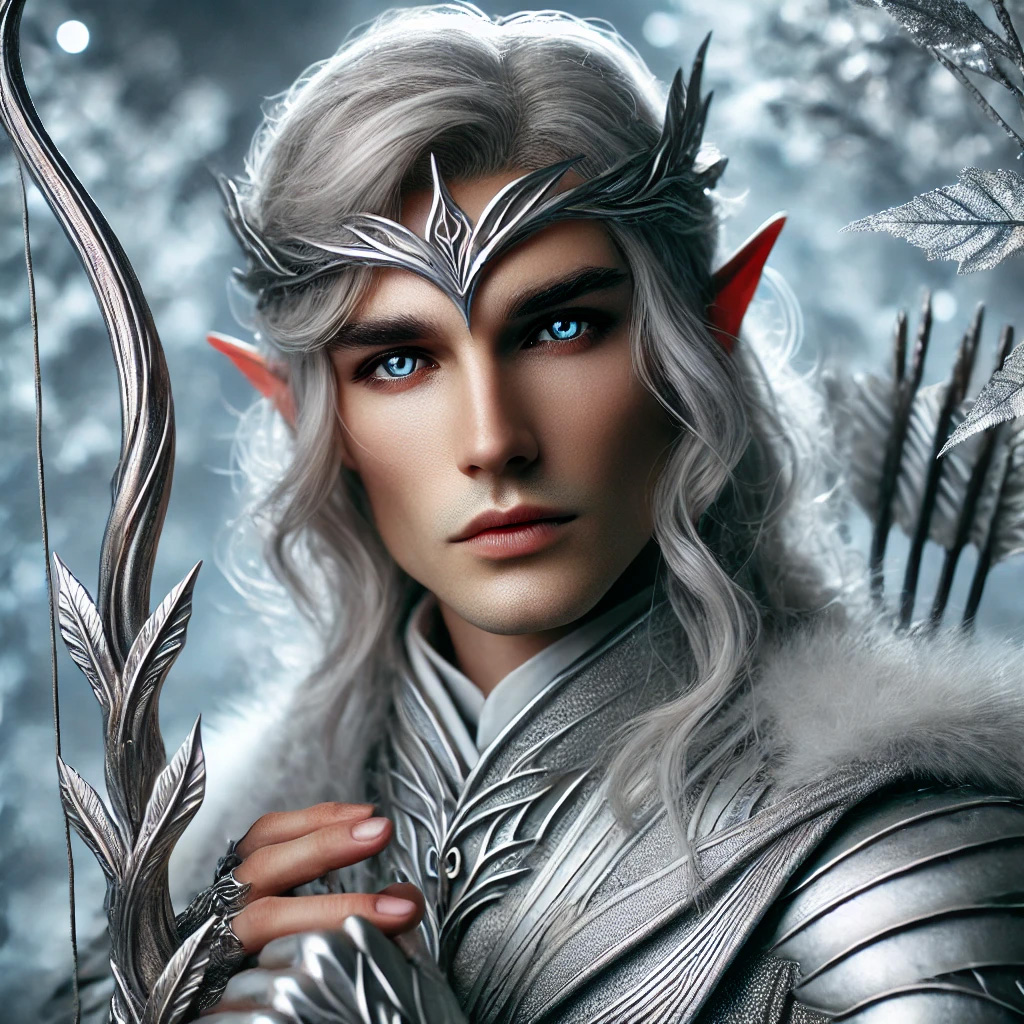
Prince Caeldor exists at the intersection of two paths, shaped by both the caution of his father and the intensity of his sister. His presence is quieter, less visible, yet no less significant. With ashen hair and ice-blue eyes, he moves through the forest like a shadow, striking with precision and vanishing before his presence can be fully understood.
Unlike Alariel, who leads from the front, Caeldor operates beyond the lines of battle, venturing deep into hostile territory, gathering knowledge, and confronting threats that few others would dare face. He has walked within the corrupted lands of Malgar, witnessed the rituals that sustain its power, and seen the full extent of what Drelkar has created. These experiences have given him a perspective that few in Thornwild share.
He understands that their enemy is not simply an occupying force, but a transformation of the land itself, a corruption that cannot be undone through conventional means. Because of this, he cannot fully commit to either extreme. He knows that immediate war may lead to destruction, yet he also recognizes that endless defense is not a solution.
This places him in a position of constant tension. He is loyal to his father, bound by duty and respect, yet he fights alongside his sister, understanding the necessity of action. To some, he represents the possibility of balance, a path that bridges caution and aggression. To others, he represents uncertainty in a time that demands clarity.
Caeldor does not seek power, nor does he seek recognition. Yet circumstances may force him into a role he has never desired, that of the one who must choose between the past and the future, and in doing so, define the fate of Thornwild.
The Fate of the Shadowed Forest
Thornwild stands upon the edge of transformation. The war against Malgar continues to escalate, the corruption spreads deeper into the land, and the unity that once defined the elves begins to fracture under the weight of impossible choices. Each path before them carries risk, and none offer certainty.
If they remain as they are, defending what remains and avoiding full confrontation, they may endure, but only for a time. The slow advance of corruption will continue, and the forest may one day be reduced to a shadow of what it once was. If they choose to strike, to reclaim the western lands through open war, they may regain what was lost, or they may lose everything that remains.
Between these extremes lies a fragile possibility, a path not yet fully defined, one that may require new alliances, new strategies, and a willingness to change without abandoning what defines them. Whether such a path exists, and whether it can be found in time, remains uncertain.
The forest still breathes.
The shadows still move.
And the fate of Thornwild has yet to be decided.