






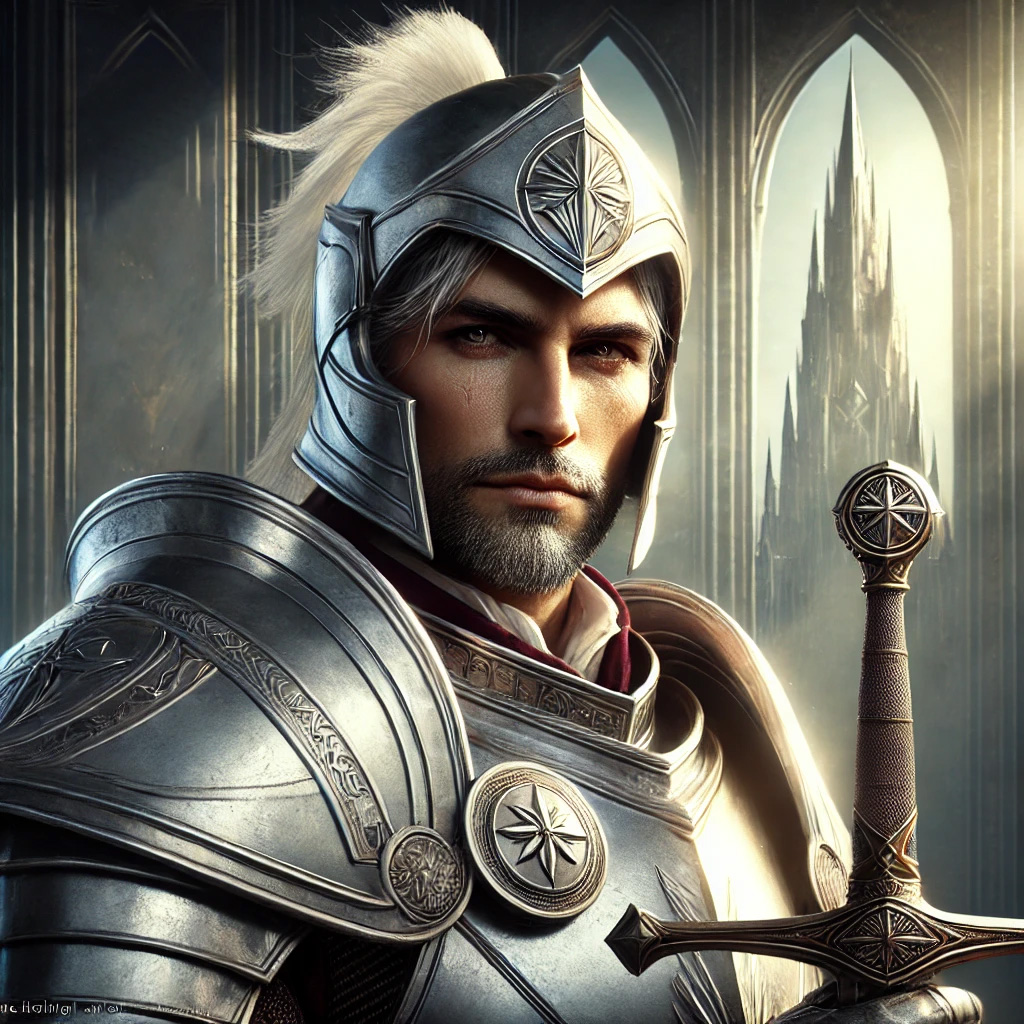
Albian, the Realm of the White Spire
A Kingdom Forged in War and Transformation
Albian was not born as a kingdom, but as a necessity, a fragile outpost carved into a hostile world during one of the darkest eras in recorded history. Its origins trace back to the Great War against the rising dominion of Agramon, when the western kingdom of Vlandor sought to establish a defensive stronghold capable of halting the spread of corruption and destruction. :contentReference[oaicite:0]{index=0}
What began as a strategic colony soon became something far greater. Positioned at the edge of encroaching darkness, the settlement was designed not to thrive, but to endure. It was entrusted to the Eldrakar, a people of immense strength and extended lifespans, whose role was to oversee its construction, maintain its defenses, and ensure that the frontier would not fall.
Yet the land itself resisted simplicity. Unlike the structured and hierarchical society of Vlandor, the frontier demanded adaptation. Survival required cooperation, resilience, and the ability to evolve beyond rigid systems. As the Eldrakar nobles established their presence, they did not remain isolated from the local human populations. Instead, necessity forged unity, and over generations, their bloodlines intertwined.
From this fusion emerged a new identity, one neither entirely Eldrakar nor human, but something uniquely Albian. Strength remained a defining trait, but it was no longer the privilege of birth alone. Merit, valor, and contribution to the realm began to shape status in ways that diverged sharply from the traditions of Vlandor.
The Birth of a Different Society
This transformation did not occur overnight. It was forged through conflict, reinforced by shared hardship, and solidified by the constant threat of annihilation. Every siege endured, every invasion repelled, every sacrifice made in defense of the land contributed to the shaping of a society where survival depended on unity rather than hierarchy.
Unlike its parent kingdom, where lineage dictates authority, Albian evolved toward a more fluid structure. While the influence of Eldrakar ancestry remains visible, particularly among the higher ranks of nobility, it does not define worth as it once did. A common-born soldier may rise through the ranks through sheer capability, while a noble who fails to serve the realm may find their influence diminished.
This meritocratic foundation has become one of Albian’s defining characteristics, admired by some and viewed with skepticism by others. To allies, it represents adaptability and strength. To more traditional realms, it appears unstable, a system that risks undermining the order that has long governed civilization.
Yet it is precisely this difference that allowed Albian to survive where others may have fallen.
Forged in war, shaped by necessity, and strengthened through unity, Albian did not simply endure the Great War.
It emerged from it as something new.
The Albian Spire, Heart of Stone and Light
At the core of Albian’s power rises the White Spire, an immense citadel carved directly into the side of a towering mountain, its pale walls gleaming like a beacon against the darker tones of the surrounding land. It is not merely a fortress, but the very heart of the kingdom, a place where political authority, military command, and arcane knowledge converge into a single, unyielding stronghold. :contentReference[oaicite:0]{index=0}
From afar, the Spire appears almost unnatural in its perfection, its structure blending monumental architecture with ancient enchantments that reinforce every wall, every gate, every tower. Its foundations run deep into the mountain itself, making it not only difficult to breach, but nearly impossible to dismantle. Over the centuries, it has endured countless sieges, each one leaving its mark not in ruin, but in legend.
Within its walls, the life of Albian unfolds in layered complexity. The upper levels house the royal court, the strategic command centers, and the arcane sanctums where mages work to maintain the magical defenses of the realm. Below, barracks, armories, and training grounds prepare soldiers for the conflicts that never seem far from the kingdom’s borders. Deeper still, vast halls carved into the stone serve as repositories of knowledge, resources, and contingency plans for wars yet to come.
The Spire is not simply defended, it is alive with purpose. Every corridor, every tower, every defensive position has been designed with war in mind, refined across generations of commanders who understood that this structure would one day determine the survival of the realm.
A Land Shaped by Conflict and Opportunity
Beyond the Spire, Albian stretches across a landscape as varied as the challenges it faces. Fertile plains extend outward from the central stronghold, providing the agricultural backbone that sustains the population and supports prolonged military campaigns. These lands, carefully cultivated and fiercely protected, are among the kingdom’s most valuable assets, making them frequent targets for raiders and invading forces.
To the south and west, rugged mountain ranges form natural barriers that both protect and isolate the kingdom. These heights serve as both shield and obstacle, slowing the advance of enemies while also complicating internal movement and trade. Hidden passes, known only to experienced guides and scouts, become critical arteries during times of war, allowing Albian to maneuver forces in ways that outsiders rarely anticipate.
Dense forests and uneven terrain further define the kingdom’s borders, creating zones where conventional warfare becomes difficult and unpredictable. In these regions, control is not measured by occupation, but by presence, by the ability to observe, disrupt, and deny access to hostile forces.
Along its coasts, the land opens toward the sea, offering both opportunity and vulnerability. Trade routes connect Albian to distant realms, bringing wealth, knowledge, and influence. Yet these same waters expose it to constant threat, as hostile fleets and opportunistic raiders test its defenses, seeking to exploit any weakness along its shores.
A Strategic Crossroads in a Shifting World
Albian’s position within the world is both a blessing and a burden. It stands at the intersection of multiple spheres of influence, bordered by allies whose support is vital, and enemies whose ambitions never waver. This location has transformed the kingdom into a central pillar of regional stability, a buffer against the expansion of darker forces and a point of convergence for trade and diplomacy.
Its roads are traveled by merchants, envoys, and soldiers alike, each movement contributing to the complex web of interactions that define the region. Control of these routes is essential, not only for economic prosperity, but for the rapid deployment of forces in times of crisis.
Yet this strategic importance comes at a cost. Albian cannot afford complacency. Every border must be watched, every alliance maintained, every threat anticipated before it fully emerges. Unlike more isolated realms, it does not have the luxury of choosing when to engage with the world.
The world comes to Albian, whether it wills it or not.
And the White Spire stands ready to answer.
The Albian Spire, Heart of Stone and Light
At the core of Albian’s power rises the White Spire, an immense citadel carved directly into the side of a towering mountain, its pale walls gleaming like a beacon against the darker tones of the surrounding land. It is not merely a fortress, but the very heart of the kingdom, a place where political authority, military command, and arcane knowledge converge into a single, unyielding stronghold. :contentReference[oaicite:0]{index=0}
From afar, the Spire appears almost unnatural in its perfection, its structure blending monumental architecture with ancient enchantments that reinforce every wall, every gate, every tower. Its foundations run deep into the mountain itself, making it not only difficult to breach, but nearly impossible to dismantle. Over the centuries, it has endured countless sieges, each one leaving its mark not in ruin, but in legend.
Within its walls, the life of Albian unfolds in layered complexity. The upper levels house the royal court, the strategic command centers, and the arcane sanctums where mages work to maintain the magical defenses of the realm. Below, barracks, armories, and training grounds prepare soldiers for the conflicts that never seem far from the kingdom’s borders. Deeper still, vast halls carved into the stone serve as repositories of knowledge, resources, and contingency plans for wars yet to come.
The Spire is not simply defended, it is alive with purpose. Every corridor, every tower, every defensive position has been designed with war in mind, refined across generations of commanders who understood that this structure would one day determine the survival of the realm.
A Land Shaped by Conflict and Opportunity
Beyond the Spire, Albian stretches across a landscape as varied as the challenges it faces. Fertile plains extend outward from the central stronghold, providing the agricultural backbone that sustains the population and supports prolonged military campaigns. These lands, carefully cultivated and fiercely protected, are among the kingdom’s most valuable assets, making them frequent targets for raiders and invading forces.
To the south and west, rugged mountain ranges form natural barriers that both protect and isolate the kingdom. These heights serve as both shield and obstacle, slowing the advance of enemies while also complicating internal movement and trade. Hidden passes, known only to experienced guides and scouts, become critical arteries during times of war, allowing Albian to maneuver forces in ways that outsiders rarely anticipate.
Dense forests and uneven terrain further define the kingdom’s borders, creating zones where conventional warfare becomes difficult and unpredictable. In these regions, control is not measured by occupation, but by presence, by the ability to observe, disrupt, and deny access to hostile forces.
Along its coasts, the land opens toward the sea, offering both opportunity and vulnerability. Trade routes connect Albian to distant realms, bringing wealth, knowledge, and influence. Yet these same waters expose it to constant threat, as hostile fleets and opportunistic raiders test its defenses, seeking to exploit any weakness along its shores.
A Strategic Crossroads in a Shifting World
Albian’s position within the world is both a blessing and a burden. It stands at the intersection of multiple spheres of influence, bordered by allies whose support is vital, and enemies whose ambitions never waver. This location has transformed the kingdom into a central pillar of regional stability, a buffer against the expansion of darker forces and a point of convergence for trade and diplomacy.
Its roads are traveled by merchants, envoys, and soldiers alike, each movement contributing to the complex web of interactions that define the region. Control of these routes is essential, not only for economic prosperity, but for the rapid deployment of forces in times of crisis.
Yet this strategic importance comes at a cost. Albian cannot afford complacency. Every border must be watched, every alliance maintained, every threat anticipated before it fully emerges. Unlike more isolated realms, it does not have the luxury of choosing when to engage with the world.
The world comes to Albian, whether it wills it or not.
And the White Spire stands ready to answer.
Fractures Beneath the Crown
For all its strength and unity in the face of external threats, Albian is far from a kingdom at peace within its own walls. Beneath the image of resilience and order lies a network of tensions, ambitions, and silent rivalries that threaten to erode the foundations upon which the realm was built. :contentReference[oaicite:0]{index=0}
At the heart of these struggles is the royal court, where influence is wielded not only through loyalty, but through manipulation, ambition, and careful control of resources. Among its most dangerous figures stands Lord Aeric, the royal steward, whose outward devotion masks a far more calculated pursuit of power. Through subtle schemes and financial maneuvering, he redirects wealth, weakens rivals, and positions himself as an indispensable figure within the kingdom’s governance.
His actions do not go entirely unnoticed, yet they remain difficult to confront. Aeric operates within the system, exploiting its complexity rather than opposing it outright. In doing so, he embodies one of Albian’s greatest vulnerabilities, the belief that internal stability can be maintained even as corruption takes root.
These tensions are further amplified by the kingdom’s own ideals. Albian prides itself on its meritocratic nature, yet the legacy of Eldrakar bloodlines still carries weight. Among the nobility, this creates an unspoken divide between those who believe authority should remain tied to heritage, and those who see the future of the kingdom in its evolving structure.
Conflicts over land, wealth, and influence emerge not as open rebellion, but as constant friction, a slow pressure that shapes decisions, alliances, and loyalties within the court.
The Weight of Wealth and Survival
Albian’s economy is both its strength and its burden. Sustained by fertile plains, rich mineral deposits, and extensive trade networks, the kingdom possesses the resources necessary to maintain prolonged military campaigns and support a growing population. Its fields feed its armies, its mines supply its forges, and its position as a trade hub ensures a steady flow of wealth through its cities.
At the center of this system stands the Albian Spire, not only as a fortress, but as a nexus of commerce and administration. Merchants from distant lands gather within its reach, exchanging goods, information, and influence. Trade routes extend in all directions, binding Albian to the wider world in ways that are both beneficial and risky.
This prosperity, however, is not without strain. War is costly, and Albian exists in a near-constant state of readiness. Every soldier trained, every weapon forged, every fortification maintained draws upon the kingdom’s resources. Balancing these demands requires precision, and even minor disruptions can ripple across the entire system.
Within this delicate balance, figures such as Finbar, the royal treasurer, play a critical role. His pragmatic approach ensures that the kingdom does not collapse under the weight of its own ambitions, yet his decisions often place him in direct conflict with military leaders who see any limitation as a potential risk to security.
Thus, even prosperity becomes a source of tension, a reminder that survival is not only won on the battlefield, but maintained through careful control of what lies behind it.
The Sword and Shield of Albian
Albian’s military is not merely an instrument of war, it is the backbone of the kingdom’s existence. Forged through centuries of conflict, it reflects the same principles that define Albian itself, discipline, adaptability, and the ability to endure against overwhelming odds.
At its core stand the Guardians of the Spire, elite knights whose duty is to defend the heart of the kingdom at all costs. Clad in heavy armor and trained to operate as a unified force, they represent the unbreakable wall upon which enemies inevitably break. Their presence within the Spire is both symbolic and practical, a constant assurance that the kingdom’s center will not fall.
Beyond them, the wider army operates across multiple fronts, adapting to the varied terrain that defines Albian’s borders. Infantry formations hold the line against invading forces, cavalry units exploit openings and pursue retreating enemies, and specialized units operate in more complex environments where conventional tactics fail.
On the coasts, the Albian navy serves as a critical extension of this defense. Under the command of Admiral Lothar, it has become a formidable force capable of countering the unpredictable raids of the Corsairs of Draxis. Naval engagements are rarely decisive, but their outcome determines the stability of trade and the safety of the kingdom’s shores.
What sets Albian’s military apart is not merely its strength, but its integration. Land and sea, strategy and execution, magic and steel, all function together as parts of a unified system. This cohesion allows Albian to respond to threats with a level of coordination that few other kingdoms can match.
Yet even this strength is tested. The constant pressure of external enemies, combined with internal divisions, ensures that the army is never truly at rest.
In Albian, peace is not the absence of war.
It is the brief moment between battles.
Valerian, Archmage of Albian
Among all the forces that sustain Albian, none are as quietly decisive as the mastery of magic, and at the center of this invisible defense stands Valerian, Archmage of the White Spire. His presence alone is enough to alter the balance of power surrounding the kingdom, not through spectacle, but through knowledge, control, and an understanding of arcane forces that few in the world can rival. :contentReference[oaicite:0]{index=0}
Valerian is not merely a powerful mage, he is one of the last surviving members of the Vhalan, an ancient and once-revered council of Eldrakar sorcerers whose influence once stretched across vast regions of the world. The Vhalan were not united by ambition alone, but by a shared vision, to bring order through magic, to guide civilizations, and to impose structure upon a world they believed too chaotic to endure without intervention.
Yet such power could not remain stable. Over time, divisions emerged within the council, not over their goals, but over the means by which those goals should be achieved. Where some, like Valerian, remained committed to balance and protection, others succumbed to the allure of domination, seeking to bend magic not to preserve the world, but to control it.
The fall of the Vhalan was not marked by a single event, but by a gradual unraveling, betrayals, rivalries, and conflicts that shattered what had once been a unified order. Among those who fell was Rumon the Pale, now remembered not as a guardian, but as one of the most dangerous traitors to ever wield arcane power. His name, like those of others who followed a similar path, remains a warning rather than a memory.
A Living Bastion of Arcane Defense
Within Albian, Valerian’s role extends far beyond that of a scholar or advisor. He is the architect of the kingdom’s magical defenses, the unseen force that reinforces the Spire’s walls, wards its gates, and shields it from threats that cannot be stopped by steel alone. Every enchantment woven into the fortress, every protective barrier layered across its structure, bears the mark of his knowledge and precision.
His mastery of elemental forces allows him to respond to dangers that others cannot even perceive. Where armies clash on the battlefield, Valerian confronts currents of magic, distortions in the arcane fabric, and hostile forces that seek to undermine Albian from beyond the visible world. In this role, he is both defender and sentinel, standing at a threshold that few others even know exists.
Yet his power is not without consequence. As a Vhalan, Valerian carries within him knowledge that others would kill to obtain. Among those who seek it most relentlessly are the Drelkars of Dreadhold, corrupted Eldrakar who have extended their lives through dark magic and now drift ever closer to becoming specters. To them, Valerian is not merely an enemy, but a key, a source of secrets that could grant them greater control over their own transformation and perhaps free them from its inevitable cost.
This makes him a constant target, forcing him to remain vigilant at all times. His existence is not only a shield for Albian, but a vulnerability that must be protected at all costs.
Bridges of Knowledge and Rivalries of Fire
Despite the dangers that surround him, Valerian does not isolate himself entirely from the wider world. He maintains a rare and significant correspondence with Revalion of Sylvara, one of the few mages whose understanding approaches his own. Through this exchange, knowledge flows between the two realms, strengthening their defenses and deepening their alliance.
Yet their philosophies differ in fundamental ways. Revalion views magic as a force to be understood in harmony with nature, something to be guided rather than controlled. Valerian, shaped by the harsh realities of Albian’s position, sees magic as a tool that must be mastered, directed, and, when necessary, weaponized. This divergence does not divide them, but it creates a tension that reflects the broader contrast between their respective cultures.
In stark opposition stands Zunak the Flame Master of Gryndor, a sorcerer whose approach to magic embodies everything Valerian rejects. Where Valerian seeks balance, Zunak embraces destruction. Where one builds defenses, the other tears them apart. Their encounters have been rare, but each has left a lasting impression, culminating in a stalemate that neither has forgotten.
For Valerian, this unresolved conflict is more than a rivalry, it is a reminder that the dangers of magic are not confined to the past. They are present, evolving, and growing stronger.
The Burden of a Broken Legacy
To be one of the last Vhalan is not a title of honor, but a burden of memory. Valerian carries with him the weight of what his order once was, and the consequences of what it became. He stands not only as a defender of Albian, but as a living testament to the dangers of unchecked power.
His purpose is not only to protect the kingdom, but to restore, in whatever limited way he can, the integrity that the Vhalan once claimed to represent. This is a task without end, a path that offers no certainty of success.
Yet he walks it regardless.
For in a world where magic can shape empires and destroy them, knowledge is both the greatest weapon and the greatest responsibility.
And Valerian carries both.
The Court of Albian, Power Beneath the Surface
Behind the imposing strength of the White Spire and the disciplined ranks of its armies lies another battlefield, quieter but no less decisive, the royal court of Albian. Here, power is not measured in steel or sorcery alone, but in influence, perception, and the ability to shape events without ever stepping onto a field of war. :contentReference[oaicite:0]{index=0}
Within these halls, alliances are formed in whispers, rivalries unfold beneath layers of courtesy, and every decision carries consequences that ripple far beyond the walls of the Spire. It is a place where loyalty is often genuine, but rarely simple, and where even the most devoted servants of the crown pursue their own interpretations of what is best for the kingdom.
Lord Aeric, the Hidden Hand
At the center of this intricate web stands Lord Aeric, the royal steward, a man whose influence extends far beyond the limits of his official role. Outwardly, he embodies loyalty, efficiency, and unwavering dedication to King Elenor II. Inwardly, he is something far more complex, a strategist of patience and subtlety, whose ambitions are carefully concealed behind layers of calculated restraint.
Aeric does not seek power through open defiance, but through control. He manipulates the flow of resources, redirects wealth, and positions himself as indispensable to the functioning of the court. Every favor granted, every alliance nurtured, every piece of information gathered serves a larger design that only he fully understands.
His greatest strength lies in his ability to remain unseen as a threat. He does not oppose the crown, he supports it, shaping its decisions from within rather than challenging them from without. In doing so, he becomes both its servant and its silent architect.
Yet his influence is not without limits. There are those within the court who watch him closely, aware that beneath his composed exterior lies a force that could, if left unchecked, destabilize the very system he claims to protect.
Finbar, Keeper of the Kingdom’s Wealth
Among those drawn into Aeric’s orbit is Finbar, the royal treasurer, a gnome whose pragmatic mind has kept Albian’s coffers stable even in times of relentless war. Finbar is not a man driven by ambition or intrigue, but by necessity. To him, numbers are not abstract concepts, but the foundation upon which the kingdom’s survival rests.
He understands that every campaign, every fortification, every alliance carries a cost, and that those costs must be managed with precision. His decisions are often unpopular among military leaders, who see financial limitations as obstacles rather than safeguards. Yet without his restraint, Albian’s strength would collapse under its own weight.
It is this practicality that makes him vulnerable to manipulation. Aeric exploits Finbar’s focus on stability, guiding his decisions in ways that serve hidden agendas. Though Finbar has begun to sense irregularities, the full extent of the steward’s influence remains just beyond his grasp.
Despite this, Finbar’s role is indispensable, and his growing awareness may yet become a turning point within the court.
Alaric, the Iron Will of the Spire
In stark contrast to the subtlety of courtly intrigue stands Alaric, commander of the Spire’s garrison, a man whose loyalty is as unyielding as the fortress he defends. To Alaric, there is no greater priority than the security of Albian, and no compromise is acceptable when that security is at stake.
His discipline is absolute, his expectations uncompromising. Under his command, the garrison operates with precision and efficiency, every soldier trained to uphold the standards he demands. This has earned him both respect and resentment, for while his methods ensure strength, they leave little room for flexibility or dissent.
Alaric’s greatest source of conflict lies with Finbar, whose financial constraints he views as a direct threat to the Spire’s defenses. Where Finbar sees balance, Alaric sees risk. Their disagreements are frequent, their perspectives difficult to reconcile, yet both are essential to the kingdom’s survival.
Despite his rigid nature, Alaric is not blind. He trusts Valerian’s judgment and values the role of magic in strengthening the Spire’s defenses, recognizing that not all threats can be met with steel alone. At the same time, he remains deeply suspicious of external infiltration, particularly from forces linked to Dreadhold, whose agents have tested the Spire’s security more than once.
A Court Held Together by Tension
What defines the court of Albian is not unity, but balance. Each of its key figures operates according to a different vision of what the kingdom requires, stability, strength, control, or adaptation. These perspectives do not align perfectly, and the tension between them shapes every decision that emerges from the Spire.
Aeric manipulates from within, seeking influence through subtle control. Finbar safeguards the kingdom’s resources, attempting to maintain equilibrium in the face of constant demand. Alaric enforces security with uncompromising discipline, ensuring that no weakness is allowed to take root.
Above them all stands the crown, relying on each of these forces while remaining subject to the consequences of their interactions. The system endures not because it is harmonious, but because each element counterbalances the others.
For now, this tension holds.
But within such a system, it takes only a single shift for balance to become fracture.
Commanders of War and Guardians of the Realm
If the White Spire is the heart of Albian, then its commanders are the lifeblood that carries its strength across every battlefield. Each of them embodies a different aspect of the kingdom’s military doctrine, discipline, adaptability, and the relentless will to endure. :contentReference[oaicite:0]{index=0}
At the head of Albian’s armies stands Baranor, brother of King Elenor II and one of the greatest military minds of his generation. Known as the Wall of Albian, he is both a strategist and a warrior, capable of holding the line against overwhelming forces while orchestrating complex campaigns across multiple fronts. His victories have secured the kingdom time and again, yet he remains marked by a single failure, a retreat against the forces of Gryndor that, while necessary, continues to weigh heavily upon him. It is this memory that drives him, pushing him to refine his strategies, to anticipate every weakness, and to ensure that such a moment is never repeated.
Along the coasts, where the land gives way to open waters and unseen dangers, Admiral Lothar commands the Albian fleet. Rising from humble origins, he has forged his reputation through tactical brilliance and unyielding determination. His battles against the Corsairs of Draxis have become legend, particularly his decisive victory at Cape Blades, where he shattered a superior enemy force through precision and timing. Yet his war is far from over. His rivalry with Tharnak the Pillager continues, each encounter sharpening both men, each victory temporary in a conflict that shows no sign of ending.
In the shadowed edges of the kingdom, beyond fortified walls and structured formations, operates Halathor, captain of the Albian Rangers. Where Baranor commands armies and Lothar controls fleets, Halathor masters the unseen war. His forces move through forests, mountains, and enemy territory with a fluidity that defies conventional tactics. Ambushes, raids, and precise strikes define his approach, allowing him to disrupt threats before they can fully materialize.
Yet his methods are not without controversy. Within his own ranks, tension simmers, most notably with Dorian, a rival captain whose philosophy stands in direct opposition. Where Halathor values instinct, adaptation, and harmony with the terrain, Dorian favors direct action, efficiency, and results above all else. Their rivalry is not merely personal, it reflects a broader question within Albian’s military, whether tradition and adaptability should guide its future, or whether necessity demands a more ruthless approach.
This tension extends beyond the Rangers. Throughout the kingdom’s forces, differing philosophies coexist, sometimes in harmony, sometimes in conflict. Yet it is precisely this diversity that allows Albian to respond to a wide range of threats, each commander contributing a piece of a larger, more flexible system.
Rising Figures and Uncertain Futures
Among the next generation stands Ealdric, son of Baranor, a young lieutenant whose potential is as evident as his recklessness. Brilliant in battle yet prone to bold and dangerous decisions, he represents both the promise and the risk of Albian’s future. His victories have already earned him recognition, but his path remains uncertain, shaped as much by his own ambition as by the expectations placed upon him.
He is drawn to figures who embody strength and legend, warriors such as Kaedric Wolfslayer, whose exploits fuel his desire to prove himself. At the same time, he navigates complex relationships within Albian’s own ranks, particularly with Dorian, whose ambition mirrors his own in ways that may one day turn alliance into rivalry.
Beyond the battlefield, the network of relationships that binds Albian to the wider world continues to influence its fate. Halathor’s cautious respect for Brynja Stoneshield of the Greyhills reflects the fragile balance between conflict and cooperation along their borders. Lothar’s exchanges with Zaraya Delsaran of Qarath extend Albian’s awareness across the seas. Even distant figures, allies, rivals, and unknown forces, play a role in shaping the kingdom’s future.
Each connection, each alliance, each rivalry forms part of a larger tapestry, one that extends far beyond the immediate concerns of war.
The Crown and the Weight of Destiny
Above all stands King Elenor II, ruler of Albian and embodiment of its ideals. He is not a king who governs from afar, but one who fights alongside his people, leading from the front when the situation demands it. His presence on the battlefield is both symbol and reality, a reminder that leadership in Albian is defined not only by authority, but by action.
Elenor walks a path between tradition and transformation. As a descendant of the Eldrakar of Vlandor, he carries the weight of history, yet as king of Albian, he must guide a society that has grown beyond those origins. His alliance with Sylvara, strengthened through his union with Elira, represents a vision of unity that extends beyond race and tradition, yet it also introduces challenges that cannot be ignored.
To some, he is a unifier, a leader capable of bringing together different peoples in the face of a common threat. To others, he is a ruler walking too close to change, risking the stability that has allowed Albian to endure.
Yet Elenor does not hesitate. He understands that inaction is as dangerous as failure, and that the future of Albian will be determined not by the safety of its past, but by the choices made in the present.
The Legacy of the White Spire
Albian stands as one of the last great bastions against the forces that seek to reshape the world through conquest, corruption, and chaos. Its strength lies not only in its armies or its walls, but in its ability to adapt, to endure, and to unite forces that might otherwise stand divided.
Yet this strength is not absolute. Internal tensions continue to grow, enemies press from every direction, and the delicate balance that sustains the kingdom is constantly tested. Every victory is temporary, every alliance fragile, every decision carries weight beyond its immediate consequence.
The White Spire still stands, its walls unbroken, its banners raised high against the darkness.
But the world around it is changing.
And in that change lies both the greatest threat to Albian, and its greatest opportunity.