






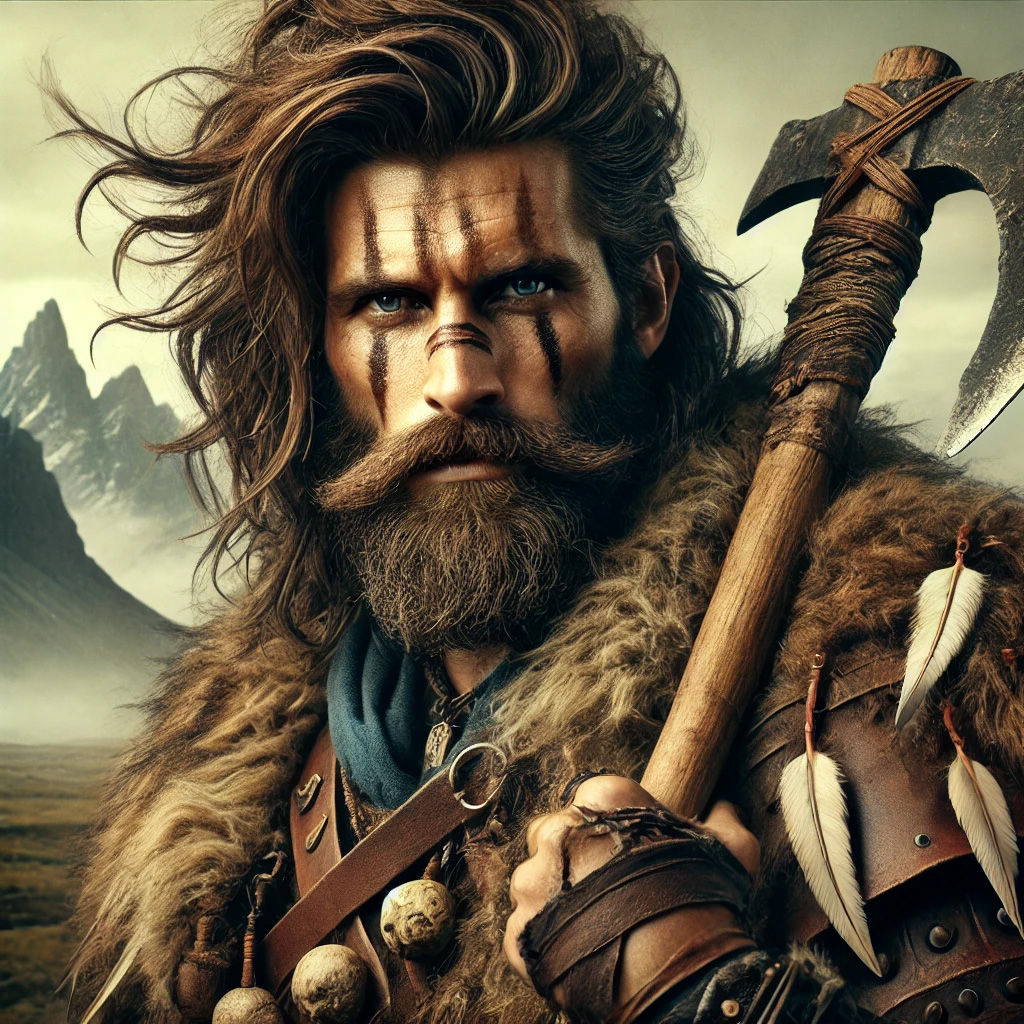
Greyhills, Land of the Freeborn
A Harsh Land That Forged an Unbreakable People
The Greyhills are not a land that welcomes life, they are a land that tests it, shapes it, and, for those who endure, transforms it into something unyielding. Across this rugged expanse of jagged hills and deep, shadowed valleys, the wind never truly rests, carving the stone and whispering through the sparse vegetation that clings stubbornly to the earth. :contentReference[oaicite:0]{index=0}
The ground itself is unforgiving, broken by sharp outcrops and uneven ridges that make travel slow and treacherous for those unfamiliar with its rhythms. Water is scarce, fertile soil even more so, and the seasons offer little mercy. Yet it is within this harsh and demanding environment that the people known as the Wutans have carved out their existence, not by taming the land, but by learning to survive alongside it.
To outsiders, the Greyhills appear barren, even hostile, a place where no kingdom could thrive. But to the Freeborn, this land is not a curse, it is a proving ground. Every hardship endured is a lesson, every scar carried is a mark of belonging, and every generation that survives strengthens the bond between people and land.
The Wutans are not merely inhabitants of the Greyhills, they are its reflection. Their resilience mirrors the stone beneath their feet, their independence echoes the untamed winds that sweep across the hills, and their refusal to bow to any external authority is as absolute as the land itself.
The Meaning of Freedom
Among the Wutans, freedom is not an ideal, it is a truth as fundamental as breath. It is not granted by rulers, nor protected by laws, but claimed, defended, and passed down through generations as a birthright that cannot be surrendered.
They call themselves the Freeborn not as a title, but as a declaration. To live in the Greyhills is to live without chains, without masters, and without the influence of distant powers who would seek to impose their will upon them. This belief defines every aspect of their society, from the way they govern themselves to the way they fight, trade, and interact with the world beyond their borders.
This independence comes at a cost. Unity is not always easily maintained among fiercely autonomous clans, and decisions often require negotiation, debate, and, at times, conflict. Yet it is precisely this refusal to submit that has allowed the Wutans to endure where more structured societies might have fractured or fallen.
To the Wutans, survival without freedom is not survival at all.
And so they endure, not as subjects of a kingdom, but as the guardians of a way of life that no empire has ever managed to break.
Exile, Survival, and the Birth of a People
The origins of the Wutans are not rooted in triumph, but in displacement. Long before they became the Freeborn of the Greyhills, their ancestors lived in more fertile lands, lands that would eventually fall under the expansion of Albian. As the kingdom grew in strength and influence, its reach extended outward, pushing beyond its original borders and reshaping the regions around it. :contentReference[oaicite:0]{index=0}
Those who would become the Wutans did not submit. Rather than accept the authority of a rising power they neither trusted nor desired, they chose exile. They fled into the Greyhills, a land few others would claim, a place too harsh to conquer and too unforgiving to exploit. What began as a retreat became, over generations, a transformation.
Survival in the Greyhills demanded more than endurance. It required adaptation, unity, and a willingness to abandon the structures of the past. Clans formed not from lineage alone, but from necessity, groups bound together by shared struggle and mutual reliance. Over time, these clans developed their own identities, their own traditions, yet all remained tied to a common truth, that they had chosen freedom over comfort, and hardship over submission.
This choice defines them still. The memory of displacement is not a wound that fades, but a foundation upon which their identity is built. Every conflict with Albian, every clash along the borders, is seen not as a new war, but as the continuation of an older one.
Traditions Carved in Stone and Blood
Life among the Wutans is governed not by written law, but by tradition, memory, and the shared understanding of what it means to endure. Their customs are not ornamental, they are functional, shaped by centuries of survival in a land that offers no forgiveness for weakness.
Seasonal festivals mark the passage of time, anchoring the clans to a rhythm that persists despite hardship. Among these, the Festival of the Wolf stands as one of the most significant. It is not merely a celebration, but a trial, a rite of passage through which young warriors must prove their worth. Strength, cunning, and resilience are tested in equal measure, and those who succeed earn their place among the defenders of their people.
These rituals serve a deeper purpose. They reinforce unity among clans that might otherwise drift apart, reminding each generation that they are part of something larger than themselves. In a society without centralized authority, such traditions are the threads that hold everything together.
The past is never distant in the Greyhills. It is carried in stories, in scars, and in the silent understanding that every generation inherits the burden of those who came before.
Leadership Forged Through Deeds
Among the Wutans, authority is never inherited blindly, it is earned, tested, and constantly reaffirmed. Chieftains do not rule by right of blood alone, but by the strength of their actions and the respect they command. A leader who fails to protect their people or who acts without wisdom will not remain in power for long.
At the forefront of this system stands Kaedric Wolfslayer, a chieftain whose name has become synonymous with defiance. His rise was not the result of lineage, but of victory, a decisive triumph against an Albian force that secured both his position and his reputation. Since then, he has proven time and again that his leadership is not symbolic, but real, grounded in the same risks and sacrifices demanded of every warrior.
Kaedric does not lead from safety. He fights alongside his people, his presence on the battlefield serving as both inspiration and challenge. To follow him is to follow someone who shares in the danger, who bleeds as they bleed, and who stands as the embodiment of the freedom they defend.
Yet leadership among the Wutans is never absolute. Decisions of consequence are often debated within Stone Circles, ancient gathering places where elders, warriors, and chieftains meet to determine the path forward. These discussions can be long, contentious, and unresolved, but they ensure that no single voice defines the fate of all.
In this way, the Greyhills remain unified not through control, but through constant negotiation, a fragile but enduring balance between independence and collective survival.
War as a Way of Survival
For the Wutans, warfare is not a pursuit of conquest, but a necessity born from the need to protect what little they possess. Every battle fought is tied to survival, to the defense of land, identity, and freedom. This purpose shapes their methods, setting them apart from the structured armies of kingdoms like Albian.
The warriors of the Greyhills do not march in rigid formations, nor do they rely on overwhelming force. Instead, they become part of the terrain itself, using the hills, valleys, and hidden paths to their advantage. Ambushes are their greatest weapon, sudden, precise, and devastating. They strike where the enemy is weakest, disrupt supply lines, isolate units, and vanish before a counterattack can form.
Their weapons reflect this philosophy. Axes, spears, and longbows, simple in design but effective in execution, crafted in hidden forges scattered across the hills. Armor is often minimal, allowing for speed and mobility, though certain warriors, such as Brynja Stoneshield, embody a different approach, standing as immovable defenders when the situation demands it.
What distinguishes the Wutans further is the role of every member of their society in warfare. Men and women fight side by side, not as an exception, but as a reflection of their values. Strength is not defined by tradition, but by capability, and those who can defend the Greyhills are expected to do so.
In battle, they are not merely warriors.
They are the will of the land itself, rising against those who would claim it.
Between Alliance and Defiance
The Wutans do not live apart from the world, they live against it, alongside it, and sometimes within it, but always on their own terms. Their relationships with neighboring powers are shaped not by diplomacy in the traditional sense, but by necessity, caution, and a deep-rooted refusal to submit to external influence. :contentReference[oaicite:0]{index=0}
To the north and beyond the forests lies Sylvara, a realm as ancient as it is distant in spirit. Trade between the two exists, though it is measured and pragmatic rather than warm. The Wutans exchange iron, steel, and crafted goods born of their mountain forges for rare materials and refined artifacts that cannot be found within the Greyhills. Yet this relationship never deepens into true alliance. The elves of Sylvara are seen as powerful but detached, a people whose long view of time and controlled harmony stands in stark contrast to the raw immediacy of Wutan life. There is respect, but little understanding.
To the south, the lands of Gryndor present a far more volatile interaction. Orc warlords and Wutan clans have, on occasion, found themselves aligned by circumstance, their shared hostility toward Albian creating temporary bonds of convenience. These alliances are never stable. Both sides recognize the opportunistic nature of the other, and betrayal is not a question of if, but when. Even so, in moments of greater threat, cooperation can emerge, brief, fragile, and often as dangerous as open conflict.
Yet it is with Albian that the deepest and most enduring tension exists. To the Wutans, Albian is not merely a neighboring kingdom, it is the force that drove their ancestors into exile, the embodiment of expansion, structure, and control. Every fortified road, every patrol, every attempt at negotiation is viewed through the lens of this history.
Skirmishes along the borders are frequent, almost ritualistic in their persistence. Raids are carried out not only for resources, but as acts of defiance, reminders that the Greyhills cannot be claimed, controlled, or absorbed. Around campfires, stories of successful ambushes and disrupted supply lines are shared as victories not just of strategy, but of identity.
To Albian, the Wutans are a destabilizing force, unpredictable and resistant to order. To the Wutans, Albian is a creeping shadow, one that must be resisted not once, but endlessly.
Between these perspectives lies a conflict that neither side can fully resolve.
The Living Land and the Spirits Within
For the Wutans, the Greyhills are not simply a place of residence, they are a living presence, a force that watches, remembers, and responds. Every hill, every valley, every shifting wind carries meaning, shaped by spirits that dwell within the land itself. These spirits are not distant deities, but immediate, ever-present entities whose influence can be felt in both subtle signs and overwhelming moments.
Before battle, warriors do not rely solely on skill or preparation. They invoke the spirits through chants, offerings, and rituals passed down through generations. These acts are not symbolic, they are believed to establish a connection, a moment of alignment between the warrior and the land they defend. To fight without this bond is to fight alone, something few Wutans would willingly risk.
This spiritual relationship extends beyond war into every aspect of life. The land provides, but it also demands respect. To take from it without acknowledgment is seen as a form of betrayal, one that can bring misfortune not just upon an individual, but upon an entire clan.
Their funeral rites reflect this belief with equal intensity. The dead are not buried beneath the soil, but returned to it through fire. Bodies are placed upon pyres, their flames rising into the open air, carrying both spirit and memory back into the world. The ashes are then scattered across the hills, ensuring that the fallen do not leave, but remain, watching over their kin, becoming part of the very land they once fought to protect.
Through this cycle, life and death are not seen as opposites, but as continuation. The past is not behind them, it is beneath their feet, in the wind at their backs, and in the silence that follows battle.
This connection is what makes the Wutans more than survivors.
It makes them inseparable from the Greyhills themselves.
Voices of the Greyhills
Among the Wutans, stories are not luxuries, they are weapons, lessons, and bonds that tie generations together. Around the flickering light of campfires, beneath skies often hidden by clouds and wind, the voices of those who have walked beyond the hills carry as much weight as those who defend them. :contentReference[oaicite:0]{index=0}
Dragan Stormfoot is one such voice, a wanderer whose journeys have taken him far beyond the Greyhills into lands most Wutans will never see. His tales are not simple entertainments, they are windows into a wider world, one filled with wonders, dangers, and truths that challenge the isolation of his people. He speaks of distant cities where wealth flows like water, of deserts where the sands themselves seem alive, and of coasts where shadows move with intent.
Yet no matter how far he travels, Dragan always returns. His stories do not weaken the resolve of the Wutans, they strengthen it. For every marvel he describes, he reminds his people of what they are not, and what they must never become. The world beyond may offer riches and power, but it also demands compromise, submission, and change. The Greyhills demand none of these.
Through Dragan, the Wutans are reminded that their struggle is not born of ignorance, but of choice.
Torven Blackeye, Weaver of Chaos
Where Dragan brings perspective, Torven Blackeye brings uncertainty. A figure as feared as he is useful, Torven moves through the Greyhills not as a leader, but as a catalyst. He does not command armies, he shapes outcomes, bending events through manipulation, deception, and a deep understanding of both allies and enemies.
To the clans, he is a necessary risk. His plans often lead to victory, his strategies disrupting Albian patrols, misdirecting forces, and creating opportunities where none should exist. Yet his loyalty is never absolute. Torven serves himself first, and the Greyhills second, a truth that all who deal with him understand, even as they accept the advantages he provides.
He thrives in chaos, not merely reacting to it, but creating it. In a land where freedom is valued above all else, Torven represents its most dangerous expression, the freedom to act without restraint, without loyalty, and without consequence until those consequences finally arrive.
Kaedric Wolfslayer, the Roar of the Freeborn
At the center of the Greyhills stands Kaedric Wolfslayer, not as a distant ruler, but as the living embodiment of Wutan defiance. His voice carries across battlefields, his presence igniting the fury and courage of those who fight beside him. He does not inspire through words alone, but through action, standing at the front of every clash, his axe rising and falling with relentless force.
To his enemies, he is a force of chaos, unpredictable and relentless. To his people, he is certainty, the guarantee that no matter how strong the opposition, the Greyhills will not fall without a fight that will be remembered for generations.
Kaedric understands that leadership is not about control, but about presence. He walks among his people after battle, listening as much as he commands, ensuring that the bond between chieftain and clan remains unbroken.
He is not merely their leader.
He is their voice, their fury, and their unyielding will.
Brynja Stoneshield, the Unbroken Wall
Where Kaedric embodies motion and aggression, Brynja Stoneshield represents endurance. On the battlefield, she is an immovable force, her shield raised against overwhelming odds, her stance unshaken even as enemies crash against her defenses.
Her name has become legend among the Wutans, not for a single victory, but for her refusal to yield. When fortresses are threatened and lines begin to break, it is Brynja who stands at the point of collapse, holding the line long enough for others to rally, regroup, and strike back.
She is more than a warrior. She is a symbol, a reminder that strength is not only found in attack, but in resilience, in the ability to stand when all else falters.
To the Wutans, as long as Brynja stands, so too do the Greyhills.
The Greyhills, Eternal and Unconquered
The Greyhills are not a kingdom, nor will they ever become one. They are something older, something less defined, and far more difficult to break. They are a land where freedom is not granted, but defended, where every generation inherits not wealth or comfort, but the responsibility to endure.
Their enemies see them as scattered, disorganized, and resistant to progress. Their allies see them as unpredictable, difficult to trust, and impossible to control. Yet both perspectives fail to grasp the truth.
The strength of the Wutans does not lie in unity of structure, but in unity of purpose. They do not need walls, for the land itself shields them. They do not need kings, for their leaders rise when needed. They do not need empires, for they have something far more enduring.
They have the will to remain free.
As long as the winds sweep across the hills, as long as the stone endures beneath their feet, and as long as even a single Wutan stands to defend it, the Greyhills will never be conquered.
Not by steel.
Not by magic.
Not by time itself.
The soft glow of the campfire illuminated Dragan Stormfoot’s weathered face, his boots resting on a stone, worn from countless miles across lands both hostile and enchanting. Around him, a circle of Wutan warriors leaned closer, captivated by his words.
“Beyond the dunes of Qarath lies a city where the sand itself seems to whisper secrets,” Dragan said, his deep voice weaving a tale of adventure. “They call it the Mirage City, where merchants sell goods so rare that even kings would empty their coffers for a single chest. But the price of entry is blood, and the shadows there move as if alive.”
The warriors hung on his every word, their rugged faces betraying awe and disbelief in equal measure. For the Wutans, Dragan was not just a storyteller—he was living proof that the world beyond the Greyhills was as dangerous and vast as their elders had warned.
Yet, Dragan’s purpose was more than to entertain. He sought to remind them that their fight for freedom was not just for the Greyhills but for the unyielding spirit that defined their people. Each tale of distant lands reinforced their resolve, for though he had seen wonders, he always returned to the hills.
As the fire crackled and sparks ascended into the dark, starless sky, Dragan’s voice dropped to a whisper. “I’ve crossed the Côte des Spectres, where even the bravest fear to tread. And do you know what kept me alive?” He leaned closer, his steely eyes meeting each warrior’s gaze. “It was the thought of home. The thought of these hills. This is our sanctuary, our bastion. Never forget what we fight for.”
The warriors nodded, their spirits renewed. Dragan smiled to himself as he leaned back, content that his tales had done their work.
Torven Blackeye - The Puppetmaster of Shadows
The dimly lit cave reeked of damp earth and secrecy. Torven Blackeye sat at the center of a makeshift council, his sharp features illuminated by the flickering light of a single lantern. Around him were clan leaders, their expressions a mixture of suspicion and intrigue.
“The Albians have grown complacent,” Torven began, his voice smooth and persuasive. “Their border patrols are predictable, their supply routes unguarded. If we strike now, we can seize their riches before they even realize we’re upon them.”
A grizzled chieftain leaned forward, his voice gruff. “And what’s in it for you, Blackeye? You never play a game without a prize.”
Torven’s lips curved into a sly smile. “My prize is your victory, my friend. When the Wutans grow stronger, so do I. And let’s not forget, no one manipulates the Albians better than I do. With their soldiers chasing phantoms, your clans can claim their spoils without breaking a sweat.”
The council murmured, weighing his words. They all knew Torven’s reputation—untrustworthy, self-serving, and dangerously clever. But they also knew that his schemes often bore fruit.
“Fine,” another chieftain muttered. “We’ll follow your plan. But if it fails, you’ll answer to us.”
Torven inclined his head, his single eye gleaming. “Failure is not in my vocabulary.”
As the meeting ended and the chieftains filed out, Torven remained seated, a faint smile playing on his lips. He didn’t just orchestrate battles—he orchestrated chaos. And in chaos, he thrived.
Kaedric Wolfslayer - The Chieftain’s Roar
The clang of steel against steel echoed through the valley as Kaedric Wolfslayer swung his axe with lethal precision. The Albian captain barely had time to raise his shield before it was split in two, sending him sprawling to the ground.
“Is this the best Albian Spire has to offer?” Kaedric roared, his voice carrying over the battlefield. “You call yourselves soldiers? You’re lambs to the slaughter!”
The Wutans surged forward, emboldened by their leader’s defiance. Kaedric was not one to command from the rear. He fought in the thick of battle, his presence a rallying cry for his warriors.
As the skirmish ended and the Albian forces retreated, Kaedric stood amidst the carnage, his axe dripping with blood. He turned to his warriors, his voice steady but fierce. “Every step they take onto our land is an insult to our ancestors. Remember their faces, remember their arrogance. And when they return, show them why the Wutans are feared.”
Later, as the campfires lit the night, Kaedric walked among his people, listening to their stories, their fears, and their hopes. He was not just their chieftain—he was their shield, their sword, and their voice.
Brynja Stoneshield - The Unyielding Defender
The Greyhills fortress was under siege. Albian forces battered at the gates with relentless fury, their siege engines hurling stones and fire. But atop the walls stood Brynja Stoneshield, her presence as immovable as the rock beneath her feet.
“Hold the line!” she bellowed, her shield raised high. “These walls will not fall, not while I draw breath!”
The Wutan defenders rallied around her, their courage reignited by her unyielding determination. As arrows rained down, Brynja stood firm, her shield deflecting blow after blow. When the gates groaned under the weight of the enemy’s battering ram, she led the charge to reinforce them, her axe crushing any who dared to breach their defenses.
Hours turned into days, but Brynja’s resolve never wavered. When the Albian forces finally withdrew, defeated and humiliated, it was her name the defenders chanted in victory.
As dawn broke over the hills, Brynja stood atop the fortress wall, gazing at the horizon. She knew the battle was only the beginning. “They will come again,” she murmured to herself. “But so will I.”
For the Wutans, Brynja was more than a warrior—she was the embodiment of their spirit, a beacon of hope in their darkest hours. And as long as she stood, the Greyhills would never fall.
The Call to Adventure
To play as a Wutan is to embody the spirit of freedom and defiance. Whether leading daring raids, uncovering ancient secrets hidden in the hills, or navigating the treacherous politics of the clans, characters from the Greyhills offer rich opportunities for storytelling. The bonds of kinship, the fight for survival, and the indomitable will to remain free make the Wutans a compelling choice for any adventurer seeking a land steeped in history and conflict.