






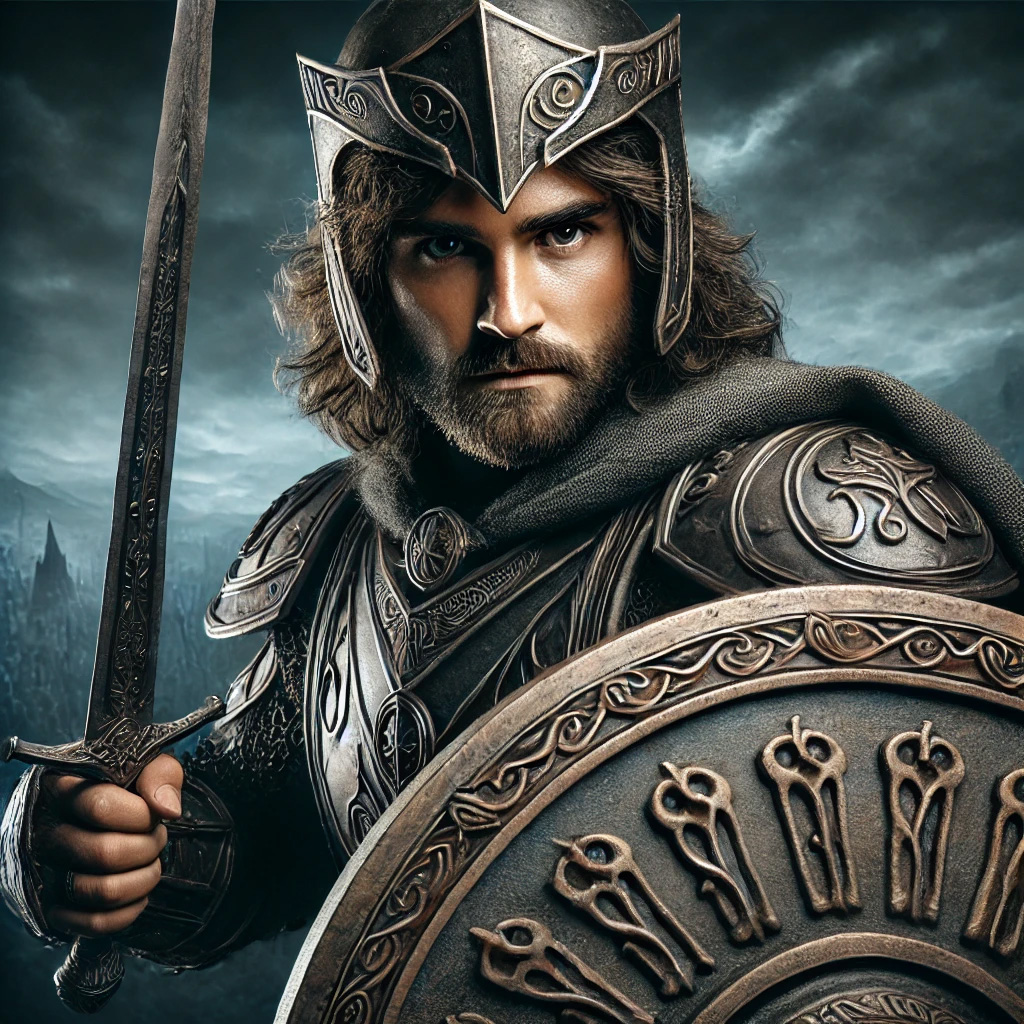
Hillfolk, the Quiet Keepers of the Hills
Geography and History
The Hillfolk, a hardy and peaceful race of gnomes, dwell within the rolling green hills of Greenholm, a land defined by fertile meadows, quiet valleys, and gentle streams that have endured with remarkable constancy across centuries. Located south of Thornwild’s shadowed forests, southwest of the mountain strongholds of Velan, west of the declining kingdom of Vlandor, and north of the deep and ancient forests of the Wildmen, Greenholm exists at the intersection of several major powers while remaining, at least outwardly, untouched by their conflicts. :contentReference[oaicite:0]{index=0}
This land is not merely peaceful, it is deliberately so. The Hillfolk have shaped their environment to sustain life without excess, creating a network of small villages, hidden burrows, and lively market towns that blend seamlessly into the surrounding hills. Their homes are not fortresses, yet they are far from vulnerable. Beneath the earth lies a labyrinth of tunnels, storage chambers, and escape routes, while above ground the terrain itself offers subtle protection through elevation, visibility, and natural barriers.
Greenholm has long served as a natural crossroads between greater powers, though the Hillfolk have never sought to control this position. To the north, the elves of Thornwild maintain distant but steady trade, exchanging rare craftsmanship, silks, and arcane objects for agricultural goods and finely worked tools. To the south, the Wildmen’s forests stand as a living boundary, their inhabitants wary yet not hostile, engaging in rare exchanges of herbs, furs, and knowledge. To the west, the Wardens of Velan remain trusted allies, bound by shared history and mutual respect. To the east, Vlandor, once dominant and now diminished, remains both a partner and a looming uncertainty.
A Land of Prosperity and Quiet Strength
Unlike many regions scarred by war and conquest, Greenholm has endured as a place of continuity. Its hills provide not only fertile farmland but also natural defenses that discourage large-scale invasion. While the Hillfolk are not warriors in the conventional sense, they are far from defenseless. Their mastery of stealth, archery, and hidden infrastructure has ensured that any force attempting to conquer them would face an enemy they cannot see, cannot easily strike, and cannot fully understand.
During the Great War, Greenholm chose a path of cautious neutrality, supplying food and materials to multiple sides while refusing to be drawn into direct conflict. This decision preserved their land, but it also shaped their identity. They became known not for conquest, but for reliability, for their ability to endure while others fell.
At the height of its power, Vlandor sought to bring Greenholm under its control, viewing its fertile lands and strategic position as too valuable to ignore. Yet every attempt at domination failed. The Hillfolk did not meet armies in open battle, instead they resisted through evasion, disruption, and an intimate understanding of their terrain. Supply lines faltered, scouts disappeared, and advances slowed to a crawl. Eventually, Vlandor abandoned the effort and turned to diplomacy, establishing a trade relationship that continues even as the kingdom itself weakens.
Over generations, the Hillfolk have refined their role as indispensable intermediaries, traders, diplomats, and artisans whose value lies not in force, but in necessity. Their goods, from food to crafted items, are sought by all, ensuring that few would risk alienating them. This quiet influence has allowed them to remain independent without ever appearing threatening.
The Free Gnomes of Darkholm
The greatest shift in Greenholm’s recent history has not come from foreign invasion, but from the arrival of their own kin. The Free Gnomes of Darkholm, once enslaved under the rule of a fallen dwarven kingdom, have begun fleeing the chaos of their homeland, seeking refuge among the Hillfolk. The elders of Greenholm, long opposed to oppression in all its forms, have welcomed them, offering shelter, food, and protection as a matter of principle as much as compassion.
Yet this act of solidarity has revealed deep fractures. Though they share ancestry, the two peoples have diverged profoundly over generations. The Darkholm Gnomes are shaped by hardship, their lives defined by survival under harsh rule, their instincts sharpened by danger and betrayal. They are wary, hardened, and fiercely independent, traits that clash with the communal, stable, and tradition-bound society of the Hillfolk.
Many among the refugees struggle to adapt, finding the quiet rhythms of Greenholm alien and restrictive. Some refuse to settle at all, instead continuing their struggle, seeking vengeance against the forces that once enslaved them, whether dwarves, goblins, or warlords who still hold power in Darkholm. Their presence introduces not only tension, but also a question Greenholm has long avoided.
Can a people built on peace coexist with those forged in conflict.
Geopolitics and the Current Balance
Though Greenholm appears tranquil and removed from the struggles of the wider world, its position at the intersection of multiple powers ensures that it is never truly isolated. The Hillfolk have survived not by withdrawing completely, but by maintaining a delicate equilibrium, one built on diplomacy, trade, and a careful understanding of the ambitions of others. This balance, maintained over generations, is now under increasing strain as the world around them shifts in unpredictable ways. :contentReference[oaicite:0]{index=0}
The Hillfolk’s strength lies not in armies or fortifications, but in their ability to remain necessary to all while belonging fully to none. Every neighboring power sees value in Greenholm, yet each also represents a potential threat. For centuries, this tension has been managed through restraint and careful negotiation, but the stability that once defined the region is beginning to fracture.
The Elves of Thornwild
To the north, within the deep and ancient forests of Thornwild, the elves maintain their long-standing isolation from the outside world. Their relationship with the Hillfolk is one of rare exception, built not on friendship, but on mutual recognition of value. The Hillfolk provide agricultural abundance, crafted goods, and practical resources that the elves do not produce themselves, while the elves offer rare herbs, enchanted materials, and refined objects that carry both utility and prestige.
This exchange has endured for generations, yet it remains fragile. The elves do not involve themselves in the affairs of other peoples, and their patience is not infinite. Should Greenholm be drawn into open conflict, especially one that disrupts the natural balance of the region, the elves may withdraw entirely, severing a relationship that has quietly supported the Hillfolk’s prosperity for centuries.
The Wardens of Velan
To the west, the Wardens of Velan stand as perhaps the Hillfolk’s most steadfast allies, though their alliance is rooted in necessity as much as history. When Velan fell and its people were scattered, Greenholm offered refuge, food, and support to those who survived. In return, the Wardens swore to defend the Hillfolk should their lands ever come under threat.
This bond remains strong, yet it is not without tension. The Wardens are locked in an ongoing and unforgiving struggle against the orc warlords of Grimstone, a conflict that demands resources, attention, and constant vigilance. While the Hillfolk continue to provide supplies and safe passage, there is growing concern that their association with the Wardens may eventually draw them into a war they have long sought to avoid.
For now, the alliance endures in a state of careful distance, sustained by mutual benefit but restrained by the Hillfolk’s reluctance to commit fully to any cause beyond their own survival.
Vlandor, A Kingdom in Decline
To the east lies Vlandor, once a mighty empire whose influence shaped much of the known world, now reduced to a weakened and uncertain kingdom. Its relationship with Greenholm has evolved from attempted conquest to pragmatic trade, a shift born from failure as much as necessity.
Where once the Eldrakar lords sought to bring Greenholm under their rule, they now depend on its stability. The Hillfolk provide grain, livestock, and crafted goods essential to sustaining Vlandor’s population, while in return they receive metals, refined materials, and access to broader trade networks.
Yet this relationship carries an undercurrent of unease. The decline of Vlandor introduces instability, and instability spreads. Should the kingdom fall into civil war or further fragmentation, the consequences will not remain contained. Trade routes may collapse, refugees may flood westward, and opportunistic factions may seek to exploit the resulting chaos. The Hillfolk understand that Vlandor’s fate is no longer a distant concern, but a looming uncertainty that may one day force their hand.
The Wildmen and the Southern Tensions
To the south, the forests of the Wildmen represent both a boundary and a mirror. Like the Hillfolk, the Wildmen have long existed outside the structures of conventional power, living according to their own traditions and maintaining a careful distance from the conflicts of others. For generations, the two peoples have coexisted with minimal interference, engaging in small exchanges without seeking deeper connection.
This fragile balance is now under strain. The Forsworn of Halgaroth, driven by the need to rebuild their ruined kingdom, have begun harvesting resources from the Wildmen’s forests, particularly sacred wood vital to their reconstruction. This intrusion has sparked conflict, as the Wildmen view the forest not as a resource, but as a living entity that must be protected.
Though Greenholm is not directly involved, it cannot remain unaffected. The Hillfolk find themselves positioned between two opposing forces, each with legitimate claims and dangerous consequences. Some within Greenholm argue that supporting the Forsworn would strengthen trade and economic ties, while others believe that aligning with the Wildmen would preserve long-term stability and prevent further escalation.
For now, neutrality remains their chosen path, but it is a position that grows more difficult to maintain with each passing season.
The Free Gnomes, A Growing Internal Divide
The presence of the Free Gnomes from Darkholm continues to deepen the internal tensions within Greenholm. What began as an act of compassion has evolved into a complex and increasingly urgent dilemma. The Hillfolk, guided by principles of hospitality and shared heritage, cannot easily turn away those who seek refuge. Yet neither can they ignore the consequences of integrating a people shaped by war into a society defined by peace.
The Free Gnomes bring with them not only their skills and resilience, but also their scars, their anger, and their unresolved struggle. Their desire to continue the fight against their former oppressors introduces a perspective that challenges the very foundation of Hillfolk identity. Where the Hillfolk see survival through balance and restraint, the Free Gnomes see survival through action and resistance.
This divergence has begun to reshape Greenholm from within. Debates that were once theoretical have become immediate and personal. Should Greenholm remain a sanctuary, or should it become a participant in a broader conflict. Should it continue to prioritize peace, or accept that peace may no longer be sustainable without strength.
No consensus has emerged. The elders remain divided, the younger generations increasingly restless, and the Free Gnomes themselves uncertain whether they are guests, allies, or something else entirely.
The balance that once defined Greenholm still holds.
But it is no longer unshakable.
Leaders of Greenholm
To understand the true nature of Greenholm, one must look beyond its hills, its trade, and its alliances, and instead observe the individuals who guide its path. The Hillfolk are a people rooted in tradition, yet their future is shaped not only by collective memory, but by the choices of those who stand at the crossroads of change. Among them, several figures embody the tensions that define Greenholm, each representing a different vision of what the hills should become. :contentReference[oaicite:0]{index=0}
Elder Brannor Hearthwise, the Voice of Tradition
Elder Brannor Hearthwise stands as the oldest and most respected leader among the Hillfolk, a figure whose authority is not imposed, but accepted through decades of wisdom and quiet influence. As head of the Council of Elders, he carries the responsibility of preserving Greenholm’s traditions, ensuring that the peaceful way of life that has defined his people for generations does not unravel under the pressures of a changing world.
He remembers a time before decline, before instability, before the fractures that now spread across neighboring lands. He remembers Vlandor at the height of its power, the Wardens of Velan as rulers rather than survivors, and the Free Gnomes of Darkholm still bound in chains. These memories do not drive him toward action, but toward caution. To Brannor, history is not a call to intervene, but a warning of what happens when societies overreach.
His belief is simple, yet increasingly contested. Greenholm survives because it does not fight the wars of others. It endures because it trades, negotiates, and adapts without surrendering its identity. He sees involvement in external conflicts as a path not to strength, but to ruin. The arrival of the Free Gnomes troubles him deeply, not because he lacks compassion, but because he understands what their presence may bring. Likewise, he views the growing tensions between the Wildmen and the Forsworn with concern, knowing that choosing a side could shatter the balance Greenholm depends upon.
Yet Brannor’s wisdom is no longer unquestioned. Among the younger Hillfolk, there is a growing belief that neutrality is no longer enough, that the world has changed in ways that cannot be ignored. To them, his caution appears less like strength and more like hesitation. Still, Brannor remains unwavering. He does not seek to be loved, only to be right. And as long as he leads, Greenholm will remain a land of peace, whether that peace is preserved or merely delayed.
Nissa Brightbrook, the Wandering Tinker
Where Brannor embodies continuity, Nissa Brightbrook represents movement, curiosity, and the inevitability of change. Born into a family of merchants and inventors, she has spent much of her life beyond the borders of Greenholm, traveling between factions, trading goods, gathering knowledge, and observing a world far more complex than the hills she calls home.
Her experiences have shaped her into something rare among the Hillfolk, a figure who does not see isolation as safety, but as vulnerability. She has walked the markets of Thornwild, shared fires with the Wardens of Velan, and ventured into the dangerous lands of Darkholm, where she has helped smuggle Free Gnomes to safety. Through these journeys, she has come to believe that Greenholm cannot remain untouched forever, and that refusing to act may be as dangerous as choosing the wrong path.
Nissa’s vision is one of adaptation. She argues that the Hillfolk must strengthen their ties, not withdraw from them, and that they must be prepared for the moment when neutrality fails. She has openly challenged the Council, questioning whether their reluctance to change is wisdom or denial. Her stance has earned her both admiration and concern, particularly among the elders who see in her ideas the potential for unnecessary risk.
Yet her influence continues to grow. Younger Hillfolk are drawn to her perspective, inspired by the possibility of a world beyond Greenholm’s quiet boundaries. Whether she is a visionary or a catalyst for instability remains uncertain, but one thing is clear. She represents a future that cannot be ignored.
Thaddeus “Thatch” Burroway, the Hidden Blade
While Greenholm presents itself as a land of peace, that peace does not exist without protection, and that protection does not always take visible form. Thaddeus Burroway, known simply as Thatch, embodies the unseen mechanisms that ensure Greenholm’s safety. He is neither a soldier nor a ruler, yet his role is as vital as any army.
Raised among trappers and scouts, Thatch learned early how to move without being seen, how to observe without being detected, and how to strike without warning when necessary. His skills set him apart from his kin, not because they are unnatural, but because they reflect a reality most Hillfolk prefer not to acknowledge. Threats do exist, and sometimes they must be dealt with before they reach the hills.
Though he holds no formal title, Thatch operates with the quiet approval of the Council, tasked with ensuring that dangers are resolved beyond the awareness of the general population. Bandits, raiders, and other threats have vanished without explanation, their absence maintaining the illusion that Greenholm remains untouched by violence.
His relationship with Brannor is built on mutual understanding. Both seek to preserve peace, though their methods differ. Where Brannor relies on diplomacy, Thatch relies on action taken in silence. Nissa, however, views him with unease, questioning whether secrecy and hidden violence undermine the very values Greenholm seeks to protect.
Thatch himself does not see his role as heroic. He does not enjoy what he does, nor does he seek recognition. To him, it is simply necessary. Yet as tensions rise, even he begins to feel the strain. The threats he once managed quietly are growing in scale, and the shadows in which he operates may no longer be enough to contain them.
Della Thornwhistle, the Hearthkeeper
If Thatch protects Greenholm from external dangers, Della Thornwhistle preserves what makes it worth protecting. As matriarch of one of the oldest families in the region, she holds no formal authority, yet her influence is deeply woven into the cultural fabric of the Hillfolk.
Through gatherings, traditions, and shared moments, she maintains the identity of Greenholm. Festivals, meals, songs, and stories are not mere customs to her, but the foundation of what binds the Hillfolk together. In a world defined by conflict and change, she ensures that her people remember who they are.
Unlike Brannor, whose leadership is rooted in governance, or Nissa, whose vision looks outward, Della focuses inward. She understands that survival is not only about avoiding war, but about preserving meaning. Yet she is far from blind to the challenges ahead. She sees the divisions forming, the tensions rising, and the uncertainty growing.
She does not reject change, but neither does she embrace it without question. Instead, she seeks balance, a way to adapt without losing the essence of what defines Greenholm. Her role is not to decide the future, but to ensure that whatever future emerges, it does not erase the past.
The Future of Greenholm
Greenholm stands at a turning point unlike any it has faced before. For generations, it has endured through neutrality, diplomacy, and careful distance from the conflicts of others. But the world around it is no longer stable, and the forces pressing upon it are growing stronger, more complex, and more difficult to ignore.
The arrival of the Free Gnomes has introduced internal division. The tensions between neighboring factions threaten to draw Greenholm into external conflict. The decline of Vlandor, the struggles of the Wardens, and the growing unrest among the Wildmen all converge upon its borders.
The Hillfolk must now decide what they will become. Whether they remain quiet keepers of the hills, preserving their way of life through caution and restraint, or whether they adapt to a world that demands greater involvement.
The answer does not lie in one voice alone, but in the balance between them.
And that balance is beginning to shift.