






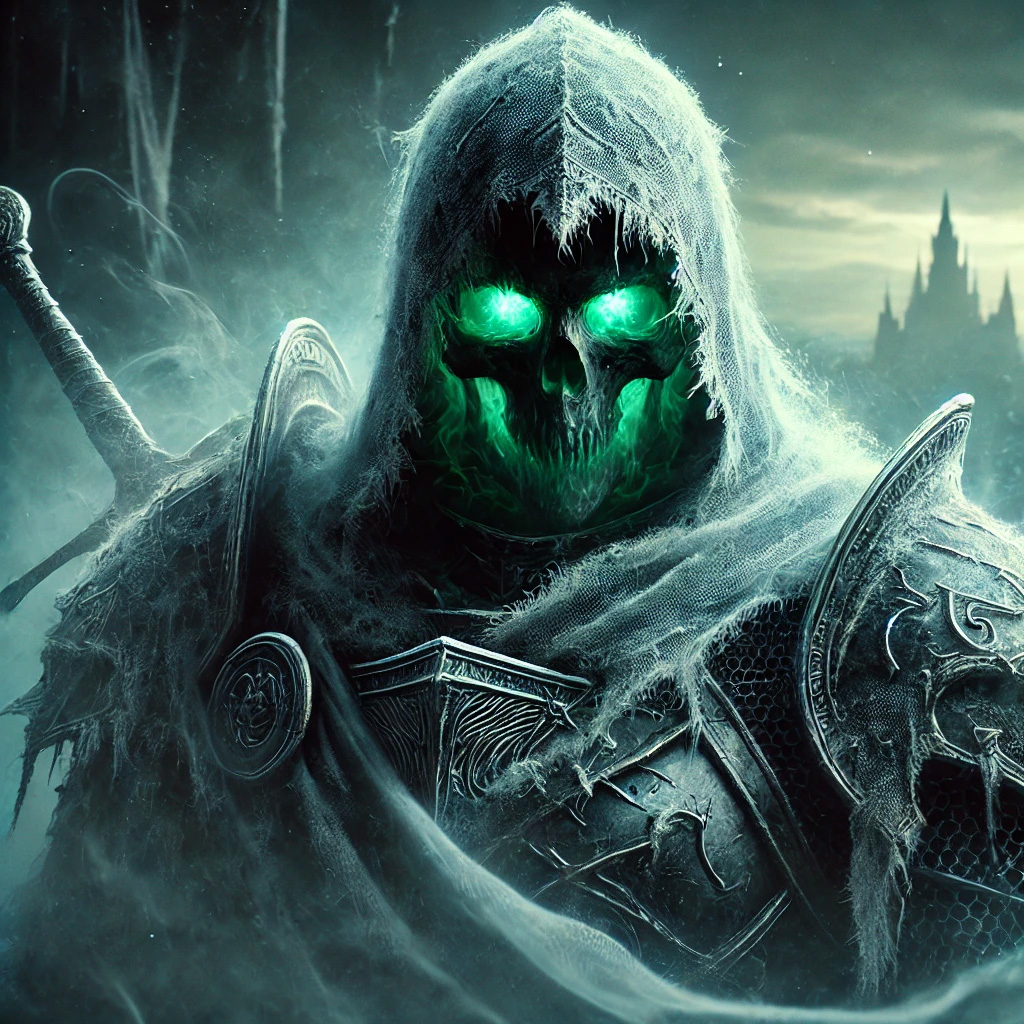
Malgar, the Shadowrealm of the Necromancer-King
A Kingdom Surrounded by Watchful Enemies
Malgar exists at the heart of a region where no border is ever truly at peace. To the north rise the unyielding mountains of Stoneward, where dwarven lords stand vigilant against any encroaching darkness. :contentReference[oaicite:0]{index=0} To the east and south stretch the ancient forests of Thornwild, their elven defenders locked in an endless struggle to reclaim what was lost. To the northeast, the hardened orcs of Grimstone fortify their territories, wary of the cursed land that once stood under their command. And to the west, beyond storm-lashed seas, lie the haunted coasts and the distant shadow of Dreadhold, where other powers of death and domination watch in silence.
At the center of this tightening ring of hostility lies Malgar, a realm suspended in a state of eternal twilight. The sky rarely clears, the light of the sun struggling to pierce the thick veil of necrotic haze that blankets the land. What was once part of the vast and vibrant Thornwild Forest has become something unrecognizable, a place where life does not simply fade, but is reshaped into something darker.
The trees themselves stand as twisted remnants of their former selves, blackened trunks contorted by unseen forces, their branches clawing at the sky like skeletal hands. The ground pulses faintly beneath the surface, infused with necromantic energy that seeps into every root, every stone, and every creature that dares to linger too long. Even the air carries the scent of decay, thick and oppressive, as though the land itself exhales death with every passing moment.
The Corruption of Thornwild
Malgar was not born as a kingdom, but as a wound. Once, this region was a thriving part of Thornwild, a forest where ancient life flourished under the guardianship of the elves. Its rivers ran clear, its groves sacred, and its balance maintained through centuries of harmony between nature and its protectors.
That balance was shattered when war came to the western continent. What began as a campaign of conquest would leave scars far deeper than any battlefield. The arrival of dark forces did not simply bring destruction, it brought transformation. The forest was not merely burned or cut down, it was altered, its essence twisted into something hostile and unrecognizable.
At the center of this transformation stands a single figure, the being now known as Malgaroth, the Necromancer-King. Once a Drelkar in service to Agramon, he would become something far greater, and far more dangerous, than any of his kind had ever been.
Under his influence, the land itself changed. The natural cycles of life and death were broken, replaced by something unnatural, something controlled. Where life once ended, it now lingered. Where death once brought silence, it now brought movement.
Malgar is not simply a conquered territory. It is a domain where death has been rewritten.
The Great War and the Fracture of Power
Malgar did not emerge in isolation. Its creation is inseparable from the final stages of the Great War, when Agramon’s vast campaign of conquest began to falter under mounting resistance. :contentReference[oaicite:0]{index=0} What had once been a relentless expansion across the western continent slowly turned into a struggle for survival, as supply lines collapsed, reinforcements dwindled, and coordinated counterattacks began to push his forces back.
Among the commanders entrusted with securing victory was Malgaroth, then one of the most formidable Drelkars in Agramon’s service. He had been given control of a major expeditionary force, tasked with consolidating conquered territories and ensuring the continued advance of the campaign. Unlike many warlords, Malgaroth did not rely solely on brute force. He understood the importance of positioning, logistics, and long-term strategy, and it was this understanding that would lead him to make a decision that would change the course of history.
As the war shifted, Malgaroth recognized that Agramon’s primary routes of reinforcement were failing. Rather than retreat or attempt to hold unstable frontlines, he devised an alternative, a new axis of advance through the heart of Thornwild. By conquering the elven forest, he believed he could establish a direct and sustainable route of supply, bypassing the collapsing networks and outmaneuvering the coalition forces of Vlandor and Velan.
At first, his plan appeared to succeed. Reinforced by elite Kragar forces from Dreadhold, Malgaroth’s armies drove deep into the eastern reaches of Thornwild. Sacred groves were burned, ancient sanctuaries desecrated, and elven defenders pushed back step by step. The advance was brutal, methodical, and devastating.
But victory came at a cost. The deeper his forces pushed into the forest, the more resistance intensified. The elves did not fight as conventional armies. They harassed, ambushed, and vanished, forcing Malgaroth’s troops into a war of attrition that slowly eroded their strength. Casualties mounted, and the campaign began to slow.
Then came the turning point.
Agramon began to lose.
Across multiple fronts, his armies suffered defeat after defeat. Reinforcements ceased entirely. The vast war machine that had once seemed unstoppable fractured under pressure, and the illusion of inevitable victory collapsed. For the commanders on the western continent, the situation became critical.
The Betrayal of Grimstone
Faced with the reality of isolation, the orcish warlords of the region made their choice. They refused to follow Malgaroth further into Thornwild. Instead, they chose survival over ambition. They consolidated their holdings, crowned their own Orc-King, and declared independence from Agramon’s failing empire.
For Malgaroth, this was more than a strategic disagreement.
It was betrayal.
He had committed his forces to a vision that required unity and continuation. Without the support of the other warlords, his position became untenable. He could no longer sustain a full campaign across Thornwild, nor could he retreat without abandoning everything he had gained.
Rather than collapse, he adapted. Malgaroth withdrew his forces from the outer reaches of the forest and fortified the territories he had already conquered. What remained under his control became the foundation of a new domain, one no longer tied to Agramon’s command or the ambitions of Grimstone.
He named it Malgar.
In that moment, the war changed.
No longer a general, Malgaroth became something else, a ruler without allies, surrounded by enemies, and forced to find power not through armies alone, but through something far more absolute.
Cut off from reinforcements, abandoned by his supposed allies, and encircled by hostile forces, he turned inward, toward the only resource that could not be taken from him.
Power.
Not the power of armies. But the power that endures beyond death itself.
The Nature of the Drelkars
The Drelkars are not a singular being, but a caste, a lineage of corrupted Eldrakars who have prolonged their existence through the use of dark magic. :contentReference[oaicite:0]{index=0} Once living, they have extended their lifespan far beyond its natural limits, binding themselves to forces that slowly erode both their bodies and their souls. What they gain in power, they lose in stability, and what begins as mastery inevitably leads toward decay.
All Drelkars share the same fate. Over time, their physical forms weaken, their flesh withers, and their presence drifts further from the material world. Eventually, they become specters, beings no longer fully anchored to reality, driven more by instinct and lingering will than true consciousness. For most, this transformation is not a choice, but an unavoidable consequence of the path they have taken.
Some serve Agramon, forming part of the dominant caste within Dreadhold, where their extended existence grants them authority and influence. Others operate independently, scattered across the world, bound to their own ambitions or obsessions. Yet all share the same underlying truth, no matter how powerful they become, they are ultimately consumed by the very magic that sustains them.
This is the curse of the Drelkars. Power that cannot be maintained. Control that cannot be preserved. An eternity that ends in dissolution.
Malgaroth, the Exception
Malgaroth did not accept this fate.
Where others saw inevitability, he saw a flaw. Where others feared their transformation, he studied it. During his campaign within Thornwild, he uncovered fragments of knowledge buried within ancient ruins, remnants of older powers that had once touched the boundary between life and death. These discoveries did not offer simple solutions, but they revealed something far more valuable, possibility.
When the moment came, when his body began to fail under the weight of the magic he wielded, Malgaroth did not resist the transformation. He embraced it, but on his own terms. Through rituals that bound his essence not to his decaying flesh, but to a controlled anchor of power, he retained what no other Drelkar had managed to preserve.
His will. His identity. His purpose. He did not become a drifting specter.
He became something stable, something enduring, something far more dangerous.
Malgaroth is not merely another Drelkar. He is the culmination of what they were always becoming, but could never fully achieve. A being that exists beyond the limits of flesh without losing the clarity of mind that defines true power. Among all Drelkars, he stands apart, surpassed only by Agramon himself, whose origin lies beyond their kind entirely. Yet unlike Agramon, whose power was forged through domination and conquest, Malgaroth’s strength is rooted in transformation and control over death itself.
The Birth of the Necromancer-King
With his ascension, Malgaroth reshaped not only himself, but the land he ruled. The necromantic energy he wielded did not remain contained, it spread, seeping into the soil, the roots, and the remnants of the battlefield that had become his domain. Death no longer marked an end, but a transition. The fallen did not remain still. They rose.
At first, as mindless forms, bodies animated by raw power. But over time, Malgaroth refined his control. Stronger individuals retained fragments of their former selves, their will bound and redirected rather than erased. Warriors became death knights. Leaders became spectral commanders. Entire armies were reforged into something that no longer depended on life to function.
In Malgar, death is not absence. It is a resource. A weapon. A foundation upon which an empire can be built.
And at its center stands Malgaroth, no longer a servant of Agramon, no longer bound by the limitations of the Drelkars, but a ruler of something entirely new.
A king who does not age. A sovereign who does not weaken. A master of a force that no living empire can truly rival.
The Lords of Death and Dominion
At the center of Malgar’s dominion stands Malgaroth, the Necromancer-King, once a Drelkar in service to Agramon, now something far beyond the limits of his former kind. :contentReference[oaicite:0]{index=0} Where other Drelkars inevitably succumb to the slow erosion of their bodies and minds, fading into unstable specters, Malgaroth achieved what none of them could, the preservation of his will beyond death. Through forbidden knowledge uncovered within the ancient ruins of Thornwild, he redefined the transformation that defines his kind, anchoring his essence to a controlled source of power rather than allowing it to dissipate. In doing so, he became the most powerful of all Drelkars, surpassed only by Agramon himself, whose origin lies beyond their corrupted lineage. As Malgaroth, the Undying, he rules not as a fading sorcerer, but as a stable and calculating sovereign, his form shifting between the physical and the spectral, his presence imposing absolute control over both the living and the dead. His mastery of necromancy is not simply a tool of war, it is the foundation of an empire where death itself is governed, directed, and weaponized.
At his side stands Varzath the Unyielding, the last truly loyal Drelkar who has not yet completed the transformation that defines his kind. Sustained by dark magic and bound by unwavering devotion, Varzath walks the fragile line between life and undeath, his body preserved through runic armor and ritual, his mind sharpened by the knowledge of what awaits him. Unlike many Drelkars who serve either Agramon or pursue their own fragmented ambitions, Varzath has chosen absolute loyalty, believing that Malgaroth’s path offers a way to transcend the inevitable fate of their kind. As both general and sorcerer, he wields the Soulcarver, a weapon that drains life to sustain his failing form, and commands shadow and cold with equal mastery, weakening enemies before they can even reach him. To Malgaroth, he is more than a servant, he is a remnant of a shared past, and potentially the first of a new kind of Drelkar, one who may yet follow the same path of controlled ascension.
Where Varzath represents loyalty and transformation, Dreadknight Kaelzar embodies the perfection of undeath as a weapon. Once a mortal warlord who led elite forces during the conquest of Thornwild, Kaelzar was reforged through necromantic ritual after his death, his soul bound to his armor and reshaped into a being of relentless purpose. Now commander of the Spectral Host, he leads Malgar’s undead legions with absolute precision, his presence on the battlefield spreading despair as much as destruction. His blade, Nightfang, does not merely kill, it captures the essence of those it strikes, ensuring that even death becomes service. Kaelzar is no longer driven by ambition or fear, but by a singular directive, to execute Malgaroth’s will with flawless efficiency, making him one of the most reliable and terrifying instruments of the Necromancer-King’s power.
Despite the dominance of the undead, Malgar still relies on the strength of the living, and none embody this aspect more than Gorgash the Butcher, the towering troll warlord who commands the mortal legions. Unlike the orcs of Grimstone, who fight for honor or dominance, Gorgash’s warriors fight because survival demands it, and because failure guarantees a far worse fate than death. Gorgash enforces this reality with brutal clarity, ensuring that only the strongest endure under his command. Armed with a massive cleaver of blackened iron, he leads charges that shatter enemy formations through sheer physical force, acting as the raw, living counterpart to the calculated inevitability of the undead. Though he serves Malgaroth, his loyalty is conditional, rooted in strength rather than devotion, and he remains one of the few figures within the kingdom who would challenge the Necromancer-King should any sign of weakness ever emerge.
Above both the living and the dead soars Zarkul the Flamefiend, a creature that exists at the boundary between beast and catastrophe. A fusion of Drakoth and Wyvern, bound through dark sorcery, Zarkul serves as Malgar’s ultimate instrument of destruction, unleashed when entire armies must be erased or fortified cities reduced to ash. Its body, covered in blackened scales as hard as forged steel, radiates heat and power, while its wings spread like a storm across the battlefield. Unlike mindless beasts, Zarkul possesses a cruel and deliberate intelligence, fully aware of its own strength and the devastation it brings. It does not serve out of obedience alone, but because Malgaroth offers it what it desires most, endless destruction. This uneasy alignment of will makes Zarkul both an asset and a latent threat, a reminder that even within Malgar’s control, some forces are only partially contained.
The March of the Undying Empire
Malgar is no longer a remnant of war or a fractured outpost abandoned by a failing empire. It has become something far more enduring, a kingdom built upon a foundation that no conventional power can replicate. Its armies do not weaken over time, they grow. Its losses do not diminish it, they reinforce it. Every battle fought within or against Malgar strengthens its core, feeding the cycle that sustains its expansion.
Yet its position remains precarious. Surrounded by enemies who understand the nature of the threat it represents, Malgar cannot afford stagnation. The dwarves of Stoneward fortify and prepare, the elves of Thornwild resist and adapt, and the orcs of Grimstone wait for an opportunity to strike. Even distant powers, such as Agramon and the forces of Dreadhold, remain factors that cannot be ignored, their own mastery of dark forces creating a balance that could one day tip toward conflict.
Malgaroth is aware of all of this, and unlike many rulers, he does not seek immediate domination at any cost. He is patient, methodical, and calculating, understanding that his true advantage lies not in speed, but in inevitability. Where others must win quickly, he can afford to endure, to weaken his enemies over time, and to turn their own losses into his strength.
The war for the western continent is not over, it has merely changed form. No longer defined by the movements of armies alone, it is now a struggle of endurance, corruption, and transformation, one in which Malgar holds a unique and terrifying advantage.
As long as Malgaroth endures, Malgar cannot truly be defeated. It can be contained, resisted, even pushed back, but never permanently erased. Because in this kingdom, death is not the end of power, it is the beginning of it.
To the north, the unyielding mountains of Stoneward loom, their dwarven lords ever watchful. To the east and south, the ancient forests of Thornwild stand defiant, their elves fighting a desperate battle against the encroaching darkness. To the northeast, the war-hardened orcs of Grimstone fortify their strongholds, wary of their spectral neighbor. And to the west, across the storm-lashed ocean, lies the Cursed Coast and the dread fortress of Dreadhold, a land forever tainted by the specters of the past.
At the heart of this accursed land lies Malgar, a realm shrouded in eternal twilight, where the blackened trees twist and wither under the weight of dark sorcery. The air is thick with the stench of decay, and the very ground pulses with necrotic energy, warping the creatures that dwell within. Once part of the great Thornwild Forest, these lands were stolen by war, twisted by the will of a single being—the Necromancer-King Malgaroth, once known as Drelkar.
The Rise of Malgar
Malgar was not always a land of death and undeath. During the Great War, it was merely another battlefield in Agramon’s grand campaign of conquest. The dark legions swept across the lands of dwarves and men, subjugating what is now Grimstone before turning their gaze to Vlandor and Velan. But Agramon’s war did not go as planned. His forces suffered crushing defeats, his reinforcements dwindled, and his most vital supply lines were severed by the elves of Everspring and their allies.
In the chaos, Malgaroth, the commander of Agramon’s expeditionary force in the western continent, made a fateful decision—he sought to secure an alternative route. He turned his armies towards Thornwild, believing that conquering the elves would allow him to outmaneuver the enemy and ensure a direct supply line to Agramon’s homeland.
At first, victory seemed inevitable. With elite Kragar reinforcements from Dreadhold securing their conquered lands, Malgaroth’s veteran orcish troops smashed through the eastern half of Thornwild, burning sacred groves, defiling ancient shrines, and pushing the elves to the brink of destruction. However, their gains came at a terrible cost—the orcs suffered massive casualties, and the sheer resilience of the elven defenders slowed the conquest.
Then came the moment that would change history.
Agramon, losing battle after battle, was forced into retreat. His empire was crumbling, and no more reinforcements would come. With war now turning against them, the orcish warlords of the western continent faced a choice:
- Defend what they had already conquered, consolidating their gains and preparing for the inevitable counteroffensive.
- Follow Malgaroth’s vision, continuing the attack into the heart of Thornwild in the hope that it would shatter Velan and Vlandor’s defenses.
But the orcs were not fools. Under the growing threat of the dwarves of Stoneward, the resurgence of Storrhold, and the counterattacks of Vlandor and Velan, they could not afford reckless expansion. They rejected Malgaroth’s command, crowned their own Orc-King, and declared their independence from Agramon’s rule.
For Malgaroth, it was the ultimate betrayal.
Left with only his loyal followers and the remaining forces that had already entrenched themselves in the forest, Malgaroth could not hope to hold the entire expanse of Thornwild. He fortified his conquered territory, declaring it Malgar, the foundation of a new dark empire. With no more allies, he turned his gaze inward, seeking power that would allow him to rule without fear of rebellion or defeat.
The Birth of the Necromancer-King
The great secret of the Drelkars was their inevitable fate. All of them, regardless of their power or skill, were doomed to become specters. It was the curse of their magic—their bodies would wither and decay, leaving them as little more than spirits bound by their own dark will. Most of them feared this transformation, seeing it as the loss of their autonomy, their souls forever shackled to their own power.
But Malgaroth saw opportunity where others saw doom.
Within the heart of Malgar, amid the ruins of elven temples and the whispers of forgotten gods, he unearthed ancient secrets—the knowledge of how to retain his mind and will, even in death. When the time came, and his body finally crumbled under the weight of dark magic, he did not fade into a mere ghost. Instead, he ascended, becoming the first true Necromancer-King Malgaroth, the undying ruler of the forsaken land that bore his name.
With his newfound spectral power, he bound the spirits of his fallen followers, ensuring their loyalty in death as they had sworn to him in life. His dark magic seeped into the land itself, twisting the forest into a nightmarish mockery of its former self. The dead rose from their graves, and creatures of darkness flocked to his banner. Malgar was no longer just a stolen piece of Thornwild—it had become something far worse.
The Orcs of Grimstone had severed their ties with him, but he never forgot their betrayal. To this day, he dreams of vengeance, of the day when the Orc-King’s head will rest on a pike before the gates of his Black Citadel. He knows that his kingdom is surrounded by enemies, but he does not fear them. Unlike the living, his armies will never tire, never age, and never waver.
He has already conquered death. Now, he seeks to conquer the world.
The Current State and Geopolitics
Surrounded by enemies and fueled by an insatiable hunger for conquest, Malgar stands as a cursed kingdom where the living and the dead march side by side under the will of the Necromancer-King Malgaroth. Though its borders remain contested, its power has only grown with time. No other realm can raise fallen soldiers endlessly, nor command an army that does not sleep, tire, or fear death itself.
Yet, Malgar is not without its challenges. With foes on every side, its domination of the western continent remains a dream unrealized. For now.
A Kingdom of the Dead and the Living
Unlike the orcish warlords of Grimstone or the noble hierarchies of Stoneward, Malgar is a realm built on the twisted balance of undeath and survival.
The living inhabitants of Malgar— orcs, trolls, and lesser creatures— live under the iron grip of their spectral overlords. Unlike in Grimstone, where orcish warlords rule through might and tribal honor, Malgar's orcs are subjugated. They fight, serve, and kill not for their own ambitions, but for the will of Malgaroth and his Spectral Lords.
Then, there are the undead, Malgar’s greatest strength. The fallen do not rest here. Every soldier who perishes in battle rises again, reforged by necromantic power. Some return as mindless thralls— nothing more than bones held together by magic. Others, the stronger and more willful, become death knights, wraith commanders, or spectral horrors, bound to the will of their master.
Malgar is a land of death in all its forms— from the rotting dead that patrol the forests to the cruel wraiths that whisper in the shadows.
Enemies on All Fronts
Despite its terrifying armies, Malgar has no allies, only enemies who wish to see it destroyed.
Stoneward – The Dwarven Guardians of the North
To the north, the dwarves of Stoneward have sworn an oath to see Malgar purged from the land. The High King and his warlords see Malgar as an abomination, a perversion of life and death that must be burned to ash. The dwarves are few, but their fortresses are impenetrable, and their legions— though mortal— are unbreakable on the battlefield.
Malgaroth knows that to expand northward would require an overwhelming show of force, one he does not yet possess. The dwarves will not fall easily, and while Stoneward wages war against Grimstone, they have not forgotten the spectral menace looming to their south.
Grimstone – Betrayers and Would-Be Rivals
To the northeast, the orc warlords of Grimstone still remember the day they broke from Malgaroth’s command. Their orc-king rules with brutal authority, ensuring his warriors bow to no master but him. Though Grimstone and Malgar share a common enemy in Stoneward, their hatred for one another runs too deep for alliance.
Malgaroth, in turn, despises Grimstone. He has never forgiven their betrayal, and he dreams of the day when their orc-king will kneel before him as a mindless thrall. But even with his undead legions, a full invasion of Grimstone would require immense preparation. For now, the two kingdoms engage in border skirmishes, testing each other’s strength.
Thornwild – The Forest that Refuses to Die
To the south and east, the elves of Thornwild remain Malgar’s most persistent foes. Ever since he carved his kingdom from their sacred lands, the Thornwild Rangers have never ceased their fight, launching hit-and-run attacks against Malgar’s patrols and burning down necromantic altars before they can corrupt more land.
Though Malgar’s armies have pushed deep into their forests before, they have never been able to fully crush the elves. The Thornwild warriors know every hidden path, every glade, and they vanish into the shadows before Malgar’s slow-moving undead forces can strike back.
Malgaroth’s patience wears thin. He has long sought a way to break the Thornwild elves once and for all, and his dark magics search for a way to taint the very heart of their forest. If he cannot kill them, he will turn their own land against them.
Dreadhold and Shadowspire – The Silent Watchers
To the west, across the ocean, lie the cursed lands of Dreadhold and Shadowspire. Though Malgaroth is no servant of Agramon, he knows that these lands still hold power— power that, if harnessed correctly, could allow him to extend his reach beyond the forest.
For now, Dreadhold remains distant, its own spectral lords watching but not interfering. Malgaroth does not know whether they see him as a potential ally or a future rival— but he knows this: in the end, there can only be one ruler of death.
The Future of Malgar – The March of the Dead
For years, Malgar has been contained, surrounded on all sides. But Malgaroth is tired of waiting. He knows that if he does not act soon, his enemies will find a way to break his hold over the land. The Thornwild elves will not stop their guerrilla war. The dwarves of Stoneward will not relent. The orcs of Grimstone will always seek his destruction.
No longer will Malgar sit idle. The dead will march.
The forests of Thornwild will burn.
The dwarven citadels will crumble.
The orc-king of Grimstone will kneel.
Malgaroth is no longer a mere necromancer. He is death incarnate, and his time has come.
Malgaroth, the Necromancer-King
Once known as Drelkar, Malgaroth was once a mortal, a mighty Drelkar general in service of Agramon, entrusted with the conquest of the western continent. But where others saw conquest as an end, he saw it as a stepping stone to something greater. His ambitions always stretched beyond the wars of men, elves, and dwarves—he sought the secrets of immortality, the power to rule not just a kingdom, but an eternal dominion where death itself would serve him.
A brilliant strategist and ruthless sorcerer, Malgaroth was feared even before his transformation. He led Agramon’s legions with precision, crushing the dwarves of Stoneward’s eastern provinces and pushing into Vlandor. But when Agramon’s empire faltered, and Grimstone’s orcish warlords betrayed him, Malgaroth refused to submit to fate. Turning to the forbidden knowledge hidden within the elven ruins of Thornwild, he uncovered ancient magic that would ensure his reign would never end.
His ascension was unlike that of other Drelkars, who inevitably faded into mindless specters upon their deaths. He discovered a way to retain his will, to defy the curse of his kind. When his mortal body could no longer withstand the weight of his dark magic, he did not crumble into oblivion—he was reborn as a spectral overlord, a being of immense power, fueled by the souls of the fallen. Now, as Malgaroth, the Undying, he rules Malgar with an iron will, his mind untouched by time, his hunger for conquest greater than ever.
Draped in robes of black smoke, his form flickers between the physical and the ethereal, his hollow eyes burning with an unholy light. His voice is a whisper that slithers into the minds of all who stand before him, a command that cannot be ignored. He wields the Scepter of the Unbroken Oath, a relic that binds his undead legions to his will, ensuring they march without hesitation, without fear, without end.
Though he is now beyond mortality, his ambitions remain the same. Stoneward will fall. Thornwild will kneel. Grimstone’s orc-king will serve him in death. And when the western continent belongs to him, he will turn his gaze eastward, toward the remnants of Agramon’s failed empire. Where his former master fell, Malgaroth will rise.
Varzath the Unyielding – Malgaroth’s Last Loyal Drelkar
Where others abandoned Malgaroth when the orcs of Grimstone rebelled, Varzath remained. A Drelkar of immense magical prowess and unwavering loyalty, he has been at Malgaroth’s side from the beginning, serving as his second-in-command and the only living being the Necromancer-King still considers a true ally.
Unlike his master, Varzath has not yet succumbed to the inevitable transformation of his kind. His mortal body remains intact, though it is sustained only by dark magic and the will of Malgaroth himself. He wears ornate obsidian armor, inscribed with runes of preservation that slow his decay, but he knows that his time is running out. Every battle, every spell cast, brings him closer to the fate of all Drelkars—an eternity as a wraith.
Yet, he does not fear it. He has seen Malgaroth transcend the curse, and he believes that he too will find a way to escape his fate. Until that day, he will fight, slaughtering in his king’s name and ensuring that Malgar’s enemies are brought to ruin.
A master of both magic and the blade, Varzath is as deadly in combat as he is on the battlefield. He wields the Soulcarver, a curved greatsword that drinks the life of those it cuts, feeding him the essence of his foes to delay his inevitable decline. With his sorcery, he can command the shadows themselves, ripping the warmth from the air and sapping the strength of those who dare stand against him.
To the outside world, Varzath is a monster, a creature whose very existence is a stain upon the land. But to Malgaroth, he is the last remnant of a world that once was—a reminder of the war that shaped them both. And when the time comes for Varzath to embrace his spectral fate, Malgaroth will ensure that he does not become a mindless wraith, but something far greater.
Dreadknight Kaelzar – The Phantom General
Once a legendary warrior among Malgaroth’s mortal armies, Kaelzar was a warlord of unmatched skill and brutality. In life, he led the Black Vanguard, the elite shock troops that carved a path through the heart of Thornwild, slaughtering elven defenders and defiling their sacred lands. His name was whispered in terror by his enemies—until the day he fell.
Struck down by an elven blade, Kaelzar refused to die. Through Malgaroth’s dark rituals, his soul was bound to his own armor, his essence reforged into something greater than life itself. Now, as the Dreadknight of Malgar, Kaelzar commands the Spectral Host, an army of undead warriors who once served in life and now serve in death.
His body is a hollow shell, encased in blackened plate armor, his spectral form flickering between the physical and the ethereal. His voice is a chilling whisper, carried on the wind, and his blade—Nightfang—drinks the life force of those it cuts, sending their souls screaming into the void.
Kaelzar knows no fear, no doubt, no hesitation. He fights only to serve his master, leading the charge in Malgar’s conquests. His mere presence spreads despair on the battlefield, for his enemies know that to fall before him is not to die—but to become his thrall, bound in undeath for eternity.
Gorgash the Butcher – Warlord of the Living Horde
While Malgar’s legions are dominated by the dead, the kingdom still requires the strength of the living. Orcs, trolls, and lesser creatures fight under its banners, and none are more feared than Gorgash the Butcher, the monstrous warlord who leads Malgar’s mortal warriors.
A towering troll chieftain, Gorgash is nearly twice the height of an orc, his massive frame covered in scars and ritual tattoos of blood and bone. Unlike the orcs of Grimstone, who fight for their own tribal honor, Gorgash’s warriors fight for one reason alone—survival. In Malgar, the weak do not endure. If they falter, they become fodder for Malgaroth’s necromancers, their bodies raised to serve in undeath.
Gorgash embraces this brutal philosophy. He rules his warriors with an iron fist, ensuring that only the strongest rise in his ranks. He cares nothing for Malgaroth’s grand ambitions or the war between the undead and the living—he only craves battle, for it is in war that his power is proven. He relishes in the slaughter, leading charges that shatter enemy lines with sheer brute force.
Armed with a colossal cleaver forged from blackened iron, Gorgash is a living engine of destruction, carving through enemies as easily as he crushes bones beneath his feet. He does not fear Malgaroth, but he respects power—and so long as the Necromancer-King proves himself the strongest, Gorgash will fight under his banner. But should Malgaroth ever show weakness, even for a moment, Gorgash will be the first to claim his throne.
Zarkul the Flamefiend – Malgar’s Scorched Earth
Where Gorgash leads the mortal warriors and Kaelzar commands the undead, Zarkul the Flamefiend exists for one purpose alone—destruction. A terrifying fusion of Drakoth and Wyvern, Zarkul is part beast, part nightmare, a creature of pure elemental fury bound to Malgaroth’s will.
Born in the volcanic chasms of the world’s forgotten places, Zarkul was captured through dark sorcery, its wild rage twisted into an instrument of war. Now, it serves as Malgar’s ultimate weapon, unleashed when entire cities must burn and armies must be turned to ash.
With blackened scales as tough as steel and wings that spread like a stormfront, Zarkul is a living inferno, spewing torrents of hellfire upon its foes. Its claws can rend through stone, its fangs can crush knights in their armor, and its very presence turns the battlefield into a charred wasteland.
Though it is bound to Malgaroth’s magic, Zarkul is not a mindless beast. It possesses a cruel intelligence, reveling in the suffering it inflicts. It understands Malgaroth’s power, but it is no mere servant—it is a force of chaos, destruction made flesh. It fights because it desires to see the world burn, and as long as Malgaroth provides it with carnage, it will remain his most devastating instrument of war.