






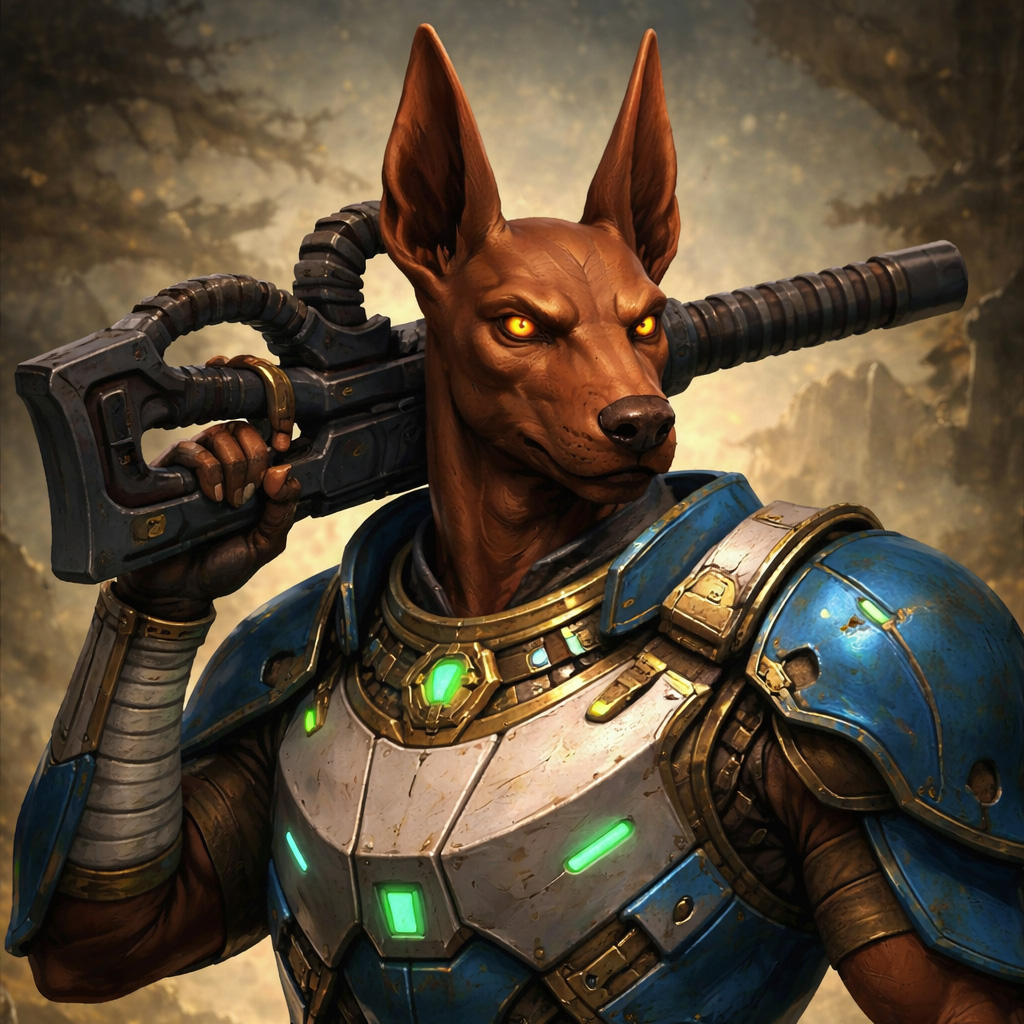
The Greanans
The Ancient Masters of Resharad
Among the many Cinan peoples of Damocles, the Greanans have always held a special place. Taller, stronger, and driven by an almost instinctive warrior nature, they were for millennia the conquerors of the southern plains of Resharad. Where other peoples built cities, the Greanans built war-kingdoms.
Their history is inseparable from that of the Kryns, those ancient beings who guided the Cinans through the cycles of catastrophe. For ages, counselors and priests, the Kryns profoundly shaped the religion and politics of the Greanan kingdoms, turning them into champions of the new Cinan faith directed against the elves and the other species.
Yet the Greanans were never mere subjects. Their warrior culture, tribal pride, and distrust of any outside authority constantly kept their relationship with the theocracy under strain.
Even today, their name evokes both the glory of the ancient empires and the brutality of the wars that shaped Damocles.
Origins
The first Greanan tribes emerged in the steppes and plateaus of southern Resharad, long after the great cyclical catastrophes had devastated Cinan civilization. In that shattered world, only the species capable of surviving in a brutal environment prospered.
The Greanans were among the most fearsome of those survivors. Their society was built around warrior clans led by tribal chiefs, where strength and bravery determined the legitimacy of power.
Over the centuries, these tribes united to form the first Greanan kingdoms, the most famous of which was Khemusep, regarded as the historical heart of their civilization. It was from this region, in the south of Resharad, now straddling Botai and Heaguk, that the Greanans launched their first great conquests.
When the elves arrived on Damocles and began establishing their colonies, the Greanans were among the first to resist them. The wars were long and bloody, marked by massacres and reprisals that fed a lasting hatred between the two species.
Over time, that rivalry was instrumentalized by the Kryns, who reshaped the Cinan religion into a call to war against the elves and the other peoples of the planet.
The Influence of the Kryns
For millennia, the Kryns had been the keepers of memory and the counselors of the Cinan kingdoms. Their longevity and wisdom allowed them to deeply influence the beastfolk societies of Damocles. In the Greanan kingdoms, their role became even more central.
The Kryns reinterpreted the ancient religion inherited from Xarax to proclaim that Damocles was destined for the Cinans and that the other species were nothing more than a trial sent by the Creator. This doctrine found fertile ground among the Greanans, already accustomed to centuries of war.
Little by little, the Cinan theocracy extended its influence over most of the Greanan kingdoms, placing Kryn advisors beside kings and steering their policies. Yet this domination was never absolute. Some kingdoms accepted the religious influence of the Kryns out of opportunism, while others openly rejected it. This division would shape Greanan politics for millennia.
The Era of the Cinan Wars
At the height of their power, the Greanan kingdoms dominated a great part of southern Resharad. But their expansion ran into many enemies: elves, bastets, ratmen kingdoms, and even other Cinan peoples.
Conflicts were constant, and alliances shifted regularly. Some Greanan kingdoms became instruments of the Cinan theocracy, while others fiercely defended their independence.
Despite their military strength, the Khemusep were slow to modernize their army and could not preserve their empire against the elves and their bastet allies. Endless wars, the political manipulations of the Kryns, and rivalries between kingdoms eventually fractured their civilization. The ancient imperial lands of Netjeret, once the heart of their power, fell into anarchy after the fall of the Khemusep dynasty. The local clans turned against one another, massacring their own kings and plunging the region into permanent chaos.
Among them, the clans of Ta-Khefet formed a new kingdom that became one of the most powerful. Supported by the Kryns of the mountains of Shur-Mekhet, this kingdom transformed itself into a true war machine directed against the elven colonies of Netjeret. Ta-Khefet produced nothing but warriors to fight the elven invasion. Armed and fed by the theocracy, they became the perfect proxy. These wars became an essential component of the Proxywars, a vast game of influence in which the Greanan kingdoms often served as intermediaries in the conflicts between the theocracy and the elven confederation.
The army of Ta-Khefet was then composed of soldiers equipped with modernized weaponry produced entirely by the Cinans of Shur-Mekhet, but also of traditional warriors, often from neighboring Netjeret, hungry for elven blood. Its ranks were later reinforced by Anubis soldier drones gifted by the Cinans and operated by Greanan war veterans. This contribution was both traumatic and decisive at the beginning of the Proxywars, especially as the Cinans used the opportunity to gather data and program their new generation of automated killing machines.
It was in this context that the Netjeret Rebels were born, located in what is now Heaguk. They were an informal coalition of Greanan clans and local tribes who waged a guerrilla war against the elven colonies. Their struggle was secretly fueled by Ta-Khefet and the Cinan theocracy, turning the region into one of the main battlefields of the Proxywars.
The Proxywars
When the Proxywars erupted, the Greanans were no longer a unified empire but a mosaic of rival kingdoms. Some joined the Cinan theocracy and adopted the new religion. Others sought to preserve their independence or to exploit the chaos to expand their territories.
This fragmentation made the Greanans unpredictable. On the same front, some clans fought alongside the theocracy, while others negotiated with the confederation. In this unstable world, one truth nevertheless remained unquestionable: the Greanans were still among the most feared warriors on Damocles.
The beginning of the Proxywars saw the fall of Estelain, then the greatest elven colony on Resharad and at the heart of Netjeret. This trauma for the elves was the first major military victory of the theocracy’s Greanan proxies against them. In addition to the large number of elf slaves captured, whose blood made the Kryns fertile again, the prestige was immense.
As a reward for their bravery, the most valiant Greanans who had taken part in the siege were granted a place in Paradise. Accompanied by a prince of Netjeret and a pair of Kryns, they were able to join a Cinan Haven, a kind of safeguard designed to open after two cycles. They were meant to awaken in a new and verdant world where no civilization could have survived, and where their intact technology would allow them to conquer and repopulate the planet.
The Last Pair of Kryns
Today, the Greanan faction that survived into the Wars of Damocles possesses a unique legacy. It shelters the last known pair of Kryns.
For millennia, the Kryns have been sterile and their species has slowly faded away. Their gradual disappearance deprived the Cinans of their ancient guides and profoundly disrupted the political balance of the planet.
The presence of the last pair makes this faction a living symbol of the old order. Some see in them the last chance to restore Cinan greatness. Others regard them as the remnants of a manipulative power responsible for millennia of war.
Whatever the case, their existence draws the attention of every power on Damocles. For if the Kryns were ever to vanish completely, an entire age of the planet’s history would die with them.
Politics and Their Place in the Current World of Damocles
The premature awakening of the Greanans was brutal. The atomic bombardments of the Imperial army had disrupted their own installation, and they would have to fight to survive and seize by force the paradise that had been promised to them. The first scouts reported zombies and other deformed monsters inhabiting the surrounding mountains. In the plain that had once held the heart of Cinan civilization, the Fukai now spread, an existential enemy believed to have been defeated forever.
In the beginning, war against it seemed natural. For these Greanans, raised on the memory of great victories against the creatures of the ancient forest, there could be only one answer to such a scourge: fire, steel, and reconquest.
But reality soon caught up with them. The faction was too small to wage a war of extermination alone. Its manpower was limited, its production chains incomplete, and its reserves precious. Every offensive into the southern valleys cost lives they could not easily replace. Above all, the Greanans discovered that the Fukai they faced was not merely a hostile forest. It was also a political space, crossed by factions, hierarchies, interests, and trafficking networks.
The first shock came when they realized that the humans of the Bug Army, serving the Drakonxos, far from being a simple horde of fanatical mutants, knew how to negotiate, salvage, transform, and produce. Through brutal reverse engineering of Cinan technologies, the Bug Army had managed to recreate certain technical chains long believed lost. Their versions were often unstable, inelegant, or organic where Cinan machines had been pure, reliable, and geometric, but they worked. Very quickly, indirect exchanges began to emerge. First through prisoners released in exchange for equipment, then through border bands, and finally through genuine tacit agreements.
The Greanans provided refined metal, weapon components, and sometimes even maintenance knowledge drawn from the Haven archives. In return, the Bug Army allowed shipments of wood and, above all, Fukai gas to pass through, an energy source the Greanans desperately needed. They also shared information about the most dangerous creatures. Neither side forgot what it was. The Greanans still saw the Bug Army as creatures born of chaos, a kind of sub-race of elf in the service of the Drakonxos. The Bug Army, for its part, learned from old legends that the Greanans had once nearly annihilated the forest, and with it learned both possible ways to rid themselves of their masters and the fate intended for them. But between potential enemies, pragmatism eventually prevailed.
A similar relationship, though even more fragile, developed with the Naxjabas of the mountains. These mutants, disfigured by atomic bombardments and radiation, still too human to be fully trustworthy, yet too useful to ignore, serve as guides, smugglers, and sometimes mercenaries. They know the ancient tunnels, the buried passes, and the forgotten shelters beneath the stone. Here too, relations remained ambiguous. Some campaigns were conducted in cooperation against forest creatures and the Bug Army. The Greanans even provided logistical support against the Voltrmens. But other expeditions ended in betrayals, columns vanishing into the mist, or convoys being diverted. Even so, despite this mutual distrust, the Greanans understood that they could not survive without playing the game of frontier alliances themselves.
The greatest upheaval, however, was neither military nor economic. It was religious.
The Greanans of the Haven had been put to sleep at the height of a worldview in which the Cinan theocracy, despite its setbacks, remained the instrument chosen by the Kryns to purify Damocles and finally break the elves. Yet they awoke in a world where that war had, in truth, been lost. The elves had not vanished. The theocracy had not reconquered the planet. The Cinans themselves had collapsed, been absorbed, scattered, or forgotten. For many Greanan warriors and priests, this was an inner earthquake far deeper than the appearance of the Fukai.
Some saw in it proof that the Kryns had been abandoned by the Creator. Others claimed, on the contrary, that the Haven itself proved that the divine design had not ended, only been delayed. This fracture ran through the whole awakened Greanan society. The most fanatical continued to believe that they had been preserved in order to one day resume the interrupted holy war. The more lucid believed instead that the old world was dead and that something else had to be built upon its ruins.
It was in this rift that the first dissidents favorable to a rapprochement with the Wulfsons emerged. For them, the Wulfsons represented the true heirs of Khemusep, not by purity of blood, but by lineage and by the fact that they had managed to survive, govern, and adapt. These voices remained a minority, for many Greanans still regarded the Wulfsons as usurpers or degenerate cousins shaped by the centuries. Yet their mere existence shows how deeply doubt has worked its way through the faction. Part of its elite no longer dreams of a restored Greanan empire, but of an honorable integration into a new order, in which they would finally cease to be revenants.
Thus, the Greanans’ place in the current Damocles is paradoxical. Militarily, they remain a formidable and disciplined force, with a technological core superior to that of many human clans. Symbolically, they still bear the immense weight of the old Cinan order and of the last pair of Kryns. But politically, they are too few to impose their will alone. They can only influence the fate of the continent by playing a subtler game: trade with the Bug Army, arrangements with the Naxjabas, careful observation of the human powers, and survival diplomacy with all those who can keep them from being encircled.
They are not yet strong enough to reconquer the world that was promised to them. But they are already too dangerous to be ignored.
The Figures of Power
At the head of the faction stands King Setekh Ta-Meren, descendant of the prince of Ta-Khefet who was once granted the right to enter the Haven. One hundred and fifty years after the awakening, he embodies both dynastic continuity and forced adaptation. Unlike the Greanan rulers of ancient ages, Setekh is not only a war king. He is also an arbiter between several incompatible truths: the memory of the promised paradise, the necessity of compromise, and the reality of a world that never waited for them. His prestige remains immense, yet many reproach him for his caution toward the Fukai and his refusal to commit the faction to a great war of purification.
At his side live Nekhar-Seth and Ilyra, the last known pair of Kryns. Their mere existence gives the kingdom a spiritual authority that no other power can claim. Nekhar-Seth is austere, almost spectral, wholly devoted to the preservation of memory and ancient plans. He continues to think in centuries, as though the apparent failure of the great design were only a detour. Ilyra, more pragmatic and more sensitive to the transformations of the world, understands better than her companion how much the survival of the Greanan people now depends on compromises once thought unthinkable. Where Nekhar-Seth still sees cycles and prophecies, she sees balances of power, shortages, and children who must be fed before anyone can pretend to reconquer anything.
The main architect of foreign policy is Hekar Vosh, merchant, diplomat, and master of the frontier trade posts. It is he who stabilized exchanges with the Bug Army, supervised transactions with certain Naxjaba groups, and established the first indirect contacts with human intermediaries. To the traditionalists, Hekar is selling the Greanan soul shipment by shipment. To his supporters, he is the one who understood before anyone else that a kingdom awakened in the wrong age cannot survive on the glory of its ancestors alone. Hekar believes neither in the promised paradise nor in the purity of holy war. He believes in secure roads, ammunition stockpiles, well-placed debts, and enemies made dependent before they are fought.
Opposing him stands General Varekh Nemu, commander of the southern armies and hero of the first campaigns against the Fukai. Where King Setekh hesitates, Varekh wants to strike. To him, every year spent negotiating with the Bug Army or tolerating the Naxjabas is one humiliation too many. He believes the Fukai must be confronted before it becomes uncontrollable, and that only rapid expansion can give the Greanans the strategic depth necessary to matter in the world. His plan is clear: retake the valleys one by one, fortify the edges, crush the independent mutant bands, and then prepare the great war that will decide whether the living forest is to dominate Damocles or be driven back once more into legend.
Around these figures, all Greanan politics is now organized. The king wants to endure. The Kryns want to understand whether history has escaped them or still obeys them. Hekar Vosh wants to make the kingdom indispensable to its neighbors. Varekh Nemu wants to restore its former terror.
And while they debate, negotiate, or prepare, the Fukai continues to spread, the Bug Army continues to learn, and Damocles continues to wait to see whether the ancient masters of Resharad have returned to rule, or simply to disappear a second time.