






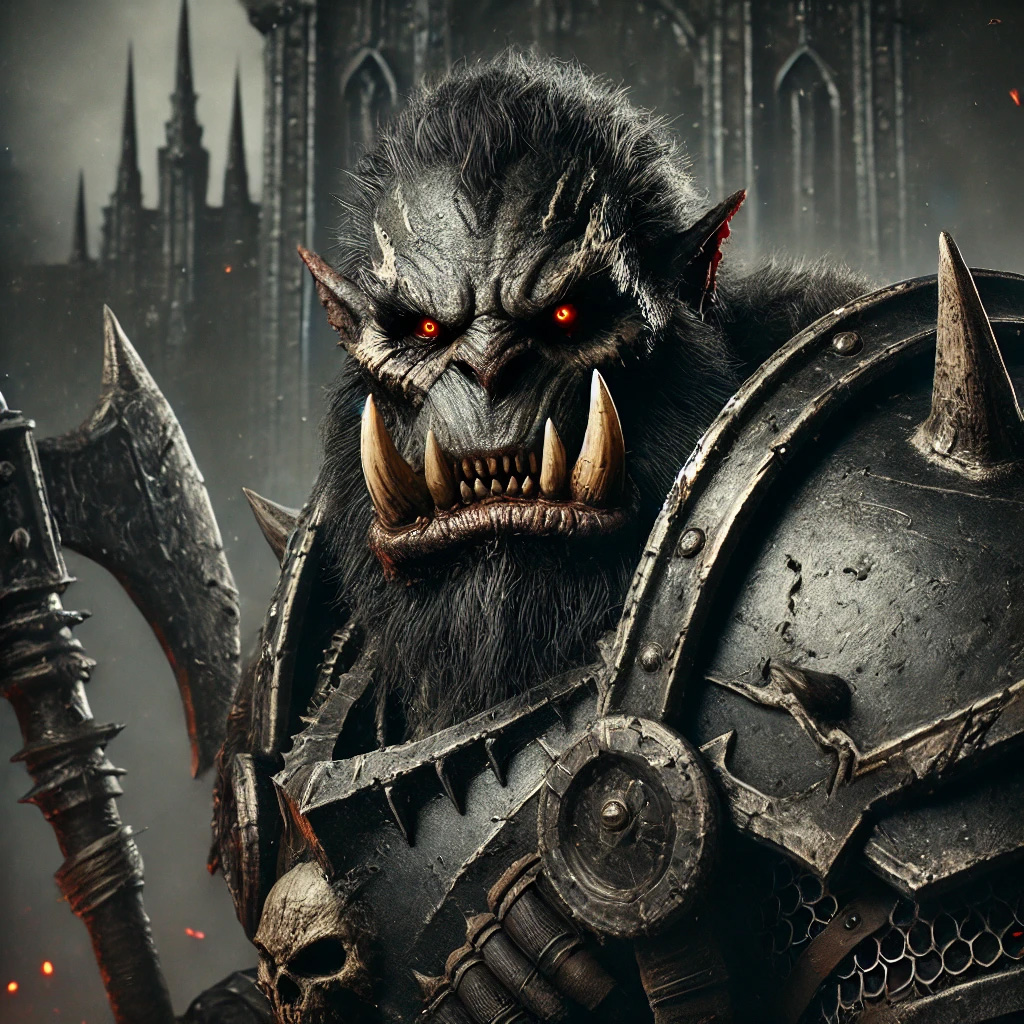
Grimstone, The Orcish Dominion
A Kingdom Forged in War
High within the jagged peaks of the northern mountains lies Grimstone, a realm unlike any other in the known world. It is not a land of chaos, nor a collection of scattered warbands as many outsiders would expect from orcish domains. Instead, it stands as a kingdom forged through discipline, shaped by war, and sustained by an unrelenting will to endure. Every stone, every fortress, every blade forged within its borders speaks of a people who have transformed survival into an art of domination.
Grimstone was not always an orcish kingdom. Long before its current rulers, these mountains belonged to the dwarves, a civilization of master builders and craftsmen whose fortresses were carved deep into the rock. Their halls were said to be impenetrable, their forges unmatched, and their legacy eternal. But the Great War shattered that certainty, breaking not only their defenses, but their claim to the land itself.
When Agramon’s legions swept across the world, the mountains of Grimstone became one of the decisive battlegrounds. The dwarves resisted with all their strength, but they faced an enemy unlike any they had known before. The orcs who marched under Agramon’s banner were no longer scattered tribes of brute force. They had been reshaped, disciplined, and empowered by dark sorcery, turned into an army capable of strategy, coordination, and relentless assault.
When the war ended, the dwarves were gone.
What remained was something new.
The orcs did not simply occupy the ruins, they transformed them. The once-proud halls of dwarven kings became the foundations of a new dominion, one built not on craftsmanship alone, but on strength, hierarchy, and the absolute rule of the powerful. The forges were reignited, not to preserve a legacy, but to fuel a war machine that would ensure the orcs would never again be cast aside or enslaved.
Under the rule of King Gorrak, Grimstone has risen from conquered territory to a fully realized empire. Its armies are disciplined, its warriors equipped with weapons forged in the very halls where their ancestors once labored as slaves, and its society is structured with a clarity that few outside forces fully understand. This is not a realm of disorder, it is a dominion where every individual has a place, and where that place is determined by strength, loyalty, and usefulness.
But this strength comes at a cost.
Grimstone is a kingdom built on conquest, sustained by war, and surrounded by enemies who would see it destroyed. It cannot afford weakness, nor can it allow itself to stagnate. Every victory must lead to another, every gain must be defended, and every generation must prove itself worthy of survival.
In Grimstone, there is no peace.
There is only the constant struggle to endure, to dominate, and to ensure that the fate of the dwarves is never repeated.
Geography and Borders
Grimstone is not merely a kingdom, it is a fortress shaped by the very mountains that surround it. Its domain lies deep within a network of jagged peaks and narrow passes, where the terrain itself serves as both shield and weapon. The harshness of this environment has forged its people as much as its enemies, creating a realm where survival depends as much on geography as it does on strength. Every approach to Grimstone is contested, every border a potential battlefield, and every neighbor either a threat, an opportunity, or both.
To the west lie the dwarves of Stoneward, the rightful claimants to these mountains and Grimstone’s oldest and most relentless enemies. For them, the loss of their ancestral homeland is not a wound that time can heal, but a debt that must be repaid in blood. Their armies press constantly against Grimstone’s defenses, launching calculated offensives in an attempt to reclaim what was taken during the Great War. Between the dwarves and the orcs, there is no diplomacy, no negotiation, only an unending war defined by vengeance and survival.
To the east stretch the chaotic territories of Darkholm, a fractured land where warlords and monstrous forces vie endlessly for control. While Grimstone recognizes no true allies, it has found moments of pragmatic cooperation within this instability. Certain factions of Darkholm engage in exchanges of weapons, slaves, and rare materials, and at times their warbands move in parallel, striking shared enemies without ever forming a true alliance. These interactions are built on necessity rather than trust, and can collapse as quickly as they are formed.
To the northeast, beyond the highest ridges, the Ocean of Storms extends into the unknown, a violent expanse from which powerful wyverns descend upon the mountains. These creatures, remnants of an ancient age, are both a threat and a source of power. Grimstone’s strongest warriors venture into these skies to hunt, tame, and bond with them, transforming a natural danger into one of the kingdom’s greatest military advantages.
To the southeast stands Darkfell Keep, a heavily contested stronghold marking the frontier with Storrhold, the domain of the horse-lords. Between these two powers exists a relationship defined by constant conflict tempered by mutual recognition. Both sides understand the strength of the other, and while neither yields ground willingly, there exists a grudging respect born from years of battle. Control of the mountain passes between them remains a strategic priority, as whoever holds them dictates the flow of war between north and south.
To the south lie the forests of Thornwild and the mountains of Velan, regions that serve as both hunting grounds and contested territories. The elves of Thornwild wage a bitter resistance against the orcs, defending their sacred lands with precision and persistence. Meanwhile, the warriors of Velan stand as a defensive bulwark, holding their ground with determination against Grimstone’s expansion. These fronts are rarely quiet, as raids, counterattacks, and skirmishes shape a constant cycle of violence.
To the southwest, the cursed land of Malgar festers under the rule of the Necromancer-King Malgaroth. Though Grimstone and Malgar share enemies, any notion of alliance is impossible. The orcs reject subjugation in any form, and the idea of serving an undead ruler is an affront to everything their society represents. Memories of Malgaroth’s actions during the Great War only deepen this hostility, ensuring that any interaction between the two powers is marked by tension, mistrust, and the potential for open conflict.
Surrounded on all sides, Grimstone exists in a state of permanent pressure. Every border demands vigilance, every neighbor represents a threat, and every weakness risks annihilation. Yet it is precisely this constant danger that has shaped Grimstone into what it is, a kingdom that does not merely endure its environment, but thrives within it.
The Fall of the Dwarves and the Rise of Grimstone
Before the rise of the orcish dominion, the mountains of Grimstone belonged to the dwarves of Stoneward, a civilization whose mastery of stone and steel was unmatched. Their fortresses, carved deep into the heart of the mountains, were considered unassailable, vast networks of halls, tunnels, and citadels designed to withstand any siege. For generations, they believed their dominion eternal, protected by both their craftsmanship and the natural defenses of the land itself.
But the Great War shattered that illusion.
When Agramon’s legions swept across the world, the dwarves stood as one of the last bulwarks against the tide of destruction. They trusted in their walls, in their engineering, and in their ability to outlast any assault. What they faced, however, was not a conventional enemy. The orcs that marched under Agramon’s banner had been transformed. No longer scattered and undisciplined, they had become a force shaped by war and dark sorcery, capable of strategy, coordination, and relentless pressure.
They did not attack blindly. They adapted. They learned.
Drawing upon siege techniques taken from conquered civilizations, the orcs began to dismantle the dwarven defenses piece by piece. Fortifications that had once been thought invulnerable were breached through persistence, cunning, and overwhelming force. Alongside them marched drakoths, massive war-beasts bred for destruction, whose sheer power shattered gates and crushed defensive lines that would have held against any mortal army.
One by one, the great fortresses of the mountains fell.
The dwarven lords, bound by pride and unwilling to surrender, chose to fight to the last. In desperation, many sealed entire sections of their underground realms, collapsing tunnels and isolating chambers in an attempt to deny their enemies access to the full extent of their domain. These acts preserved fragments of their legacy, but they could not change the outcome.
In the end, the dwarven kingdom was broken.
Those who survived fled westward, retreating to Stoneward, carrying with them the memory of their lost homeland and a vow that it would one day be reclaimed. Behind them, the ruins of their empire were left to those who had conquered it.
The aftermath of the conquest marked a turning point not only for the orcs, but for all who had lived beneath dwarven rule. The goblins, long enslaved within the mines and forges, were freed, their chains broken not through rebellion, but through the collapse of their masters. Yet freedom did not bring equality. Instead, it marked the beginning of a new order, one in which power would once again determine place.
The orcs did not preserve the dwarven legacy, they reshaped it.
Golden statues of dwarven kings were torn down and melted, their symbols of pride reduced to raw material. Weapons once forged to defend the mountain halls were reforged for conquest. The forges themselves, masterpieces of dwarven engineering, were reignited under new masters, no longer serving craftsmanship alone, but fueling a growing war machine.
From the ruins of the old kingdom, a new dominion was born.
It was not built on heritage or tradition, but on strength, survival, and the refusal to ever return to the chains of the past. The orcs had not merely taken Grimstone.
They had remade it.
The Birth of the Kragar Rule
In the aftermath of the Great War and the fall of the dwarven kingdom, Grimstone did not immediately emerge as a unified power. The mountains, though conquered, were fractured, divided among rival warlords, each seeking to claim a portion of the fallen domain for themselves. Victory had not brought order, only opportunity, and with it came a new cycle of conflict, as the orcs turned against one another in a struggle for dominance.
But Grimstone could not survive in such a state.
Surrounded by enemies on all sides, the vengeful dwarves of Stoneward to the west, the relentless warriors of Velan to the south, and the growing necromantic threat of Malgar to the southwest, the fractured orcish factions faced a simple truth. Without unity, they would be destroyed. The same forces that had shattered the dwarves would, in time, consume them as well.
From this chaos rose Gorrak, the first Kragar king of Grimstone.
Gorrak was not merely a warlord of brute strength, though his power in battle was undeniable. He was something far more dangerous, a leader capable of understanding that survival required more than conquest. Where others saw territory, he saw structure. Where others fought for dominance, he fought for control. One by one, he challenged rival warlords, breaking those who opposed him and forcing the rest into submission. Through blood and strategy alike, he forged a single, unified dominion from the scattered remnants of conquest.
The system he established became the foundation of Grimstone’s strength. At its core stood the Kragars, an elite caste of orcs bred and selected for their strength, discipline, and capacity for leadership. These were not merely warriors, but commanders, strategists, and rulers, individuals capable of maintaining order in a land where chaos had once prevailed. Under their authority, clans were reorganized, hierarchies enforced, and loyalty made absolute.
Grimstone was no longer a collection of warbands.
It became an army.
Under Gorrak’s rule, every aspect of society was shaped by war. The military was restructured into disciplined legions, equipped with standardized weapons and armor forged in the reclaimed dwarven forges. Training became systematic, ranks clearly defined, and command chains unbreakable. Even those not born as warriors were integrated into this structure, contributing to the war effort through labor, craftsmanship, or support roles essential to the kingdom’s survival.
Slavery, once a tool of the dwarves, was not abolished, but redefined. Where the dwarves had used it for industry, Gorrak expanded it into a pillar of the kingdom’s economy and military strength. Captives were no longer merely workers, they were resources to be shaped, trained, and exploited in ways that served the dominion’s long-term ambitions.
One of Gorrak’s most significant innovations was his recognition of the strategic value of the wyverns that inhabited the northern skies. These ancient predators, long feared by the dwarves, became instruments of power in orcish hands. The strongest warriors were tasked with hunting and taming them, forming bonds that transformed these creatures into mounts of war. From this arose the Warbat Legion, an elite aerial force capable of striking from above with devastating speed and force.
The presence of wyvern riders reshaped warfare for Grimstone. No longer confined to the ground, its armies could project power across mountains, bypass defenses, and strike deep into enemy territory. Castles that once stood secure behind walls found themselves vulnerable, and battlefields once defined by terrain were redefined by the sky itself.
With his dominion secured, Gorrak turned his attention outward. He understood that Grimstone could never afford passivity. Surrounded by enemies, survival depended on constant readiness, on maintaining strength through action rather than waiting for attack. Raids intensified, defenses were reinforced, and war became not merely a necessity, but the defining condition of existence.
Yet even under such structure, Grimstone remains a realm under pressure. Its enemies are many, its resources finite, and its internal balance fragile. The Kragar system enforces unity, but unity maintained through strength must always be proven. Should that strength falter, the order Gorrak built could fracture as quickly as it was forged.
For now, however, the system holds.
And under the rule of the Kragars, Grimstone stands as one of the most formidable war powers in the world.
A Culture of Strength and Survival
In Grimstone, strength is not merely valued, it is the foundation upon which the entire society is built. From the lowest warrior to the highest warlord, every individual is raised with the understanding that power determines worth, and that only those capable of proving their strength deserve to lead. This belief has shaped a culture where discipline and loyalty bind the clans together, where honor is measured through action rather than words, and where weakness is neither tolerated nor ignored.
Unlike the chaotic warbands found in other orcish lands, Grimstone’s clans operate within a rigid and carefully maintained hierarchy. Each clan is led by a chieftain whose authority is unquestioned within their domain, yet all ultimately answer to King Gorrak and the Kragar elite. This structure ensures that ambition does not lead to fragmentation, but instead feeds into the greater strength of the kingdom. Rivalries exist, as they always do among orcs, but they are controlled, contained, and redirected toward external enemies rather than internal collapse.
Grimstone is not solely a land of warriors. It is a society shaped by necessity, where survival demands adaptability. Hunters track the scarce resources of the mountains, wyvern tamers risk their lives in the northern skies, and craftsmen labor tirelessly within the forges that burn without end. Every role, whether in battle or beyond it, contributes to the strength of the dominion.
The Role of Kragars and Wyverns
At the pinnacle of Grimstone’s hierarchy stand the Kragars, a caste of orcs distinguished not only by their physical power, but by their discipline, intelligence, and capacity to command. They are larger, stronger, and more controlled than common orcs, embodying the ideal upon which Grimstone is built. As leaders of clans, commanders of armies, and rulers of fortresses, they ensure that the kingdom remains unified and focused, preventing the chaos that defines other orc societies.
Alongside them stand the wyverns, ancient predators that dominate the northern skies. These creatures are more than beasts, they are symbols of power, status, and mastery. Only the strongest warriors are permitted to attempt to tame them, and those who succeed rise above their peers, earning a place among the most feared fighters in Grimstone. The Warbat Legion, composed of these riders, represents the pinnacle of the kingdom’s military might, capable of striking from above with devastating speed and precision.
The bond between rider and wyvern is not easily formed. It requires strength, will, and the ability to dominate a creature that was never meant to be controlled. Those who fail do not return. Those who succeed become legends.
Warfare and Raiding Culture
War is not an event in Grimstone, it is a constant state of existence. The kingdom does not merely defend its borders, it actively shapes the battlefield beyond them. While its fortresses stand strong against the assaults of Stoneward and Velan, its armies are rarely idle. Raids are launched not only for conquest, but for survival, to weaken enemies, secure resources, and maintain pressure on all fronts.
Among the most feared of these forces are the Grimfang Riders, mounted warriors who strike with speed and brutality. Riding massive wolf-like beasts bred for war, they descend upon enemy territories with little warning, overwhelming defenses before retreating back into the mountains. Their targets are varied, villages, supply lines, isolated outposts, anything that can be taken, destroyed, or exploited.
The southern lands of Thornwild and Velan bear the brunt of these attacks. The elves of Thornwild respond with precision and guerrilla tactics, striking from the shadows and fading before they can be engaged directly. The warriors of Velan, by contrast, stand firm, holding mountain passes with unyielding determination. Neither has succeeded in ending the raids, but neither has been broken by them. The conflict persists, shaping both sides through constant war.
Despite their reliance on force, the orcs of Grimstone are not without sophistication in warfare. The knowledge inherited from the dwarves has transformed their approach to combat. Their weapons and armor are crafted with precision, their siege capabilities refined, and their understanding of defensive warfare deeply ingrained. Goblin and gnome craftsmen, once slaves of the dwarves, now serve under orcish rule, ensuring that Grimstone’s war machine remains supplied and effective.
The Economy of Conquest
Grimstone’s economy is built upon conquest and exploitation. Slavery is not a byproduct of war, it is a fundamental component of the kingdom’s survival. Captives taken during raids are not wasted. Humans, elves, and even dwarves are brought back alive whenever possible, set to work in mines, forges, and labor camps that sustain the dominion’s industry.
Within this system, different races occupy different roles. Goblins, gnomes, and trolls, once enslaved under dwarven rule, have been integrated into Grimstone’s hierarchy, though their position remains far from equal. Gnomes, valued for their intelligence, contribute as craftsmen and engineers, while goblins perform more expendable labor, and trolls are bred and trained for war. Freedom exists only within the limits imposed by usefulness.
Despite its aggressive nature, Grimstone does engage in trade, though only under strict conditions. Certain factions within Darkholm and Ironwatch have established pragmatic exchanges with the orcs, trading weapons, raw materials, and war beasts. These relationships are fragile, built on mutual benefit rather than trust, and can dissolve instantly should circumstances change.
A Kingdom on the Edge
For all its strength, Grimstone exists in a constant state of tension. The dwarves of Stoneward will never abandon their claim, pressing relentlessly against the kingdom’s western borders. The warriors of Velan continue to resist expansion to the south, while the necromantic forces of Malgar present a threat unlike any other, an enemy that cannot be intimidated, exhausted, or exploited.
King Gorrak understands that stagnation is death. His rule is defined by the necessity of constant strength, ensuring that no internal rival can rise and no external enemy can exploit weakness. Yet the balance is fragile. Every victory comes at a cost, every campaign stretches resources, and every generation must prove itself stronger than the last.
For now, Grimstone endures. Its forges burn without rest, its wyverns dominate the skies, and its warbands ride into battle with unrelenting purpose.
But survival is not guaranteed.
In Grimstone, it never is.
King Gorrak, the Iron Tyrant
In the brutal and unforgiving lands of Grimstone, where survival is earned through strength and maintained through discipline, none stand above King Gorrak, the Iron Tyrant. A towering Kragar, he embodies the very principles upon which the kingdom is built, power, control, and absolute authority. His rule was not granted by lineage or tradition, but seized through conquest, forged in battle, and secured through the destruction of all who opposed him.
Gorrak rose to power by crushing rival warlords and uniting the fractured orcish clans beneath a single banner. Those who resisted were slain, those who survived were forced to swear loyalty, and those who betrayed him were met with punishments severe enough to ensure that defiance would not spread. His reign transformed Grimstone from a chaotic land of competing factions into a disciplined and militarized dominion.
He wields Doomfang, a massive black iron battle axe reforged from the melted weapons of defeated dwarven kings. Etched with runes of dominance and bloodshed, the weapon stands as both a symbol and an instrument of his rule. Clad in spiked black armor reinforced with wyvern scales, Gorrak leads from the front, not as a distant ruler, but as a warrior whose presence on the battlefield reinforces his authority with every strike.
Despite his brutality, Gorrak is no simple tyrant. He understands that Grimstone is surrounded by enemies and that survival depends on more than strength alone. Under his command, the kingdom has evolved into a structured war machine, its armies organized, its forges ever-burning, and its wyvern riders dominating the skies. Yet his rule is not without tension. Some among the orcs believe his discipline comes at the cost of their nature, while others argue that Grimstone should expand further, embracing conquest without restraint.
Gorrak walks a narrow path. If he shows weakness, his throne will be taken. If he pushes too far, his kingdom may be destroyed by the very forces it provokes. For now, he remains unchallenged, but in Grimstone, power is never permanent.
Varzok the Unbroken, First Warlord of Grimstone
Second only to the king himself, Varzok the Unbroken stands as Grimstone’s greatest warlord and the iron hand that enforces Gorrak’s will. A Kragar of immense resilience, he has survived countless battles that would have ended the lives of lesser warriors, earning both his title and the unwavering respect of the orcish legions.
Varzok does not fight for glory alone. He sees war as a necessity, a means to ensure the survival of Grimstone in a world that constantly seeks to destroy it. His experience in battles against the dwarves of Stoneward and the warriors of Velan has shaped him into a master of siege warfare and defensive strategy. Many believe that without his leadership, the kingdom’s fortresses would have already fallen.
He wields Blackfang, a brutal war hammer said to be forged from the bones of a slain drakoth. With it, he crushes armor, shatters shields, and breaks any who stand before him. His armor bears the marks of countless battles, each scar a testament to his refusal to fall.
Though fiercely loyal to Gorrak, Varzok is not blind. He recognizes the strain placed upon the kingdom by constant war and has often advocated for strengthening defenses rather than pursuing endless expansion. Yet he also understands that hesitation can be fatal. If total war comes, he will not resist it, he will lead it.
Varzok does not seek death in battle, as many orcs do. He seeks endurance. To him, survival is the greatest victory.
Drogath Skullsplitter, Chieftain of the Bloodfang Clan
If Gorrak is the mind of Grimstone, Drogath Skullsplitter is its fury made flesh. A Kragar warlord defined by brutality and dominance, he leads the Bloodfang Clan, one of the most feared and aggressive forces within the kingdom. His rise to power was not guided by strategy or diplomacy, but by strength alone, defeating every rival who dared stand against him.
His body is marked by countless scars, each one a record of a battle survived. Where other leaders value discipline, Drogath embraces the raw violence of traditional orc warfare, overwhelming enemies through speed, aggression, and sheer force. His warriors follow him not out of obligation, but because they believe in his strength.
Unlike the structured legions of Grimstone’s core army, the Bloodfang Clan fights with a savage intensity that borders on chaos, yet remains devastatingly effective. Drogath favors shock assaults, driving his forces into the heart of enemy lines before they can respond, breaking formations through fear and destruction.
Despite his nature, he remains loyal to Gorrak, recognizing him as the strongest ruler the orcs have ever known. Yet his patience is limited. The defensive wars against Stoneward and the drawn-out conflicts with Velan frustrate him. He believes Grimstone should expand relentlessly, conquering new lands and claiming greater spoils.
His loyalty is real, but it is conditional. Should Gorrak ever fail to embody the strength he demands of others, Drogath would not hesitate to act.
Zharak the Stormborn, Warlord of the Wyvern Riders
Where Drogath represents raw power, Zharak the Stormborn embodies control, precision, and calculated destruction. A Kragar of exceptional skill, he commands the Wyvern Riders, Grimstone’s most elite and feared military force. Under his leadership, the skies themselves have become a battlefield.
His mount, Thunderfang, is a massive and ancient wyvern, scarred by countless battles and bound to its rider through strength and will. Together, they strike like a storm, appearing without warning, unleashing devastation, and disappearing before retaliation can be mounted.
Zharak approaches war as a strategist rather than a berserker. He studies his enemies, exploits their weaknesses, and strikes where it will have the greatest impact. His forces specialize in targeted assaults, destroying supply lines, eliminating key leaders, and destabilizing entire armies before they can properly respond.
Though loyal to Grimstone, Zharak’s allegiance is not blind. He understands the fragile balance upon which the kingdom rests and recognizes that a single mistake could lead to its downfall. Should that moment come, he would not hesitate to act in what he believes to be the best interest of the dominion, even if it means challenging the king himself.
Whether he is a loyal servant or a patient contender is a question that few can answer with certainty.
Morgath Ironfang, Warchief of the Boldgrim Raiders
Few figures inspire as much fear along Grimstone’s southern borders as Morgath Ironfang, the ruthless leader of the Boldgrim Raiders. A towering Kragar, he commands warbands that move with speed and precision, striking deep into enemy territory before vanishing back into the mountains.
His name is drawn from his iron-plated tusks, a mark of both his victories and his relentless nature. Morgath fights with instinct and ferocity, trusting in his own strength and the loyalty of his Grimfang riders, warriors mounted on massive wolf-like beasts bred for war.
His Grimfang, Bloodhowl, is the largest of its kind, a creature as feared as its master. The sound of its howl is often the only warning before a raid begins, echoing through forests and valleys moments before destruction follows.
Unlike other leaders, Morgath has little interest in politics or long-term strategy. War is not a means to an end for him, it is a way of life. Yet beneath this brutality lies a sharp instinct for survival. He knows when to strike, when to withdraw, and how to ensure that his forces remain effective despite constant conflict.
His loyalty to Gorrak is based on strength, not devotion. As long as the king maintains Grimstone’s power, Morgath will follow. But should that strength falter, he will do what is necessary to ensure his own survival and that of his warriors.
A Dominion of War
Grimstone stands as one of the most formidable powers in the world, not because it is unchallenged, but because it has learned to endure in the face of constant threat. Its leaders represent different aspects of its strength, discipline, fury, strategy, and survival, each contributing to a system that, for now, holds together.
Yet this balance is fragile. Enemies press from all sides, resources are constantly tested, and ambition never truly fades within the ranks of the Kragars. Should unity falter, the kingdom could fracture. Should it hold, it may become something far greater than it already is.
For now, Grimstone remains what it has always been since its rise, a dominion forged in war, sustained by strength, and defined by the unyielding will to survive.