






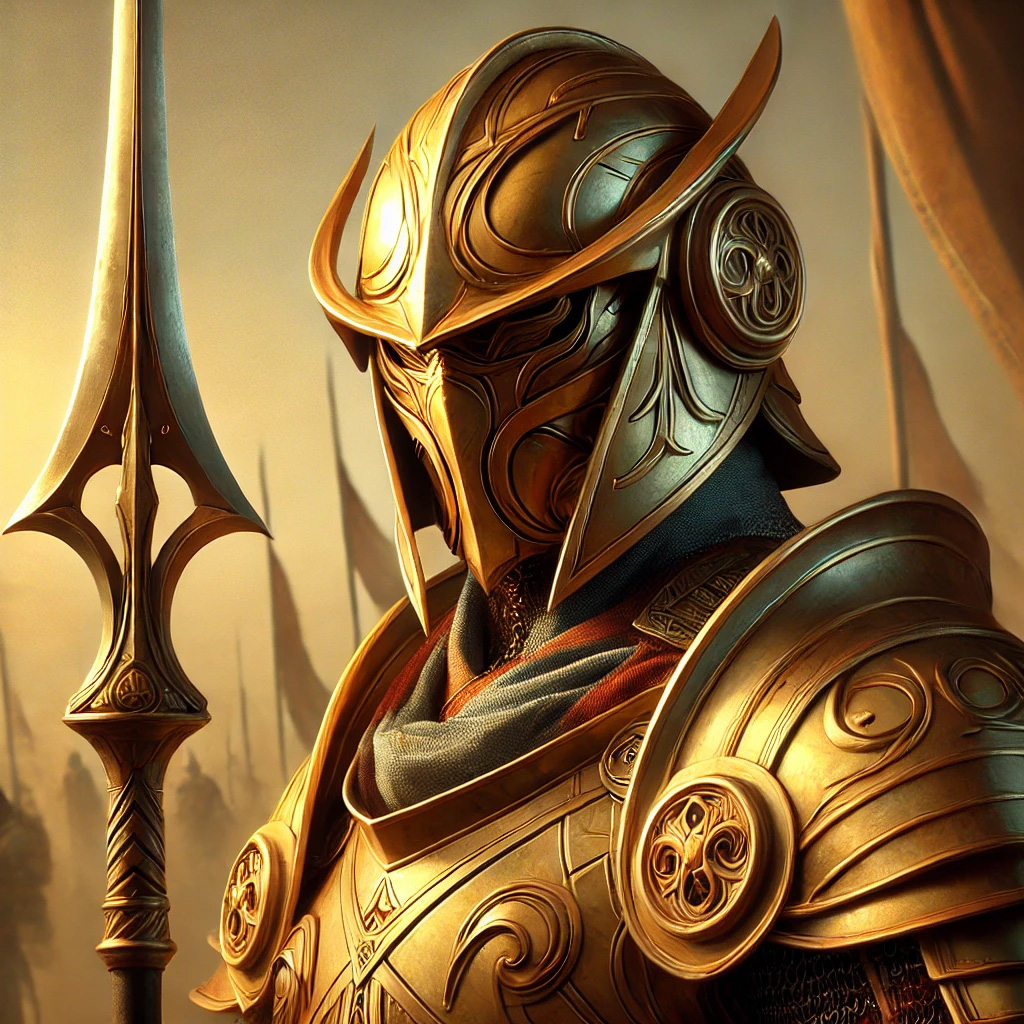
The Dawnsun Empire, Realm of the Rising Sun
The Dawnsun Empire stands as a land of splendor and calculated ambition, a realm where wealth flows through its cities like rivers of gold and where power is never taken for granted, only managed, negotiated, and secured through constant vigilance. Its towering minarets and radiant domes reflect not only prosperity, but a civilization shaped by pragmatism above all else, a nation that has learned to survive not by rigid ideals, but by adaptability and control.
Within its borders, faith and magic exist in a state of perpetual tension, each vying for dominance over the direction of the empire. War and commerce are not opposing forces, but complementary tools, each used with precision to secure advantage over rivals. In Dawnsun, morality is rarely absolute. Decisions are weighed not by honor or tradition, but by outcome, by whether they strengthen the empire or ensure its continued survival in a world defined by conflict.
Unlike Brightkeep and Albian, whose rulers often cling to ideals of honor, duty, and righteousness, the emperors of Dawnsun have always understood a harsher truth. Power is not maintained through virtue alone, but through timing, calculation, and the willingness to act when others hesitate. This philosophy has defined the empire for generations, shaping its expansion, its diplomacy, and its role within the balance of the world.
The Dawnsun Gambit
During the early years of the Great War, the Dawnsun Empire found itself surrounded by uncertainty. Though already a regional power, ruling fertile lands, vital trade routes, and cities of immense wealth, it was encircled by threats on all sides. The remnants of ancient Qarathian kingdoms lingered to the south, the western human realms continued to expand, and above all loomed the rising shadow of Agramon, the Dark Forgemaster, whose campaigns would soon reshape the world.
Faced with this shifting landscape, the rulers of Dawnsun made a decision that would define their legacy. Rather than oppose Agramon directly, they chose to align with him. This choice was not born of loyalty or belief, but of opportunity. While the priesthood condemned the warlord as an abomination, the imperial court recognized the strategic advantage of standing beside him, at least for a time.
As Agramon’s forces advanced across the continent, spreading destruction and drawing the attention of the western kingdoms, Dawnsun moved with careful precision. Its armies did not throw themselves into the heart of the conflict. Instead, they advanced along its edges, annexing neighboring city-states and rival kingdoms under the justification of securing stability. Each campaign was calculated, each conquest measured, ensuring that the empire expanded while others exhausted themselves in direct confrontation.
Albian and Brightkeep, locked in their desperate struggle against Agramon, could do little to prevent this expansion. As their resources were consumed by war, Dawnsun absorbed territories, wealth, and manpower, strengthening itself without exposing its forces to unnecessary risk. It was not a war of glory, but of positioning, a silent consolidation of power that would prove decisive in the years to come.
Then came the turning point. As the tides of war began to shift and Agramon’s strength showed signs of faltering, the empire acted once more. In a single, calculated move, Dawnsun turned against its former ally. Its legions struck where it mattered most, severing supply lines, capturing key strongholds, and destabilizing what remained of Agramon’s war machine.
This betrayal was not impulsive, but inevitable. Dawnsun had never intended to stand beside Agramon to the end. It had waited, watched, and chosen the precise moment when such a move would yield the greatest advantage with the least cost.
The result reshaped the balance of the world. Agramon, though not destroyed, was weakened. Brightkeep and Albian, though victorious, emerged from the war exhausted and diminished. And Dawnsun, having suffered the least while gaining the most, rose to prominence as one of the dominant powers of the post-war era.
Yet this victory carried with it a legacy that would endure far beyond the war itself. The empire had secured its strength through betrayal and opportunism, and such a foundation, while powerful, would never be free of consequence.
A Nation Divided by Strategy and Ideology
Centuries after the Great War, the Dawnsun Empire remains powerful, wealthy, and influential, yet it is far from unified in purpose. The legacy of its choices during that conflict still echoes through its institutions, shaping not only its external relations, but the very structure of its internal power. What once was a calculated strategy has become a source of division, a fracture that runs through the heart of the empire and influences every decision made at its highest levels.
At the center of this division stand two opposing forces, each convinced that it alone holds the truth of Dawnsun’s future. On one side are the Solar Priests, guardians of the empire’s spiritual authority, who view the past alliance with Agramon as a stain that must be cleansed. To them, the empire’s strength cannot be secured through manipulation or opportunism alone. It must be sanctified through action. They call for a renewed crusade, a united war alongside Brightkeep and Albian to eradicate the lingering shadow of Agramon and restore the moral legitimacy of the empire.
Opposing them are the Arcane Sorcerers and Warlocks, figures whose influence has grown alongside the empire’s expansion and whose mastery of magic has become a cornerstone of its power. To these individuals, Agramon is not a symbol of corruption, but of potential. They do not see his defeat as a victory, but as an unfinished opportunity. In their eyes, the empire’s greatest mistake was not its alliance with him, but its decision to abandon it. They believe that the forces of darkness, if properly understood and controlled, could elevate Dawnsun beyond all rival powers.
At the forefront of this arcane faction stands the enigmatic Prince Dragon, a figure whose influence reaches far beyond that of a mere advisor. His studies into forbidden knowledge, particularly the secrets of the Drelkar, have raised questions that few dare to voice openly. There are whispers that he is no longer entirely human, that his pursuit of power has altered him in ways that blur the boundary between man and something far older, far more dangerous.
Caught between these opposing visions is the Emperor himself, burdened not only by the weight of his throne, but by the consequences of every path before him. He has seen the cost of war, has lost what cannot be replaced, and understands that neither blind faith nor unchecked ambition offers a true solution. Rather than commit to either extreme, he has chosen a more delicate course, one defined by balance, manipulation, and restraint.
Through careful diplomacy and calculated inaction, he ensures that Dawnsun remains strong while its rivals weaken themselves in conflict. He allows tensions to persist, both within his empire and beyond its borders, maintaining a state where no single force can dominate, but where Dawnsun continues to benefit from the instability of others.
Yet such a balance cannot be maintained indefinitely. The pressures from both factions continue to grow, each demanding decisive action. The priests grow impatient, seeing delay as weakness. The sorcerers grow bolder, their ambitions expanding beyond the Emperor’s control. And beyond the empire’s borders, the world moves toward another inevitable conflict.
For now, Dawnsun stands divided but stable, its power sustained through tension rather than unity. But the question remains unresolved, and when the time comes to choose, the consequences of that decision will shape not only the empire, but the fate of the world itself.
The Last Sun, Emperor Zaravan IX
At the center of the Dawnsun Empire, where splendor and tension converge beneath the weight of history, sits Emperor Zaravan IX, a ruler caught between past victories and present uncertainties. From his golden palanquin, carried by the strongest of his warriors, he presides over a realm of contradictions, a land where radiant temples stand beside towers of forbidden magic, where disciplined legions march alongside corsairs who plunder in his name, and where every decision is shadowed by the consequences of the past.
Once, Zaravan IX was a prince defined by ambition, a man shaped by war and driven by the promise of expansion. He had known conquest, had commanded armies, and had witnessed firsthand the rise of Dawnsun into one of the most powerful empires of its age. He had played the game of power as it was meant to be played, with precision, calculation, and an unyielding will to prevail. The empire had grown stronger under his watch, its influence spreading across the world as its rivals faltered.
But power, in Dawnsun, has never come without cost.
War took from him what no victory could replace. His two sons, heirs to his legacy and symbols of the empire’s future, were both lost to the very conflicts that had secured Dawnsun’s dominance. The eldest fell on the western front, cut down in battle against the knights of Brightkeep, a warrior whose pride and strength had once mirrored his father’s own. The second, a mind of strategy and vision, was slain in the north, where the forces of Dreadhold turned even the most calculated plans into chaos and death.
These losses reshaped the emperor in ways no enemy ever could. The fire of conquest that had once defined him dimmed, replaced by a weariness born not of weakness, but of understanding. He had seen what war demanded, had paid its price, and knew that victory was often indistinguishable from loss. Where once he sought expansion, he now sought stability. Where once he embraced conflict, he now measured it with caution.
Yet ruling Dawnsun offers no refuge from such choices.
The empire he governs is not a unified force, but a convergence of opposing powers. The Solar Priests demand a crusade to cleanse the empire of its past sins, calling for a war that would restore its divine purpose. The Arcane Sorcerers, operating in shadow and secrecy, seek to reclaim what was abandoned, believing that the empire’s future lies not in rejecting Agramon’s legacy, but in mastering it. Between these forces, the emperor must navigate a path that preserves the empire without allowing it to be consumed by either extreme.
Zaravan IX does not command blindly, nor does he surrender to pressure. Instead, he maintains a fragile equilibrium, allowing each faction just enough influence to remain invested in the empire’s stability, while ensuring that neither gains the dominance required to act without restraint. It is a dangerous balance, one that demands constant attention, but it is the only path he believes can prevent Dawnsun from tearing itself apart.
Beyond the halls of power, the world itself shifts. The western kingdoms recover from past wars, their strength slowly returning. The shadow of Agramon lingers, diminished but far from extinguished. Trade routes expand and fracture, alliances form and dissolve, and every movement beyond Dawnsun’s borders carries the potential to reshape its future.
And within his own court, uncertainty remains.
His uncle, the enigmatic Prince Dragon, stands as both advisor and enigma, a presence whose influence is as undeniable as it is unsettling. There are questions the emperor does not ask, truths he cannot confirm, and yet the shadow of doubt lingers. Tarzias Al’Narakh has always been there, always watching, always waiting, and in a court already defined by uncertainty, his existence adds a layer of tension that cannot be ignored.
Zaravan IX understands the reality of his position. He cannot avoid the coming storm. The empire will be forced to choose a path, whether toward war, alliance, or something far more dangerous. He can delay it, shape it, influence its course, but he cannot prevent it entirely.
For now, he holds the empire together, a ruler defined not by conquest, but by endurance. He has seen what power can build, and what it can destroy. He has learned that the greatest challenge is not to rise, but to remain standing when all forces seek to pull a kingdom apart.
And so he waits, not out of indecision, but out of understanding, knowing that when the moment comes, the choice he makes will determine not only the fate of Dawnsun, but the balance of the world itself.
The Dragon Prince, Tarzias Al’Narakh
There are few figures within the Dawnsun Empire whose presence inspires as much uncertainty as Tarzias Al’Narakh, known throughout the realm as the Prince Dragon. He exists at the edge of history and legend, a figure who has endured across generations, witnessing the rise and fall of rulers while remaining unchanged. To some, he is a guardian of the empire, a constant presence of wisdom and strength. To others, he is something far more unsettling, a being whose true nature lies beyond the understanding of mortal men.
Tarzias has worn many roles over the course of his long existence. He has been a warlord, a scholar, a sorcerer, and an advisor, always positioned close to power, yet never fully defined by it. He has fought in countless wars, stood beside Agramon during the darkest moments of the Great War, and emerged from conflicts that destroyed entire nations without bearing the marks of time or age. While emperors have risen and fallen, he has endured, unchanged, patient, and ever watchful.
His transformation did not come without cost. Those who have observed him closely, and lived long enough to reflect upon it, speak of a gradual change, subtle at first, but undeniable over time. His once living complexion has grown pale, his presence colder, more distant. He does not eat, nor does he sleep as others do. There is an absence where something essential should remain, as though the man he once was has been altered by forces that no longer belong to the natural world.
Whispers persist of his journeys beyond the known boundaries of the empire, of travels to places where few dare to walk. It is said that he ventured to the Coast of Specters, where the dead are believed to linger, and that he returned with knowledge that no mortal should possess. Others claim he stood among the ruins of forgotten civilizations, uncovering secrets buried long before the rise of Dawnsun. The most troubling accounts speak of his contact with the Drelkar, and of the bargain he may have struck in pursuit of power that transcends the limits of humanity.
Yet despite these rumors, Tarzias does not act openly. He has never moved against the Emperor, nor has he sought to seize power directly. Instead, he waits. He observes. He allows the empire to evolve, to strain under its own contradictions, to move toward a future shaped by conflict and division. His patience is not passive, but deliberate, a strategy that unfolds over decades rather than years.
To Zaravan IX, he is both advisor and enigma, a presence that cannot be removed, yet cannot be fully trusted. The Emperor has long suspected that his uncle’s ambitions extend beyond loyalty, but suspicion alone offers no solution. Tarzias is too deeply woven into the fabric of the empire, too influential, too necessary, and perhaps too powerful to confront without consequence.
In public, the Prince Dragon fulfills his role as protector. He rides into battle upon Nyxthar, the Wyvern of Shadow, his presence inspiring awe among the people who see in him a symbol of strength and continuity. They cheer him as a hero, as a figure who stands between the empire and its enemies. They see only what is presented to them, a warrior of unmatched skill and an advisor of boundless knowledge.
But beneath that image lies something far more complex. Tarzias does not share the Emperor’s desire for balance, nor the priests’ devotion to faith, nor the sorcerers’ reckless ambition. He seeks something else entirely, a future in which Dawnsun is not bound by the limitations of its past, nor constrained by the powers that surround it.
He has seen what lies beyond those limits. He has glimpsed the nature of power in its purest form, and he understands that the world as it exists cannot endure unchanged.
For now, he remains the Dragon Protector, a guardian in name, a strategist in practice, and a force whose true intentions remain concealed behind patience and time. But the moment will come when observation gives way to action.
And when that moment arrives, the empire may discover that the greatest threat it faces was never beyond its borders, but has always stood at its side.
The Sunblade, Lord-General Vareth Sulzar
Among the warriors of Dawnsun, few names carry the weight of legend as profoundly as Vareth Sulzar, known across the empire as the Sunblade. His reputation was not built through titles or lineage alone, but through an unbroken record of victories, campaigns fought across the western fronts, and battles where his presence alone shifted the course of war. He stands as both symbol and instrument of the empire’s military strength, a commander whose understanding of warfare is as relentless as it is precise.
Chosen by Emperor Zaravan IX not only as a general but as a member of his own bloodline through marriage, Vareth occupies a unique position within the empire. With the Emperor’s sons gone, his role extends beyond that of a military leader. To some, he represents the future of Dawnsun, a figure who may one day inherit not only command of its armies, but its throne. To others, he is a man of ambition, whose loyalty, though unquestioned in action, is constantly examined in intention.
His campaigns have taken him across every major front of the empire’s conflicts. He has faced the disciplined forces of Brightkeep, clashed with the knights of Albian, and commanded fleets against the Corsairs of Draxis. Each battle has reinforced his understanding that war is not merely strength against strength, but timing, positioning, and the exploitation of weakness. He does not fight for glory, but for victory, and in this, he embodies the strategic philosophy that defines Dawnsun itself.
Yet Vareth is not without internal conflict. While he sees clearly the opportunity presented by the weakness of the western kingdoms, and believes that Dawnsun should strike before its rivals recover, he remains bound by the will of the Emperor. Zaravan IX seeks stability, favors diplomacy, and delays the inevitable conflict that Vareth knows is coming. Thus, the Sunblade waits, outwardly loyal, inwardly divided between duty and conviction.
This tension is not shaped by politics alone, but by those closest to him. His wife, the Emperor’s daughter, stands as both anchor and counterbalance, tempering his drive for war with a perspective grounded in caution and foresight. Through her, Vareth is reminded that conquest is not the only path to strength, even as every instinct within him urges otherwise.
For now, he remains the empire’s blade, sheathed but ever ready, waiting for the moment when hesitation can no longer be sustained and action becomes unavoidable.
General Kaelith Zaros, the Bastard Prince
Where Vareth represents discipline and legacy, Kaelith Zaros embodies something far more raw, a force forged through hardship, conflict, and relentless determination. Born outside the line of succession, the son of an imperial prince and a concubine, Kaelith was never meant to rise within the hierarchy of Dawnsun. Yet through war, he carved his place, earning every rank through blood and endurance rather than inheritance.
His early life offered none of the privileges granted to trueborn heirs. There were no halls of learning, no refined tutors, no sheltered path toward command. Instead, his education was shaped by battle, by survival, and by the constant need to prove his worth in a world that offered him no inherent legitimacy. This struggle defined him, transforming him into a leader whose authority is unquestioned not because of his name, but because of his actions.
Kaelith rose through the ranks during campaigns against the northern threats, where the forces of Dreadhold tested even the most experienced commanders. He faced horrors that few within the empire could fully comprehend, monstrous creatures, relentless warbands, and sorceries that twisted both land and flesh. These experiences shaped not only his skill, but his worldview. To him, the threat of Agramon is not theoretical, but immediate, a danger that must be confronted, not delayed.
Unlike many within Dawnsun, Kaelith does not question the empire’s past decision to betray Agramon. To him, it was necessary, and any suggestion of returning to such an alliance is not merely misguided, but intolerable. He rejects the ambitions of the Arcane Sorcerers, distrusts the influence of the Prince Dragon, and views hesitation as a risk the empire can no longer afford.
Yet his position within the empire remains complex. Though of royal blood, he has never been fully accepted within the court. Emperor Zaravan IX acknowledges him only as duty requires, maintaining a distance that reflects both political necessity and personal detachment. Kaelith does not seek approval, nor does he expect it. His loyalty is not to the Emperor as a figure, but to the empire as a whole.
At his side stands the one figure he trusts without reservation, Orithen Mael. Together, they represent a balance of force and thought, fire and restraint, united by shared experience and a common purpose.
Kaelith waits, but unlike others, his patience is not endless. When war comes, as he believes it must, he will not hesitate. He will meet it with the full force of everything he has become.
Orithen Mael, the Unbroken Oath
In a realm defined by division between faith and magic, Orithen Mael stands as a rare and controversial bridge between the two. Both priest and sorcerer, he embodies a synthesis that many within the empire find difficult, if not impossible, to accept. To the Solar Priests, he challenges the purity of their doctrine. To the Arcane Sorcerers, he represents an attempt to impose limits upon forces that they believe should remain unbound.
Born into a noble family devoted to the worship of the Sun God, Orithen was raised within the traditions of faith, trained in doctrine, ritual, and divine law. Yet from an early age, he displayed a curiosity that extended beyond the boundaries of accepted belief. He did not see magic as inherently corrupt, nor faith as inherently restrictive. Instead, he sought a way to reconcile the two, to understand how they might coexist as parts of a greater whole.
This pursuit defined his life. Through study, debate, and experience, he became both priest and wielder of arcane power, mastering each discipline without abandoning the other. His staff, known as the Dawnbrand, stands as a physical representation of this balance, forged through sacred rites yet imbued with raw magical force. To some, it is a symbol of unity. To others, it is an affront to the natural order.
Despite the controversy surrounding him, Orithen’s loyalty has never been in question. He does not seek power for himself, nor does he align with any single faction within the empire. His commitment is to Dawnsun as a whole, to its people, and to the possibility that it might overcome its internal divisions rather than be consumed by them.
This belief binds him closely to Kaelith Zaros. Their shared history, forged in the crucible of war, has created a bond that transcends politics. Where Kaelith seeks to confront the empire’s enemies through strength, Orithen seeks to understand and counter them through knowledge and balance. Together, they represent a convergence of approaches that, if aligned, could shape the future of Dawnsun.
Yet Orithen is not blind to the dangers that surround him. He has sensed the unnatural presence of the Prince Dragon, recognized that whatever Tarzias Al’Narakh has become lies beyond the limits of ordinary power. While others focus on external threats, Orithen’s attention has begun to turn inward, toward the possibility that the empire’s greatest danger may already reside within its own ranks.
If Dawnsun is to survive what lies ahead, it will not be through strength alone, nor through faith, nor through magic, but through the difficult and fragile balance that Orithen alone seems willing to pursue.
Lady Seraphis Al’Dazir, the Phantom of the Sands
Among the many forces that shape the Dawnsun Empire, few operate with as much subtlety and reach as Lady Seraphis Al’Dazir. While generals command armies and priests preach destiny, she moves through the unseen layers of power, weaving influence across courts, markets, and shadows alike. To those who know of her, she is not merely a noble, but a presence, a force that exists wherever information, secrets, and ambition converge.
Born into one of the empire’s most powerful and wealthy houses, Seraphis was never defined by lineage alone. From an early age, she was shaped not for war, but for control, trained in the art of perception, manipulation, and long-term strategy. Where others relied on strength or authority, she learned to operate through knowledge, understanding that the right information, revealed at the right moment, could reshape outcomes more effectively than any army.
Her rise was neither sudden nor visible. While other nobles competed openly for influence, she remained in the background, positioning herself where she could observe, listen, and act without drawing attention. Over time, her network expanded, reaching into every layer of the empire. Merchant guilds, noble houses, corsair fleets, and even foreign courts became threads within a web she carefully maintained.
To the imperial court, she is a stabilizing force, a figure whose influence ensures that no single faction gains uncontested dominance. To the merchants, she is a partner and a regulator, guiding trade while maintaining the balance that sustains the empire’s wealth. To the Corsairs of Draxis, she is both patron and threat, providing resources while holding the knowledge that could destroy them if they turned against Dawnsun. And to the Shadowmasters, the empire’s most feared agents, she is their undisputed master.
Yet Seraphis does not serve out of loyalty alone. Her vision of Dawnsun is not rooted in conquest or ideology, but in survival. She understands the fragility beneath the empire’s grandeur, the reality that its power is sustained through balance rather than unity. War, if mismanaged, could shatter that balance. Peace, if prolonged without control, could allow internal decay to spread unchecked. Her goal is not to choose between these paths, but to shape them, ensuring that Dawnsun endures regardless of the direction events take.
There are, however, limits to her reach. Two figures remain beyond her full control, the Prince Dragon and Orithen Mael. Tarzias Al’Narakh is an enigma even to her, a presence that resists observation and defies prediction. His movements leave no trace she can fully follow, his intentions remain obscured, and his connection to forces beyond the natural world places him outside the systems she has mastered. Orithen, in contrast, is unpredictable for an entirely different reason. His lack of ambition, his refusal to engage in the games of power, and his unwavering commitment to principle make him immune to the tools she relies upon.
For Seraphis, these two anomalies represent uncertainty, the only true threat to a system built on control. Yet even uncertainty can be managed, delayed, or redirected. And so she watches, adapts, and prepares, ensuring that when the moment comes, she will not be caught unready.
The Corruption of Power
Beyond the influence of individuals lies a broader transformation, one that has taken root within the structure of the empire itself. Dawnsun’s wealth, accumulated over centuries of expansion and trade, has reshaped its society in ways both subtle and profound. The noble houses that once defined themselves through leadership and conquest have, in many cases, turned inward, focusing on luxury and excess rather than responsibility.
This shift has created a widening gap between the heart of the empire and its outer regions. In the great cities, wealth flows freely, sustaining a culture of refinement, indulgence, and political maneuvering. In the provinces, however, the burden of maintaining the empire falls upon governors, soldiers, and common citizens who receive little of the prosperity they help sustain. This imbalance has not yet led to open fracture, but it has introduced a tension that continues to grow.
Within the imperial administration, corruption has become embedded rather than exceptional. Positions of authority are traded, resources diverted, and decisions influenced by personal gain as much as by strategic necessity. Military forces, though still formidable, are affected by this decay, their equipment and supply chains weakened by inefficiencies and exploitation. What was once a system of strength has become one of negotiation, where power is maintained not through clarity, but through compromise.
The merchant guilds, once instruments of economic expansion, now operate with a level of autonomy that rivals that of the state itself. Controlling vast networks of trade, they influence policy, dictate prices, and shape the flow of resources across the empire. Their interests do not always align with those of the throne, and in times of tension, their decisions can either stabilize or destabilize entire regions.
Yet despite this decay, the empire does not collapse. It adapts. It absorbs imbalance and continues forward, sustained by the same pragmatism that has always defined it. But this endurance comes at a cost, one that becomes more apparent with each passing generation.
Control Through Balance
What defines Dawnsun is not unity, but equilibrium. Its strength lies not in the elimination of conflict, but in its management. Every faction, every institution, every individual of influence exists within a system where no single force is allowed to dominate completely. This balance is fragile, constantly shifting, and dependent upon the awareness and actions of those who understand it.
Figures like Seraphis ensure that the system continues to function, that tensions do not escalate beyond control, and that opportunities are seized before they can be lost. The Emperor maintains this balance at the highest level, while others, both seen and unseen, reinforce it in their own domains.
But balance is not permanence. It is a state that must be maintained, adjusted, and defended against both internal decay and external pressure. As the world moves toward another period of conflict, the ability of Dawnsun to preserve this equilibrium will be tested as never before.
And should that balance fail, the consequences will not be limited to the empire alone.
The Corsairs of Draxis and the Price of Control
The Dawnsun Empire commands no official navy, yet its influence extends across the seas through a far more ambiguous force, the Corsairs of Draxis. These pirate fleets, feared throughout the western waters, have long served as both weapon and shield for the empire, disrupting the trade of its rivals while extending its reach far beyond its shores. Though no formal alliance is ever declared, the connection between Dawnsun and the corsairs is well understood by those who study the patterns of power.
Through covert support, the empire provides weapons, resources, and opportunities, allowing the corsairs to operate with strength and confidence. In return, these raiders weaken Dawnsun’s enemies, destabilizing trade routes and forcing rival nations to divert resources toward defense rather than expansion. It is a system built on deniability, where influence is exerted without direct accountability.
Yet such a system is inherently unstable. The corsairs are not bound by loyalty, but by profit, and their allegiance shifts as quickly as the tides they sail upon. Some have grown bold enough to prey upon Dawnsun’s own merchants, testing the limits of the empire’s tolerance. Others have begun to engage in dealings with rival powers, blurring the line between ally and adversary.
More troubling still are the whispers that circulate among traders and spies, rumors that certain corsair captains have entered into darker arrangements, that forces tied to Agramon may now move upon the seas. If such influence takes hold, Dawnsun may find that the very instrument it has relied upon for control has become a liability, leaving its coastlines exposed and its authority challenged.
The Oracles of the Wind and the Uncertain Future
Beyond the structured authority of the Solar Priests exists another voice within the empire, one older, more elusive, and far less predictable. The Oracles of the Wind are not bound to temples or cities, but move across the deserts and borderlands, listening to forces that cannot be seen and interpreting truths that cannot be fully understood. Their words are rarely direct, their prophecies delivered in fragments and symbols, yet their accuracy has ensured that they are never ignored.
Throughout the history of Dawnsun, emperors have sought their counsel in moments of uncertainty. Their warnings have guided decisions that shaped the fate of the empire, often revealing dangers long before they became visible to others. Yet their presence also introduces unease, for they do not offer certainty, only possibility. Their visions suggest futures that can be avoided or fulfilled, but never fully controlled.
In a realm already divided between faith and arcane ambition, the Oracles represent a third perspective, one that neither commands nor manipulates, but observes and interprets. Their influence does not dominate the empire, but it lingers at its edges, shaping decisions in ways that remain difficult to measure.
The Tyralisks, Living Icons of Imperial Power
Among the most visible expressions of Dawnsun’s strength are the Tyralisks, towering creatures whose presence on the battlefield reflects the empire’s identity as clearly as its armies or its cities. These massive, scaled beasts, adorned in elaborate armor and raised within sacred enclosures, are not merely instruments of war, but symbols of authority, lineage, and dominance.
Each noble house claims stewardship over its own line of Tyralisks, breeding and training them across generations. Their connection to the empire is reinforced through ritual as much as through discipline, as priests bless them as manifestations of divine favor and living extensions of Dawnsun’s will. To ride one into battle is a privilege reserved for the elite, a distinction that marks both status and responsibility.
Unlike the war beasts of other nations, the Tyralisks are not driven solely by instinct. They are trained to respond with precision, functioning as extensions of their riders rather than as uncontrollable forces. Their presence transforms the battlefield, projecting both physical power and psychological dominance, reinforcing the empire’s image as a force that commands not only men, but the very creatures of the world.
The Bleeding Borders and the Lords of War
Far from the golden cities of the empire’s heartlands, Dawnsun’s frontier regions exist in a state of constant conflict. Along the northern territories, the western marches, and the Qarathian borderlands, war is not an event, but a condition of life. These lands are defined by instability, where the authority of the empire is tested daily by external threats and internal ambition.
Here, the governors and warlords who hold these regions wield power that often rivals that of the imperial court itself. They command their own forces, enforce their own laws, and make decisions based on immediate necessity rather than distant command. Their loyalty to the emperor is maintained through a combination of obligation, advantage, and circumstance, but it is not absolute.
Some among them see opportunity within this instability. The further these regions drift from the direct influence of Sunspire, the more their leaders begin to imagine futures where they rule independently, carving out domains from the chaos that surrounds them. Others remain loyal, not out of devotion, but because they understand that without the empire, they would stand alone against forces far more dangerous.
In these frontier lands, Dawnsun reveals its true nature, not as a perfectly unified empire, but as a structure held together by strength, necessity, and the constant negotiation of power.
An Empire on the Edge of Its Destiny
The Dawnsun Empire stands as one of the most formidable powers in the world, yet it is defined as much by its contradictions as by its strength. Faith and magic, unity and division, wealth and decay, all coexist within its borders, creating a system that is both resilient and fragile. Its survival depends not on the elimination of these tensions, but on their balance, a balance that has been maintained for generations through careful strategy and relentless adaptation.
But the forces that sustain this equilibrium are not permanent. The ambitions of its factions grow, the pressures from beyond its borders increase, and the hidden influences within its own structure begin to shift. The choices that lie ahead will demand more than calculation, they will demand commitment.
The empire cannot remain between paths forever. It will be forced to act, to choose between war and restraint, between faith and power, between control and transformation.
The sun still rises over Dawnsun, casting its light across a realm of unmatched wealth and influence. Yet beneath that light, the future remains uncertain, shaped by decisions that have yet to be made and by forces that have yet to reveal their full intent.
When that moment comes, the empire will not simply endure it.
It will define it.