






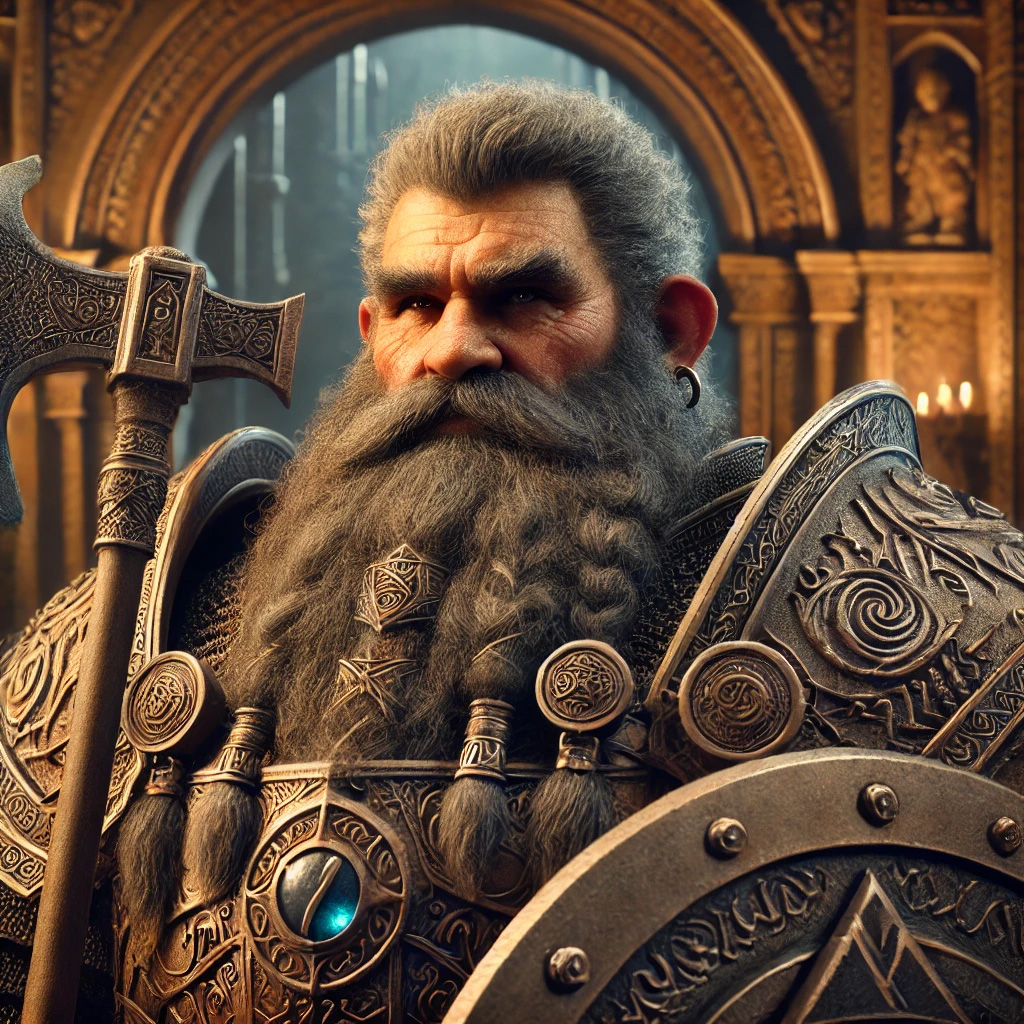
Stoneward, the Last Dwarven Kingdom
The Last Bastion of the Mountain Kings
In the rugged northwestern highlands of the western continent, where mountains rise like unbreakable sentinels and the winds carry the echoes of ancient wars, stands Stoneward, the last true dwarven kingdom. It is a realm carved into the very bones of the earth, its fortress-cities buried deep beneath stone and steel, its halls illuminated by the glow of ever-burning forges. :contentReference[oaicite:0]{index=0}
Unlike the other dwarven realms that fell to rebellion, decay, or internal strife, Stoneward has endured. It has not survived unchanged, however. Its people have been shaped by loss, by war, and by the constant pressure of enemies that surround them on all sides. Their survival has demanded adaptation, and that adaptation has come at a cost that is written into every scar upon their kingdom.
Half of their ancestral lands are gone. What was once a unified dwarven empire has been broken, its eastern provinces torn away and transformed into something unrecognizable. To the south, a different kind of threat festers, one that does not seek conquest alone, but transformation. And yet, despite all this, Stoneward remains unbroken.
The Sundering of the Dwarven Empire
There was a time when Stoneward and Grimstone were not enemies, but one and the same, a single dwarven empire that stretched across the mountains in an unbroken chain of fortresses and mines. It was a kingdom defined by strength, discipline, and an unshakable belief in its own permanence.
That illusion was shattered in the aftermath of the Great War. As the world reeled from devastation, the eastern provinces of the dwarven realm began to fracture. What began as unrest soon became rebellion, and what followed was a transformation that the dwarves could neither prevent nor fully understand. Orc warlords rose within those lands, seizing control through force, reshaping the holds into the brutal and militaristic domain now known as Grimstone.
To the dwarves of Stoneward, this was not merely a loss of territory. It was a betrayal etched into stone, a wound that has never healed. The halls they once built, the cities they once ruled, now stand under the banners of their greatest enemies. Every campaign, every battle fought along that border is driven not only by strategy, but by memory.
Yet the dwarves did not fall with their empire. Where others might have collapsed, they endured. Their society hardened, their structures evolved, and their focus shifted from expansion to survival. Stoneward became something different from the kingdoms that came before it, less an empire, and more a fortress against a world that sought to break it.
A Kingdom Surrounded
Stoneward does not exist in isolation. It is a kingdom defined by pressure, its position placing it between forces that would see it destroyed for very different reasons. To the east lies Grimstone, the broken half of their own legacy, now ruled by orc warlords who seek to finish what they began, the complete eradication of the last free dwarves. To the south spreads the cursed domain of Malgar, a land once tied to the elven forests of Thornwild, now twisted by dark magic and ruled by the spectral warlock Drelkar.
These two enemies share nothing but their desire for Stoneward’s fall. The orcs of Grimstone reject any notion of submission to Drelkar, viewing his sorcery with suspicion and disdain, while the warlock himself sees the orcs as tools at best, obstacles at worst. This rivalry, born of pride and conflicting ambition, has become one of Stoneward’s greatest advantages.
The dwarves are outnumbered. They are besieged. Yet their enemies are divided, and in that division lies the narrow margin that has allowed Stoneward to endure.
For now.
The Rivalries of the North
Stoneward stands at the center of a fractured northern theater, caught between two enemies whose hatred for the dwarves is matched only by their refusal to unite. This fragile balance of hostility has become one of the kingdom’s greatest strategic advantages, for while both Grimstone and Malgar seek its destruction, they do so along separate paths, driven by ambitions that cannot be reconciled.
To the east, Grimstone rises from the ruins of what was once dwarven land, now transformed into a brutal stronghold ruled by orc warlords. These warbands wage an unrelenting campaign against Stoneward, not merely to conquer, but to erase. To them, the existence of the remaining dwarves is an unfinished war, a lingering defiance that must be crushed. Their raids are constant, probing the mountain defenses, testing for weakness, seeking the moment when Stoneward’s strength might finally falter.
To the south, the threat takes a far more insidious form. The forest of Malgar does not wage war through sheer force alone, but through corruption and transformation. Under the rule of Drelkar, the land itself has become an extension of his will. The dead do not remain dead, and the living who fall into his grasp rarely return unchanged. His interest in Stoneward is not born of conquest alone, but of acquisition. The dwarves’ mastery of craftsmanship, their knowledge of metallurgy, and their mastery of machines represent tools he would twist to serve his own dark designs.
Despite their shared objective, these two powers remain bitter rivals. The orcs of Grimstone will not bow to a sorcerer they neither trust nor respect, while Drelkar sees them as crude instruments unworthy of alliance. This mutual disdain prevents the formation of a united front, and it is this fracture that has allowed Stoneward to survive against odds that would otherwise be insurmountable.
The dwarves understand this reality better than anyone. They do not seek to defeat their enemies outright, not yet. Instead, they endure, exploiting the tension between Grimstone and Malgar, ensuring that neither can commit fully without risking the other. It is a dangerous balance, one that could collapse at any moment, but for now, it remains their shield.
A Kingdom Forged in Hierarchy
In contrast to many of the dwarven civilizations that fell before it, Stoneward is not governed by merchant guilds or fractured clans. It is a feudal monarchy, rigid, structured, and deliberately designed to prevent the internal divisions that once led to ruin. Authority flows downward from a single source, ensuring that, in times of crisis, there is no ambiguity in command.
At the apex of this structure stands the High King, the ultimate authority in all matters of war, governance, and law. In times of peace, his power is balanced by the Council of Great Lords, but in war, his command becomes absolute. This distinction is not ceremonial, it is essential, for Stoneward exists in a state where hesitation can mean annihilation.
Beneath the High King stand the Great Lords, rulers of the fortress-cities that lie beneath the mountains. Each lord governs a domain carved into stone, overseeing not only its defenses, but its industries, its population, and its contribution to the greater kingdom. These cities are not independent states, but extensions of the crown, bound by duty and reinforced through centuries of shared survival.
Below them, the vassal lords manage the smaller structures that sustain the kingdom’s foundation, the mining outposts, the remote fortifications, the production hubs that feed the endless demand of war. Their authority is more limited, but no less important, for without them, the entire structure would collapse.
This hierarchy is not merely political, it is cultural. Every dwarf understands their place within it, not as a restriction, but as a necessity. Stoneward has learned from the fate of other realms that unity is not optional. It is the condition of survival.
Power, Duty, and Control
The strength of Stoneward’s system lies in its clarity. Every lord owes allegiance to the crown, every resource is accounted for, every soldier ultimately answers to the will of the High King. In return, the crown ensures protection, stability, and the continuation of dwarven identity in a world that has already consumed so much of it.
Rebellion is not tolerated, not because the dwarves are incapable of dissent, but because they understand its cost. The memory of lost kingdoms, of fractured alliances and internal collapse, remains ever present. There is no romanticism in disunity, no illusion that independence would bring strength. To fracture is to fall.
And yet, even within such a rigid structure, tension exists. The Great Lords are not without ambition, and while they remain loyal, their visions for the future of Stoneward do not always align. Some see the current system as the only path forward, a structure that must be preserved at all costs. Others believe that adaptation must go further, that the kingdom cannot remain static while the world around it changes.
These tensions do not erupt into open conflict, not yet. But they are there, beneath the surface, as constant and enduring as the pressure within the mountains themselves.
And like the mountains, they may one day shift.
Industry, Adaptation, and the Price of Survival
The survival of Stoneward has not been achieved through strength alone, but through transformation. The loss of the eastern provinces did not only strip the dwarves of land, it deprived them of the labor systems upon which their ancient economy depended. Where once vast numbers of trolls sustained the heaviest industries of the kingdom, that foundation collapsed with the fall of those territories, forcing Stoneward to reinvent itself or perish.
What followed was not decline, but adaptation. In the depths of their mountain holds, the dwarves turned to invention, developing machines of iron and steam to replace the strength that had been lost. Great automated forges now burn without rest, driven by mechanisms that never tire, while intricate systems of gears and pistons perform tasks once reserved for creatures of immense physical power. These constructs are not merely tools, they are the embodiment of a new philosophy, one where control, precision, and permanence replace reliance on living labor.
This transformation has reshaped Stoneward at every level. Industry has become more centralized, more controlled, and more efficient. Production no longer depends on unpredictable forces, but on systems that can be replicated, maintained, and expanded. The forges have become the heart of the kingdom, their output sustaining not only the dwarves themselves, but the network of trade that connects Stoneward to the wider world.
Yet this evolution has not come without consequence. It has altered the balance between the races that exist within the kingdom, redefining roles that had remained unchanged for generations.
A Society of Unequal Pillars
Stoneward is not a homogeneous realm. Beneath its rigid political structure lies a complex social order, one shaped as much by necessity as by tradition. Each group within the kingdom occupies a defined role, and each role reflects both its value and its limitations.
The trolls, once a fundamental part of dwarven industry, are now all but gone. Many were exterminated during the upheavals that followed the loss of the eastern lands, while others fled into Grimstone, where they found a place among the orc warbands. Those that remain within the borders of Stoneward are hunted without hesitation, seen not as former assets, but as potential threats. Their strength, once relied upon, is now feared, a reminder of a system the dwarves have chosen to abandon.
The gnomes occupy a far more complex position. Once relegated to the role of servants and artisans, they have risen in importance with the decline of troll labor. Their aptitude for trade, engineering, and organization has made them indispensable to the functioning of the kingdom. Merchant guilds, many of them led by gnomes, now control vast segments of Stoneward’s economy, facilitating trade routes, managing resources, and ensuring that the machinery of war continues to function.
Despite this rise, they are not equals. They remain second-class citizens, tolerated and protected, but never fully trusted. Their exclusion from military service is not an oversight, but a deliberate decision. The dwarves do not wish to create a class of gnomes who might one day see themselves as capable of claiming greater rights through force. Instead, they are kept within the sphere of commerce and industry, where their influence grows, but remains contained.
The goblins occupy the lowest tier of this structure. Unlike the gnomes, they have not risen with the changing times. They remain enslaved, their population tightly controlled, their role defined by expendability. Without the trolls to support them, their position has become even more precarious. They are used where risk is highest, sent to the front lines in times of war, deployed in tasks where survival is uncertain. Their continued existence is not born of necessity alone, but of calculation. They are a resource, and like all resources in Stoneward, they are managed with cold efficiency.
This structure is not questioned openly. It is understood, accepted, and maintained. In a kingdom under constant threat, stability is valued above all else, even when it comes at the cost of inequality.
The Economy of War
Everything within Stoneward ultimately serves a single purpose, survival through strength. Its economy is not one of luxury or excess, but of production, efficiency, and endurance. The forges produce weapons and armor of unmatched quality, the mines yield the raw materials that sustain this output, and the trade networks ensure that these goods reach allies and markets beyond the mountains.
Trade is not a secondary concern, it is a strategic necessity. Through carefully maintained caravans and agreements, Stoneward secures resources it cannot produce, while exporting the products of its industry to reinforce its position within the broader world. Steel, machines, and engineered constructs flow outward, while wealth, information, and alliances flow inward.
Yet war shapes every aspect of this system. Production is prioritized based on military need, supply lines are guarded as fiercely as fortresses, and economic decisions are made with the understanding that conflict is not temporary, but constant. There is no true peace within Stoneward, only periods of preparation between battles.
This has created a kingdom that is both incredibly resilient and perpetually strained. Its systems are efficient, its output formidable, but everything operates at the edge of necessity. There is little margin for error, little room for complacency.
The Dwarven Way of War
Stoneward does not fight as its enemies do. It does not rely on overwhelming numbers like the orcs of Grimstone, nor does it wield the unnatural forces that define Malgar. Its strength lies in discipline, preparation, and an unyielding refusal to break.
The dwarven legions form the backbone of its armies, warriors clad in armor forged from rune-etched steel, trained from an early age to hold the line against any foe. Their formations are precise, their movements deliberate, and their resolve absolute. They do not advance recklessly, nor do they retreat without purpose. Every action is calculated, every engagement controlled.
Supporting them are the engineers and siege corps, masters of machines that transform the battlefield itself. War engines, defensive constructs, and mechanized systems extend the reach of dwarven strength beyond what their numbers alone would allow. These are not tools of conquest, but instruments of control, designed to shape the flow of battle and deny the enemy any advantage.
Stoneward’s armies are smaller than those of its enemies, but this is by design. Every warrior is trained, equipped, and supported to a degree that ensures maximum effectiveness. Where an orc warband relies on numbers, a dwarven unit relies on cohesion. Where Malgar sends endless waves of the dead, Stoneward answers with precision and endurance.
This approach has allowed them to survive where others have fallen. But survival is not victory, and even the strongest defense can only hold for so long.
One day, the dwarves will have to decide whether endurance is enough.
High King Durnvar Ironfury, the Unyielding Monarch
High King Durnvar Ironfury stands as the living embodiment of Stoneward’s endurance, a ruler forged not in times of peace, but in the relentless crucible of war. His reign has spanned more than a century, and in that time, he has carried the kingdom through its darkest trials without once allowing it to break. His presence is imposing, his frame still powerful despite the passage of years, his beard marked with streaks of silver that speak not of weakness, but of experience hard earned upon the battlefield. :contentReference[oaicite:0]{index=0}
He did not inherit a stable kingdom. When his father fell in battle against the orcs of Grimstone, Durnvar took the crown in the midst of chaos, swearing that Stoneward would never bow, never fracture, and never fall as other dwarven realms had. From that moment onward, his rule became defined by necessity. He reshaped the kingdom, strengthened its defenses, and oversaw the transformation of its industries, ensuring that it could survive not just the wars of his time, but those yet to come.
In battle, he wields the Hammer of the Mountain, a relic of ancient kings whose power is as much symbolic as it is destructive. With it, he has shattered enemies and rallied his warriors, its runes glowing like the forges that sustain his realm. Yet Durnvar is more than a warrior king. He is a strategist, a ruler who understands that survival sometimes demands restraint. While others call for vengeance and expansion, he has chosen endurance, fortifying the kingdom and preserving its strength rather than risking it in uncertain campaigns.
This choice has not gone unchallenged. Among the Great Lords, there are those who see his caution as hesitation, who believe that Stoneward must reclaim its lost lands or slowly fade into irrelevance. Others fear that his grip on power has grown too rigid, that his vision leaves little room for adaptation beyond what he deems necessary. Durnvar hears these voices, but he does not bend to them. He carries the weight of every life within his kingdom, and he will not gamble it lightly.
Yet even he knows that time is not on their side. Stoneward cannot remain on the defensive forever. The question that haunts him is not whether war will come, but when he must choose to embrace it.
Vaelric Stonearrow, the Wanderer of the Wilds
Among the dwarves of Stoneward, Vaelric Stonearrow is an anomaly, a figure who has stepped beyond the safety of stone walls to embrace a life that few of his kind would understand. Where most dwarves find strength in the mountain, he has learned to survive in the open world, moving through forests, ruins, and contested lands with a skill that borders on the unnatural.
Clad in leather and light chain, his presence is easily mistaken for that of a ranger rather than a son of Stoneward. His weapon, known as the Widowmaker, is a longbow of exceptional craftsmanship, capable of delivering shots with a force that rivals siege engines. In his hands, distance offers no safety, and armor provides little protection.
His path began in tragedy. Once a soldier of the dwarven legions, Vaelric saw his entire unit destroyed in an orcish ambush. He survived, but only by retreating, a choice that has defined him ever since. Unable to bear the weight of that survival, he chose exile over return, abandoning the structured life of the kingdom to become something else entirely.
Despite this, he has never truly severed his ties to Stoneward. He moves along its borders, watching, hunting, and intervening where necessary. He warns of approaching threats, eliminates key targets, and ensures that the fragile lines of trade and communication remain intact. Yet he never stays. He does not reclaim his place, nor does he seek forgiveness.
He tells himself that he is free, that he owes nothing to the kingdom he left behind. But as the war intensifies and Stoneward faces greater danger, the question remains whether he will continue to walk alone, or whether he will one day return to stand among his people once more.
Zenidbac Goldvein, the Architect of Power
Zenidbac Goldvein does not command armies, nor does he stand upon the battlefield, yet his influence within Stoneward rivals that of any lord or general. Small in stature, meticulously dressed, and always composed, he represents a different kind of strength, one built not on steel, but on control, negotiation, and foresight.
As Steward of the High King, Zenidbac occupies a position that would have been unthinkable in earlier eras. Once, the gnomes were little more than servants within dwarven society, their talents recognized but their status limited. That world has changed. With the fall of troll labor and the rise of mechanized industry, the importance of trade, organization, and economic management has grown beyond anything the old system could sustain.
Zenidbac rose within this transformation, leveraging intelligence, ambition, and an unmatched understanding of economic systems to secure his position. Under his guidance, Stoneward’s trade networks have expanded, its resources have been optimized, and its war efforts have been sustained through carefully structured agreements and calculated investments.
Yet his rise has not been without consequence. Many dwarves view him with suspicion, questioning whether his loyalty lies fully with the kingdom or with the structures of power he has built around himself. The merchant guilds he influences operate with a degree of independence that unsettles the traditional order, and whispers persist that his ambitions may one day extend beyond stewardship.
Zenidbac does not deny his pragmatism. He does not believe in tradition for its own sake, nor in war as an end in itself. To him, survival is a matter of balance, of ensuring that Stoneward remains viable not only as a fortress, but as a participant in a wider world. Whether this vision aligns with that of the High King, or ultimately conflicts with it, remains to be seen.
Durnik Ironshield, the Voice of Vengeance
Durnik Ironshield is a relic of a war that never truly ended. A veteran of the Grimstone Rebellion, he carries the memory of a time when Stoneward still held its eastern lands, when the fall of those territories was not yet inevitable. His armor bears the marks of countless battles, and his presence commands the respect of those who understand what he has endured.
Once the lord of Ironshield Hold, a fortress that stood at the very edge of dwarven territory, he resisted the orcish uprising for years, holding the line against overwhelming odds. When the hold finally fell, he was forced to retreat, leaving behind not only his home, but the people he had sworn to protect. That loss has never left him.
Now, he stands among the Great Lords as one of the strongest advocates for war. To him, Stoneward cannot survive indefinitely behind its walls. The kingdom must reclaim what was lost, not only for strategic reasons, but for the very identity of the dwarves themselves. To remain passive is, in his eyes, to accept defeat in slow motion.
Yet even he understands the risk. A failed campaign would not simply cost territory, it could break the kingdom entirely. This tension defines him, a warrior torn between the desire for vengeance and the knowledge that acting too soon could doom everything he seeks to protect.
He waits, but not patiently. And when the moment comes, he will not hesitate.
Baldric Flameheart, the Last Oathsworn
Baldric Flameheart walks a path that few in Stoneward still understand. He is one of the last of the Oathsworn Knights, an order that once stood as the personal guardians of the High King, bound not by politics or strategy, but by unbreakable vows. Most of his kin fell during the loss of Grimstone, their oaths shattered alongside the lands they were sworn to protect. Baldric endured.
Clad in blackened steel etched with ancient runes, he carries Oathkeeper, a blade reforged across generations, tempered by the legacy of fallen kings. His shield, marked with the crest of Stoneward, has withstood blows that would have felled lesser warriors. Yet it is not his weapons that define him, but his purpose.
He has no hold to govern, no land to call his own. Once a noble in his own right, he lost everything during the fall of Ironshield Hold. Captured by the orcs, he spent years in captivity, enduring suffering without surrender. When he escaped, he returned not as a lord, but as something else, a knight without a domain, bound only to the oath that still drives him.
He travels where he is needed, appearing in times of crisis, fighting battles that others cannot, then vanishing once his duty is fulfilled. Some see him as a relic, a symbol of an age that no longer exists. Others see him as the purest expression of what it means to be dwarven, unbroken, unwavering, and bound by honor above all else.
Yet even Baldric can feel the shift within Stoneward. The world is changing, and there is less space for those who fight for ideals rather than outcomes. He remains steadfast, but he cannot ignore the question that lingers at the edge of his thoughts.
When the final war comes, will there still be a place for those like him, or will he truly be the last of his kind.
The Fate of Stoneward
Stoneward has endured where others have fallen, but endurance is not the same as victory. The kingdom stands at a crossroads, its future uncertain, its enemies unrelenting, and its internal tensions growing with each passing year.
If it remains as it is, a fortress against the world, it may survive for a time, holding back the tides of Grimstone and Malgar through discipline and resilience. But time favors its enemies, and the slow erosion of strength may one day achieve what war could not.
If it chooses to strike, to reclaim its lost lands and confront its enemies directly, it may achieve a victory that reshapes the balance of power. Or it may fall, its strength spent in a war it cannot win.
Between these paths lies uncertainty, a future that has yet to be defined. Stoneward must decide not only how it will fight, but what it is willing to become in order to survive.
The forges still burn.
The mountains still stand.
And the last dwarven kingdom has yet to fall.