






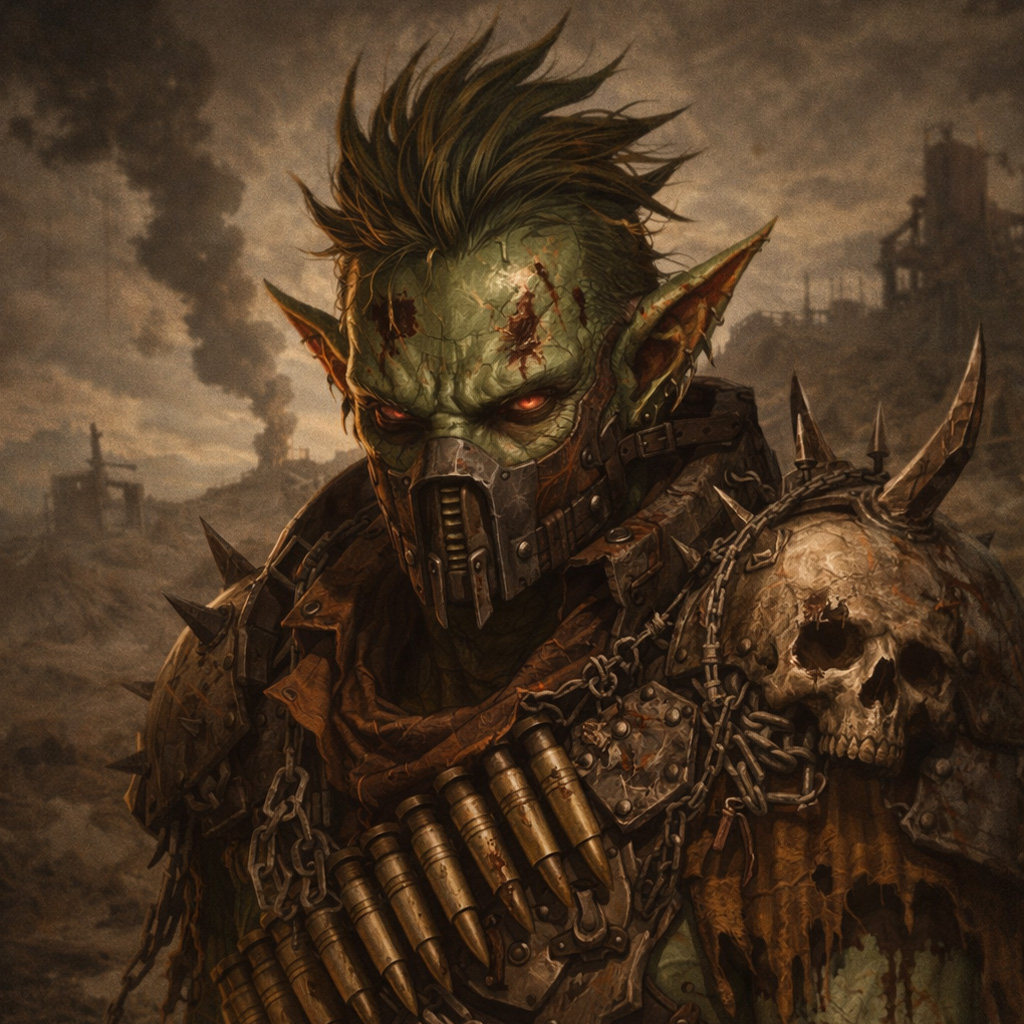
Orc Rebels, freedom or death!
Origins of the Orcs and the Experiments of the Elven Kingdoms
The orcs are not a natural species of Damocles. They were created by the first elven kingdoms shortly after their settlement in the system, at a time when the descendants of Ildarion were still trying to rebuild a civilization capable of rivaling the ancient Atlantean and Centaurian empires. The elves still possessed part of the ancient biological technologies inherited from Atlantis, including systems of artificial growth, accelerated gestation, and genetic manipulation once used to maintain or rapidly increase certain colonial populations. Originally, these technologies had not been designed to produce servile races, but to compensate for the catastrophic demographic losses caused by the invasion wars of the Second Atlantis. Yet the elven kingdoms quickly understood that they could also become an immense tool of domination in a system as hostile and vast as Damocles.
Many experiments were carried out during the first centuries of colonization. Elven biologists worked from proto-humans, primitive local populations, and sometimes even genetic material recovered from ancient buried Seraphim installations. Several artificial lineages were produced, but many proved too unstable, too intelligent to accept their condition over the long term, or, conversely, incapable of surviving in the extreme environments of Damocles. The orcs ultimately became the creation that best met the needs of the great houses. Their extremely rapid metabolism allowed for massive demographic growth, their bodies could endure working and battlefield conditions that killed most other species, and their aggressive psychology made them natural soldiers. The elves deliberately limited some of their cognitive abilities in order to reduce the risk of large-scale rebellion, but they were never able to fully suppress their social instincts, ambition, or capacity for adaptation.
Very quickly, the orcs became the material foundation of all elven civilization. The first great cities of Damocles, the fortresses of Wanyue, the trade routes, the deep mines, and even a large part of the restored Seraphim complexes were built or maintained by an almost inexhaustible orc workforce. Their efficiency far surpassed that of the other servile lineages previously tested. Where proto-humans retained too much individuality, and where other artificial creations often developed dangerous genetic instabilities, the orcs combined robustness, collective instinct, and sufficient obedience to become indispensable to the great houses. The elves themselves gradually came to regard the orcs as their most successful creation, not because they were the most intelligent or refined, but because they were the most useful to the survival and expansion of the kingdoms.
Yet this relationship remained deeply ambiguous from the very beginning. The elves despised the orcs as much as they depended on them. The biologists of the great houses often regarded their creations as mere biological tools, but the constant wars of the elven kingdoms eventually produced a strange proximity between the two species. For millennia, the orcs fought in practically every campaign of the kingdoms, dying by the millions in wars whose true objectives they often did not even understand. Yet the elves also discovered that the orcs shared with them one unexpected trait: an almost instinctive ability to structure extremely effective warrior hierarchies. Over time, some elven aristocrats even began to see in the orcs a brutal, primitive, and imperfect version of their own martial civilization.
The Orcs in the Service of the Elven Kingdoms
Over the centuries, the orcs became completely indispensable to the functioning of the elven kingdoms. They were not merely slaves or auxiliary soldiers, but the true foundation upon which almost the entire economy of the great houses rested. They were found in the deepest mines of Damocles, on the gigantic construction sites of Wanyue, in military convoys crossing the continents, and above all in the armies of the Proxywars. The elves, too few in number to sustain permanent large-scale wars by themselves, used the orc populations as an almost infinite resource. Entire generations of orcs were raised solely to fight in dynastic conflicts, wars of expansion, or campaigns that sometimes served the personal prestige of the great houses more than any true strategic necessity.
Very early on, the elves also understood that war itself had become an essential tool of social control. Orc populations possessed an extremely high level of aggression, reinforced both by their biological design and by their living conditions. When this violence could be directed toward an external enemy, the system functioned relatively efficiently. Wars made it possible to eliminate the most dangerous individuals, to offer orc chiefs opportunities for advancement, and above all to prevent the accumulation of internal tensions within elven territories. The great houses therefore came to maintain an almost deliberate state of permanent conflict. Even when the kingdoms experienced periods of relative stability, peripheral campaigns, raids, or indirect wars continued to feed the orc military machine.
Conversely, long periods of peace gradually became one of the greatest fears of the elven elites. When armies remained inactive for too long, internal violence rapidly exploded within the servile territories. Rival bands appeared, local warlords accumulated power, and accumulated tensions almost always ended up turning into open revolts. The elves therefore understood that their domination rested on an extremely fragile balance: they had created a population aggressive enough to conquer entire worlds, but too dangerous to be left inactive for long. This contradiction ran through the entire history of the elven kingdoms and explains in large part why wars practically never ceased on Damocles and Wanyue.
Despite their inferior status, the orcs also developed their own military culture within the elven armies themselves. Orc regiments passed down their traditions, war songs, systems of loyalty, and internal hierarchies from generation to generation. Some warlords even gained immense prestige among their own troops while remaining officially in the service of the elven houses. This shared warrior culture slowly contributed to the creation of a collective consciousness that extended beyond the borders of individual kingdoms. The elves still saw the orcs as an interchangeable biological resource, but the orcs themselves were already beginning to develop a historical memory built upon centuries of massacres, military campaigns, and permanent exploitation.
The Great Rebellions and the Limits of Elven Control
The first great orc revolts broke out long before the cyclical catastrophe. As long as the elven kingdoms remained technologically dominant and relatively stable, these uprisings could be contained, but they returned constantly throughout the entire history of Damocles and Wanyue. Some rebellions began in mines, others among auxiliary armies abandoned after particularly murderous campaigns, and still others in regions where the great houses had attempted to brutally reduce the resources granted to servile populations after long periods of war. Orcs sometimes massacred entire garrisons, captured fortresses, or destroyed industrial centers before the elves could react. Several minor kingdoms even disappeared entirely during these uprisings.
Yet despite their violence, these rebellions almost always failed in the long term. The elves eventually understood that the main weakness of orc societies came from their own demographic structure. Orcs rarely lived beyond thirty years, and reaching forty was already considered extremely old. This very short life expectancy prevented the emergence of stable ruling lineages capable of maintaining centralized authority over time. Great warlords often died at the height of their power, either in battle or simply because of their accelerated aging. After their disappearance, their coalitions almost systematically fragmented into rival bands incapable of preserving the unity achieved by the previous generation. For millennia, this natural instability prevented the rise of a true unified orc empire capable of rivaling the elven kingdoms over the long term.
The elves consciously exploited this weakness. The great houses gradually learned to manipulate the internal rivalries of orc clans, to support certain chiefs against others, to promise wealth or military prestige to the most useful bands, and to push the servile populations into permanent wars against one another. In many regions, the elves no longer even needed to fight the rebels directly: they simply used other loyal orc armies to crush the uprisings. This logic became so common that an immense part of the servile wars of Damocles were, in reality, conflicts between orcs themselves. The elves rarely appeared on the front line, preferring to remain in headquarters, elite units, or command centers while the servile populations slaughtered one another for their interests.
Despite this, each rebellion left something new behind. The orcs accumulated shared stories, war myths, heroic figures, and above all a collective memory of their exploitation. Even when crushed, revolts transmitted ideas from one generation to the next. Some chiefs began to understand that the elves were not invincible, that their kingdoms depended entirely on servile labor and armies, and that the great houses feared nothing more than the lasting unification of the orc peoples. Slowly, through centuries of massacres and failures, the ideological foundations of the future Kubuka began to appear.
The Cyclical Catastrophe and the Orc Awakening
When the cyclical catastrophe struck Damocles once again, the elven kingdoms had already been deeply weakened by centuries of global war against their excessive expansion and by repeated servile revolts. The old infrastructures began collapsing one after another. Energy networks became unstable, trade routes were cut, portals gradually stopped functioning properly, and entire regions sank into climatic, geological, and biological chaos. For the great elven houses, the immediate priority quickly became the survival of the remaining centers of power that were still capable of functioning. In this context, control over the orc populations brutally became a secondary concern in many regions of Damocles and even Wanyue.
This disorganization triggered the greatest orc rebellions ever seen up to that point. Servile garrisons abandoned by their officers mutinied, entire mines fell under rebel control, and several peripheral kingdoms completely disappeared beneath the uprisings. Unlike previous revolts, the elves no longer possessed the logistical means required to rapidly restore order. Their armies were scattered, the houses isolated from one another, and their technological reserves were rapidly dwindling. In some regions, the orcs even discovered abandoned military or industrial installations containing weapons, vehicles, and energy stockpiles once reserved for the elites. For the first time since their creation, immense orc populations began living for several generations without direct control from the great houses.
It was during this period that the concept of Kubuka gradually appeared, a term meaning roughly “the Awakening” in several ancient orc dialects. Kubuka did not merely refer to a military rebellion, but to a profound ideological transformation. For millennia, the majority of orcs had lived in a state of permanent violence without any true global historical consciousness. From then on, the stories of massacres, mining exploitation, servile wars, and betrayals by the great houses began to be transmitted as a shared memory. Rebel chiefs gradually understood that the elves were not natural masters, but a minority dependent on the labor and blood of the peoples they dominated. This idea slowly transformed local revolts into something far more dangerous for the elven kingdoms: a common orc identity capable of surpassing the old clans and traditional rivalries.
Despite this, the rebellions still remained deeply fragmented. The catastrophe had destroyed an immense part of the elven structures, but it had also ravaged the territories conquered by the orcs. Famine, internal wars, infrastructural collapse, and struggles for resources still prevented the emergence of a true lasting central authority. Yet, unlike in previous centuries, something had changed irreversibly. Even when defeated, the rebels now transmitted a common vision of their history. Kubuka gradually became an idea more powerful than individual warlords. The elves eventually managed to stabilize certain regions, but they also understood that they were now facing something different from the old servile revolts: a nascent orc civilization built upon hatred of the elven kingdoms.
The Wars of Kubuka
The current revolts on Wanyue, which belong to the wider movement of Kubuka, no longer resemble the old disorganized uprisings that marked the early ages of the elven kingdoms. Over time, the rebels have learned to survive in a state of permanent war against a technologically superior power. Certain industrial regions captured during the great rebellions have become true fortified bastions capable of producing weapons, ammunition, and vehicles from recovered or diverted material. The great rebel clans now control entire territories across Wanyue that have completely escaped the authority of the Senate. Fighting has become permanent, fragmented, and extremely brutal, combining guerrilla warfare, sieges, massive raids, and local extermination campaigns.
Yet despite the external image of a war between elves and orcs, the reality of the conflict is far more complex. The majority of battles against Kubuka actually oppose rebel orcs to other orcs still serving the elves and the Republic. The elven elites remain relatively rare on the front lines. True elves appear mainly in headquarters and elite technological units. Even the troops considered “elven” are often made up of Eldrakars genetically extremely close to the elves and practically assimilated to them. Thus, the wars of Kubuka frequently take the form of gigantic orc civil wars fueled and manipulated by the interests of the great houses of Wanyue.
The rebels themselves are far from unified. Some clans simply want to survive outside elven control, others dream of destroying the Republic entirely, while certain factions seek to build a true new orc order capable of rivaling the civilizations that came before. Important differences also exist between the orcs of southern and northern Wanyue, where the rebellion has managed to attract more Eldrakars. The former often live in wilder and more unstable territories, marked by the bloody raids of the Drakonoxes. The latter are generally more industrialized, better equipped, and more accustomed to urban combat or raids against the infrastructures of the Republic. This diversity greatly complicates any attempt to unify Kubuka over the long term, despite the presence of certain great chiefs capable of temporarily federating several clans.
Over time, the wars of Kubuka have also become a structural problem for the Republic itself. The great houses need the orc populations to keep their industries, mines, and armies functioning, but each new generation of war also strengthens the military experience of the rebels. The orcs learn, recover technologies, infiltrate commercial networks, and gradually develop their own clandestine structures. Certain regions of Wanyue, though formally under republican control, now live in a state of almost permanent conflict where sabotage, attacks, and clashes between armed bands have become part of everyday life. Many elven elites are beginning to understand that Kubuka is no longer a simple servile crisis, but a civilizational war that may eventually threaten the very existence of the Republic.
Orc Society and the Culture of War
Orc society was built over millennia around war, physical domination, and the ability to survive in an extremely violent environment. Among the rebels of Kubuka, strength remains the main source of political and social legitimacy. A chief exists only for as long as he is capable of protecting his band, winning victories, and attracting fighters beneath his banner. This logic produces extremely fluid hierarchies where alliances change quickly and weak chiefs are often overthrown or killed. Yet despite this apparent chaotic brutality, orc societies possess their own rules, traditions, and systems of loyalty that can sometimes be extremely solid within clans, as long as each individual’s worth has no reason to be questioned.
Warrior prestige plays a central role throughout the culture of Kubuka. The greatest chiefs accumulate wealth, weapons, territories, and above all gigantic harems sometimes composed of several dozen females. This organization creates permanent genetic pressure favoring the most aggressive, most resilient individuals and those most capable of imposing their domination. Many orcs therefore regard war not only as a material necessity, but as the natural foundation of existence. Dying in battle is often seen as an honorable end, while weakness or the inability to protect one’s band quickly leads to loss of status. This mentality partly explains why orc societies continue to produce so many warlords despite their very short life expectancy.
Nevertheless, reducing the orcs to mere violent barbarians would be a serious mistake. The societies of Kubuka possess an extremely rich collective memory transmitted orally through stories, war songs, and tribal traditions. Some bands even maintain lineages of storytellers or keepers of memory tasked with preserving the history of ancient rebellions and the great massacres carried out by the elven kingdoms. The orcs also place considerable importance on certain forms of personal honor, loyalty between warriors, and respect toward chiefs who have truly fought alongside their troops. A chief who remains hidden far from the front is generally despised, regardless of his wealth or power.
The cultural differences between the orcs of the south and those of the north also remain significant. The southern clans often live in far wilder territories where survival depends directly on raiding and clashes with the Drakonoxes. By contrast, the orcs of northern Wanyue have developed more industrialized structures, closer to the ancient elven infrastructures they now partially occupy. Some rebel bastions on the moon even resemble true underground military cities powered by recovered energy networks. Despite these differences, all nevertheless share the same vision of the world: the conviction that only strength makes it possible to survive in the brutal universe created by the elves themselves.
The Eldrakars and the Temptation of Rebellion
For a long time, the elven elites regarded the Eldrakars as a relatively stable solution to the demographic and economic problems of Wanyue. More fertile than the elves, physically robust, and capable of understanding both the technologies of the great houses and the brutal realities of the servile wars, they gradually became indispensable to the functioning of the Republic. Yet despite their growing importance, the Eldrakars remained trapped in a deeply ambiguous position. In practice, they administered cities, managed manufactories, commanded military units, and even served within certain structures of the Senate. But legally and culturally, they remained inferior to the ancient elven bloodlines. Those genetically closest to the aristocratic houses could hope for partial advancement, while the majority remained confined to subordinate roles despite several generations of loyalty to the Republic.
This situation gradually produced an increasingly visible identity crisis. The Eldrakars shared part of elven culture, but lived daily in contact with the orc masses who formed the core of Wanyue’s laboring and military population. Over time, the orc language had in fact become the true vernacular tongue of the moon. The Elvish of Myriam, officially used by the Senate, the great houses, and the central administrations, remained a complex language filled with cultural, legal, and aristocratic nuances that were extremely difficult to master perfectly for anyone outside the ancient bloodlines. Even many educated Eldrakars did not always understand all the subtleties of the noble dialects used by the elites. By contrast, orc had become a direct, simple, efficient language, understandable almost everywhere on Wanyue. The Eldrakars were almost all bilingual, while even a large part of the elves understood and spoke at least some orc in daily life, in the armies, or in trade. This linguistic evolution in reality reflected a much deeper transformation of lunar society: despite the official preservation of elven authority, the everyday functioning of Wanyue now relied largely on populations that were no longer truly elven.
In this context, some Eldrakars gradually began to join Kubuka. For most republican elites, the phenomenon initially remained marginal and almost incomprehensible. The Eldrakars objectively benefited from a far better position than the orcs, and many retained a deep cultural contempt for them, often seeing them as brutal, unstable, or primitive. Yet several factors made rebellion increasingly attractive to certain ambitious or marginalized individuals. In elven society, even an exceptional Eldrakar often remained limited by birth and by the implicit barriers imposed by the great houses. Among the rebels, on the other hand, personal strength, military charisma, and the ability to attract fighters allowed for far faster advancement. Some Eldrakars therefore joined Kubuka simply because there they could become warlords, accumulating wealth, prestige, territories, and harems in a way almost impossible to achieve within the official hierarchy of the Republic.
Others, however, joined the rebellion for more ideological reasons. Some Eldrakar officers or administrators eventually came to believe that the elves would never truly reform the Republic and that they would forever remain second-class citizens within a system built to preserve the domination of the ancient aristocratic bloodlines. A few even began to see Kubuka not merely as an orc revolt, but as the possible beginning of a new political order freed from the elven monopoly. Their presence gradually transformed certain rebel factions, which became more organized, more disciplined, and above all far more strategically dangerous. The Eldrakars brought military, industrial, and administrative knowledge that previous orc rebellions had rarely possessed on a large scale. For many of Wanyue’s elites, this evolution probably represented the most alarming sign since the first great servile revolts.
Rebel Bastions and Lost Zones
Over time, certain regions escaped the control of the Senate for so long that they eventually became true permanent rebel territories. Many of these zones were former industrial complexes, mining networks, or energy infrastructures partially abandoned by the great houses during the most violent periods of crisis. The rebels of Kubuka gradually learned to recover, divert, and keep part of these installations functioning despite their limited technological knowledge. Ruined cities were turned into improvised fortresses, industrial tunnels became defensive labyrinths, and several underground networks escaped all reliable mapping by the Republic. In some regions of Wanyue, senatorial forces no longer truly control anything beyond the great fortified trade routes linking the major industrial centers.
These rebel bastions survive through an extremely brutal yet surprisingly effective economy. Pillaging, smuggling, technological salvage, and the diversion of republican convoys feed an immense parallel economy crossing the entire moon. Some rebel bands even possess workshops capable of recycling military vehicles, reproducing simple weapons, or partially maintaining ancient energy infrastructures. Over time, several clandestine networks also appeared within republican territories themselves. Certain Eldrakar agents officially working for the great houses discreetly provide information, equipment, or logistical access to the rebels. In several industrial cities, entire black markets function thanks to tacit agreements between certain economic interests of the Republic and the clans of Kubuka.
The geography of Wanyue itself also favors this permanent war. A large part of the ancient infrastructures built during the imperial ages and the Proxywars forms a gigantic network of tunnels, abandoned complexes, buried bunkers, and partially restored Seraphim structures. Many rebel regions are therefore almost impossible to reconquer completely without massive extermination campaigns that would cost the Republic immense resources. The orcs use this territorial depth perfectly to disappear, reappear elsewhere, and wage a permanent war of attrition against senatorial forces. Even when a bastion falls, the survivors generally scatter into the underground networks before rebuilding somewhere else a few years later.
This situation has gradually transformed certain parts of Wanyue into permanent war zones where no one truly distinguishes the border between rebel territory and republican territory anymore. Cities officially controlled by the Senate may have their lower levels infiltrated by orc bands, while certain theoretically rebel regions discreetly maintain commercial exchanges with neighboring houses. Many great industrial families even sometimes prefer to maintain certain conflicts at low intensity rather than risk the total destruction of infrastructures upon which they economically depend. This permanent ambiguity makes Kubuka particularly difficult to eradicate: the rebellion is no longer merely an enemy army, but a political, economic, and social ecosystem deeply rooted in the very functioning of Wanyue.
Recent Genetic Manipulations
Faced with their growing inability to control the orc rebellions over the long term, several great elven houses gradually chose a strategy of biological escalation. The laboratories of Wanyue relaunched ancient genetic manipulation programs inherited from the first ages of the elves on Damocles in order to produce new forms of servants capable of resisting Kubuka. One of the first major results was the creation of orc lineages modified to assimilate Fukai gas directly into their organisms. These mutants developed extremely advanced regenerative abilities, physical resistance far superior to that of ordinary orcs, and above all a total dependence on the gas required for their survival. Elven biologists believed they had finally found the ideal solution: practically immortal warriors who could not survive for long without supplies controlled by the Republic.
The result, however, was far from what they had hoped. Some of these mutants nevertheless eventually joined Kubuka. Through raids on energy depots, smuggling networks, and clandestine complicities within certain industrial zones, they managed to maintain their supply of Fukai gas despite the Senate’s efforts. These individuals quickly became almost mythological figures among certain rebel clans. Their longevity, now potentially unlimited as long as they have access to gas, profoundly disrupts the historical balance of orc societies. For the first time, certain warlords can accumulate experience, prestige, and authority for decades without disappearing quickly like the old leaders of Kubuka. Many elven elites are beginning to understand that they may have accidentally created the first generation of orc chiefs capable of building a truly lasting power.
Biological manipulation did not stop there. Elven laboratories also began experimenting on the Norvegs, gigantic humans who appear sporadically among certain populations possessing Ante ancestors. Their genetic material was crossed with that of the orcs in order to produce massive creatures commonly called Yaku in orc, though their true scientific designation is Norvrakar. These monsters combine orc brutality, the size of the Norvegs, and biological enhancements linked to Fukai gas. Initially designed as living weapons meant to definitively crush the rebel bastions, several groups of Norvrakars also eventually joined Kubuka after escaping the control of their creators. Their mere presence on a battlefield is often enough to cause mass panic among ordinary republican units.
Faced with these repeated failures, some biologists of the great houses are now working on even more extreme forms: entirely artificial flesh golems, modular and almost completely devoid of will. These monstrous creatures are designed solely for massacre and absolute obedience. Yet even among the elven elites, many are beginning to fear that this biological escalation may be repeating exactly the mistakes that once led to the creation of the orcs themselves. The more the houses seek to produce biological weapons capable of saving the Republic, the more they seem to create new threats that may one day escape their future control.
The Orcs Facing the Future of Wanyue
Modern Kubuka is no longer a simple succession of local revolts comparable to the old servile wars of the elven kingdoms. For the first time in their history, the rebels have become a force capable of durably threatening the very balance of the Republic of Wanyue. Entire regions have now escaped the control of the Senate for several generations, and several great houses are beginning to understand that total victory has likely become impossible without a level of destruction that could annihilate the balance of the moon itself. This situation is creating growing divisions within Kubuka as well as among the republican elites. Many orcs believe that the current war is only a transitional stage before the final collapse of elven power, while others fear that the total destruction of the Republic would also cause the collapse of the infrastructures upon which the survival of millions of individuals now depends.
Within Kubuka itself, several visions of the future now openly clash. Some warlords simply want to exterminate the elves and permanently destroy the old great houses in order to end millennia of exploitation. Others seek instead to build a true unified orc empire capable of rivaling the ancient powers of Damocles and organizing coordinated offensives against the great portals of Wanyue. A few more pragmatic factions also try to encourage more Eldrakars to defect, hoping to use their military, administrative, and technological knowledge against the Republic. For many rebel chiefs, Wanyue’s true weakness no longer lies in its military power, but in its absolute dependence on a social structure that has become incapable of properly integrating the majority of its own population.
Yet the rebels themselves must also face immense limitations. The Republic still retains direct control over most of the great portals linking Wanyue to the Fukai, a practically limitless energy source that powers the industries, armies, and infrastructures of the great houses. The rebels do possess smuggling routes and clandestine networks allowing them to obtain part of these resources, but they remain unable to match the Senate’s overall industrial power. To this is added the permanent threat of the Seraphims who returned from Myia, whose first offensives have already devastated certain regions of the moon. Many orc chiefs even consider the Seraphims a far greater threat than the elves, because they seek neither economic domination nor servile exploitation, but the pure and simple annihilation of every rival civilization.
The rebels must also survive within an increasingly hostile environment in southern Wanyue, where the Drakonoxes continue their hunting campaigns against the orc populations. For these ancient predators, the wars of Kubuka represent both entertainment and a way of keeping the servile populations in a state of permanent weakness. Entire bands regularly disappear in massacres organized by the Drakonoxes, and even the greatest warlords often hesitate to engage in prolonged direct conflicts against them. Thus, despite their growing power, the rebels of Kubuka remain surrounded by enemies who are technologically, biologically, and strategically superior. Many now understand that their long-term survival will probably depend less on their ability to win a total war than on their capacity to gradually fracture the Republic from within until its collapse becomes inevitable.
The Great Chiefs of Kubuka
Among the many figures to have emerged during the modern wars of Kubuka, few inspire as much fear as Mulom Usala. An immense orc warlord capable of temporarily unifying several rival clans, he has become one of the living symbols of the Awakening on Wanyue. Unlike many older chiefs of Kubuka, Mulom fully understands the historical limits of orc societies. He knows that the rapid death of leaders has always prevented the emergence of a lasting power capable of rivaling the elven kingdoms. Obsessed with his own mortality, he has spent years seeking a way to prolong his existence without becoming entirely dependent on Fukai gas like the mutants created by elven laboratories. Some claim that he secretly funds clandestine biological research, while others insist that he is searching for Seraphim artifacts capable of altering his own body. Whatever his true intentions may be, Mulom remains today one of the few chiefs capable of coordinating several major offensives against the Republic at the same time. But for how much longer?
Another figure who has become famous throughout Kubuka is Kaelor Venh, an Eldrakar who joined the rebels mainly out of personal ambition. Born into a family connected to the administrative structures of Wanyue, he quickly understood that he would never rise beyond certain limits imposed by the ancient elven bloodlines, despite his military talents. Unlike the more ideological chiefs of Kubuka, Kaelor feels no deep hatred toward the elves themselves. What he desires above all is power, glory, and the riches he believes were unjustly reserved for the old aristocratic houses. Among the rebels, he quickly became famous for his spectacular raids, his immense harem, and his ability to attract warriors fascinated as much by his charisma as by his taste for luxury and violence. Many elves consider him the perfect example of what they had long feared: an Eldrakar using the orcs to build his own personal power against the Republic.
Opposite Kaelor stands Seredan Imlad, another major Eldrakar of Kubuka, but one driven by a far more ideological vision. A former military officer who served several great houses, Seredan eventually concluded that the elves would never truly reform the republican system. To him, the Eldrakars will remain forever tolerated servants as long as the ancient bloodlines retain the political and cultural monopoly of the Senate. Unlike more traditional orc chiefs, Seredan seeks less to completely destroy the existing structures than to create a new society dominated by the Eldrakars, where the orcs would keep an important place while being less brutally exploited. Many orc rebels distrust him, believing that he remains fundamentally a product of elven culture, while part of Wanyue’s elites probably considers him the most dangerous individual within Kubuka precisely because he understands the internal functioning of the Republic perfectly.
Finally, no figure of Kubuka is surrounded by as many myths as the elven champion Elysara Serithil. Born from an ancient aristocratic house of Wanyue, she gradually abandoned the republican elites after decades spent fighting on the servile fronts. Fascinated by the brutality, frankness, and warrior culture of the orcs, she came to regard the great houses as decadent, weak, and obsessed with comfort rather than true martial power. Unlike most elves, Elysara fights almost exclusively in close combat, surrounded by orc warriors whom she personally leads into battle. Her physical strength, martial abilities, and exceptional longevity quickly gave her an almost supernatural aura among many rebel clans. Some orcs now consider her a kind of warrior demi-goddess sent to guide Kubuka against the ancient houses. Among the elves, however, she has become a deeply controversial figure, both a symbol of absolute betrayal for some and a humiliating reminder of the moral degeneration of the elites for others.