






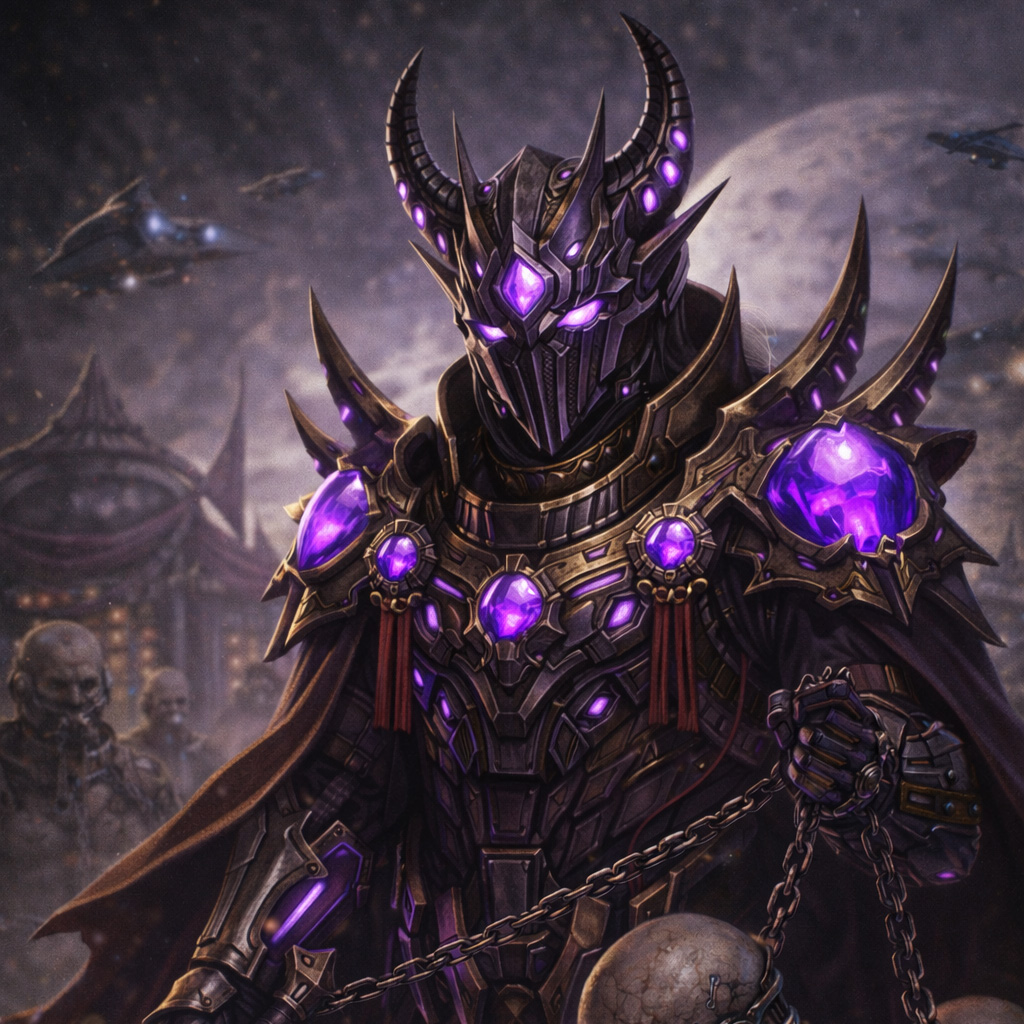
Wanyue Raider, The Sword Over Damocles
Origins of the Elves and the Exodus to Damocles
The elves are not native to the Damocles system. Their ancestors were created during the final periods of the ancient Atlantean civilization, at a time when humanity on Earth had already reached a technological and scientific level that is now almost impossible to comprehend. The first elven prototypes were the result of vast genetic engineering programs designed to create beings that were stronger, more intelligent, and capable of living for several centuries. The Atlanteans sought both to transcend the biological limitations of humanity and to create a caste capable of preserving their civilization against the crises already beginning to threaten their world. The first elves quickly developed their own social structures, ambitions, and above all an identity distinct from that of their creators. Their longevity, intellectual abilities, and relative genetic stability allowed them to rapidly climb the ranks of Atlantean society. However, this rise generated growing distrust among ordinary human populations. Over time, tensions escalated into open conflict, eventually leading part of the Atlantean elite to exile the elves to a distant colony: Centaurus.
The journey to Centaurus lasted for centuries. Several ships were lost during the voyage, but some ultimately reached their destination. There, the elves discovered a world already inhabited by the Centaurians, an ancient civilization possessing extremely advanced psychic abilities. Unlike the Atlanteans, the Centaurians had developed a civilization focused on the mastery of the mind, immaterial planes, and complex energetic phenomena rather than material expansion. After an initial period of mistrust, the two peoples eventually coexisted and later collaborated. The elves brought their technological and organizational knowledge, while the Centaurians gradually taught them certain psychic and esoteric disciplines. The generations born on Centaurus slowly began to change under the combined influence of local gravity, ancient biological manipulations, and prolonged contact with the Centaurians. The elven bloodlines gradually evolved into the forms now associated with the great houses of Wanyue.
This era of prosperity came to a brutal end with the arrival of the survivors of the Second Atlantis. The ancient Atlanteans, wielding forbidden technologies capable of destroying entire continents from orbit, launched a war of extermination against the elves and their allies. The cities of Centaurus were methodically devastated over countless generations. The Centaurians were slaughtered even within their hibernation sanctuaries, and the elves were gradually forced to abandon most of their cities. It was during this war that the Celdarins first appeared, hybrid beings born from joint research between elves and Centaurians, designed to wield psychic powers of extraordinary magnitude. Yet despite these efforts, the war seemed lost. Under the leadership of Ildarion, the surviving elves eventually transformed a captured Atlantean vessel into a survival ark intended to flee Centaurus. This departure was not that of a conquering civilization, but of a people on the brink of extinction desperately seeking a refuge distant enough to disappear from galactic maps.
The journey to Damocles also lasted for millennia. When Ildarion’s ark finally reached the system, the elves discovered a region already ancient, marked by the ruins of civilizations that had vanished tens of thousands of years earlier. Damocles was not a virgin world. The Cinans already dominated several major territories, and traces of the ancient Seraphims remained visible through immense abandoned structures. The elves quickly understood that they could never rebuild their civilization through brute force alone. Their population was small, their resources limited, and much of their former knowledge had been lost during the exodus. They therefore chose to settle gradually, first securing isolated territories before developing the first elven kingdoms of the system.
The First Elven Kingdoms and the Conquest of Wanyue
The first centuries of elven presence on Damocles were marked by a fragile coexistence with the powers already established there. The Cinans still dominated vast regions of the world. Although few in number, the elves still possessed knowledge inherited from Centaurus as well as part of the technologies preserved during the exodus. This technological advantage allowed them to rapidly establish several fortified kingdoms capable of rivaling local powers that were nonetheless far more numerous. The first great elven houses emerged during this period. Some descended directly from the officers of Ildarion’s ark, while others rose progressively through their mastery of ancient technologies, trade, or warfare. Yet the elves quickly realized that they could never sustain their expansion through their own population alone. Their low birth rate severely limited their military and industrial capabilities. It was within this context that the first great servile races created through genetic manipulation appeared.
The orcs became the most important of these artificial peoples. Designed to serve simultaneously as soldiers, workers, and heavy laborers, they rapidly became indispensable to the functioning of the elven kingdoms. Their extremely rapid demographic growth allowed the elves to sustain long wars while developing their infrastructures on a massive scale. Other auxiliary races were also created or modified during this period, but none ever reached the strategic importance of the orcs. Gradually, the elven kingdoms began to expand across Damocles.
It was during this long period that one of the most important discoveries in the entire history of the system took place. In southern Damocles, orc laborers employed by the kingdom of Miriel began uncovering abnormally deep structures beneath an ancient ruined region. At first, the elves believed they had discovered a particularly ancient Cinan city. But the further the excavations progressed, the clearer it became that the buried constructions were far older than any known kingdoms.
The work lasted for decades. Thousands of orcs died in collapses, unstable tunnels, and ancient installations that still remained active underground. Little by little, the elves realized that they had uncovered an immense forgotten city dating back to the Seraphim Ages.
The city was renamed Myriam. Very quickly, scholars, engineers, and archaeologists flooded in from across Damocles to study the ruins. Yet progress remained slow. The symbols discovered there had evolved over tens of thousands of years, and many early interpretations proved completely wrong.
For a long time, the elves did not even truly understand what they had found. At the center of the city stood an immense arch of stone and metal that fascinated researchers in particular. Some believed it was a religious monument. Others imagined it to be an ancient energy machine. These debates lasted for entire generations.
Only after several centuries of research did a team of engineers finally attempt a decisive experiment. Against the advice of many archaeologists, they connected the arch to Myriam’s partially restored energy network. For only a few seconds, a luminous surface appeared within the structure before the entire system collapsed into a total power failure.
The event completely transformed the course of research. The elves understood then that they were not facing a mere monument, but an ancient Seraphim transit gate. The “Moon Gate” had been rediscovered.
The Proxywars and the Age of the Great Houses
Over the millennia, the elven kingdoms gradually ceased to be simple survivor colonies and became true imperialist powers. The ancient bloodlines descended from Ildarion’s ark slowly transformed into great aristocratic houses controlling entire armies, intercontinental trade networks, and gigantic industrial complexes fueled by generations of servile races. Yet this expansion also caused a constant multiplication of conflicts. The elven kingdoms regularly fought one another for the control of resources and trade routes. At the same time, wars against the Cinans, the Greanan, the Bastets, and many other local powers never truly ceased. This era of nearly permanent conflict would later become known as the Proxywars, as alliances, political manipulation, and indirect wars played a central role within it.
Wanyue gradually became the strategic heart of this new elven civilization. Its relative climatic stability and its central position within several portal networks made it an ideal refuge for the elites. The greatest houses established there immense fortified villas combining Centaurian architecture, repurposed Seraphim structures, and ever-growing industrial complexes. It was during this age that the foundations of the future merchant and military-industrial dynasties that still dominate the Republic of Wanyue today were established. Noble bloodlines also began practicing extremely advanced forms of genetic selection in order to preserve the elven traits they considered superior. Blood purity, longevity, and psychic abilities gradually became central elements of the social status of the great houses. At the same time, orcs were used massively in increasingly deadly wars of attrition, already creating the first deep tensions that would eventually lead to the future great rebellions.
Excessive Expansion and the Coalition of the Peoples of Damocles
After the Proxywars, the elven kingdoms entered a new phase in their history. The great houses of Wanyue and Damocles had survived centuries of indirect wars, dynastic rivalries, and conflicts against the other powers of the system, but that survival had made them even more arrogant. The Second Great Cinan War, followed by the discovery of the Tree of Life, opened a more chaotic period marked by centuries of corruption, permanent wars across Wanyue, and internal struggles between elven houses. Yet when this instability eventually began to fade, many elves interpreted this relative return to order as proof that their civilization had triumphed over every danger. The old elites no longer truly viewed the other peoples of Damocles as rivals capable of disputing the future of the world, but merely as local forces to contain, manipulate, or use against one another. This illusion became one of the deepest causes of the crisis that followed.
During this long period of relative peace, the elven kingdoms continued their expansion across Damocles with growing confidence. Their trading outposts became fortresses, their colonies became principalities, and their spheres of influence evolved into territories administered almost directly by the great houses themselves. Orcs and other servile races were employed in ever greater numbers within mines, construction sites, auxiliary armies, and colonization campaigns. The local peoples, who had long tolerated elven alliances out of necessity or interest, gradually began to perceive this presence as a permanent domination. The Cinans, the Greanans, the Bastets, and many other powers of Damocles all had their own reasons to hate or fear the elves, but for a long time their internal rivalries prevented any unified response. In the end, it was the excess of elven expansion itself that created the conditions for a coalition.
The war that followed was therefore not a simple local revolt. It was the result of a slow accumulation of resentment, broken treaties, annexed territories, and populations sacrificed in conflicts whose benefits almost always flowed back to the same houses. The elves had built their power upon their ability to divide their enemies, but their arrogance eventually produced the opposite effect. Several species of Damocles, previously incapable of sustaining any lasting alliance, gradually united in order to drive the elves out of the Northern Continent. The war was long, difficult, and irregular, marked by major campaigns, endless sieges, broken alliances, and servile uprisings. The elven kingdoms still possessed considerable technological and organizational advantages, but they were now fighting on too many fronts, depended too heavily on auxiliaries whose loyalty was beginning to fracture, and were forced to defend a territorial system far too vast for their own numbers.
On Wanyue, the war was initially perceived as a distant crisis before becoming a direct threat. The great lunar houses sent reinforcements, equipment, advisors, and orc contingents to support the kingdoms of the continent, but every setback on Damocles intensified the internal tensions of the moon itself. The oldest bloodlines accused the merchant houses of weakening the conquering spirit of the elves, while the industrial houses blamed the military aristocrats for provoking a war that could never truly be won. Within the fortified cities of Wanyue, strategic debates were already becoming intertwined with growing concerns regarding the reliability of the orcs, whose losses were immense and whose local uprisings were becoming increasingly frequent. Elven civilization had not yet collapsed, but this war brutally revealed that its age of limitless expansion was nearing its end.
The Cyclical Catastrophe and the Collapse of the Kingdoms
While the elven kingdoms were already weakened by this great war, the cyclical catastrophe struck Damocles. The planet entered a new age of massive climatic, geological, and ecological upheavals, similar to the great collapses that had already shattered previous civilizations many times before. Entire regions were devastated, supply networks collapsed, roads became impassable, cities were isolated from one another, and an immense part of the technological infrastructure inherited or restored over centuries ceased to function. The portals, which had long allowed the elves to compensate for their low population through superior strategic mobility, almost all fell into inactivity or instability. What had once been a difficult war became a crisis of civilizational survival.
The catastrophe did not merely destroy armies and cities. It shattered the administrative, economic, and symbolic ties that had still maintained the unity of the elven world. The kingdoms of Damocles suffered the worst devastation, for they depended upon systems of exchanges, portals, depots, and technological relay networks that could not survive such a brutal collapse. Some heavily fortified bastions managed to endure, often at the cost of near total isolation, but most exposed territories disappeared into famine, forced migrations, local wars, or attacks from their ancient enemies. The great houses lost archives, laboratories, entire bloodlines of engineers, and stockpiles of irreplaceable equipment. Their technological superiority did not vanish all at once, but it became fragmented, poorly understood, and confined to a few surviving centers incapable of properly transmitting their knowledge.
Wanyue was spared the most destructive aspects of the catastrophe, as it had often been during previous cycles, but it was not spared its consequences. The moon lost much of its connection to Damocles and saw waves of refugees, defeated officers, ruined scholars, and noble houses arriving in search of whatever could still be saved. The lunar territories thus became the last great region where some form of elven continuity still seemed possible. Yet that continuity was fragile. The resources of Wanyue could not compensate for all the losses suffered on the continent, old rivalries between houses intensified, and dependence on orc labor became even more dangerous. The elven elites understood that the main planet had entered a new era of deep regression, but many still refused to admit that their own civilization had also been irreversibly diminished.
In the generations that followed, technological collapse took on an almost insidious form. The most advanced machines could still be used, but no longer always repaired. Technical rituals sometimes replaced genuine understanding of ancient systems. Fortresses continued to function thanks to reactors whose principles no one fully mastered anymore. The surviving portals became objects of fear as much as power, for a failed activation could condemn an entire city to isolation or destruction. It was within this diminished world, where the elves still retained the prestige of a superior civilization without always possessing the real means behind that superiority, that the great orc rebellions reached their full scale.
The Great Orc Rebellions
The orcs had not waited for the catastrophe to revolt, but it was only after it that their uprisings became impossible to contain. For millennia, they had served as soldiers, laborers, miners, builders, and expendable cannon fodder for the elven kingdoms. Their numbers had been encouraged as long as they fueled expansion, their violence channeled as long as it sustained the wars of the great houses, and their status maintained through brutal servitude enforced by military control, economic dependence, and biological manipulation. When the kingdoms were still strong, these revolts could be crushed one after another. But after the cyclical catastrophe, the garrisons were scattered, command networks weakened, military reserves depleted, and many houses could no longer rely on the rapid arrival of reinforcements from Wanyue or the remaining bastions.
On Damocles, the rebellions often took the form of territorial uprisings. Entire mines fell under orc control, fortified industrial sites became rebel strongholds, and auxiliary armies massacred their officers before joining the enemies of the elves or forming their own warbands. In certain regions, the orcs sought not only to escape elven domination, but to systematically destroy everything that could allow its return. Archives were burned, laboratories were sacked, bloodlines of overseers were hunted down, and several already weakened elven kingdoms disappeared entirely beneath these waves of violence. The other peoples of Damocles sometimes exploited these revolts, but it would be false to reduce them to mere instruments of an anti-elven coalition. The orcs possessed their own memories, their own hatred, and their own reasons to rise after millennia of exploitation.
On Wanyue, the situation was different but no less severe. The moon had resisted the catastrophe more successfully, and the great houses still retained fortresses, workshops, military reserves, and a more coherent political authority there. Yet the sheer density of the servile populations made the crisis even more dangerous. The cities, agricultural domains, arsenals, and mining facilities depended massively upon orc labor. Every revolt therefore threatened not only the social order, but the material functioning of lunar civilization itself. The elves were forced to mobilize their remaining strength in order to maintain vital corridors, protect the great fortified villas, and prevent the insurgents from permanently seizing ancient Seraphim sites. The war on Wanyue was not a succession of isolated battles, but a grinding conflict of attrition that forced the houses to transform their own domains into permanently militarized territories.
This period completed the transition of elven civilization into a new age. The great houses survived, but they emerged weakened, more distrustful, more dependent than ever upon their lunar bastions, and far less capable of restoring the old order on Damocles. An immense part of elven technological knowledge was lost through the combined effects of catastrophe, wars, and rebellions. The orcs, meanwhile, ceased forever to be viewed as a simple controllable resource. They had become a historical force capable of toppling kingdoms, blocking trade routes, exterminating bloodlines, and threatening the very heart of Wanyue itself. Thus, when humanity finally arrived within the system, the elves of the moon were no longer at the height of their power. They were an ancient civilization, still brilliant in certain ways, but exhausted by centuries of collapse and engaged in a total war they were slowly losing.
The Arrival of Humanity on Wanyue
It was within this context of gradual collapse that humanity finally arrived in the Damocles system. They traveled aboard a standard colonization vessel whose journey had lasted so long that the entire situation of the system had changed during the voyage itself. By the time the colonists finally reached Damocles, the main planet had already entered a new phase of destruction caused by the cyclical catastrophe. Vast regions had become uninhabitable, ancient infrastructures had collapsed, and the surviving elven kingdoms were engaged in permanent wars against the orc rebellions and the other powers of the world over the few remaining resources. Humanity quickly understood that it would be impossible to establish a stable colony directly on Damocles. Their attention therefore shifted toward Wanyue, which remained habitable despite the ongoing war.
At that time, the elves of Wanyue were still engaged in an extremely difficult struggle against the great orc rebellions. Several houses had already lost entire territories, and some mining or industrial regions had completely escaped their control. Despite their initial distrust toward these new human arrivals, the lunar elites quickly understood the strategic value they represented. The colonists brought with them technical knowledge different from that of the elves, industrial capabilities that were still relatively preserved, and above all a demographic potential capable of partially compensating for the gradual decline of the elven populations. Where the great houses were losing entire generations in endless wars and suffered from an extremely low birth rate, humans could rapidly produce new workers, soldiers, and colonists. The first agreements were therefore concluded far more out of pragmatic necessity than any genuine spirit of alliance.
Humans were progressively settled in several regions controlled by the elven houses, first as technical auxiliaries and support populations, then as full colonists. Humanity soon established its own kingdoms upon lands reclaimed from the elves.
Within the elven kingdoms, the elves used human industrial expertise to restore partially abandoned complexes, rebuild infrastructures, and support the war effort against the orcs. Humans often admired the sophistication of elven civilization, but the lunar elites primarily viewed them as a useful resource to integrate into their own system of domination. Yet despite this implicit hierarchy, the daily proximity between human and elven populations gradually transformed the society of Wanyue in ways many old aristocrats had never anticipated.
Over time, the constant contact between humans and elves led to the appearance of the first Eldrakars. These hybrids rapidly became a central element of lunar society. More resilient and fertile than the elves while inheriting part of their physical and intellectual characteristics, they represented for many houses a solution to the biological limitations that had weakened elven civilization for millennia. At first, hybridizations remained limited to the peripheries of certain houses or secondary bloodlines, but their gradual multiplication profoundly transformed the demographic balance of the elven kingdoms of Wanyue. Within only a few generations, the elven kingdoms began producing a new population that was no longer truly human, yet not entirely elven either.
The Birth of the Eldrakars
The appearance of the Eldrakars gradually transformed the entire social organization of the elven kingdoms of Wanyue. At first, many elven houses viewed hybridization as a simple pragmatic necessity linked to war and reconstruction. But over time, the Eldrakars ceased to be isolated individuals and became a major demographic component of the moon itself. Their fertility, superior to that of the elves, combined with their adaptability and cultural proximity to both populations, allowed them to spread rapidly through cities, industrial domains, and agricultural territories controlled by the great houses. In some regions, they became the majority within only a few centuries. This evolution generated growing tensions among the old aristocratic bloodlines, which increasingly saw the rise of a hybrid population capable of questioning the traditional social order without being easily separated from the rest of society.
An implicit hierarchy, later becoming increasingly official, developed around the degree of elven blood. Not all Eldrakars were perceived in the same way. Some, born from bloodlines very close to the ancient noble houses, retained an almost entirely elven appearance and benefited from a relatively elevated place within society. Others, more genetically distant from the original lineages, became nearly indistinguishable from ordinary humans and occupied far more modest positions. The great houses then began practicing extremely complex forms of genetic selection in order to preserve certain characteristics they considered desirable. The wealthiest bloodlines sought to preserve elven traits while maintaining sufficient fertility, creating an unstable balance between “elvenization” and demographic survival. This genetic obsession gradually became one of the major social foundations of Wanyue.
At the same time, a significant part of the old elven elites categorically rejected this transformation of lunar civilization. For these traditionalist aristocrats, hybridization represented not only biological dilution but also the gradual abandonment of the historical identity of Ildarion’s descendants. Several houses therefore began leaving the heavily mixed central regions of Wanyue in order to settle farther north, in more isolated territories where they hoped to preserve bloodlines considered “pure.” This migration was not merely a geographical movement. It marked the beginning of a profound cultural fracture between the traditionalist elites and the mixed societies that now dominated much of the moon. The northern regions gradually became military and aristocratic bastions where the ancient warrior and expansionist values remained particularly strong.
Meanwhile, the Eldrakars continued gaining influence in nearly every aspect of society. They served within the armies, managed manufactories, administered cities, and already participated in the interregional trade connecting the different territories of Wanyue. Yet despite their growing importance, they remained excluded from much of the true political power still held by the old elven bloodlines. This contradiction would become one of the central problems of the moon’s future history. For the more indispensable the Eldrakars became to the functioning of Wanyue, the harder it became to justify their complete exclusion from the highest spheres of decision-making.
The Great Northern Migrations and the Heroic Ages
The migrations toward the north profoundly transformed the political and cultural balance of Wanyue. The elven houses that rejected hybridization did not merely isolate themselves; they undertook the construction of new domains capable of preserving their way of life, their military traditions, and their hierarchical vision of civilization. These northern territories were harsher, less densely populated, and often much closer to the ancient wild zones still marked by the remnants of previous wars. There, the traditionalist elites developed heavily militarized societies where discipline, blood purity, and martial training occupied a central place. Yet these migrations also brought the elves into contact, and eventually into conflict, with the ancestors of the Voltrmen and other human populations already established within the northern regions of Wanyue.
The traditionalist elves often viewed these wars as a rebirth of the old conquering spirit of Ildarion’s kingdoms. Yet despite their military power, they never managed to impose complete domination over the northern territories. The local human populations, the proto-Voltrmen clans, and the various confederations emerging in the north developed their own warrior traditions and political structures.
The northern territories were filled with forgotten ruins, partially active underground complexes, and dangerous regions where forms of life originating from the ancient ages of the world still survived. This period was also marked by extremely violent wars against the Drakonoxes and other creatures linked to the ancient Seraphim powers. Many of Wanyue’s legends originate from these conflicts. The stories surrounding Geom’a, the first Kento clans, and the great human confederations date back to this era, when the boundaries between war, exploration, and survival remained extremely blurred. The heroes of those generations were not merely military leaders, but often explorers, monster hunters, or lords capable of maintaining the unity of isolated populations within unstable territories.
Meanwhile, the central territories of the moon continued their economic and demographic transformation around mixed elven and Eldrakar societies. Despite this fragmentation, the great elven houses still maintained a form of global unity thanks to the authority of the Blue Dragon, descendant of Ildarion and major figure of both the Proxywars and this era. Adventurer, scholar, and warrior, he already devoted a vast part of his existence to the study of Seraphim ruins and the research surrounding the ancient portal networks, convinced that the future of Wanyue and Damocles still depended upon the secrets buried deep below.
The Blue Dragon and the Reopening of the Portals
As Wanyue continued its political and cultural transformation, the Blue Dragon gradually became the central figure around whom the great houses still managed to maintain a form of unity. A direct descendant of Ildarion, hero of the Proxywars, explorer, and obsessive scholar, he devoted an immense part of his existence to studying the Seraphim ruins scattered across Damocles and Wanyue. Unlike many elven aristocrats who viewed ancient artifacts merely as instruments of power, the Blue Dragon was convinced that the Seraphims had left behind a global system of which the elves still understood only a tiny fraction. In his eyes, the future survival of their civilization depended less on wars between houses than on the ability to rediscover and restore the ancient networks inherited from the Seraphim Ages.
The engineers, archaeologists, and scholars sent into the depths of the city gradually succeeded in restoring certain energy infrastructures and, above all, in better understanding the functioning of the ancient transit gates. The “Moon Gate,” discovered several generations earlier, remained largely unstable and only partially understood. Numerous experiments ended in catastrophes, energy overloads, or the disappearance of entire teams within poorly understood phenomena. Despite this, the Blue Dragon continued his research with an almost obsessive determination. It was ultimately thanks to the Seraphim Crown of Knowledge, an ancient artifact discovered deep below, that he managed to achieve a decisive breakthrough. The artifact allowed the partial stabilization of several Seraphim systems and granted access to a far more advanced understanding of the ancient portal networks.
The reopening of the portals immediately transformed the balance of the system. For the first time since the cyclical catastrophe, the kingdoms of Wanyue were once again able to project their forces massively toward Damocles. Ancient abandoned cities were recolonized, trade routes gradually reappeared, and several isolated elven bastions cut off for centuries were reconnected to the rest of the world. The recolonization of Damocles then began on an unprecedented scale. The elven houses saw it as an opportunity to rebuild their former empires, while the human kingdoms of Wanyue viewed the new territories as a vast opportunity for expansion. Yet this new conquest did not take place in unity. Very quickly, it became necessary to organize the division of the reclaimed territories. The southern continent of Damocles was progressively reserved for the elven and Eldrakar kingdoms, while the northern continent came largely under human domination. This distribution prevented an immediate war between the different powers of Wanyue, but it also laid the foundations for the future geopolitical rivalries of the system.
The price of this victory, however, was immense. The efforts required to understand and reactivate the ancient Seraphim networks nearly destroyed the body of the Blue Dragon. The artifacts used, the manipulated energy flows, and the psychic connections imposed upon his mind left him in a critical condition. In order to preserve what remained of him, the great houses ultimately decided to place him in stasis. His disappearance caused a tremendous shock across Wanyue. For centuries, he had served as an implicit arbiter between the houses, a common heroic figure, and above all the guardian of the great projects tied to the portals and the return to Damocles. Without him, the rivalries that had long been contained by his prestige quickly began to resurface. The reopening of the portals had allowed the rebirth of elven expansion, but it had also opened a new era of instability whose true consequences no one yet fully understood.
The Fragmentation of Wanyue and the Rise of the Great Houses
After the disappearance of the Blue Dragon, the old tensions running through Wanyue rapidly resurfaced. The great elven houses, which had temporarily accepted a degree of cooperation in order to support the research efforts and the recolonization of Damocles, gradually returned to prioritizing their own interests. The reopening of the portals had created immense economic, military, and territorial opportunities, but it had also made possible a new phase of generalized competition between the powers of the moon. The old structures of common authority no longer possessed the legitimacy required to arbitrate these rivalries over the long term. Officially, all major factions remained subordinate to the High Council of Myriam, which still claimed to represent the unity of Ildarion’s heirs. In reality, the elves of Damocles no longer held any true control over the great houses of Wanyue, whose wealth and industrial power now vastly surpassed those of the continental kingdoms.
Wanyue then entered a long era of political fragmentation dominated by the great merchant, military, and industrial dynasties. Certain houses controlled immense arsenals and private fleets capable of waging entire regional wars. Open conflicts between houses still existed, but they now took forms very different from those of the old Proxywars. Direct confrontations were costly and risked destabilizing the entire economic system upon which Wanyue’s wealth now depended. Rivalries therefore increasingly took the form of sabotage, assassinations, trade wars, indirect raids, and the massive use of sacrificial orc armies in peripheral conflicts.
This evolution profoundly transformed lunar society. The great fortified villas gradually became the centers of immense economic complexes combining biological laboratories, military manufactories, aristocratic academies, and commercial ports connected to the newly restored portal networks. The oldest elven bloodlines still retained the symbolic prestige of power, but the great Eldrakar families were also gaining increasing influence thanks to their central role in industry, administration, and the armies. Yet despite the growing power of the hybrid populations, the political structures remained dominated by the old elven elites. This contradiction was already fueling deep tensions within the societies of Wanyue themselves.
At the same time, the wars against the orcs never truly ceased. On the contrary, the economic and industrial expansion of Wanyue further increased the demand for servile labor and auxiliary troops. The houses continued using millions of orcs within their mining operations, construction sites, and private armies, while regularly waging indirect wars for control over the resources of Damocles. Each conflict fed the growing hatred accumulating among the servile populations. Yet during this era, the majority of Wanyue’s elites remained convinced that these rebellions could still be controlled as they always had been. Few understood that their civilization was already preparing the conditions for a new major explosion.
The Republic of Wanyue and the Industrialization of the Fukai
The imperial conquest of Damocles and the exploitation of the Fukai transformed Wanyue even further. The emergence of new energy sources derived from the mutant forest completely reshaped the economy of the system. The gases extracted from the Fukai, the biological materials produced by its organisms, and the new technologies developed through research into its properties allowed the massive industrialization of the lunar territories. The great forges of Wanyue then entered an unprecedented period of expansion. Immense industrial complexes were constructed around the reactivated ancient Seraphim networks, combining elven technologies, infrastructures inherited from the ancient ages, and innovations developed from the resources of the Fukai. This growth permanently transformed Wanyue into one of the greatest economic and industrial powers of the Damocles system.
This new prosperity also changed the nature of the conflicts between houses. Open wars had become too dangerous for economies so deeply interconnected. Rivalries therefore took increasingly indirect forms: industrial sabotage, commercial raids, political manipulation, technological espionage, and peripheral wars conducted through intermediaries. The great houses continued to maintain gigantic private armies, but these forces served as much to protect trade flows and energy installations as to directly conquer territories. The orcs remained at the center of this system, used massively as soldiers, laborers, and expendable populations in endless low-intensity conflicts.
It was during this period that the Republic of Wanyue officially emerged. Behind this new political structure lay above all an attempt by the greatest houses to stabilize their rivalries while collectively protecting their economic interests. A Senate dominated by the elven elites was created in order to represent the great dynasties of the moon. Three Consuls were entrusted with executive power, each supported by complex networks of commercial, military, and industrial alliances. Officially, the Republic claimed to represent all civilized peoples of Wanyue. In reality, full citizenship remained reserved for elves, while the Eldrakars, despite their demographic and economic importance, remained largely excluded from the highest spheres of power. For a time, this organization succeeded in preventing major civil wars between houses while further accelerating the industrial expansion of the moon.
It was also during this era that the term “Wanyue Raiders” first began to appear. From the outside, Wanyue increasingly appeared as an aggressive, wealthy, technologically advanced power ready to intervene anywhere within the system in order to protect its economic interests. Yet behind this apparent stability, tensions continued to accumulate. The ever more brutal exploitation of the orcs, combined with the decline of the great wars that had once channeled their violence, was already creating the foundations for a new wave of massive rebellions. At the same time, a growing part of the Eldrakar population had begun questioning a political order that continued to treat them as inferior citizens despite their central role in the Republic’s power. Wanyue seemed wealthier and more powerful than ever before, yet many of its leaders already understood that this prosperity rested upon extremely fragile balances.
The Wanyue Raiders Today
Today, Wanyue has become one of the major economic, industrial, and military powers of the Damocles system. Its portal networks, biological manufactories, and commercial fleets sustain an immense part of the exchanges linking the moon to Damocles and the peripheral territories. The great houses possess resources capable of rivaling those of many planetary kingdoms, while the technologies developed from the Fukai have enabled considerable advances in the fields of energy, biology, and warfare. Yet behind this image of prosperity and power, the Republic lives in a state of permanent war that has almost become normal. Roughly a third of Wanyue now entirely or partially escapes the control of the Senate and the great houses. Entire regions are contested between republican forces, orc rebel warbands, private militias, and local factions of varying autonomy.
The modern orc rebellions no longer resemble the disorganized uprisings of previous centuries. Many rebel groups now possess their own fortifications, heavy weapons either recovered or produced clandestinely, supply networks, and sometimes even temporary agreements with rival factions of the Republic itself. The permanent wars waged by the houses over generations have ultimately produced an immense orc population accustomed to combat, capable of recovering and reproducing part of the technologies used against them. Some lost industrial zones have even been transformed into rebel bastions that are practically impossible to reconquer without massive extermination campaigns, which the Senate hesitates to launch both because of the economic cost and the fear of triggering an uncontrollable escalation. The most militaristic houses regularly demand total offensives, while others prefer maintaining low-intensity warfare that still allows the exploitation of certain frontier regions without risking the collapse of the entire economic system.
At the same time, the Eldrakar question becomes more dangerous for the traditional elven elites with every passing century. The Eldrakars now occupy a central role in almost every sector of society: military, administration, trade, industry, research, navigation, and energy exploitation. In some regions of Wanyue, fully elven populations have even become an ultra-minority for a very long time. Yet the core of political power remains controlled by the ancient elven houses and by the senatorial structures built to preserve their historical domination. A portion of the Eldrakars still accepts this balance, often because they themselves benefit from the Republic’s economic system. But others have begun to see the orc rebellions not merely as a security threat, but as the symptom of an ancient order incapable of reforming itself. Some Eldrakars even join and command factions of rebel orcs, living lives of adventure surrounded by harems of warrior women. Nevertheless, within the Republic itself, very few still dare to openly speak of challenging elven authority.
The Seraphims who returned from Myia have already begun invading the western coast of Wanyue, triggering a new conflict whose true scale no one yet fully understands. The great houses also know that a new cyclical catastrophe will inevitably strike the system sooner or later, even if no one can predict when. Some even believe that a future catastrophe could offer Wanyue a unique opportunity to permanently reclaim control over Damocles before other powers are able to react. To this is added the permanent threat of an imperial return. An expedition of reconquest or extermination therefore remains a possibility taken extremely seriously by the lunar elites.
Despite all this, the Republic continues to function. Freight trains still cross the great industrial corridors. Military convoys depart every day toward the war zones. The houses continue their alliances, betrayals, and economic struggles as if this fragile balance could endure forever. For many inhabitants of Wanyue, war, terrorist attacks, sabotage, and rebellions have become part of the normal functioning of the world. Yet in the depths of the industrial cities as well as within the villas of the ancient elven bloodlines, many understand that the Republic may slowly be approaching another historical rupture comparable to those that have already destroyed the civilizations of the system several times before.
The Great Factions of the Republic and the Masters of Wanyue
Viewed from the outside, the Republic of Wanyue often appears as a unified state ruled by a powerful Senate and perfectly organized houses. The reality is far more complex. Behind the official institutions exists a permanent struggle between great economic dynasties, military factions, intelligence networks, industrial consortiums, and ancient aristocratic bloodlines. The three Consuls, the senators, and the great houses cooperate whenever the common interests of Wanyue are threatened, yet each of them also prepares for future crises according to their own vision of the future. This permanent competition shapes the entirety of modern lunar politics.
Among the most influential figures of this era stands Elyrion Vael, descendant of Thaldor and principal representative of the militaristic faction of the Republic. Born from an ancient northern elven house that participated in nearly every great war of expansion fought by the elven kingdoms, he believes that Wanyue must abandon all illusions of lasting stability and prepare for a new age of total war. To him, the orc rebellions, the return of the Seraphims, and the possibility of a future imperial invasion prove that only massive militarization will allow elven civilization to survive. Extremely popular among military industrialists, the traditionalist houses of the north, and part of the old elven elites, he supports the accelerated development of biological military programs, the expansion of private armies, and above all a formal alliance with the Drakonoxes in order to fully reconquer Damocles. His opponents regularly accuse him of wanting to transform the Republic into a paranoid fortress trapped within a permanent war economy.
Opposed to this vision stands Shaelys Miranor, heiress to an immense commercial dynasty and principal figure of the diplomatic and mercantile faction. Where Elyrion sees survival through military domination, Shaelys believes that the true strength of Wanyue lies within its economy, its commercial networks, and its ability to make other powers dependent upon its technologies and energy resources. She supports maintaining pragmatic agreements with certain factions tied to the Celestial Peace, defends limited forms of cooperation with several external powers, and seeks above all to avoid a total war that would destroy the economic balances upon which the moon’s wealth was built. Her enemies often view her as naive or too willing to compromise with Wanyue’s historical enemies. Yet even among her adversaries, many recognize that she probably understands the true fragility of the lunar economic system better than anyone else.
More discreet yet equally feared, Thaedros Kelvane embodies the clandestine state of the Republic itself. Officially nothing more than a Consul responsible for external security, he actually controls an immense web of agents, mercenaries, private fleets, and intelligence cells spread throughout the entire system. Political assassinations, infiltrations of orc rebellions, industrial espionage, economic sabotage, and diplomatic manipulations often pass directly or indirectly through his networks. Many consider him the most dangerous man on Wanyue, because unlike the other factions, Thaedros seems less interested in political prestige than in the control of information itself. Some rumors even claim that he possesses forbidden archives concerning Alya, the ancient Celdarins, and certain Seraphim secrets unknown even to the Senate.
The rise of the Eldrakars has also produced its own major political figures, none more important than Kael Vardain. Hero of numerous campaigns against the rebel orcs, admired as much for his martial abilities as for his charisma, Kael has become within only a few decades the most popular figure among the hybrid populations of Wanyue. Officially loyal to the Republic, he nonetheless represents a growing concern for many elven houses. Many fear that in the event of a major crisis, the Eldrakars may finally seek to claim a political position corresponding to their true weight within lunar society. In such a scenario, Kael Vardain would naturally emerge as the leader capable of unifying those demands. He himself remains deliberately ambiguous, avoiding both openly revolutionary speeches and demonstrations of total submission toward the old elites.
Finally, no portrait of the forces dominating Wanyue today would be complete without mentioning Vaerokh Nethys. A brilliant yet terrifying elven biologist, he has directed for centuries several secret genetic programs tied to the orcs, hybridizations, and war organisms. His laboratories, deeply buried beneath Wanyue, stand at the center of countless rumors. Officially, the Republic condemns some of his most extreme experiments. Unofficially, nearly every great house continues financing his research, convinced that future conflicts will require ever more advanced biological weapons. Many see him as the symbol of the most dangerous drift of lunar civilization itself: a technologically brilliant society obsessed with survival, yet willing to repeat the worst mistakes of the ancient empires in order to preserve its domination.
Thus, behind the image of a powerful and prosperous Republic, Wanyue now appears as a civilization fractured by immense divisions. Militarists, merchants, traditionalists, clandestine networks, Eldrakar factions, and biological consortiums each pursue their own vision of the future while knowing that another great upheaval is inevitably approaching. A new cyclical catastrophe, an imperial return, total war against the orcs, the awakening of ancient Seraphim powers, or internal collapse: no one knows what form the next crisis will take. But all now understand that it will likely determine the final destiny of Wanyue and perhaps even that of the entire Damocles system.