






Arboryn, the Ancient Forest
Geography and Origins
The vast and ancient woodland of Arboryn stretches along the coast between two great peninsulas, standing as a natural barrier between the heart of Vlandor to the south and the warrior kingdom of Storrhold to the north and west. To the east, the forest meets the sea, where mist-laden shores give way to the plains bordering the mountains of Ironwatch. Enveloped in mystery, Arboryn is not merely a forest but a living entity, a realm where the natural and the mystical intertwine. Towering trees, their roots deep as time itself, form a near-impenetrable canopy, casting the land below in eternal twilight. Here, the very air hums with an ancient magic, as if the forest remembers every footstep upon its soil.
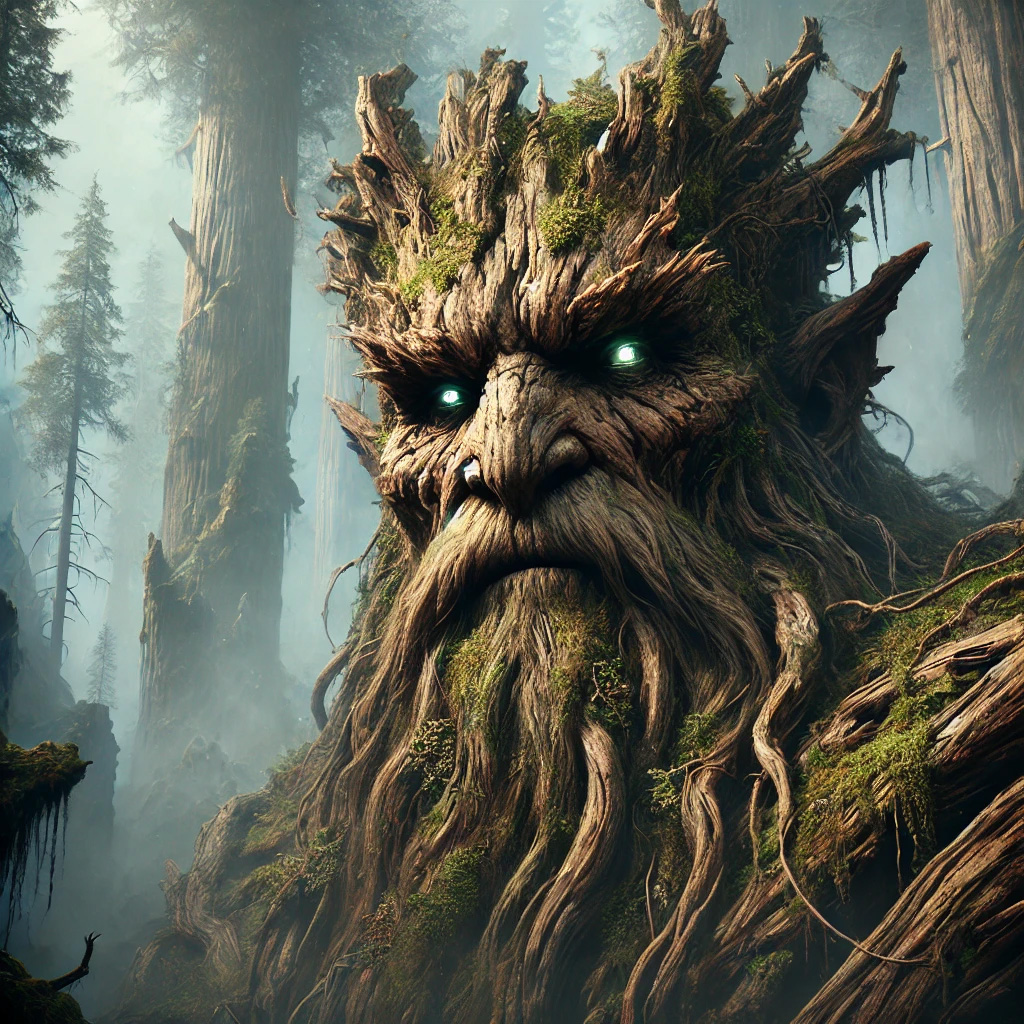
For millennia, Arboryn has been home to the Ancients, colossal tree-like beings who have watched over the land since time immemorial. These towering sentinels are more than mere creatures, they are guardians of the natural order, their wisdom stretching back through the rise and fall of empires. They do not only speak in words, but in the creaking of wood, the whisper of leaves, and the slow, deliberate movement of a force that has outlived kings and conquerors alike.
Among those who dwell beneath their shadow are the Gorathians of Arboryn, one of the oldest races of the world, as ancient as the elves themselves, with whom they once lived in harmony long before a forgotten catastrophe reshaped the balance of the world. The Gorathians are not beings of bark, despite what most outsiders believe. Their bodies are covered in thick, reptilian scales, similar to those of trolls and other primordial creatures. Yet after countless generations spent within the forest, these scales have hardened, layered, and weathered into forms that resemble bark, allowing them to blend seamlessly into their surroundings. This natural adaptation has given rise to the widespread misconception that they are creatures of wood.
They are widely believed to be the ancestors of both orcs and trolls, though such knowledge is rarely spoken openly beyond ancient traditions and hidden lore. Where those younger races embody brute force or chaotic instinct, the Gorathians retain a deeper connection to balance, shaped not by conquest but by coexistence. In Arboryn, they do not dominate the forest, they exist as part of it. They live among the roots of immense trees, crafting their tools only from fallen wood, never harming living growth, and acting as emissaries, hunters, and protectors in service of the Ancients.
Arboryn’s Role in the Great War
Though Arboryn has long remained a place of neutrality, untouched by the ambitions of kingdoms, the Great War forced the forest to act. As the legions of Agramon spread across the world, Vlandor found itself under increasing pressure. While its armies fought across the plains, a new threat emerged in the north, the Drakoth Legions, monstrous war-beasts twisted by dark sorcery, threatened to break through the northern passes and descend upon the heartlands.
It was then that the Ancients stirred from their long silence. Though they had remained distant from the affairs of mortals, the corruption spreading through the world could no longer be ignored. When the Drakoths attempted to cross into Arboryn, they did not find an unguarded forest, they found a living one. The Walking Groves, vast formations of awakened Ancients and Gorathian warriors, advanced to meet them. Their movement was slow, inevitable, and unstoppable, slowing the monstrous horde before it could reach Vlandor.
This moment became more than a battle, it became a symbol. The land itself had risen against the darkness. The Eldrakars of Vlandor saw in it a divine sign, proof that the natural order still resisted the corruption of the world. Though the Ancients returned to their silent vigil after the war, the bond forged in that moment endured. Arboryn was no longer merely a sacred forest, it had become a bulwark, a living defense against forces beyond mortal control.
To this day, Vlandor honors Arboryn, leaving its borders untouched and its will unchallenged. Storrhold, too, acknowledges its power, sending emissaries not as tribute, but as a gesture of respect. Both understand that if darkness rises again, the forest will answer.
Yet peace is never absolute. Ironwatch, now under the rule of Rumon the Pale, and the outlaws who roam the eastern plains pose a growing threat. The Kragars, driven by industry and survival, see the forest not as sacred, but as a resource. They cut where they should not, burn what should remain untouched, and have even begun to strike against the forest’s guardians.
Rumon himself seeks alternatives, attempting to rely on trade with Mirelm Haven to reduce the pressure on Arboryn. But the merchants of the Haven understand the danger. The Kragars are not future allies, they are a future threat. And so the fragile balance begins to weaken.
The forest watches. And it remembers.
The Sacred Forest in a Changing World
The world beyond Arboryn has changed, shaped by war, ambition, and the fall of empires. Yet within its ancient borders, time moves differently. The great trees remain untouched, and the silence of the forest stands in stark contrast to the chaos beyond its edges.
The conflict between the Gorathians and the Kragars is not a war of armies, but a war of shadows. There are no grand battles, only silent strikes in the depths of the forest. Gorathian hunters eliminate intruders without warning, disappearing before retaliation can take form. In response, Kragar warbands burn deeper into the forest, each act of destruction pushing the balance closer to collapse.
The Ancients remain silent. But their silence is not indifference. It is patience.
And patience, even for beings older than empires, has its limits.
If the destruction continues, if the warnings remain ignored, Arboryn will not remain passive.
The trees will march once more.
The Guardians of Arboryn
Var’kan the Rootbinder stands as the voice of the Ancients among the Gorathians. Both warrior and sage, he serves as a bridge between the mortal and the eternal. Through him, the will of the forest is interpreted, not as commands, but as understanding. He sees the conflict not through the urgency of battle, but through the slow erosion of balance. To him, time is a weapon, and patience is a form of strength.
Yet not all share his restraint. Among the Gorathians, a different voice rises.
Rhazka the Thornforged embodies the wrath of Arboryn. Where Var’kan waits, she acts. She leads strikes against those who threaten the forest, showing no mercy to those who burn or cut what should remain untouched. To her, there can be no negotiation with those who desecrate the sacred. She represents a future in which Arboryn no longer waits for balance to be restored, but enforces it through violence.
Between patience and vengeance, the Gorathians stand divided, not in loyalty, but in method. Both paths serve the forest. The question is not which is right, but which will come first.
The Great Elder
At the heart of Arboryn stands the Great Elder, the oldest and most powerful of the Ancients. It is not merely a being, but a presence, a living monument to the age of the world itself. Its roots run deeper than memory, its form marked by the passage of countless ages.
It does not speak in words. Its will is felt rather than heard, carried in the movement of the forest, in the shifting of roots, in the quiet tension that fills the air. To stand before it is to feel the weight of time itself, a reminder that all things, kingdoms, empires, even entire races, are fleeting.
The Gorathians revere it, not as a ruler, but as something greater, something beyond understanding. Even Var’kan does not claim to fully grasp its will. It does not command. It does not rule. It simply exists.
Yet even it is not untouched by the changes of the world.
The Kragars do not fear ancient things. They cut, burn, and expand without reverence. Ironwatch cannot fully control them. And beyond the forest, new conflicts rise once more.
The Ancients have always been patient. But patience is not infinite.
If the Great Elder were to awaken, if it were to rise and move once more, then the world would remember why Arboryn has never fallen.