






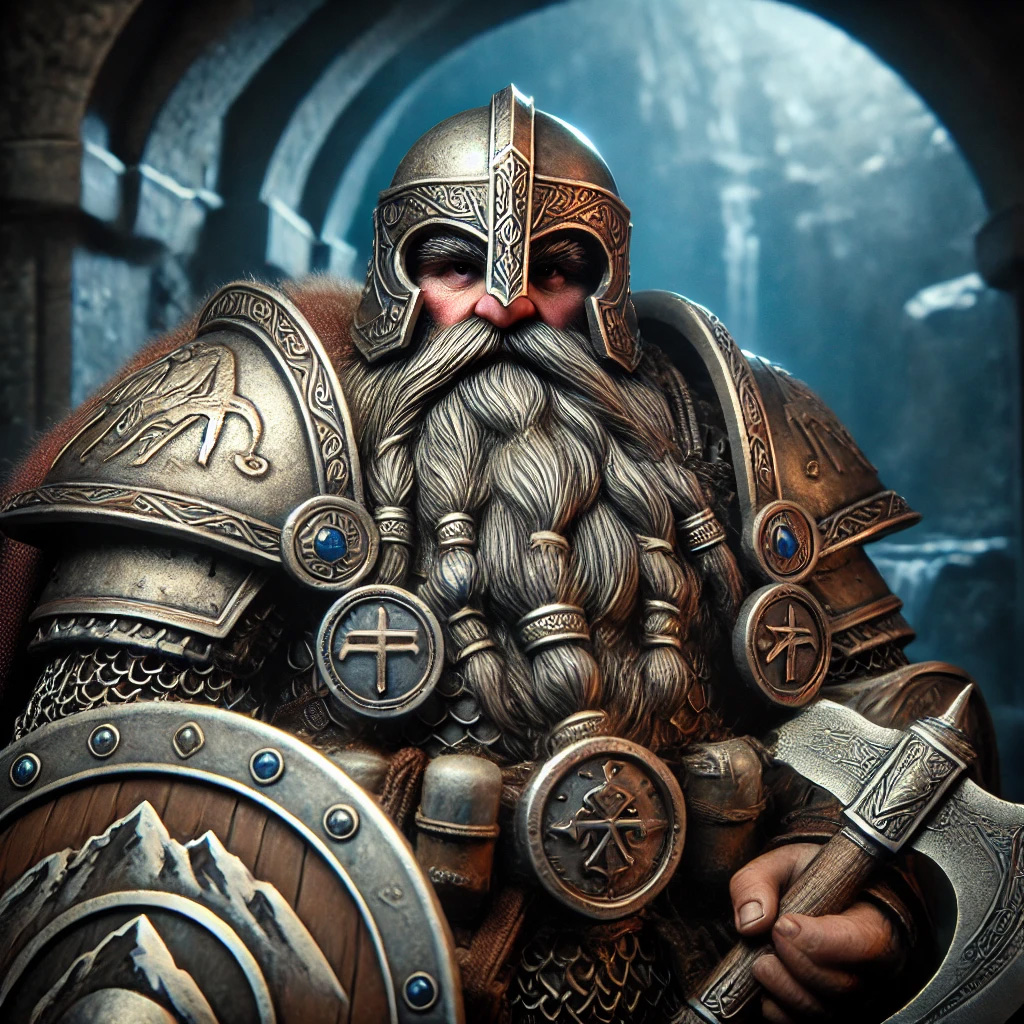
Steelhalls, the Fortress of the Deep
The Fall of the Dwarven Empire
Long before Steelhalls became the last refuge of a broken people, the dwarves ruled a vast and powerful empire beneath the western mountains. Their underground kingdoms stretched across entire ranges, a network of halls, forges, and mines where the sound of hammer on steel never ceased. They were masters of stone and metal, shaping the world beneath the surface with unmatched precision and discipline, their civilization built upon strength, industry, and absolute control over their domain.
Yet this dominion was not sustained by dwarven hands alone. Beneath the grandeur of their empire lay a foundation of forced labor. Goblins, trolls, and gnomes were bound into servitude, driven into the deepest tunnels to extract ore, build fortifications, and sustain the ever-growing demands of dwarven expansion. For generations, this system endured, enforced through authority and the unshakable belief that such order was necessary for the stability of their world.
But stability built on oppression does not endure forever.
In the aftermath of the Great War, as the dwarven empire weakened and its attention was divided, the fractures within its foundations began to widen. The enslaved masses, long subjected to unrelenting labor, seized their moment. What began as isolated resistance quickly grew into a full uprising, spreading through the tunnels with a force that the dwarves had neither anticipated nor prepared to contain.
The rebellion was swift, brutal, and overwhelming. Tools once used for labor became weapons, and the very structures that had symbolized dwarven strength became conduits for their downfall. Fires raged through the halls, turning strongholds into infernos, while the narrow passages that once protected the dwarves became traps from which there was no escape.
Darkholm, the greatest of their strongholds, fell in a single night of blood and fire. The dwarven rulers, long accustomed to commanding from positions of absolute authority, found themselves surrounded and outnumbered within their own domain. Their defenses, designed to repel external threats, proved useless against an enemy rising from within. The banners of their empire were torn down, their thrones shattered, and their legacy reduced to ruin in the span of hours.
What had taken centuries to build collapsed in a single, unstoppable wave. In that moment, the dwarven empire ceased to exist, not through defeat by an external force, but through the inevitable consequence of the system upon which it had been built. Those who survived were no longer rulers of the deep, but fugitives in a world that had turned against them.
The Exodus of King Durnir
Amid the chaos and destruction of their fallen empire, a remnant of dwarvenkind refused to vanish. Led by King Durnir Ironhand, one of the last true rulers of their people, the survivors gathered what remained of their strength and fled eastward. It was not a retreat of strategy, but a desperate escape, a final act of preservation in the face of annihilation.
The journey that followed would test the limits of dwarven endurance. Pursued by remnants of the rebellion and hunted by those who had once served under their rule, they were forced to abandon the safety of the deep and cross a world that offered them no refuge. Mountain passes turned into death traps, plains into open grounds for ambush, and every step forward carried the weight of loss.
Hunger, exhaustion, and constant conflict took their toll. Many fell along the way, some to the elements, others to roaming warbands of orcs, men, and creatures that saw the exiled dwarves not as survivors, but as prey. The journey stripped them of more than numbers. It stripped them of certainty, of identity, and of the belief that they would ever reclaim what had been lost.
Yet they endured.
Years passed before the survivors reached the eastern continent, their numbers diminished but their will unbroken. There, rising against the horizon, stood the Brightkeep Mountains, a harsh and imposing range that would become both their sanctuary and their prison. Within these peaks lay the possibility of survival, and with it, the beginning of something new.
The Founding of Steelhalls
The Brightkeep Mountains offered no comfort, only opportunity. For the dwarves, this was enough. Though broken by exile and reduced in number, they turned once more to the craft that had defined their civilization. They built.
Deep beneath the mountains, they carved a fortress-city unlike the sprawling empires they had once ruled. This was not a domain of expansion, but of endurance. They named it Steelhalls, a name that carried within it both defiance and remembrance, a declaration that though their empire had fallen, their people would not.
Every passage, every chamber, and every gate was constructed with a singular purpose, survival. Layers of defenses were carved into the stone, tunnels designed to control movement, choke points established to break invading forces, and traps laid with the precision only dwarven engineers could achieve. The forges of Steelgate, the heart of the new kingdom, were reignited, their flames once again shaping iron and rune-etched steel into tools of war and resilience.
But Steelhalls was not what had come before. It was smaller, more focused, and bound by necessity rather than ambition. The dwarves no longer sought to dominate vast territories beneath the earth. They sought to survive within the space they had carved for themselves.
Yet even this survival was not theirs alone to secure.
The eastern lands were already claimed, ruled by the Eldrakar lords of Brightkeep, powerful human rulers who viewed the arrival of the dwarves with a mixture of interest and caution. Steelhalls, for all its strength, existed within a world that no longer belonged to dwarvenkind.
To endure, they would need more than stone and steel.
They would need allies.
The Pact with Brightkeep
Steelhalls, for all its strength and resilience, could not exist in isolation. The eastern lands into which the dwarves had fled were not unclaimed wilderness, but the domain of the Eldrakar lords of Brightkeep, a powerful human kingdom that ruled over the mountainous heartlands. The arrival of the dwarves, though remarkable, was not enough to grant them sovereignty by right alone. Survival, once again, would depend not only on strength, but on diplomacy.
King Durnir Ironhand understood this with absolute clarity. His people were diminished, his resources limited, and his position precarious. To secure a future for Steelhalls, he sought an audience with the ruler of Brightkeep, offering not submission, but value. What the dwarves lacked in numbers, they could compensate for with something no other power could rival, their mastery of craftsmanship.
The agreement that followed was not a simple alliance, but a carefully balanced exchange of necessity and power. The dwarves pledged loyalty to the crown of Brightkeep, acknowledging its dominion over the eastern lands, while retaining autonomy over their internal affairs. In return, Steelhalls was granted recognition as a dwarven domain, a sanctuary where their people could rebuild and endure.
This recognition came with obligations. The dwarves would supply Brightkeep with weapons, armor, and fortifications, ensuring that the kingdom remained prepared for war in an increasingly unstable world. Their forges would serve not only their own survival, but the strength of their human allies, binding the two powers together through mutual dependence.
To some, this pact represented wisdom, a necessary compromise that secured the survival of their people. To others, it was a bitter reminder of what had been lost. Once rulers of vast underground empires, the dwarves now swore allegiance to human kings, their independence tempered by necessity. The weight of this reality settled deeply within Steelhalls, shaping both its politics and its future.
A Fractured People
Though Steelhalls stood as a unified fortress, its people were far from united in vision. The scars of exile had not only reshaped their world, but their identity, giving rise to differing beliefs about what their future should be.
King Durnir Ironhand, hardened by loss and guided by pragmatism, believed that survival must come before pride. To him, the alliance with Brightkeep was not a weakness, but a foundation, a means of ensuring that the dwarves would endure, even if it meant abandoning the dream of reclaiming their lost empire. His rule was defined by restraint, by the understanding that a single reckless decision could undo everything they had rebuilt.
At his side stood Borin Stonefist, his most loyal warrior and steadfast supporter. Borin did not see Steelhalls as a stepping stone toward vengeance, but as a refuge, a place that must be protected above all else. To him, the greatest failure of their past had been overreach, and he was determined that such a mistake would never be repeated.
In contrast, Thrain Goldmaster, the kingdom’s steward, looked not to war, but to prosperity. He saw in Steelhalls the potential to become an economic power, a center of trade and influence that could rival even Brightkeep itself. Through commerce, diplomacy, and the unmatched quality of dwarven craftsmanship, he envisioned a future where the dwarves would regain their strength without returning to the cycles of conquest that had led to their downfall.
Yet not all shared this vision of patience and reconstruction. Among the younger generation rose a different voice, one that rejected exile as fate. Khargrim Stonebreaker, leader of the Hallsworn, embodied this defiance. To him and his followers, Steelhalls was not a final refuge, but a temporary hold, a place from which they would one day march westward and reclaim the ruins of their ancestral halls.
These differing beliefs did not yet fracture the kingdom, but they created a tension that could not be ignored. Steelhalls stood united in structure, but divided in purpose, its future shaped by a balance that could shift with time, pressure, or a single decisive event.
Trade, Craftsmanship, and Influence
Despite their fall and exile, the dwarves of Steelhalls did not lose the one advantage that had always defined them, their mastery of craft. In the years that followed their settlement beneath the Brightkeep Mountains, their forges became the foundation of their recovery, transforming hardship into opportunity.
Their rune-etched weapons and armor quickly became some of the most sought-after creations in the eastern lands. Noble houses, military leaders, and merchants alike sought dwarven steel, recognizing that its quality surpassed anything produced elsewhere. This demand allowed Steelhalls not only to sustain itself, but to establish a network of trade that extended far beyond its immediate surroundings.
Brightkeep remained their primary partner, receiving a steady supply of arms and fortifications that strengthened its position across the continent. Beyond this, trade routes extended toward Mirelm Haven, where dwarven craftsmanship was exchanged for rare materials, exotic goods, and arcane components that enriched their own production. Further connections reached Albian, where growing armies and merchant guilds relied on dwarven steel to secure their ambitions.
Through this network, Steelhalls gained more than resources. It gained influence. Though no longer an empire of stone and tunnels, it became a power of a different kind, one that shaped the world not through conquest, but through necessity. Wherever war was prepared, wherever defenses were raised, the mark of dwarven craft could be found.
Yet this reliance on trade also introduced vulnerability. Steelhalls’ strength became tied to the stability of its alliances and the safety of its routes. A disruption in these connections, whether through war, betrayal, or shifting political tides, could weaken the foundation upon which their recovery depended.
Thus, even in prosperity, the dwarves remained aware of the fragile balance that sustained them, a balance between independence and reliance, between strength and necessity.
The Hallsworn and the Call for War
Not all dwarves of Steelhalls are content to rebuild, trade, and endure. Beneath the surface of discipline and pragmatism, a fire still burns, one that refuses to accept exile as the final chapter of their history. This fire has taken form in the Hallsworn, a growing movement led by Khargrim Stonebreaker, whose voice resonates strongly among the younger generations.
To the Hallsworn, Steelhalls is not a home, it is a stronghold, a temporary refuge carved from necessity rather than destiny. They do not see survival as victory, but as delay. In their eyes, the ruins of Darkholm are not a symbol of failure, but a call to action, a reminder that what was lost can, and must, be reclaimed.
Khargrim embodies this belief with unwavering conviction. Where others preach patience, he speaks of honor. Where others see risk, he sees purpose. Under his leadership, the Hallsworn train relentlessly, preparing not for defense, but for conquest. Weapons are forged not for trade, but for war. Strategies are whispered in hidden chambers, and alliances among like-minded warriors grow stronger with each passing season.
This movement does not yet challenge the authority of King Durnir directly, but its influence continues to expand. Each success of Steelhalls strengthens it, providing resources that can be turned toward its cause. Each moment of peace gives it time to prepare. The tension between those who seek to preserve what remains and those who wish to reclaim what was lost grows steadily, a fracture that, if left unchecked, may one day reshape the kingdom entirely.
For now, the Hallsworn remain a force of potential rather than action. But the sound of war grows louder in the halls of Steelhalls, carried in the sharpening of axes, the forging of armor, and the quiet certainty that exile was never meant to be permanent.
The Deep Places and the Forgotten Threats
While the dwarves look outward, toward politics, trade, and the possibility of war, another danger lies beneath their feet, silent, patient, and largely ignored. The depths of the Brightkeep Mountains are far older than Steelhalls, older even than the memory of dwarvenkind. The tunnels that now form the outer layers of their kingdom brush against something far more ancient, a network of forgotten chambers and sealed passages that have not been opened for millennia.
Miners and explorers have begun to report strange occurrences in these lower depths. Whispers echo through the stone where no voices should exist, faint and unintelligible, yet persistent. Tools left behind are found moved, paths once mapped seem subtly altered, and in some cases, entire sections of tunnel have revealed structures that do not match dwarven design.
Artifacts have been uncovered, objects of unknown origin, bearing markings that no living dwarf can interpret. These discoveries suggest that the mountains once held inhabitants far older than the dwarves themselves, a presence that has long been buried, but perhaps not entirely gone.
There are even rumors of sealed gates deep within the foundations of Steelhalls, massive stone doors etched with runes that do not belong to any known tradition. Some claim that beyond them lie caverns untouched by light, places where the stone itself seems altered, scorched, or shaped by forces that defy understanding. Others speak more cautiously, suggesting that whatever lies beyond was sealed for a reason, and that reopening such paths could unleash something better left undisturbed.
For now, these concerns remain secondary, overshadowed by the immediate challenges of survival and politics. But the deeper the dwarves dig, the closer they come to truths that may prove more dangerous than any enemy above the surface.
The Future of Steelhalls
Steelhalls stands at a crossroads, its fate shaped by forces both within and beyond its walls. It has endured exile, rebuilt from ruin, and secured a place within a world that no longer belongs to it. Yet survival alone is not a final destination, it is a question that demands an answer.
One path leads toward stability, strengthening their ties with Brightkeep, expanding their influence through trade, and solidifying Steelhalls as a permanent stronghold, a kingdom defined not by what it has lost, but by what it has become. This is the path of Durnir, of patience, resilience, and careful adaptation.
Another path leads westward, toward the ruins of Darkholm and the shattered remnants of their former empire. It is a path of war, driven by the belief that identity cannot be rebuilt without reclaiming the past. This is the vision of the Hallsworn, a future forged through conquest and risk.
And beneath both of these choices lies a third, less understood but no less significant. The depths of the mountains hold secrets that may reshape everything the dwarves believe about their world. Should those secrets awaken, the struggle for Steelhalls may shift from a question of destiny to one of survival once more.
The forges burn, the hammers fall, and the warriors prepare. Whether they build, march, or uncover something far older than themselves, one truth remains unchanged.
The story of Steelhalls is not yet finished.