






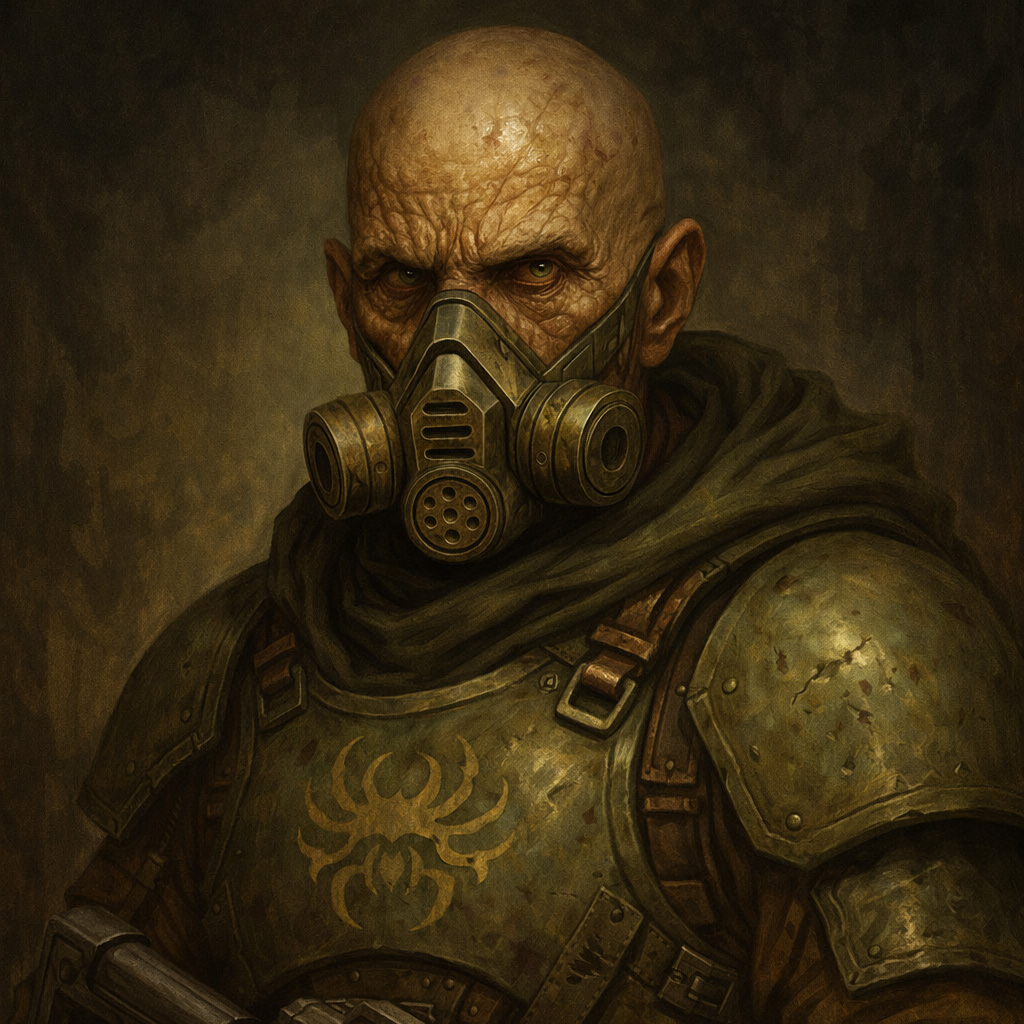
The Bug Army, The Ones Humanity Left Behind
Atomic Purification
At the end of the war of conquest, the nobles of the Supreme Empire, weary of decades of fighting on Damocles, ordered what their chronicles politely call the “atomic purification.” The last rebel strongholds, the zones too contaminated to be worth conquering, the desperate defensive lines were drowned in nuclear fire. Cities became blistered glass, plains turned to ash, survivors to burned silhouettes etched into the rock.
Beneath the crust of Damocles, something had been waiting for that signal for millennia. The Fukai, the ancient forest, once driven back by the Greanans and the forgotten weapons of the Ancients, awoke. Its charred roots began to boil. Spores rose with the radioactive smoke, seeping into bunkers, trenches, and tank carcasses. They found wounded, dying, abandoned bodies: soldiers left for dead by their officers, prisoners of war nobody wanted, civilians trapped in no man’s land.
Some suffocated, devoured from within. Others changed, and in their dreams a collective whisper took root, an ancient will. Those became the first of the Bug Army: beings torn away from humanity, not quite monsters yet, but already linked to the diffuse consciousness of the Fukai.
Among them was an officer whose name is lost, later known only as the First Standard-Bearer. He led the survivors into the heart of the newborn jungle, bargained with the forest’s invisible masters, and spoke the oath that cursed his bloodline: as long as the Fukai needed human hands, his lineage would belong to it.
Today, his direct heir still lives. They call him Rael Ashbound. Born with root fragments fused into his spine, Rael hears the whispers of the forest as clearly as a voice in the ear. Through him, the Fukai keeps its grip on the oldest regiments of the Bug Army. For many veterans he is a sacred figure, proof that the forest does not forget its promises.
Between Two Worlds
Centuries passed. Where the bombs had gouged craters, the Fukai covered everything: molten metal, bones, and bunkers swallowed beneath a carpet of toxic vines. Along its edges sprang up military bases and laboratories belonging to all the great clans of the continent. No one could ignore such a miracle of survival and power. The Lioners, whose borders almost touched the canopy, were the quickest to react: lines of fortifications, exclusion zones, watch posts bristling with guns, as much to contain the forest as to ensure that no one else claimed it.
But the Fukai was not only a threat. It was also a source of energy.
Certain woods, fermented in ancient vats salvaged from the war ruins, released a dense, violent gas capable of feeding engines, turbines, and later the old saurian portals rediscovered by the elves. Other strains grafted themselves onto steel, engulfed it, replaced it, thickened armor and healed impacts on their own. The most gifted among the infected realised they could sculpt this living wood just as the Drakonxos did their own creations: woven exoskeletons, chitin plates, organic weapons half-root, half-bone.
Thus the Bug Army slowly became an entire society, trapped between two worlds. If it left the forest, it was gunned down as contagious mutant vermin by the “civilised” clans. If it ventured too deep into the Fukai, it faced fiercer beasts and toxic gases that mutated the lucky and killed the rest. That was the domain of the Drakonxos, the true masters of the forest. So the leaders sought a balance: close enough to the Forest to draw on its power, human enough to keep control of their decisions… and of their weapons.
Massaloï Under the Shadow
The plain of Massaloï, all around the Fukai, is now a land gnawed by fear. The sects of the Cultists still maintain their altars to Celestial Peace there, but each night masked figures cross their lines, burn supply depots, and abduct prisoners who never return. The Naxjabas, mountain mutants, are accused of shielding the forest’s flanks. The Voltrmens are blamed for seeking new ways to exploit the forest instead of ways to destroy it. The Lioners are cursed for not sending enough troops.
Yet those who have seen the shapes in oiled-cloth cloaks up close, the makeshift rifles bound with living wood, the banners marked with larva and scarab, make no mistake: it is the Bug Army that leads the dance.
With the Naxjabas, relations are as shifting as the irradiated mists of the high valleys. Some raids are conducted jointly, the mutants providing knowledge of old tunnels, the Bug Army the weapons and explosives drawn from the Fukai. At other times, a quarrel over the division of slaves escalates: a convoy is diverted, a column disappears in a “chance” landslide, a commander changes his mind mid-battle. Neither faction can do without the other, and neither forgets that in times of weakness, yesterday’s ally could become tomorrow’s shipment of meat.
Under the mountains, the Greanans are waking. Great canine beings who once dominated the planet, they were those who eradicated the first Fukai and the blood-drenched tyranny of the Drakonxos. Old tales whispered within the Bug Army say that if these colossi march again, the forest will have to spend more than spores to survive. No one knows whether the Bug Army will defend its saurian masters then… or whether some will see in this threat a chance to finally slip free of their grasp.
Life Within the Vines
In the maze of vines and roots, the humans of the Bug Army are not alone. Stocky Abgakeas, sturdy reptiles used as mounts; swarms of phosphorescent beetles that light the grown tunnels; leaf-serpents whose venom feeds the needles of organic arquebuses, a whole bestiary of horrors, tamed or half-wild, is part of daily life. New recruits quickly learn that their first loyalty is not to a banner, but to the symbiosis that keeps them alive: filtering mask, skin scarred by spores, muscles strengthened by sap. Hair is usually shaved or kept short to avoid the lethal Fukai lice.
For those who survive long enough, the Fukai sometimes offers “gifts.” Bony growths protecting skull and spine. Nodules capable of secreting antitoxins. Augmented eyes that see spore currents as others see the wind in grass. Such advanced mutants often become priests or champions, or test subjects, if they are captured.
Father Maldrin Vess
Among them, no name inspires more fear than that of Father Maldrin Vess. A former field doctor of the Imperial army, captured and infected in the early days of the Bug Army, Maldrin refused to dissolve into the forest’s collective will. He discovered that certain forbidden practices, transfusions of sap drawn from living victims, successive grafts of young organic tissue, life-drain rituals borrowed from elven lore, can slow, even reverse, the accelerated aging caused by spores.
Today his body is a patchwork of scars, chitin plates, and elven runes burned into flesh. Officially, he serves as high priest of the “Inner Branch,” the circle of mutants that speaks for the Fukai to the Bug Army’s leaders. Unofficially, he sells his knowledge to those who can pay, trades slaves for talismans from Wanyue, and does not hesitate to sacrifice loyal comrades in his experiments. The elves jokingly call him “the Flesh Gardener.” He prefers to see himself as the only truly free being: neither human nor creature of the forest, but someone who uses both to stay alive.
Trade Through the Portals
It is through him that trade with Wanyue first took shape. Thanks to the gas extracted from fermented Fukai woods, the ancient saurian portals were reactivated. The elves, the half-human Eldrakars and their short-lived orcs see in this an unexpected chance to hold their ground against the rebels of the moon. The forest’s almost limitless energy gives them secure supply lines, and in exchange they pour onto Damocles refined weapons, war artefacts, siege engines, but also prisoners, slaves, and esoteric knowledge.
Day-to-day negotiations are entrusted to Lysa Teren, nicknamed “Iron Leaf.” Born into one of the first generations raised entirely within the Fukai, she grew up with one human ear and one ear of wood, literally: a chitinous bud covers half her skull and lets her feel the portal’s vibrations as others feel rain. Lysa speaks several elven dialects, knows the exact price of a barrel of gas on Wanyue, and above all understands that the Bug Army will survive only as long as it remains essential to both sides. She plays the elves against the clans of Massaloï, the Lioners against the Naxjabas, ensuring that none can break the pact without losing everything.
The elves think they are buying the obedience of the Bug Army with their relics and charms. Lysa knows that in truth, it is the Bug Army that is buying their dependence.
Mira Old-Rock
Of course, not everyone in the forest accepts this dangerous game. Part of the troops can no longer bear to serve distant masters, arrogant sorcerers, and a jungle that devours its own children. From this anger a new figure arose, whose name now circulates even in the taverns of Tenkyo: Mira Old-Rock.
Mira was born in a refugee camp on the edge of Massaloï. Her village was “pacified” by a Lioner detachment, then forgotten. When the Fukai advanced, she had only two choices: death or infection. She chose the latter, but refused to bow. To her, the forest is a weapon, not a deity. The elves are just one more empire, the Drakonxos, whom she always calls “Frogons” with contempt, just another species convinced it has a divine right to Damocles.
Her creed is simple: the humans marked by the Fukai must seize control of the Forest before someone else does. The elves will eventually sacrifice them as they sacrificed their own orcs. The Drakonxos are only waiting for the chance to “purify” the planet in payment of some imaginary debt. As for the other humans, they will never tolerate an army of mutants at their gates for long.
Under her banner gather whole bands of deserters, freed slaves, and renegade cultists. She has already had elven envoys executed, sabotaged gas convoys bound for the portals, and attempted to assassinate Father Maldrin Vess. She is branded traitor, heretic, madwoman. In the alleys of Bug Army outposts, some whisper that she might be the only hope for their children to be born one day outside the yoke of the Drakonxos. But yet, she and her followers are infected and will never have their place among the other humans on the planet. Aren't they fighting against their only hope of survival?
Ambitions of Korz Vellian
At the very heart of the hierarchy, another kind of threat appears: ambition. The current commander of the Bug Army, Marshal-General Dorn Helgar, is a pragmatic veteran, more attached to survival than to ideals. He listens to the whispers of the forest but does not let them rule him; he tolerates Lysa’s deals with the elves while supporting Mira’s bloody expeditions when they weaken their common enemies.
For some, that is not enough. In the best-equipped battalions, one name returns more and more often: Korz Vellian.
Korz is the perfect example of what the Fukai can create when it shapes a leader for war. Tall and lean, clad in an armour of living plates that close over his wounds, he has led raids to the very gates of Lioner fortresses, severed entire supply lines, and shattered three simultaneous reconquest attempts by the Cultists. He knows how to speak to mutants and still-humans alike, flatters the forest in his sermons while reminding everyone that “roots need a guide.”
Officially, he swears loyalty to Dorn Helgar. Unofficially, he gathers around himself all those who want a more disciplined Bug Army, better centralised, ready not just for ambushes but for full campaigns. Some say he already dreams of the day when Rael Ashbound will be paraded as a respected but useless relic, when Maldrin Vess will be “purified” for his excesses, when Mira Old-Rock will be hunted to the margins like a common bandit. A Bug Army united under a single banner, his own.
Sergan the Devoted
Yet for all Korz’s ambition and Maldrin’s schemes, neither is called when a situation is beyond saving. When a base vanishes under living roots, when a patrol fails to return, when something older than the forest begins to stir, the Bug Army turns to another figure. Sergan is not a commander, nor a priest of the Fukai. He does not lead troops, negotiate with elves, or speak for the Forest. He walks alone, appearing only when something has already gone wrong.
It is said that he has ventured deeper into the Fukai than any human should and returned, not once, but many times. The spores did not claim him, the roots did not bind him, and whatever the forest tried to make of him failed. His body bears the marks of that defiance: veins darkened by sap, scars that never fully heal, and a gaze that seems to follow movements others cannot perceive. He does not speak of what he has seen, and no one insists.
Among the Bug Army, this has earned him a strange reverence. Not as a chosen of the Forest, but as someone who endured it without surrendering himself to it. To many, that makes him more than a warrior. It makes him proof that something human can still exist within the Fukai. When he intervenes, he does so alone. He moves where he is needed, strikes with precision, and leaves before questions can be asked. Some believe he follows a plan. Others think he simply knows where the line between survival and extinction lies.
For Sergan, there is only one cause: the survival of his people. Not the will of the Forest, not the designs of the elves, but those who still wear the mask and fight to exist. If the Bug Army ever fractures beyond repair, many believe its future will not be decided by its leaders, but by Sergan — and by whoever he chooses to save.
The Bug Army Today
Thus the Bug Army stands today: a people living amid ashes and spores, trapped between human clans that want them erased, elves and Drakonxos who want to use them before finishing the work begun millennia ago, and a semi-conscious, hostile forest.
Rael Ashbound speaks for the memory of the first pacts. Father Maldrin Vess twists life and death to prolong an existence he deems far too interesting to end. Mira Old-Rock plots to wrench the Fukai away from all its masters, seen and unseen. Lysa Teren weaves a web of debts and cargo between Damocles and Wanyue. Korz Vellian dreams of unifying the army beneath his fist. Sergan the Devoted stands at the front, ready to die a thousand times so that a few might return.
As long as they coexist, the Bug Army continues to advance, to strike, to bargain, to survive. The day one of them prevails over the others, Damocles will at last discover what the Fukai truly intended to do with the humans it saved from the bomb.