






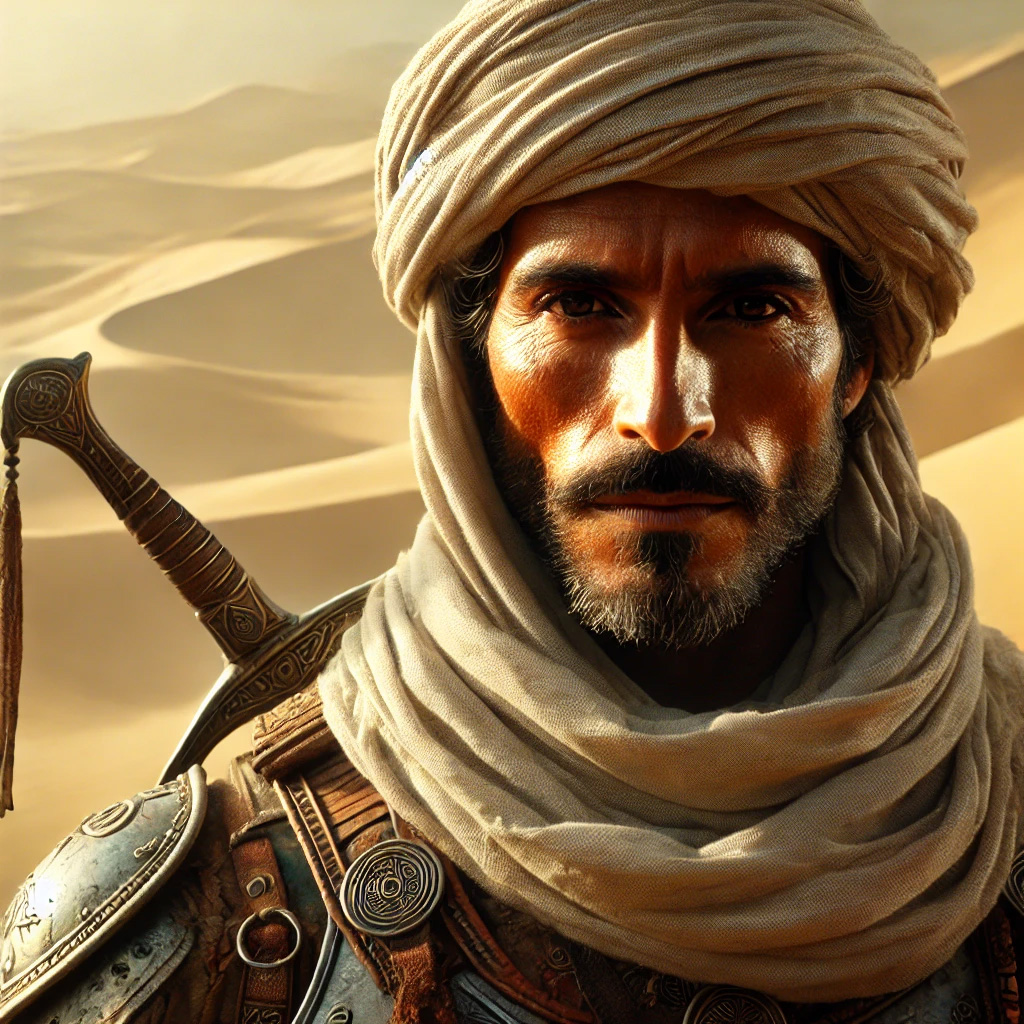
Dunes of Qarath, The Desert Kingdom
The Dunes of Qarath stretch across the northeastern reaches of Gryndor, forming one of the most unforgiving yet culturally rich regions of the known world. Vast seas of golden sand dominate the landscape, broken only by rare oases, ancient caravan routes, and the occasional fortress carved into stone or dune. The desert offers no mercy, its scorching winds and relentless heat shaping not only the land, but the people who have learned to survive within it.
To the south rise the Greyhills, a harsh and rugged mountainous region inhabited by human tribes whose hostility toward Albian has remained constant for generations. These mountains serve as both barrier and refuge, a place where resistance can take root beyond the easy reach of desert authority. To the west lies Sylvara, with whom the Qarathians maintain a fragile and often shifting relationship, shaped as much by trade as by mistrust. Every border of Qarath reflects tension, opportunity, and uncertainty, reinforcing its role as a crossroads of both commerce and conflict.
Long before the rise of kings and centralized power, Qarath belonged to the nomadic clans. These tribes roamed the dunes for centuries, guided by the stars and bound by traditions older than any city. They mastered survival in a land where water meant life and knowledge of the terrain was the difference between prosperity and death. Their culture was not primitive, but deeply adapted, built upon memory, oral history, and a spiritual connection to the desert itself.
Commerce has always been the lifeblood of Qarath. Caravans crossing the desert carried spices, silks, rare minerals, and ancient artifacts between distant civilizations. These routes did more than generate wealth, they connected worlds. Through them, ideas, alliances, and rivalries spread across continents, making Qarath not just a trading hub, but a central artery of global exchange.
At the heart of this network stands Qarath City, a vast oasis of civilization rising from the sands. Its towering sandstone palaces, sprawling markets, and labyrinthine streets reflect centuries of accumulated wealth and influence. Here, traders from Ashmarsh, Dreadhold, Gryndor, and beyond gather, exchanging goods that cannot be found anywhere else. The city is a place of contrasts, where luxury and danger coexist, where fortunes are made and lost in a single negotiation, and where power is measured as much in influence as in gold.
Despite the harshness of the surrounding desert, Qarath City has long symbolized resilience and prosperity. It stands as proof that even the most unforgiving environments can give rise to centers of culture, trade, and power. Yet beneath its wealth lies a deeper truth, the stability of Qarath has always depended on balance, between clans and merchants, between freedom and authority, between survival and ambition.
That balance, once maintained across generations, would not last forever.
Sahladorn, the Unifier of the Dunes
The rise of Sahladorn marked a turning point in the history of Qarath, a shift from a land of loosely connected clans and shared traditions to a kingdom forged through force, control, and calculated ambition. Before his ascent, Qarath existed as a complex web of alliances, rivalries, and negotiated coexistence, where no single authority dominated completely. Power was fluid, constantly shifting between clans, merchants, and local leaders, allowing a fragile but enduring balance to persist across the desert.
Sahladorn emerged from this landscape not as a simple warlord, but as a strategist who understood both the strengths and weaknesses of his people. A clan chief of formidable presence and relentless determination, he recognized that the very freedom that defined Qarath was also the source of its vulnerability. Divided, the clans could not stand against organized external powers, nor could they fully control the immense wealth flowing through their lands. Where others saw tradition, Sahladorn saw inefficiency. Where others saw independence, he saw fragmentation.
Through a combination of military strength, political manipulation, and calculated alliances, he began to unite the desert under his authority. Some clans joined willingly, persuaded by promises of stability and shared prosperity. Others resisted, and were crushed with decisive brutality. Each victory reinforced his legitimacy, not through heritage, but through undeniable power. Over time, resistance gave way to submission, and the scattered tribes of Qarath were brought under a single rule for the first time in their history.
At the center of this new order stood Qarath City, transformed from a hub of trade into the seat of centralized power. Under Sahladorn’s command, the city became more than a marketplace, it became a capital of control, where decisions affecting the entire desert were made and enforced. The old networks of influence, once distributed among clans and merchant families, were drawn inward, concentrated within his court and those who served him.
To enforce this new structure, Sahladorn relied on his most feared instrument, the Ibndorn warriors. These elite fighters, mounted on swift desert steeds and armed with curved blades and long spears, became both guardians and enforcers of his rule. Their presence extended across the desert, from trade routes to distant settlements, ensuring that no challenge to Sahladorn’s authority went unanswered. Discipline, speed, and absolute loyalty defined them, making them as much a symbol of order as of oppression.
Under their watch, the freedom that once defined Qarath began to erode. The independent movement of caravans was replaced by regulated trade, monitored and taxed under strict conditions. Clans that had once governed themselves were now subject to oversight, their leaders forced to answer to a central authority that tolerated neither dissent nor deviation. What had been a decentralized culture rooted in survival and adaptability was reshaped into a structured system built on obedience and control.
Sahladorn did not see this transformation as tyranny, but as necessity. To him, Qarath could no longer afford the weaknesses of its past. Unity was not a choice, but a requirement for survival in a world increasingly dominated by powerful empires and dark forces. His rule was harsh because he believed the world demanded it, and because he understood that hesitation would invite destruction.
Yet even as his power grew, so too did the tension beneath it. The desert does not forget its past, and the clans, though subdued, did not abandon their identity. Beneath the surface of Sahladorn’s unified kingdom, resentment began to take root, quiet, patient, and waiting for the moment when control might falter.
The unification of Qarath had been achieved, but its cost had only begun to reveal itself.
The Alliance with Agramon and the Seeds of Division
Despite the apparent strength of Sahladorn’s rule, his control over Qarath remains fragile, sustained as much by force as by fear. The greatest source of this instability lies in one of his most controversial decisions, his alliance with Agramon, the dark lord whose influence spreads from the north. What Sahladorn views as a strategic necessity is seen by many among his people as a betrayal of everything Qarath once stood for.
Through this alliance, Sahladorn has gained access to powerful war machines, knowledge of siegecraft, and support from the forces of Dreadhold. These advantages have strengthened his position, allowing him to suppress rebellion and project power far beyond what the desert kingdom could once achieve. Yet this strength comes at a cost, one that cannot be measured in weapons or territory alone.
For many Qarathians, the desert is not merely land, but a sacred entity, a place bound to ancient traditions, spirits, and the rhythm of the stars. Agramon’s presence, and the dark forces associated with him, are seen as a corruption of that sacred balance. His influence does not simply threaten the political structure of Qarath, it challenges its identity at its core.
As a result, divisions within the kingdom have deepened. While Sahladorn’s loyalists accept the alliance as a necessary step toward survival and dominance, others reject it entirely. Among the clans, in the mountains, and across the more remote regions of the desert, resistance has begun to grow. What was once quiet discontent has evolved into organized opposition, fueled by both cultural defiance and moral conviction.
The Burning Dunes and the Awakening of Ancient Horrors
Within the vast expanse of Qarath lies a region known as the Burning Dunes, a place where the sand itself seems to glow beneath the relentless sun. This area has long been associated with both immense wealth and great danger, its depths said to conceal relics of forgotten civilizations and treasures buried beneath centuries of shifting sands.
For generations, adventurers have been drawn to the Burning Dunes, seeking fortune among its ruins. Few return. The region is not only defined by its extreme heat and disorienting terrain, but by the presence of ancient defenses, traps, and creatures left behind by civilizations that predate even the oldest desert clans. These remnants serve as both protection and warning, a reminder that Qarath’s history extends far beyond recorded memory.
In recent years, however, something has changed. Whispers spread among travelers and survivors, stories of movements beneath the sand, of creatures long dormant now stirring once more. Some believe that Agramon’s growing influence has begun to awaken these ancient horrors, disturbing forces that were never meant to rise again. If these rumors hold truth, then the desert itself may soon become as dangerous to Sahladorn’s rule as any rebellion.
Commerce in Decline and the Rise of Desperation
Commerce remains central to Qarath, but its nature has shifted under Sahladorn’s rule. What was once a system of open exchange and negotiated trust has become increasingly rigid, controlled, and exploitative. The caravans that once moved freely across the desert are now subject to heavy taxation, their routes monitored and enforced by the Ibndorn warriors. Only those who demonstrate loyalty to Sahladorn are permitted to operate without obstruction, creating a system where wealth is concentrated among a select few.
This transformation has altered the culture of trade itself. Rivalries between merchants, once defined by competition and negotiation, have evolved into ruthless struggles for survival. Alliances are formed and broken with little regard for honor, betrayal has become commonplace, and success often depends more on political favor than on skill or reputation.
The markets of Qarath City reflect this change. Still vibrant and filled with goods from distant lands, they now carry an undercurrent of tension and unease. Foreign traders, drawn by opportunity, flood into the city, bringing with them not only wealth, but influence, espionage, and exploitation. The presence of outsiders further destabilizes the region, as native Qarathians watch their traditions erode under the pressure of external forces.
Amid this growing instability, resistance takes many forms. Some clans retreat into the mountains, organizing themselves into guerrilla forces that strike at Sahladorn’s patrols and disrupt the trade routes that sustain his power. Others work from within the system, manipulating commerce, information, and alliances to weaken his control. These acts of defiance, though scattered, share a common purpose, to challenge a rule that many now see as illegitimate.
The Dunes of Qarath stand at a critical moment in their history. Once defined by balance between freedom and survival, they now exist in a state of increasing tension, where every alliance carries risk and every decision pushes the kingdom closer to transformation or collapse.
Ashmarsh, the Tainted Lands
Ashmarsh is a cursed land where desolation reigns and the very ground rejects life. Once, it was a lush and fertile region, much like Far Qarath, inhabited by gorathians and elves who thrived in harmony with the environment. However, a catastrophic eruption from Shadowspire long ago disrupted the planet’s climate, leaving Ashmarsh permanently scarred. This apocalyptic event transformed the region into the barren, toxic wasteland it is today.
In the aftermath of the disaster, the surviving gorathians and elves were forced to adapt or perish. Over centuries, the two species intermingled, and natural selection shaped a new people: the orcs. Prolific and short-lived like humans, yet endowed with exceptional resistance to disease and a slow metabolism, orcs emerged as the ultimate survivors in this harsh environment. Unlike their distant gorathian ancestors—half-troll, half-primate beings of immense strength but limited intellect—modern orcs possess a cunning edge that has made them formidable warriors. The gorathians themselves now linger only in the remote jungles of Far Qarath, relics of a forgotten time.
A Wasteland of Shadows
Ashmarsh now stretches across arid plains and rugged mountains, its poisoned marshes dotted with stagnant pools of black water covered in greasy scum and lifeless vegetation. The air hangs heavy with the stench of sulfur from nearby volcanic peaks, casting the land in a perpetual twilight. This cursed landscape serves as a natural barrier between the distant lands and the tainted forces of Shadowspire, with its eerie silence broken only by the howling winds.
Ashmarsh is not merely a dead land—it is alive with malevolence. Dark sorcery permeates the soil, twisting the creatures that dwell within it. Among these are the grimfangs, massive wolves bred for war, which serve as mounts and companions to the semi-nomadic orc tribes. Grimfangs are not only tools of destruction but also symbols of power and status, their ferocity unmatched on the battlefield. Orcs who bond with these beasts wield entire packs as weapons, dominating both their enemies and their own kin.
The Political Climate and Rebellions
Though nominally under the sway of Agramon, Ashmarsh is far from unified. The local orcish chieftains are fiercely independent, their loyalty to Agramon ever tenuous. In exchange for resources and support, they serve as part of Agramon’s war machine, raiding and battling the kingdoms of Gryndor and Albian. However, rebellion simmers just below the surface. Many orc chieftains despise the chains that Agramon has placed upon them and dream of overthrowing his rule, while others seek only to rise in rank through bloody conquest.
Garthrak the Ironclaw
Garthrak the Ironclaw, a brutal warlord loyal to Agramon, leads the largest of the tribes. Known for his iron-clad fists and relentless thirst for power, Garthrak has crushed numerous rebellions in Agramon’s name. However, his hold on the region is far from secure, as other orc leaders constantly vie for dominance, seeking to break free from Agramon’s yoke.
Morgal Bloodspite
One such rival is Morgal Bloodspite, a cunning and ambitious chieftain who has quietly gathered a coalition of disgruntled tribes under his banner. Morgal dreams of leading a rebellion that will see the orcs free from Agramon’s influence, and he is willing to go to any lengths to achieve this, secretly courting the rival tribes of Far Qarath, hoping to spark conflict and turn the tides of power in his favor.
The Bringer of Death
Amid the power struggles, there is one figure whose voice carries more weight than any warlord—Thra’gul, the Bringer of Death, a powerful orcish shaman whose words are revered by the tribes. With a voice said to be infused with the very essence of Ashmarsh, Thra’gul’s prophecies are feared and heeded by all. It is said that his incantations can bring death to enemies or turn the tide of battle with terrible sorcery, summoning forth the darkest forces of the land itself. Thra’gul speaks rarely, but when he does, all of Ashmarsh listens.
The Huntress of Vengeance
Amid the warring tribes and shifting allegiances, one orc female walks a darker path—Vashnak the Vengeful, a mercenary adventurer whose hatred burns brighter than any flame. Vashnak harbors a deep and unyielding loathing for the men of Qarath, a hatred born from a bloody betrayal where her entire clan was slaughtered by their forces. Driven by vengeance, she now takes on any contract that allows her to strike against the Qarathians, relishing the opportunity to raid their villages and ambush their soldiers with ruthless precision.
Vashnak’s masterful tactics and brutal efficiency have made her a feared and respected figure among the orc tribes. But unlike her kin, who shun the touch of dark magic and fear the specters of the Drelkar above all, Vashnak embraced the shadow. During a mission with the infamous Kaelar the Betrayer, she lured him into teaching her the dark magic of the Drelkar, gaining the secrets of their black arts. Through this initiation, she acquired an unnaturally long life, much like the cursed Drelkar.
While most orcs would rather face death than succumb to the fate of the Drelkar, terrified of becoming the specters they dread, Vashnak’s desire for vengeance outweighed her fear. She willingly chose the path of corruption, forsaking her own mortality for the chance to live long enough to exact her revenge on Far Qarath. Now, with her extended lifespan, she continues her bloody campaign, feared even among her own kind for the dark power that sustains her. Though she despises Agramon and what he stands for, Vashnak occasionally lends her blade to his cause—for the right price and to further her own ends.
The Struggle for Resources and the Threat of War
Ashmarsh’s strategic position and the presence of valuable minerals in the arid mountains have made it a critical region for trade, especially with Qarath. Despite their hostility, the orc tribes maintain fragile trade relationships with Far Qarath, exchanging raw materials and iron in return for supplies and other goods. This uneasy alliance is constantly strained by border skirmishes and raids. The tribes of Ashmarsh often clash with the desert nomads of Qarath, both over resources and ancient grudges. The region remains a powder keg, with war between the two constantly looming on the horizon.
Agramon uses the orc tribes in his endless wars, sending them against Gryndor and Albian. Though they are his servants, the orcs of Ashmarsh view these conflicts as opportunities for plunder and glory. Yet as Agramon’s influence wanes, it is clear that the loyalties of Ashmarsh’s warlords will not hold forever.
Talgor the Silent, a master tactician and the chief strategist of Shadowspire, is quietly laying the groundwork for Agramon’s downfall. Feigning absolute loyalty to the dark lord, Talgor has been methodically gathering allies in secret, preparing to unite the tribes of Ashmarsh against Shadowspire. Among his closest confidants is Morgal Bloodspite, who once served under Talgor’s command. The two share a mutual respect, forged by their common goal of freeing their people from Agramon’s tyranny, and their collaboration runs deep.
Talgor and Morgal work in concert, orchestrating covert missions and clandestine gatherings to sway the orc tribes. Their efforts are focused not only on rallying the orcs to their cause but also on unraveling the secrets of the Drelkars’ black magic. Both know that to stand a chance against Agramon’s overwhelming power, they must find a way to subvert the Drelkar, those twisted Eldrakar who serve Agramon out of fear and corruption.
The day is coming when the tribes of Ashmarsh may rise against Shadowspire, led by Morgal’s brutal strength, with the hope that they can finally break free from the chains of their oppressor.
Ashmarsh is a land where cruelty and ambition thrive, and only the strongest survive. Whether through war, treachery, or dark magic, the orc tribes continue to carve their bloody path through the desolate marshes, each one vying for dominance in a land where loyalty is fragile and betrayal is a way of life.