






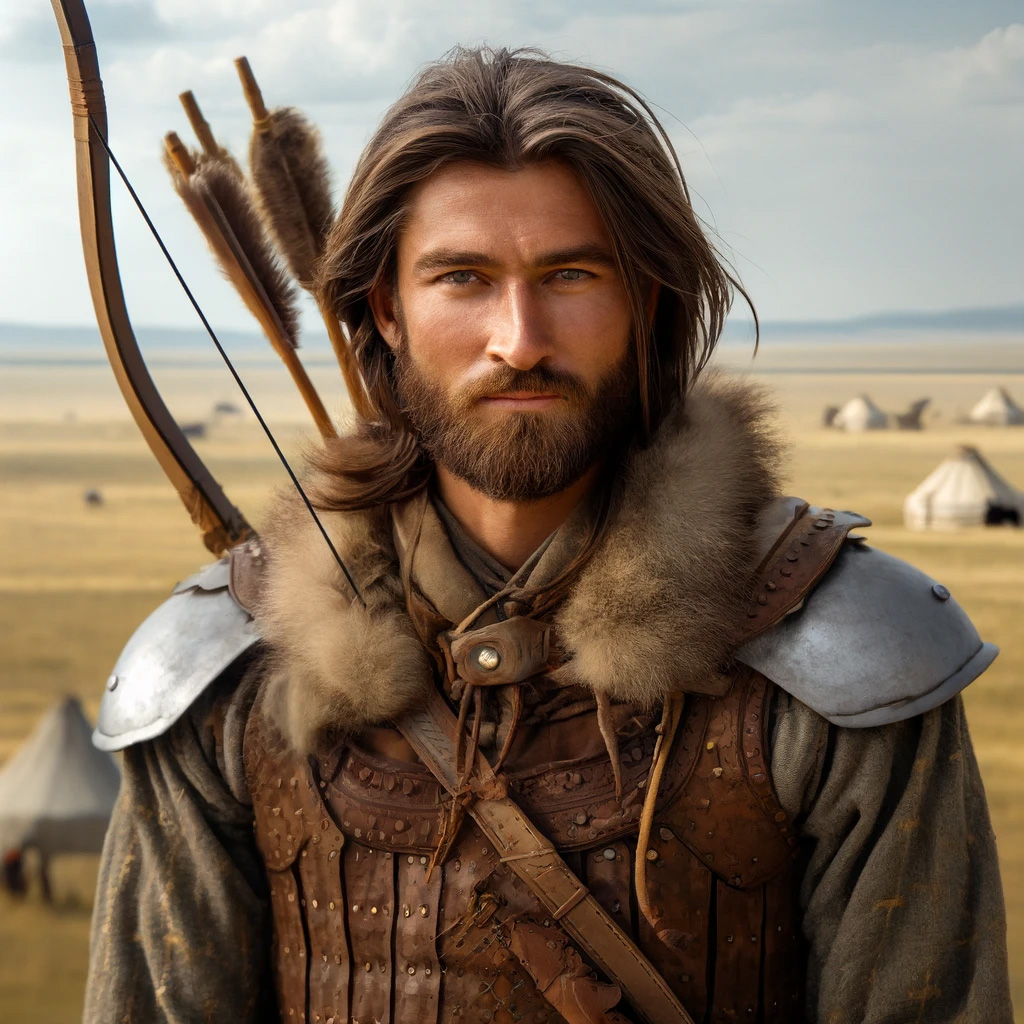
Steppes Clans, The Riders of the Eastern Plains
Children of the Wind and War
The Steppes Clans are a people shaped not by walls or cities, but by movement, by wind, and by the endless horizon. They inhabit the vast southern peninsula of the western continent, a land defined by extremes where survival is never guaranteed and comfort is unknown. The steppes stretch in all directions, a sea of dry grass and rolling hills where the sky feels impossibly wide and the earth offers little shelter. Trees are rare, water uncertain, and the wind, ever-present, carves both the land and the people who endure it.
To the north rise the cursed peaks of Halgaroth, jagged and unforgiving, their silhouettes cutting into the sky like broken blades. These mountains are more than a boundary, they are a reminder, a scar left by ancient betrayals and forgotten oaths that still echo in the memory of the clans. To the west lie the structured kingdoms of Vandor, Albian, and Brightkeep, lands of stone, law, and permanence, everything the steppes are not. These kingdoms watch the eastern plains with caution, knowing that the riders who emerge from them are as unpredictable as the winds that guide them.
Life upon the steppes follows no fixed path. The clans move with the seasons, guided by the migrations of great herds that sustain them. These beasts provide food, materials, and purpose, shaping a way of life that is inseparable from the land itself. There are no permanent borders, no cities to defend, only movement, adaptation, and survival. Each encampment is temporary, each gathering fleeting, and yet from this impermanence emerges a culture that is both resilient and deeply rooted in tradition.
Leadership among the clans is not inherited, nor is it granted by ceremony. It is taken, proven, and constantly reaffirmed. Strength alone is not enough, a true Khan must be more than a warrior. He must be a master of the saddle, a strategist of the open plains, and a survivor capable of holding together a people who value freedom above all else. Authority exists only as long as it is respected, and respect must be earned again and again through action.
Despite their apparent disorder, the clans are bound by ancient customs that govern everything from warfare to alliances. These traditions are not written, but remembered, carried through generations in stories, rituals, and shared experience. They define what it means to be of the steppes, to ride, to fight, and to endure.
For centuries, the Steppes Clans have lived largely apart from the wider world. They have crossed their borders only when necessity demanded it, for trade, for vengeance, or for war. To outsiders, they are raiders, unpredictable and relentless. To themselves, they are something else entirely, the last people who still live as the world once was, unbound, untamed, and unyielding.
Yet there was a time when even they could not remain apart.
A time when the world itself was at war.
The Price of Betrayal, The Clans During the Great War
When the Great War erupted and Agramon, the Dark Forgemaster, cast his shadow across the world, the Steppes Clans did not answer the call of honor, nor did they rally beneath banners of righteousness. The war, to them, was not a question of good or evil, but of opportunity. While kingdoms of the west mobilized in desperation, clinging to alliances and ideals, the riders of the steppes saw something else entirely, a world thrown into chaos, rich with plunder, weakened by conflict, and ripe for those bold enough to seize it.
At the time, the clans were united under a Khan who understood the value of timing over loyalty. Rather than commit to any side, the riders began as predators of circumstance, striking where defenses were thin, where armies had already passed, and where the war had left scars. Border towns fell quickly, supply lines were severed, and isolated settlements burned under the hooves of swift cavalry that appeared without warning and vanished just as swiftly. They did not wage war in the traditional sense, they exploited it.
But as the conflict deepened, Agramon himself took notice. Recognizing the effectiveness of the clans’ mobility and brutality, he extended an offer that few among them could refuse. Wealth, land, and power, not as distant promises, but as immediate rewards for allegiance. For many within the clans, the decision was simple. Why resist the greatest force of destruction the world had ever seen, when they could ride alongside it and claim a share of its victories?
And so, the Steppes Clans joined the armies of Agramon.
Their role within his war machine was unlike that of any other force. Where his legions brought overwhelming might, the riders brought speed, unpredictability, and precision. They became the storm on the battlefield, sweeping across flanks, cutting supply routes, isolating enemy forces, and striking where resistance was weakest. Entire campaigns were shaped by their presence, as their raids destabilized defenses long before Agramon’s main forces arrived.
For a time, they thrived. Victories brought spoils, and the chaos of war masked the consequences of their choices. But no alliance with darkness comes without a price. As the war began to turn, and Agramon’s grip on the world started to falter, the same instincts that had led the clans to join him now drove them to abandon him.
They did not fall with him. They did not stand in his final battles. Instead, they vanished, retreating into the vastness of the steppes, leaving the Dark Forgemaster to face his fate alone. To them, it was survival. To the rest of the world, it was betrayal layered upon betrayal.
Yet the consequences did not end there. Among the clans were those who had sworn true oaths to Agramon, warriors who had bound themselves not just by convenience, but by loyalty. When the clans turned away, those oaths were broken, and Agramon’s wrath was neither distant nor symbolic. Legends speak of curses laid upon the oathbreakers, of spirits condemned to wander the steppes, neither living nor dead, their suffering carried by the wind itself. Even now, some riders claim to hear whispers in the night, echoes of those who betrayed and were condemned for it.
When the war ended, the western kingdoms did not forget. To them, the Steppes Clans were not opportunists, they were traitors who had sided with the greatest enemy the world had ever known. Albian and Brightkeep, in particular, responded with fury. Their armies marched east, not for conquest, but for punishment. Campaign after campaign was launched against the clans, seeking to break them, scatter them, and ensure that such betrayal would never rise again.
The result was devastation. The clans, once unified and strong, were fractured under the pressure of these retaliatory wars. Encampments were destroyed, herds scattered, and alliances shattered. What followed was not recovery, but division, as surviving clans turned inward, competing for dwindling resources and struggling to endure in a world that now saw them as enemies.
That was a century ago. No living rider remembers the Great War. But the world does.
And the steppes have never truly been free of its shadow.
The Rule of Batu Khan
A century after the Great War and the long years of retribution that followed, the Steppes Clans were no longer the unified force they had once been. They had become fragmented, divided by old grudges, weakened by internal conflict, and shaped by a world that no longer trusted them. What had once been a people bound by movement and shared purpose had devolved into rival clans struggling for survival across a harsh and unforgiving land.
It was from this fractured state that Batu Khan emerged.
Batu was not simply another warlord rising through violence, he was something far more dangerous, a leader capable of imposing order upon chaos. Through strength, strategy, and an unyielding will, he began to do what none had achieved since the aftermath of the Great War, he unified the clans. One by one, rival leaders were defeated, absorbed, or eliminated. Some bent the knee willingly, recognizing the inevitability of his rise. Others resisted and were crushed without hesitation.
Under Batu Khan, unity was not a matter of alliance, it was a matter of submission. The independence that had long defined the clans did not disappear, but it was reshaped, brought under a single authority that demanded loyalty above all else. Batu did not erase the identity of the clans, he harnessed it, forging their strength into something more focused, more dangerous, and more purposeful than it had been in generations.
His rule brought stability, but it was a stability forged through dominance rather than harmony. The endless internal wars that had once consumed the steppes were silenced, not through reconciliation, but through fear and control. Old rivalries were buried beneath the weight of his authority, though never truly forgotten. Beneath the surface, tensions remained, waiting for the moment when his grip might weaken.
With unity restored, the strength of the clans returned. The great herds once again roamed under protection, trade resumed in controlled forms, and the warbands of the steppes rode with renewed purpose. No longer scattered raiders, they became a coordinated force, capable of projecting power far beyond their homeland. Where once they had survived, now they began to grow.
Yet Batu Khan is not a ruler content with preservation. His vision extends beyond the steppes. He sees the lands of the west not as distant kingdoms, but as opportunities, territories shaped by law and structure that stand in contrast to the raw strength of his people. To him, the past is not a burden, but a lesson. Where the clans once acted without direction, he intends to guide them with purpose.
This ambition, however, comes at a cost. Unity imposed through strength is never absolute, and those who bow today may rise tomorrow. Whispers of dissent move quietly through the clans, carried in hushed conversations and secret gatherings. Some remember what it meant to be free, unbound by a single ruler. Others see Batu not as a savior, but as a tyrant no different from the forces their ancestors once resisted.
Batu Khan is aware of this. He does not ignore it, nor does he fear it. To him, opposition is inevitable, a test of strength that must be answered, not avoided. His rule endures not because it is accepted, but because it is enforced, and because no one has yet proven strong enough to take it from him.
For now, the steppes ride as one.
But unity born of conquest is never permanent.
And the winds of the plains carry more than just dust and thunder.
The Shamans and the Dark Spirits of the Steppes
Among the Steppes Clans, faith is not bound to temples, nor preserved in written doctrine. It lives in the wind, in the earth beneath their feet, and in the endless sky above them. Their beliefs are ancient, older than kingdoms, older than borders, rooted in a world where spirits are not distant myths, but ever-present forces that shape reality itself. To the riders of the steppes, the land is alive, and those who know how to listen can hear its voice.
At the heart of this spiritual world stand the Sky Seers, the shamans of the clans. They are not merely priests, but intermediaries between the physical world and the unseen forces that surround it. Through ritual, meditation, and sacrifice, they interpret the will of the spirits, reading omens in the flight of birds, the movement of clouds, and the shifting patterns of the stars. Their role is vital, guiding the clans through war, migration, and hardship, offering counsel that blends intuition with ancient knowledge.
Sky Seers are respected, but never beyond question. Their power is not absolute, and their interpretations are often debated among warriors and leaders alike. In a culture that values strength and independence, even the voices of the spirits must prove their worth through results. Yet when their visions prove true, when their warnings save lives or lead to victory, their influence becomes undeniable.
But the steppes do not harbor only benevolent forces.
The Great War left scars upon the land that time has not erased. Where blood was spilled and oaths were broken, something lingered. The spirits that dwell in these places are restless, twisted by suffering and bound to memories of betrayal. They whisper in the wind, they linger in abandoned camps, and they answer those who dare to call upon them.
From this darker aspect of the steppes emerged the Shadow Shamans. Unlike the Sky Seers, they do not seek harmony with the spirits, they seek control. Through forbidden rituals and dangerous pacts, they bind these entities to their will, drawing power from forces that should never be commanded. Their magic is not subtle. It manifests in curses, in spectral apparitions, in the manipulation of fear and death itself.
They are feared, even among their own people. To walk the path of a Shadow Shaman is to risk becoming something less than mortal, a vessel for powers that consume as much as they grant. And yet, in a land where strength determines survival, their abilities cannot be ignored. Many warlords, even those who publicly condemn them, have turned to their services when victory demanded it.
Batu Khan himself does not reject their existence. He is too pragmatic for that. Power, in any form, is a tool, and tools are meant to be used. There are whispers among the clans that his rise was not achieved through strength alone, that somewhere along his path, he made contact with forces beyond the natural world. Whether these rumors are truth or myth, none can say for certain. But the presence of Shadow Shamans has grown since his ascension, and their influence continues to spread.
This duality defines the spiritual life of the steppes. On one side, the Sky Seers, keepers of balance, tradition, and guidance. On the other, the Shadow Shamans, wielders of forbidden power, feared and yet indispensable. Between them lies a fragile equilibrium, one that mirrors the state of the clans themselves.
For the steppes are not merely a land of wind and war.
They are a land where the living and the unseen walk side by side.
The Two Exiles, Rivals and Rebels
Even under the rule of Batu Khan, the unity of the Steppes Clans is far from absolute. Beneath the surface of enforced order, resistance endures, carried by those who refuse to accept a future shaped by a single will. Among them stand two figures whose names are spoken in both admiration and fear, warriors once bound to Batu, now his most dangerous enemies.
They are not allies by nature, nor are they united by loyalty to one another. They are rivals, shaped by different paths, driven by different visions of what the steppes should become. And yet, for now, they share a common purpose, the fall of Batu Khan.
Möngke the Stormblade
Once the greatest general in Batu Khan’s army, Möngke was a warrior without equal, a master of the charge, and the blade that carved Batu’s path to power. He was more than a commander, he was the embodiment of the Khan’s early victories, a symbol of strength, discipline, and unrelenting efficiency in war.
But Möngke’s loyalty was not without limits.
During a campaign against a rival clan, Batu ordered the complete annihilation of his enemies, not just their warriors, but their families, their elders, their entire lineage. To Batu, it was a necessary act, a demonstration of power meant to ensure that resistance would never rise again. To Möngke, it was something else entirely.
He refused.
That refusal changed everything. In a society where obedience defines survival, defiance cannot be tolerated, especially from one so influential. Möngke was stripped of his title, cast out from the clans, and branded a traitor. His name, once spoken with respect, became a warning.
Now, he rides in exile, no longer a general, but a symbol of resistance. Those who follow him are not bound by fear, but by choice, warriors, outcasts, and dissenters who believe that the clans should not be ruled through terror alone. Möngke does not seek chaos, nor does he seek domination. He seeks a different kind of unity, one that does not erase the will of those who live within it.
Yet even in exile, he remains a threat that Batu cannot ignore. For every warrior who joins Möngke, the illusion of absolute control weakens.
Khulan the Wanderer
Where Möngke represents defiance from within, Khulan embodies something far less predictable. A rogue, a trickster, and a warrior shaped by the world beyond the steppes, he is a figure who does not fit easily within any structure, not even rebellion.
Khulan did not remain after his exile. Instead, he left the steppes entirely, crossing into lands that few of his people had ever truly known. He fought in the arenas of Albian, where strength is measured in spectacle as much as in skill. He sailed with the Corsairs of Draxis, learning the ways of war upon the sea, far from the open plains of his birth. He lived among foreigners, adapting, observing, and evolving.
When he returned, he was no longer simply a rider of the steppes.
He was something else.
Khulan brings with him knowledge that no other clansman possesses, tactics drawn from distant cultures, strategies shaped by experiences beyond the traditions of his people. Where others fight as they always have, he fights with unpredictability, turning expectation into weakness and familiarity into a trap.
He does not seek to rule as Batu does, nor to restore what once was. His goal is more elusive, to break the system entirely, to shatter the structure Batu has imposed and return the clans to a state where no single voice can dominate the rest. Whether this vision would lead to freedom or chaos is a question even his followers cannot fully answer.
Between Möngke and Khulan lies a tension that mirrors the greater conflict of the steppes. One seeks a new form of unity, the other a return to unbound freedom. Both oppose Batu, yet neither fully trusts the other. Their rivalry is quiet, restrained for now by necessity, but it is only a matter of time before their paths collide.
And when they do, the future of the steppes may be decided not by Batu Khan, but by the outcome of their conflict.
An Uncertain Future
The Steppes Clans stand once more at a turning point in their history, a moment where the past, the present, and the future collide beneath the endless sky of the eastern plains. They are no longer the scattered remnants left behind by war and punishment, nor are they the opportunistic raiders they once were during the age of Agramon. Under Batu Khan, they have become something greater, a unified force, disciplined, organized, and poised to reshape their place in the world.
Yet this unity is fragile.
Beneath the surface of strength lies a tension that cannot be silenced forever. The clans remember what it means to be free, to ride without command, to live without bending the knee to a single ruler. Batu Khan has brought them stability and purpose, but he has also imposed a structure that stands in direct opposition to the very nature of the steppes. What he has built through strength may one day be undone by it.
Beyond their borders, the world watches closely. The kingdoms of the west have not forgotten the betrayal of the Great War, nor the devastation that followed in its wake. To them, the rise of a unified Steppes Clans is not a sign of renewal, but a warning. Old fears awaken as reports spread of organized warbands, of riders moving not as scattered raiders, but as a coordinated force capable of sustained campaigns.
Some prepare for war. Others hope that the storm will pass them by. But few believe that the steppes will remain silent for long.
Within the clans, the threat is just as great. Möngke gathers those who believe in a different path, one where unity does not come at the cost of honor. Khulan moves through the shadows, sowing doubt, breaking certainties, and reminding the people of a time before kings. And Batu Khan, ever watchful, tightens his grip, knowing that the greatest threat to his rule does not come from beyond the plains, but from within them.
The balance cannot hold forever.
Whether the future of the Steppes Clans will be shaped by conquest, rebellion, or collapse remains uncertain. Each path leads to a different destiny, yet all are bound by the same truth, the era of silence has ended.
The riders are gathering.
The winds are shifting.
And when the storm breaks, it will not be contained.
The world will feel it.