






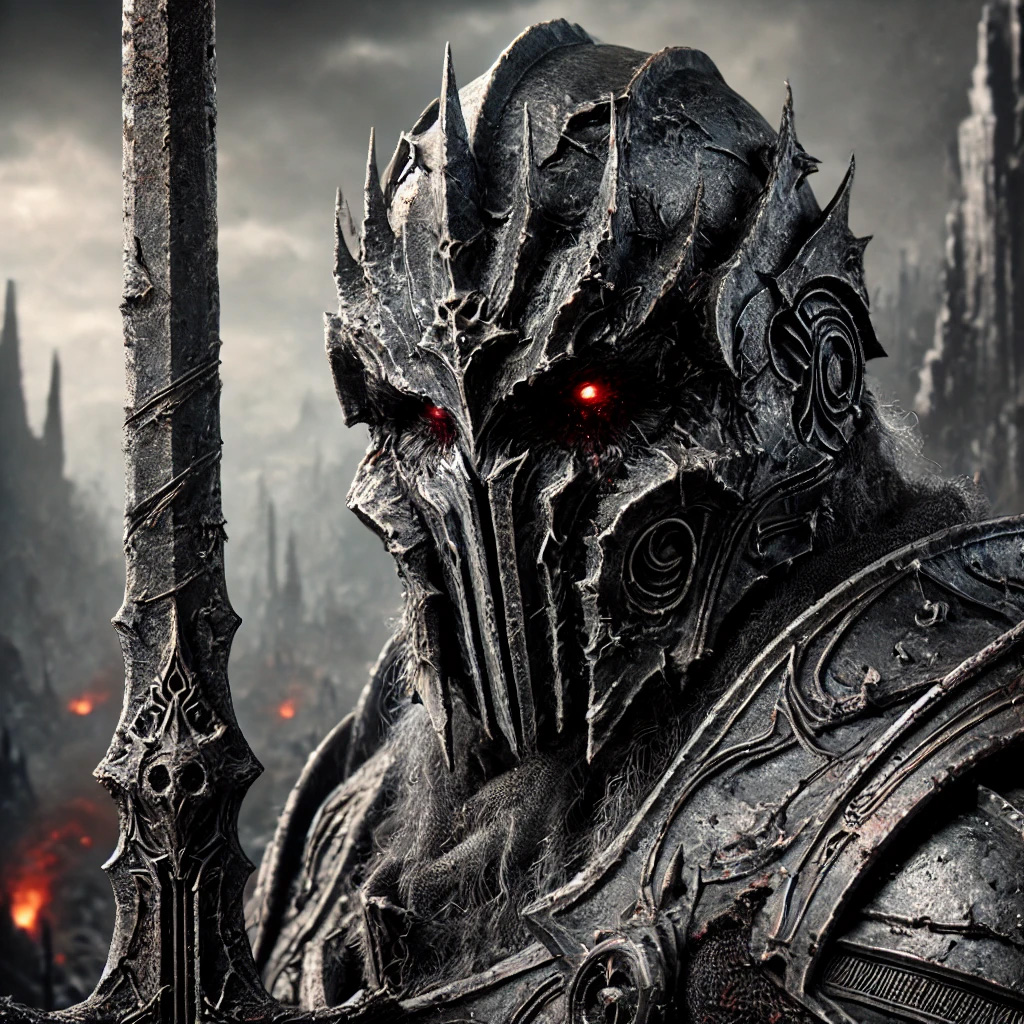
Shadowspire, Throne of Eternal Dread
The Black Mountain of Dreadhold
At the heart of Dreadhold rises Shadowspire, not merely a fortress, but a mountain of black iron and obsidian whose jagged peaks pierce the storm-filled skies like a wound in the world itself. :contentReference[oaicite:0]{index=0} Its silhouette dominates the horizon, casting vast, unnatural shadows across a land where life has long since withered. The ground beneath it is scorched, cracked, and silent, save for the ceaseless wind that carries whispers of suffering and forgotten screams.
Shadowspire is not a place that was built in the traditional sense, it was forged, shaped by the will of Agramon, the Dark Forgemaster, whose mastery over both metal and forbidden magic allowed him to create a stronghold that exists as much in the physical world as it does in something far darker. Its walls seem to breathe, its stones pulse with residual energy, and those who enter its depths often speak of a presence that watches, remembers, and judges.
Within its labyrinthine structure lies a world of iron corridors, towering battlements, and vast subterranean forges that burn without end. These ancient furnaces are not merely tools of war, they are the foundation of Agramon’s power, feeding both his armies and his rituals. It is said that the very metal shaped within Shadowspire carries echoes of the souls that have perished there, bound forever to the will of its master.
Agramon, the Dark Forgemaster
The name Agramon is spoken with reverence and fear by all who know of him, for he is no longer bound by the limitations of mortality. Once a mortal mage of extraordinary talent, his relentless pursuit of forbidden knowledge led him beyond the boundaries of life itself. Through necromancy and dark rituals, he uncovered the means to prolong existence, not merely extending life, but transcending death.
This transformation, however, came at a terrible cost. Agramon exists in a state that defies nature, sustained by forces that consume as much as they grant. His immortality is not a gift freely given, but a constant struggle against decay, a balance maintained through power, sacrifice, and control over those who serve him.
From the Obsidian Hall at the core of Shadowspire, he rules what remains of his fractured empire, a dominion built not on loyalty, but on fear, ambition, and necessity. Though his authority is absolute, it is never secure. The memory of betrayal still lingers from the end of the Great War, when allies turned against him, and his dreams of total domination were shattered. That memory has shaped him into a ruler who trusts no one, not even those closest to his throne.
The Curse of the Drelkar
Among Agramon’s greatest creations, and his most tragic legacy, are the Drelkar, once Eldrakar, now transformed into beings caught between life and death. Drawn by promises of power and extended life, they embraced Agramon’s forbidden magic, only to discover that what they had gained was inseparable from what they had lost.
The Drelkar endure far beyond normal lifespans, their bodies sustained by dark energy, yet this endurance is temporary. With time, their forms begin to fade, their essence slipping toward a spectral existence. To delay this transformation, they must consume the blood of the living, a ritual necessity that has shaped their entire society into one driven by predation, domination, and an ever-present thirst.
Each resurrection, each return from death, accelerates this process. The more they rely on Agramon’s magic, the further they drift from what they once were. The oldest among them have long since lost all trace of emotion beyond hatred and cruelty, their forms twisted, their presence alone enough to break the resolve of even hardened warriors.
The Coast of Specters
To the east of Shadowspire stretches the Coast of Specters, a desolate expanse that serves as the final destination for those Drelkar who have crossed the threshold beyond return. There, stripped of reason and identity, they wander as shadows of their former selves, bound neither fully to life nor to death.
These spectral remnants are feared even within Dreadhold itself. Their forms shift unnaturally, their hollow eyes reflect nothing, and their ability to move through darkness makes them nearly impossible to track or escape. They do not serve Agramon in any structured sense, yet their existence reinforces his dominion, a constant reminder of the fate that awaits those who embrace his power too completely.
In Shadowspire, power is never free.
It is borrowed from something far worse.
A Society Built on Power, Fear, and Decay
The society of Shadowspire does not function through stability, it survives through imbalance, sustained by fear, ambition, and the constant struggle for dominance. :contentReference[oaicite:0]{index=0} Every individual within its walls understands a simple truth, power is the only currency that matters, and it must be taken, defended, or stolen before someone stronger claims it.
At the summit of this brutal hierarchy stand the Drelkar, former Eldrakar whose bodies and minds have been reshaped by Agramon’s dark magic. They form the ruling elite, not through unity, but through competition. Each seeks to rise above the others, weaving alliances, betrayals, and silent rivalries that shift like shadows within the halls of Shadowspire. Loyalty exists, but it is always conditional, always temporary, and always subject to change.
Beneath them stand the Kragars, elite warriors drawn from the strongest orc bloodlines of Dreadhold and Ashmarsh. Unlike the Drelkar, their power does not come from magic, but from raw strength, discipline, and unwavering obedience. They form the Dread Wardens, an elite force capable of locking into impenetrable shield formations, holding ground against forces that would shatter lesser armies. Their loyalty to Agramon is absolute, or at least it appears so, for even among them, ambition and silent resentment can grow.
Humans also exist within Shadowspire, though rarely by accident. Some arrive seeking power, others wealth, and some are drawn by darker desires they cannot name. They are often used as spies, infiltrators, and expendable agents beyond the borders of Dreadhold, tools that allow Shadowspire to extend its reach without exposing its core. Few of them truly understand what they have entered, and fewer still ever leave.
The Culture of Poison and Intrigue
Within Shadowspire, warfare does not begin on the battlefield, it begins long before, in whispers, in shadows, and in the slow, deliberate application of poison. It is a weapon as valued as any blade, not only for its effectiveness, but for what it represents, control over life, suffering, and inevitability.
The Drelkar have mastered its use to an art form. Poisons are infused into weapons, mixed into food, carried in concealed vials, and deployed in ways that ensure the enemy weakens long before the first strike is delivered. Death is rarely immediate. It is slow, calculated, and often invisible until it is too late to resist.
This philosophy extends beyond war into the very fabric of their society. Intrigue is constant, every conversation carries weight, every alliance hides a potential betrayal. To survive within Shadowspire requires more than strength, it requires awareness, patience, and a willingness to act before others do.
Even the appearance of the Drelkar reflects this corruption. Their partially spectral features, their hollow, cold eyes, and the unnatural stillness of their movements create an aura of unease that unsettles even their allies. They are living reminders of what power in Shadowspire truly costs.
The Throne of Obsidian and the Weight of Paranoia
At the center of this fractured and dangerous system sits Agramon, upon the Obsidian Throne, a ruler whose authority is absolute, yet never secure. He commands without opposition, his will enforced through fear and overwhelming power, yet he is surrounded by those who would take his place if given the opportunity.
His paranoia is not weakness, it is experience. The memory of the Great War still shapes his rule, when allies turned into enemies, when generals he trusted sought to claim power for themselves, and when his empire fractured under the weight of its own ambition. The orcs of Grimstone broke away, the Spectral King of Malgar forged his own dominion, and distant human territories cast off his influence.
Now, Agramon rules not a unified empire, but a volatile one, held together by force, fear, and the careful balance of competing powers within Shadowspire itself. He trusts no one fully, and ensures that no subordinate grows powerful enough to challenge him without consequence.
Zelkar, Voice of the Dark Will
Among the few who stand closest to Agramon is Zelkar, his Herald, a figure as feared as he is mysterious. Encased in dark armor etched with ancient runes, his presence alone is enough to silence dissent. His iron mask hides whatever remains of his face, though many believe it is no longer a mask at all, but a permanent fusion of flesh and magic.
Zelkar is more than a messenger. He is Agramon’s voice made manifest, carrying his commands across the realm and ensuring they are executed without hesitation. Through his mastery of dark magic, he can project Agramon’s will across vast distances, reinforcing the illusion that the Dark Forgemaster is everywhere, watching, judging, and commanding.
He also serves as enforcer, eliminating threats before they can fully emerge. Rebellion does not spread in Shadowspire, it is extinguished at its source, often before it is even recognized as such.
Yet even Zelkar is not untouched by ambition. Beneath his unwavering loyalty lies a desire for transcendence, a need to push beyond his current existence and uncover the deeper secrets of the power he serves.
The Ancient Lords and the Shadow of Eternity
Beyond the visible hierarchy exist the Ancient Lords, once-great Drelkar warriors who have been granted a form of immortality that has stripped them of nearly everything they once were. They drift between life and death, their identities eroded, their purpose reduced to eternal service.
Among them stands Valtheron the Accursed, a commander whose name still carries echoes of the warrior he once was. Once noble, once proud, he now exists as a being caught between worlds, bound to Agramon’s will yet haunted by the remnants of his past.
He commands the Iron Legion with ruthless precision, leading forces that strike fear into even the most disciplined armies. His presence on the battlefield is overwhelming, not only for his skill, but for what he represents, the inevitable fate of those who walk too far down the path of Shadowspire.
And yet, whispers persist. That beneath the spectral form, beneath the obedience and the terror, something remains. A fragment of will, a memory of who he once was, struggling against the darkness that consumes him.
In Shadowspire, even eternity is a prison.
Warlords, Traitors, and Ambition Without Limits
Within Shadowspire, power is never static, it shifts constantly, shaped by ambition, rivalry, and the ever-present possibility of betrayal. Among those who rise within this brutal system, some do so through strength, others through cunning, and a few through a dangerous combination of both. :contentReference[oaicite:0]{index=0}
Grakthar Ironfist stands as one of the most imposing figures within Agramon’s domain, a towering orc whose sheer physical dominance has earned him the role of enforcer. His warhammer, infused with dark energy, is not merely a weapon, but an instrument of terror used to crush dissent and reinforce Agramon’s authority. Yet beneath his apparent loyalty lies ambition. Grakthar does not question Agramon’s power, but he does envision a place for himself beyond his current station, watching, waiting, and measuring every opportunity that might allow him to rise further.
In contrast to Grakthar’s brutality, Kaelar the Betrayer represents a different kind of threat. A Drelkar adventurer and assassin, Kaelar serves no master beyond his own interests. He sells his skills to the highest bidder, including Agramon when it suits him, moving between shadows, courts, and battlefields with equal ease. His mastery of deception and assassination makes him invaluable, yet entirely untrustworthy. Even within Shadowspire, where betrayal is expected, Kaelar remains an anomaly, a man whose loyalty cannot be bought permanently, only temporarily secured.
More dangerous still are those who operate from within the core of Agramon’s power. Thalonis the Silent, a strategist of unmatched intellect, stands at the center of Shadowspire’s military brilliance. Many of Agramon’s greatest victories bear his mark, campaigns executed with precision and foresight that few could rival. Yet behind his calm demeanor lies a deeper ambition, one not aligned with Agramon’s rule.
Thalonis believes that the Drelkar are not meant to serve, but to rule, free from the chains of the very magic that sustains them. He sees Agramon not as a master, but as an obstacle, a necessary force that must one day be removed if the Drelkar are to reclaim their true potential. His plans are not rushed, they are cultivated, unfolding slowly within the shadows of the very system he helps maintain.
He is not alone in this vision. At his side stands Lorthen, the High Priest, a scholar of dark magic whose outward devotion masks a far more dangerous objective. While he advises Agramon on spiritual and arcane matters, his true pursuit lies elsewhere, in understanding the nature of the curse that binds the Drelkar and discovering a way to break it.
Together, Thalonis and Lorthen form a silent alliance, one rooted not in loyalty, but in shared purpose. They do not seek immediate rebellion, they seek inevitability, a moment when Agramon’s downfall is not a risk, but a certainty.
Dominion, Influence, and Fragile Control
Though Shadowspire appears as a singular, immovable power, its influence extends far beyond the borders of Dreadhold, reaching into regions where control is less absolute, but no less significant. Agramon’s rule over Dreadhold itself is unquestioned, enforced through fear and the constant threat of annihilation. Those who defy him do not simply disappear, they become examples, their fates reinforcing the consequences of resistance.
In Ashmarsh, his authority is more complex. While he has imposed a brutal order that has reduced large-scale rebellion, unrest continues to simmer beneath the surface. Local leaders comply not out of loyalty, but out of necessity, waiting for moments of weakness that may never come.
Beyond these core territories, Agramon has turned to influence rather than direct rule. Trade with the Dunes of Qarath and Far Qarath has strengthened his position, creating economic ties that bind distant powers to his interests. These relationships are built on mutual benefit, but sustained through fear. Those who trade with Shadowspire know that profit comes with risk, and that Agramon’s favor can shift as quickly as his temper.
His interactions with Gryndor remain volatile, shaped by shared ambition and mutual distrust. Alliances form when convenient, particularly in opposition to Albian, but they are never stable. Both sides recognize the threat the other represents, and cooperation is always temporary, a pause between conflicts rather than a true partnership.
With the Greyhills, Agramon’s approach is more cautious. The Wutans are not easily manipulated, nor easily subdued. Their independence makes them difficult allies, yet potentially valuable ones. Agramon sees in them an opportunity, a force that could disrupt his enemies if guided correctly, but also a risk that must be handled with care.
Perhaps his most delicate efforts lie with the Dawnsun Empire. Agramon seeks to draw them into an alliance against Albian, presenting himself as a counterbalance to western power. Yet the memory of the Great War still lingers. The Dawnsun rulers remember his attempt to dominate the world, and while they respect his strength, they fear the inevitability of his ambition. Negotiations continue, but trust remains elusive.
An Empire on the Edge of Itself
Shadowspire stands as one of the most formidable powers in the world, a dominion built on mastery of dark magic, relentless ambition, and the ability to instill fear in all who oppose it. Its armies are strong, its influence vast, and its ruler nearly immortal.
Yet beneath this strength lies instability. Every alliance is fragile, every subordinate a potential traitor, every victory a temporary reinforcement of a system that is constantly eroding from within.
Agramon rules through control, but control is never absolute. The forces that sustain his empire are the same forces that threaten to tear it apart. The Drelkar grow stronger, but also more unstable. His generals win battles, but question his rule. His allies obey, but do not trust.
Shadowspire does not stand because it is stable.
It stands because nothing has yet been able to break it.
But within its walls, within its people, and within the very magic that sustains it, the seeds of its downfall are already taking root.
And when they finally emerge, they will not come from outside.
They will come from within.