






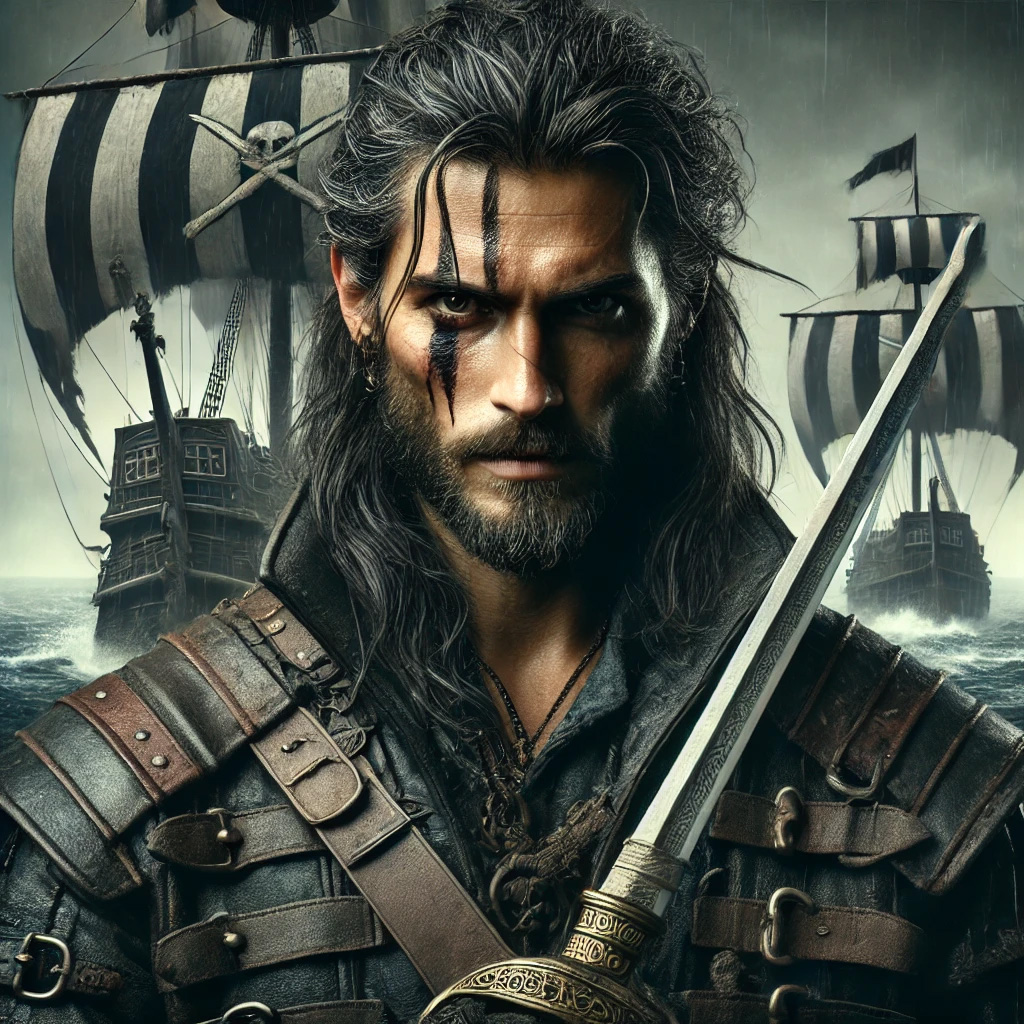
Corsairs of Draxis, Scourge of the Southern Seas
The Kingdom of Black Sails
The Corsairs of Draxis are feared across every known sea, their black sails a symbol not merely of piracy, but of inevitability. Where they appear, trade falters, fleets vanish, and coastal cities prepare for fire and blood. Draxis itself is not a kingdom in the traditional sense, but a maritime dominion carved into jagged coastlines and hidden within labyrinthine coves, a place where towering cliffs, concealed harbors, and fortified ports form a natural bastion against any who would attempt to challenge its rule. :contentReference[oaicite:0]{index=0}
Within these waters, power does not flow from lineage or divine right, but from dominance, cunning, and the ability to seize opportunity without hesitation. The Corsairs are not bound by loyalty to land, nor by the rigid structures that define mainland empires. They are creatures of movement, of shifting alliances and calculated betrayals, united not by ideology, but by profit, survival, and the shared understanding that the sea rewards only the bold.
The wealth of Draxis is not cultivated, it is taken. Every coin, every weapon, every ship that fills its harbors is a testament to conquest, to raids carried out under cover of night, to fleets ambushed and broken before they could react. This constant influx of plunder has transformed Draxis into a thriving stronghold, one where markets overflow with stolen goods and where fortunes are made and lost with terrifying speed.
The Origins of a Pirate Empire
The Corsairs of Draxis trace their origins to the Archipelago of Draxis, a scattered chain of islands once governed by a ruling council that sought to control the seas through sanctioned violence. Letters of marque were issued freely, granting privateers the legal authority to raid enemy vessels and weaken rival powers, turning piracy into an instrument of statecraft. What began as a controlled strategy soon spiraled beyond its creators’ grasp.
The privateers, enriched by success and emboldened by distance, began to operate with increasing independence. Wealth accumulated faster than authority could contain it, and loyalty to the council weakened as individual captains realized that they no longer needed permission to take what they could claim by force. Rivalries emerged, fleets clashed not only with foreign enemies but with one another, and the fragile structure that once governed the archipelago collapsed under the weight of its own ambition.
From this chaos, the Corsairs were born. No longer bound by law or oversight, they seized control of the islands, eliminating the remnants of the council and forging a new order built not on governance, but on dominance. The strongest captains rose, the weakest disappeared, and Draxis transformed from a state that tolerated piracy into one that existed solely because of it.
During the Great War against Agramon, the Corsairs found in the turmoil an opportunity unlike any before. While the great kingdoms of the mainland exhausted themselves in brutal conflict, their fleets stretched thin and their defenses weakened, the Corsairs struck with precision and ferocity. Coastal cities burned, trade routes collapsed, and entire fleets were dismantled before they could regroup. Among their most devastating campaigns were the raids upon Vlandor, where they seized immense wealth and contributed to the kingdom’s eventual decline.
By the war’s end, Draxis was no longer a fragmented pirate haven. It had become a maritime power, its influence extending across the southern seas, its fleets unmatched in speed and brutality, and its reputation sufficient to inspire fear long before its ships were even sighted.
In the years that followed, the Corsairs abandoned any illusion of loyalty beyond their own interests. They became mercenaries of the tides, selling their strength to the highest bidder while maintaining their independence. Kings, warlords, and merchants alike have learned that the Corsairs cannot be trusted, yet cannot be ignored. Their allegiance is temporary, their promises conditional, and their betrayal always a possibility.
This unpredictability has become their greatest weapon. Wherever their black sails appear, alliances fracture, plans unravel, and the balance of power shifts in ways few can anticipate.
The Black Cove, Heart of Draxis
At the core of Draxis lies the Black Cove, a natural harbor carved into the coastline and concealed within towering cliffs that rise like jagged walls against the sea. This place is more than a port, it is the beating heart of the Corsair dominion, a sanctuary for their fleets and a fortress that few outsiders have ever seen and lived to describe. The entrance itself is narrow and treacherous, hidden among shifting currents and sharp rock formations known only to those who sail under the black sails, ensuring that any hostile fleet attempting to breach it would be shattered long before reaching its depths. :contentReference[oaicite:0]{index=0}
Within the cove, hundreds of ships crowd the waters, their hulls reinforced, their decks stained by years of battle and blood. These vessels are not uniform, but each bears the mark of adaptation, shaped by countless encounters at sea. Ballistae line their decks, harpoons are mounted for brutal boarding actions, and reinforced rams allow them to tear through enemy hulls with devastating force. Speed remains their greatest advantage, allowing them to strike without warning and vanish before retaliation can take form.
Beyond the fleet, the harbor itself is fortified with iron walls, watchtowers, and layered defenses that transform the cove into a near-impenetrable stronghold. Markets flourish along the docks, filled with goods taken from across the world, exotic materials, stolen relics, weapons, spices, and treasures that tell the story of countless raids. Here, wealth flows as freely as blood, and influence is measured not in titles, but in what one can command and defend.
Tharnak the Pillager, Lord of Draxis
At the center of this volatile power stands Tharnak the Pillager, the man who achieved what few believed possible, the unification of the Corsairs under a single authority. Towering in both presence and ambition, Tharnak is a figure shaped by violence and driven by vision. His scarred face and piercing gaze speak of a life spent at the edge of death, while his reputation speaks of a leader who does not simply survive chaos, but bends it to his will.
Tharnak did not inherit his position, he seized it. Through a combination of ruthless force, calculated alliances, and strategic brilliance, he brought the fractured pirate factions into alignment, crushing those who resisted and rewarding those who submitted. Yet his rule is not absolute in the manner of a king. It is maintained through strength, through the constant demonstration that no rival can match him, and through the understanding that unity, however fragile, benefits all who sail under his banner.
His flagship, the Stormraven, is the embodiment of his power. Larger, faster, and more heavily armed than any other vessel in the fleet, it serves not only as his command ship, but as a symbol of dominance. To see it on the horizon is to understand that resistance is futile.
Tharnak’s ambitions extend beyond the sea. He does not see Draxis as merely a pirate haven, but as the foundation of something greater, an empire built not on land, but on control of the world’s arteries, its trade routes, its coastal cities, and its lifelines. To him, the mainland kingdoms are not enemies to be feared, but opportunities waiting to be claimed.
Kaldarion, the Eldrakar Admiral
Standing in opposition to Tharnak’s dominance is Kaldarion, an Eldrakar admiral whose very existence challenges the nature of the Corsairs. Where Tharnak represents chaos harnessed into power, Kaldarion represents order imposed upon it. His Crimson Armada is not a collection of opportunistic raiders, but a disciplined and unified force, trained, loyal, and precise in execution.
Unlike most of his kin, who would consider piracy beneath them, Kaldarion has embraced the seas as a means of restoring what he believes to be the rightful order of the world. To him, the Corsairs are not rulers, but usurpers, a disorderly force that must either be brought under control or destroyed. His fleets move with calculated intent, striking not for plunder alone, but to establish dominance, to impose structure where there is none.
The clashes between Kaldarion and Tharnak have become the stuff of legend, battles of maneuver, strategy, and raw force that have reshaped entire regions of the sea. Neither has yet secured a decisive victory, and this ongoing rivalry serves as both a threat and a balance. As long as Kaldarion endures, Tharnak’s dominance remains contested, and the Corsairs’ unity remains under pressure.
Kaldarion’s ultimate goal is not merely victory, but transformation. He seeks to build a naval empire rooted in discipline and hierarchy, one that reflects the legacy of the Eldrakar rather than the chaos of piracy. In this, he is both an enemy and a mirror to Draxis, a vision of what the Corsairs could become, or what they may one day be forced to confront.
Mordran, the Puppetmaster of the Sands
While Tharnak and Kaldarion shape the visible struggle for dominance upon the seas, another force operates beneath the surface, subtle, patient, and far more dangerous in its implications. Mordran, a human originating from the Dunes of Qarath, is not a warlord in the traditional sense, but a manipulator whose influence extends through whispers, bargains, and carefully orchestrated events.
Acting in service to Sahladorn, the most powerful clan leader of Qarath, Mordran has embedded himself within the Corsairs of Draxis, navigating their volatile politics with remarkable precision. His silver tongue and strategic mind have earned him trust where others would have been discarded, allowing him to guide decisions without ever appearing to command them.
His purpose is clear, to redirect the destructive force of the Corsairs toward the enemies of Sahladorn, weakening rival powers while maintaining plausible deniability. Through him, raids become targeted, alliances shift subtly, and conflicts ignite in places that serve interests far beyond Draxis itself.
Yet Mordran is no mere servant. Beneath his loyalty lies ambition, carefully concealed but steadily growing. He has begun assembling his own fleet, building influence not only within Draxis, but beyond it, preparing for a future in which he no longer serves another’s vision, but his own.
He walks a dangerous path, balancing between allegiance and betrayal, between manipulation and exposure. In a world where trust is already scarce, one misstep could see him destroyed. Yet if he succeeds, he may become something far greater than any pirate lord.
Not a ruler of the seas, but the one who decides who rules them.
Karissa Bloodtide, Mistress of the Storm
Among the many captains who sail under the black banners of Draxis, few inspire as much fear and fascination as Karissa Bloodtide. Known as the Mistress of the Storm, she has carved her reputation through a combination of raw brutality and unnatural mastery over the elements, bending wind and waves to her will in ways that few can comprehend. Her presence on the battlefield is as much a force of nature as it is a display of skill, and many who have faced her speak not of defeat, but of being overwhelmed by something far greater than a single commander. :contentReference[oaicite:0]{index=0}
She commands the Tidebreaker, a sleek and deadly vessel designed for speed and precision, capable of outmaneuvering even the fastest ships on the open sea. Under her command, it becomes more than a ship, it becomes an extension of her will, striking with sudden violence before vanishing into mist and storm. Her raids are calculated, her movements unpredictable, and her victories often decisive.
Karissa’s loyalty to Tharnak is genuine, forged not through fear, but through mutual respect. She sees in him a leader worthy of following, a reflection of her own ambition and strength. Yet within the ranks of the Corsairs, whispers persist. Her growing influence, her command of both crew and storm, and her increasing independence have led some to believe that she may one day rise beyond her current station. For now, she remains one of Tharnak’s most powerful lieutenants, a weapon he unleashes when overwhelming force is required.
Jorath Ironclad, Architect of the Fleet
If Tharnak is the will of Draxis and Karissa its fury, then Jorath Ironclad is its foundation. A reclusive yet brilliant shipwright, Jorath stands behind the Corsairs’ greatest advantage, the superiority of their fleet. While others fight upon the decks, he shapes the vessels themselves, designing and overseeing the construction of ships that are faster, stronger, and more lethal than anything their enemies can produce.
His innovations have transformed Draxis from a collection of raiders into a dominant naval power. Reinforced hulls allow Corsair ships to withstand impacts that would cripple lesser vessels, enhanced weapon systems increase their destructive capability, and advanced navigation techniques enable them to move through treacherous waters with confidence and speed. Each design reflects not only technical mastery, but an understanding of how war is fought at sea.
Jorath rarely leaves his workshops, and he has little interest in politics or power. His loyalty to the Corsairs is not rooted in ideology, but in the opportunity they provide him to perfect his craft. Yet even he recognizes excellence when he sees it. Among all their enemies, he holds a quiet respect for Kaldarion, whose disciplined fleets represent a different, but equally refined, expression of naval mastery.
Through Jorath’s work, the Corsairs do not merely survive upon the seas.
They dominate them.
The Corsairs as a Fighting Force
The forces of Draxis are as diverse and unpredictable as the sea itself, a collection of pirates, mercenaries, criminals, and adventurers bound together by ambition and the promise of wealth. Unlike traditional armies, they do not rely on rigid hierarchy or standardized tactics. Each crew brings its own methods, its own strengths, and its own interpretation of warfare, creating a force that is difficult to predict and even harder to counter.
What unites them is their approach to combat. Speed, surprise, and overwhelming aggression define their strategy. They strike where defenses are weakest, overwhelming their targets before a coordinated response can be organized. Boarding actions are their preferred method of engagement, brutal, chaotic clashes fought at close quarters where discipline often gives way to raw violence.
Their equipment reflects this philosophy. Light armor allows for mobility, curved blades and daggers are favored for swift, lethal strikes, and crossbows provide ranged support without sacrificing speed. Every tool is chosen for efficiency in close combat and rapid engagement, ensuring that once the Corsairs commit to an attack, it is resolved quickly and decisively.
On land, their methods remain the same. Coastal villages, trade hubs, and isolated strongholds are their primary targets, struck with precision and abandoned before retaliation can take hold. They do not seek to hold territory in the conventional sense, but to exploit it, extracting wealth and leaving instability in their wake.
Enemies, Rivals, and Unstable Alliances
The Corsairs of Draxis exist in a state of constant conflict, not only with the outside world, but within it. The kingdoms of the mainland, including Brightkeep and Albian, have long sought to end their dominance, launching fleets and campaigns aimed at breaking their hold over the seas. Yet time and again, these efforts have failed, undone by the Corsairs’ superior mobility, their knowledge of the waters, and their ability to choose when and where battles are fought.
Kaldarion remains their most immediate and persistent rival, his Crimson Armada representing a direct challenge to their supremacy. His presence forces the Corsairs to remain vigilant, preventing them from becoming complacent in their dominance. At the same time, Mordran’s hidden influence introduces an entirely different kind of threat, one that does not come from open battle, but from manipulation, misdirection, and unseen agendas.
Despite these dangers, the Corsairs continue to operate within a web of temporary alliances. They are hired, bargained with, and occasionally tolerated, not because they are trusted, but because their strength cannot be ignored. Every agreement they make is conditional, every alliance fragile, and every partnership carries the implicit understanding that it may end in betrayal.
The Dominion of the Black Sails
Draxis is not a stable empire, nor is it a unified kingdom. It is a force in motion, a shifting dominion sustained by momentum, fear, and the constant flow of wealth taken from others. Its power lies not in permanence, but in its ability to adapt, to strike, and to remain just beyond the reach of those who would seek to destroy it.
Yet even such a force is not immune to pressure. Rivalries grow, ambitions rise, and the balance that holds the Corsairs together is as fragile as it is powerful. Tharnak’s rule, Kaldarion’s challenge, Mordran’s schemes, and the ambitions of captains like Karissa all converge toward an uncertain future.
For now, the black sails still dominate the horizon.
But the seas are never still.
And even the greatest storms eventually break.