






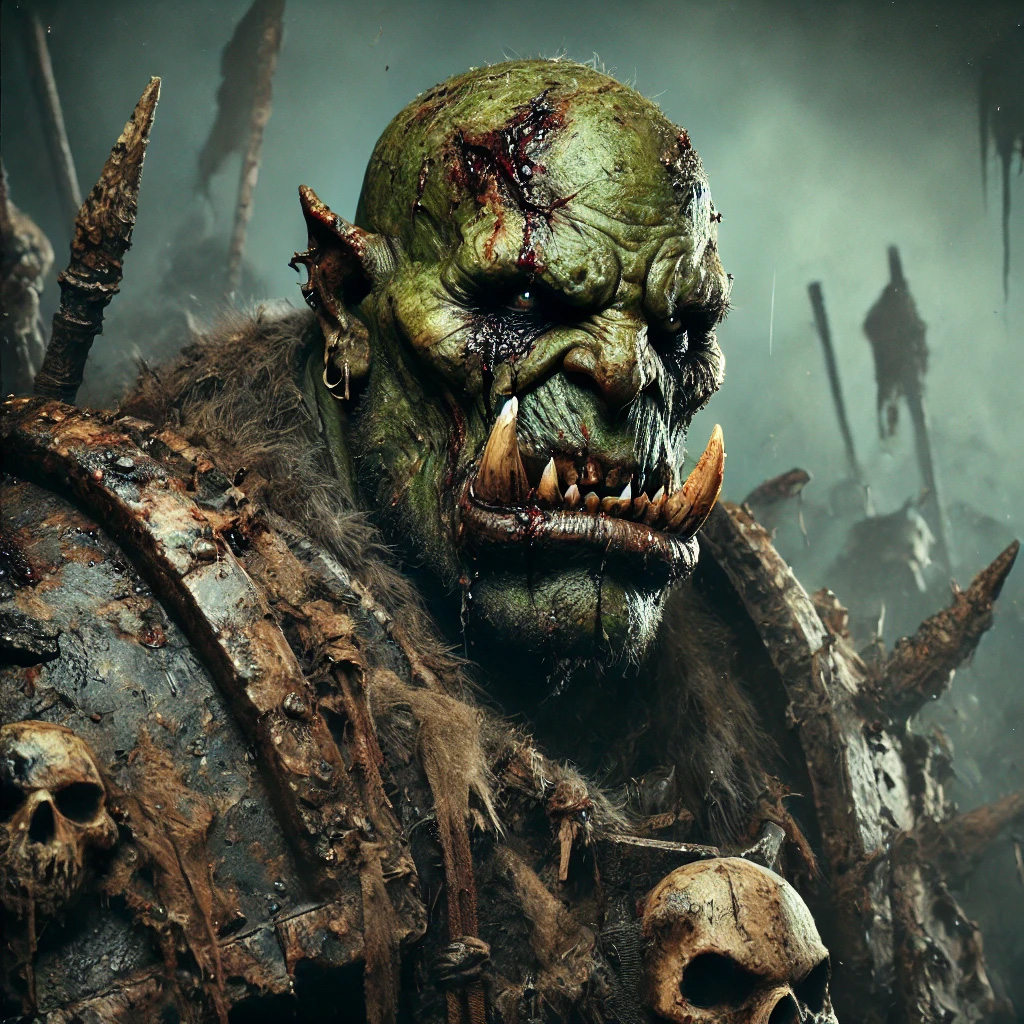
Ashmarsh, the Tainted Lands
From Paradise to Ruin
Ashmarsh was not always a land of decay and poison. Long before the rise of Agramon and the shadow cast by Shadowspire, it stood as a fertile and thriving region, not unlike Far Qarath, where life flourished in balance and abundance. :contentReference[oaicite:0]{index=0} Gorathians and elves lived there in harmony, shaping the land without breaking it, drawing strength from its cycles rather than bending it to their will.
This balance was shattered by a catastrophe that reshaped not only the region, but the fate of its inhabitants. A massive eruption from Shadowspire unleashed forces that disrupted the very climate of the world. Ash fell like endless rain, the skies darkened, and the land itself became hostile to life. What had once been green and vibrant was reduced to a scarred wasteland, its soil poisoned, its waters corrupted, and its ecosystems irreversibly altered.
In the aftermath, survival was no longer a matter of adaptation, but of transformation. The Gorathians and elves who remained were forced into a brutal struggle against extinction, one that would reshape them over generations. Through time, intermingling, and the relentless pressure of natural selection, a new people emerged from this crucible, the orcs.
Unlike their distant Gorathian ancestors, massive beings of immense strength but limited intellect, or the refined and long-lived elves, the orcs became something uniquely suited to Ashmarsh. Prolific, resilient, and adaptable, they combined physical endurance with a sharpened cunning that allowed them to survive where all others had failed. Their slow metabolism, resistance to disease, and capacity to endure hardship made them the perfect inhabitants of a land that rejected weakness.
The Gorathians themselves did not vanish entirely. Far from Ashmarsh, deep within the jungles of Far Qarath, they persist as relics of a distant age, reminders of what once was before the world was broken.
A Living Wasteland
Today, Ashmarsh stretches across a desolate expanse of arid plains, jagged mountains, and poisoned wetlands. Its marshes are filled with stagnant pools of blackened water, coated in thick, greasy films where nothing natural grows. The air is heavy with the scent of sulfur rising from nearby volcanic peaks, and a perpetual twilight hangs over the land, as if the sun itself struggles to reach it.
This is not merely a dead land, it is a corrupted one. Dark magic has seeped into the very soil, twisting both flora and fauna into unnatural forms. Creatures that survive here are not simply adapted, they are altered, shaped by forces that distort life into something harsher, more aggressive, and more unpredictable.
Among the most iconic of these creatures are the Grimfangs, massive wolves bred and raised by the orcs. These beasts are more than mounts or companions, they are extensions of their riders, symbols of dominance, status, and survival. Raised from birth for war, Grimfangs form deep, instinctive bonds with their handlers, and in battle, entire packs can be unleashed with terrifying coordination.
An orc mounted upon a Grimfang is not merely a warrior, but a force of nature, swift, relentless, and nearly impossible to contain once unleashed.
In Ashmarsh, survival is not about resisting the land.
It is about becoming part of it.
Power, Survival, and Fragile Allegiances
Though Ashmarsh falls nominally under the dominion of Agramon, its reality is far more unstable. Control here is not absolute, it is negotiated, contested, and constantly at risk of collapse. :contentReference[oaicite:0]{index=0} Orc chieftains rule their tribes with fierce independence, their loyalty to Shadowspire maintained less through devotion than through necessity, fear, and opportunity.
These tribes form the outer edge of Agramon’s war machine, raiding the borders of Albian and Gryndor, gathering resources, and sustaining the constant flow of conflict that defines his empire. Yet beneath this apparent obedience lies resentment. Many chieftains view Agramon not as a ruler, but as a chain, one that binds them to wars that are not their own.
Among these warlords, Garthrak the Ironclaw stands as the most dominant figure, a brutal and relentless leader whose strength has allowed him to subjugate rival tribes and enforce Agramon’s will across much of Ashmarsh. His iron-clad fists and unyielding aggression have crushed numerous uprisings, making him both feared and respected. Yet his dominance is never secure. Other leaders constantly seek to challenge him, knowing that in Ashmarsh, power is never permanent.
Ambition, Prophecy, and Vengeance
Opposing Garthrak’s authority, though rarely in open conflict, is Morgal Bloodspite, a chieftain whose strength lies not only in battle, but in vision. Where others seek immediate power, Morgal seeks transformation. He has begun to gather a coalition of tribes disillusioned with Agramon’s rule, forging alliances through shared resentment and calculated diplomacy.
Morgal does not rush toward rebellion. He understands that open defiance would be crushed. Instead, he builds quietly, weaving a network that grows stronger with time. His ambitions extend beyond Ashmarsh, reaching toward Far Qarath, where he seeks to manipulate rivalries and ignite conflicts that may weaken the balance of power in his favor.
Standing apart from both warlords and rebels is Thra’gul, the Bringer of Death, a shaman whose influence transcends tribal divisions. His voice is said to carry the essence of Ashmarsh itself, and when he speaks, even the most hardened warriors listen. His prophecies are neither clear nor comforting, but they are always respected. It is believed that his magic can shift the course of battle, calling upon the dark forces that permeate the land.
Thra’gul does not rule, yet his presence shapes decisions. In a land driven by strength, he represents something deeper, the will of Ashmarsh itself, unpredictable, dangerous, and impossible to ignore.
Among the most feared individuals to walk this land is Vashnak the Vengeful, a mercenary whose path is defined not by loyalty, but by hatred. Her clan was annihilated by the forces of Qarath, and since that moment, her life has been devoted to vengeance. She moves between tribes and battlefields, offering her blade wherever it brings her closer to her goal.
Unlike most of her kin, Vashnak has embraced what others fear. Through her encounter with Kaelar the Betrayer, she learned the forbidden arts of the Drelkar, accepting the curse that extends her life at the cost of her humanity. While other orcs recoil from such corruption, she welcomed it, choosing power over mortality, vengeance over fear.
Now she walks a path few dare follow, feared even among the orcs, a living contradiction who despises Agramon yet occasionally serves him when it aligns with her own purpose.
Trade, War, and the Edge of Collapse
Despite its hostility, Ashmarsh holds significant strategic value. Its mountains contain valuable minerals, and its position between major regions makes it a critical zone of exchange and conflict. Trade with Qarath persists, fragile and often strained, as orc tribes exchange raw materials for supplies they cannot produce themselves.
These relationships are unstable. Raids, skirmishes, and old grudges constantly threaten to break the balance. Qarathian forces view the orcs as both trading partners and enemies, while the orcs see Qarath as both opportunity and target. War between them is not a distant possibility, it is an ever-present reality waiting for the right spark.
Meanwhile, Agramon continues to exploit Ashmarsh as both resource and battlefield, sending its tribes into his wars while maintaining control through division and fear. Yet his influence is not absolute, and cracks are beginning to form.
At the center of this slow shift stands Talgor the Silent, a master strategist who operates in the shadows of Shadowspire’s power. While outwardly loyal, Talgor works alongside Morgal, building a hidden alliance aimed at breaking Agramon’s control. Their efforts focus not only on uniting the tribes, but on understanding and ultimately subverting the dark magic of the Drelkar.
They know that strength alone will not be enough.
To defeat Agramon, they must undermine the very power that sustains him.
A Land Ready to Ignite
Ashmarsh is a land where ambition, resentment, and survival collide. Every tribe fights for dominance, every leader balances between loyalty and rebellion, and every alliance carries the seeds of betrayal.
It is not a stable region. It is a battlefield waiting to erupt.
The orcs grow restless. The warlords prepare.
The shamans whisper of change.
And in the shadows, the foundations of Agramon’s power begin, slowly but inevitably, to crack.