






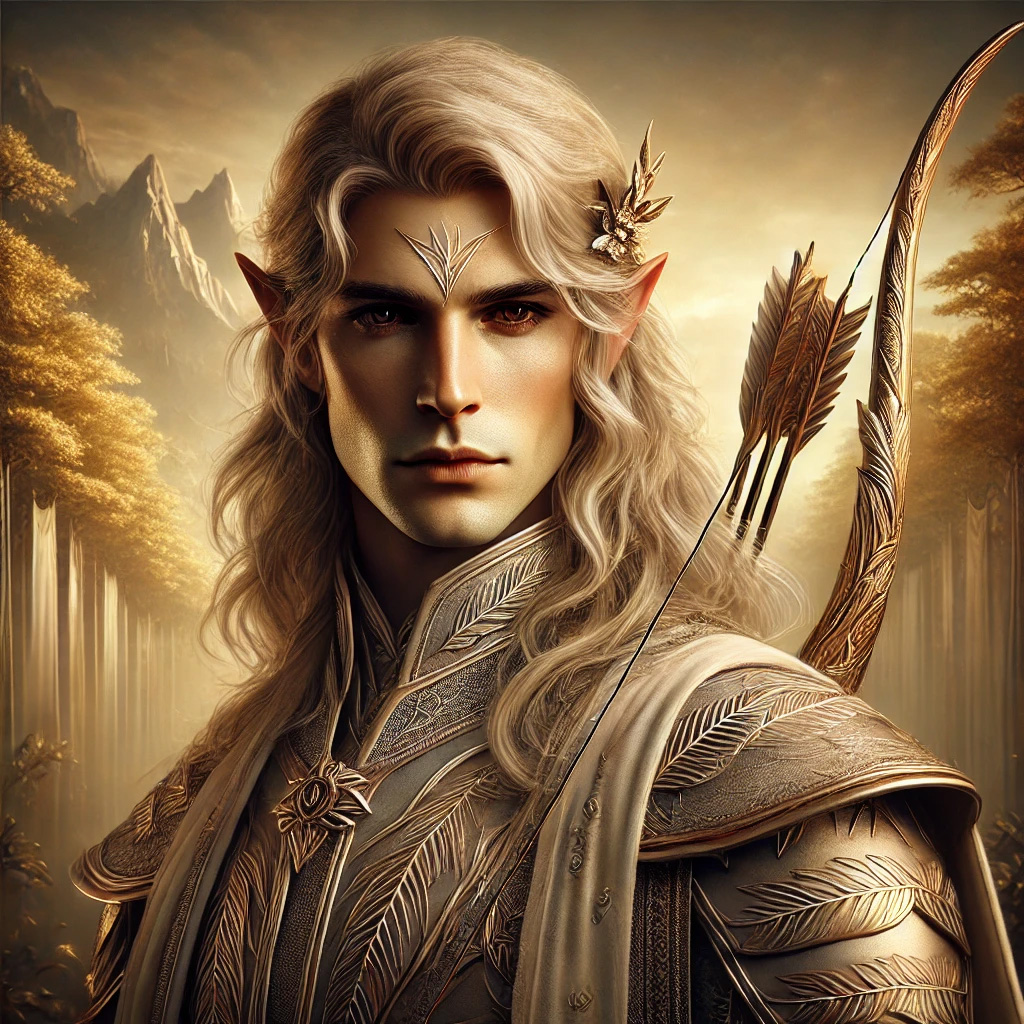
Everspring, the Eternal Refuge
The Island of the Silver Crown
Everspring is not merely a kingdom, it is a sanctuary suspended between past and present, an island untouched by the erosion of time that has reshaped the rest of the world. Isolated amidst the vast oceans that divide the continents, it rises as a place of quiet power, where beauty and vigilance exist in perfect balance. At its heart lies Lake Ethirion, a vast and luminous body of water whose surface reflects the stars with an almost unnatural clarity, as though the heavens themselves had chosen to linger upon its depths.
Encircling this sacred lake stretch the ancient forests of Latharion, where towering trees with silver leaves grow upon enchanted soil veined with arcane stone. These forests are not merely wilderness, they are living archives, silent witnesses to an age long forgotten elsewhere. Beneath their roots and within the mountains of the island lie rich deposits of Eldralite, a rare and highly prized metal whose properties combine resilience with magical affinity. From this material are forged the weapons and armor of Everspring, creations that embody both elegance and lethality.
Though isolated, Everspring does not exist outside the world, it exists at its center, connected through carefully maintained routes of trade and diplomacy. To the east, beyond the Azure Straits, lies Gryndor, a rising industrial empire driven by expansion and conquest, whose ambitions cast a long shadow over the seas. To the northeast stretch the Dunes of Qarath, a harsh and unstable land where alliances shift as quickly as the sands themselves. To the south-southeast lies Sylvara, a kindred realm bound to Everspring through shared heritage, mutual respect, and ancient ties that have endured through the ages.
To the west, across the open sea, stands Mirelm Haven, the great floating city of commerce and diplomacy. Among all its connections, this is the most vital. Through Mirelm Haven flows the lifeblood of Everspring’s external relations, goods, knowledge, and influence moving across the waters in a constant exchange that strengthens both powers. It is not merely a trade partner, it is a bridge between Everspring and the wider world.
The island itself is protected not only by distance but by design. Its coasts are treacherous to navigate, lined with reefs, shifting currents, and hidden hazards known only to those who have lived their entire lives upon these waters. Beyond these natural defenses stand the Sentinel Isles, a chain of fortified outposts encircling the maritime approaches. These strongholds serve as both watchtowers and bastions, manned by warriors and seers whose vigilance ensures that no fleet may approach unseen.
In Everspring, geography is not a passive feature of the land, it is a weapon, a shield, and a statement. Every current, every forest, every stone has been understood, mastered, and woven into a system of defense so complete that invasion is not merely difficult, it is nearly unthinkable.
Memory of the Ancient World
Unlike many of the younger civilizations that now shape the fate of the world, Everspring is not built upon fragments of forgotten history, it is built upon memory. Within its borders still live those who witnessed the world as it once was, before the Great Cataclysm shattered the balance of existence and reshaped the destiny of every race. These are not tales reconstructed from ruins or guessed through fragments of lost knowledge, they are lived truths, preserved through direct testimony, ancient tomes, and oral traditions that have never been broken.
There was a time when the sky was clear, when the lands beyond the seas were untouched by the scars of endless war, and when the rhythm of the world followed a harmony long since lost. Before the wyverns descended from the north, before the arrival and expansion of mankind from the south, before the slow dimming of the heavens, the world belonged to the elder races. Among them, the Elves of Everspring stood as one of its defining powers, not through conquest, but through mastery, balance, and understanding.
In that distant age, they were not alone.
The Gorathians, a race now believed by most to be extinct, once shared the world with the Elves. They dwelled primarily beneath the surface, in vast subterranean halls carved into the bones of the earth itself, shaping stone and metal with a level of mastery that rivaled even the finest elven craftsmanship. Though often misunderstood by younger races, they were neither simple creatures of brute strength nor primitive beings. They were ancient, complex, and deeply tied to the world in ways that modern scholars struggle to fully comprehend.
The relationship between the Elves and the Gorathians was one of distant kinship rather than alliance or rivalry. They were not enemies, yet they did not merge into a unified civilization. Instead, they existed in parallel, two ancient peoples sharing the same world, each following its own path, occasionally intersecting, occasionally influencing one another, but never bound together by dependency or conflict.
Then came the Cataclysm.
The exact nature of this event remains one of the greatest mysteries preserved within Everspring’s archives. It was not a single moment, but a transformation, a breaking of the world’s balance that echoed across land, sky, and sea. The heavens dimmed, the flow of magic shifted, and forces long dormant began to stir. The arrival of wyverns from the north marked a turning point, not merely as a new threat, but as a symbol that the world itself had changed.
In the wake of this upheaval, the Gorathians vanished.
Whether they were destroyed, driven into deeper realms, or transformed into something else entirely remains unknown. No definitive record marks their end, no final battle or great exodus is recorded with certainty. What remains are traces, ruins buried deep beneath the earth, fragments of their craft, and echoes within the oldest songs of the Elves. For the scholars of Everspring, this absence is not a closed chapter, but an open question, one that continues to shape their understanding of the world and its hidden layers.
For the Elves, the Cataclysm was not an end, but a transition. They endured, but survival came at a cost. The world that followed was no longer one of balance, but one of instability, where new races rose, new ambitions took root, and conflict became a defining force rather than an exception. The arrival of mankind, the spread of new kingdoms, and the emergence of darker powers forced Everspring to adapt without abandoning its core identity.
Yet, unlike others, Everspring never forgot.
Its people do not look upon the past as a distant myth, but as a living reference point. Every decision, every strategy, every act of diplomacy is informed by an understanding that the world has changed once, and can change again. Where others see the present as the only reality, the Elves of Everspring see a continuum, a fragile balance between what was, what is, and what may yet come.
It is this memory, more than any weapon or fortress, that defines their strength. For in a world that has forgotten its origins, those who remember hold the greatest advantage of all.
The Great War and the Strategy of Thalathar
When the Great War against Agramon began, the world answered with fire and fury. Kingdoms rallied, armies marched, and countless rulers rushed to meet the rising darkness with steel and sacrifice. But Everspring did not follow this path. While others charged into battle driven by urgency, fear, or pride, the Elves chose restraint. Their response was not born of hesitation, but of understanding, the understanding that war, once entered blindly, consumes more than it resolves.
At the center of this calculated stillness stood King Thalathar, already ancient by the standards of most races, yet unmatched in clarity of vision. He did not see the war as a series of battles to be won, but as a system to be unraveled. Where others focused on confronting Agramon’s armies directly, Thalathar sought to dismantle the foundations upon which those armies depended. To him, victory was not achieved on the battlefield alone, it was forged long before swords were drawn.
Rather than committing his forces prematurely, Thalathar orchestrated a campaign of isolation and attrition. Supply lines were disrupted, alliances weakened, and the cohesion of Agramon’s forces slowly eroded. Through diplomacy, manipulation, and precise intervention, he turned allies into liabilities and strength into vulnerability. Armies that once stood united began to fracture, their coordination breaking under pressure they could neither see nor fully understand.
Everspring’s forces, when they did engage, did so with absolute precision. They struck where it mattered most, at key locations, critical moments, and decisive turning points. Battles were not fought to prove strength, but to conclude inevitability. Every engagement was the result of preparation, every victory the confirmation of a plan already set in motion long before the first arrow was released.
This approach did not bring immediate glory, nor did it inspire the same legends of heroic charges that defined other factions. But over time, its effectiveness became undeniable. Agramon’s empire, vast and terrifying in its reach, began to weaken not through a single decisive blow, but through a thousand carefully orchestrated fractures. His forces were stretched thin, his command destabilized, and his influence eroded until collapse became unavoidable.
Without Everspring’s intervention, the war might have endured for generations. Instead, it was brought to an end through strategy rather than annihilation. Thalathar’s role in this outcome secured his place among the greatest tacticians in history, not as a conqueror, but as a master of inevitability, a ruler who understood that true victory lies not in fighting harder, but in ensuring that the enemy has already lost before the battle begins.
Yet the end of the war did not restore the world to what it had been. The fall of Agramon marked the end of one era, but it did not undo the changes brought by the Cataclysm. The skies remained dimmer, the balance of power shifted, and new forces rose to fill the void left behind. The kingdoms of men expanded, conflicts multiplied, and the stability that once defined the ancient world could not be reclaimed.
For Everspring, victory was not a return to the past, but a confirmation of a new reality. They had preserved themselves, protected their people, and shaped the outcome of the greatest war of their age, yet they had also witnessed the irreversible transformation of the world. From that moment onward, their philosophy would remain unchanged, never fight without purpose, never act without foresight, and never assume that victory today guarantees peace tomorrow.
In the memory of Everspring, the Great War is not remembered as a triumph of arms, but as a lesson in control. It stands as the moment when the Elves proved that in a world driven by chaos, the greatest power is not strength, but mastery over the forces that shape it.
The Balance of War and Beauty
In Everspring, war and beauty are not opposites, they are reflections of the same philosophy. Strength is not measured solely through destruction, but through control, precision, and the ability to shape outcomes with intent. This belief permeates every aspect of elven society, from the forging of weapons to the conduct of war itself. To the people of Everspring, there is no separation between artistry and warfare, both are expressions of mastery, both require discipline, and both demand perfection.
Their weapons are not simply instruments of battle, they are crafted works of art, each blade balanced with exacting precision, each bow shaped to channel both physical force and subtle enchantment. Forged from Eldralite and refined through generations of accumulated knowledge, these creations embody the union of resilience and elegance. Armor, though offering remarkable protection, remains light and fluid, allowing warriors to move with unmatched speed and grace, never encumbered, never slowed, always in control.
Yet it is not the equipment alone that defines the strength of Everspring, it is the discipline of those who wield it. The warriors of the island are few when compared to the vast armies of human empires or the industrial legions of Gryndor, but each individual represents a level of training and mastery that compensates for any numerical disadvantage. To fight without certainty is considered a failure of preparation, and so every battle is approached not as a contest of strength, but as the final step of a process that began long before the armies met.
This doctrine has shaped a tradition of strategic supremacy. Engagements are chosen, not endured. Conflicts are studied, not rushed. Every movement is calculated, every weakness identified, every outcome anticipated. When Everspring commits to war, it does so with the full confidence that victory has already been secured through foresight and preparation. The battlefield becomes not a place of uncertainty, but a stage upon which a predetermined outcome unfolds.
The training of Everspring’s warriors reflects this philosophy in its entirety. Combat is not limited to strength or technique, it extends into deception, misdirection, and psychological dominance. Enemies are not only defeated physically, they are disoriented, isolated, and broken before they fully understand the nature of the conflict they have entered. Victory is achieved not by overpowering the opponent, but by removing their ability to respond effectively.
Among the most renowned forces of Everspring are the Tolori, elite naval infantry whose reputation extends across every sea touched by elven ships. Masters of coordinated strikes, they excel in precision assaults that cripple enemy fleets before open conflict can even begin. Their operations are swift, deliberate, and devastating, leaving behind not chaos, but silence, the unmistakable mark of a perfectly executed plan.
Equally feared are the blade-dancers, warriors who embody the principle of “one strike, one kill.” Their movements are fluid and exact, each motion serving a purpose, each attack delivered with absolute efficiency. To witness them in combat is to see violence reduced to its purest form, where excess is eliminated and only the necessary remains. There is no hesitation, no wasted effort, only execution.
Despite this mastery of war, Everspring does not define itself through conflict. War is not pursued, it is accepted when required. The memory of past catastrophes remains ever present, a reminder that even victory carries a cost. While their warriors train without cease, their purpose is not conquest, but preservation, the protection of a way of life built upon harmony, knowledge, and creation.
This balance, between the capacity for destruction and the desire for beauty, is what defines Everspring. It is not a kingdom of war, nor a kingdom of peace, but a realm that understands both, and chooses, with careful deliberation, when each must prevail.
A Kingdom at the Crossroads of Time
Everspring does not simply exist within the present, it exists across time. It is a realm where the past is not forgotten, where the present is not taken for granted, and where the future is never approached without caution. Unlike the younger kingdoms that rise and fall with the tides of ambition, Everspring endures through continuity, guided by memory as much as by vision. It stands as a living remnant of an earlier age, one that has not vanished entirely, but survives in the decisions, traditions, and perspectives of its people.
At the heart of this temporal awareness stands King Thalathar, a ruler who has witnessed centuries unfold and who understands that change is not merely inevitable, it is constant. He does not resist it, nor does he embrace it blindly. Instead, he observes, measures, and guides it, ensuring that Everspring adapts without losing itself. To him, the greatest danger is not external conquest, but internal erosion, the slow loss of identity that occurs when a people forget who they are and why they endure.
This perspective shapes every aspect of Everspring’s role in the world. The kingdom does not act impulsively, nor does it seek dominance through expansion. It watches. It listens. It studies the movements of nations, the rise of new powers, and the return of ancient threats. Its influence is often subtle, exerted through guidance, diplomacy, and carefully chosen interventions rather than open displays of force. When Everspring acts, it does so with purpose, and never without understanding the consequences of that action.
Yet this restraint is not without tension. The world beyond the island is changing at an accelerating pace. Empires grow more aggressive, conflicts more frequent, and forces long thought dormant begin to stir once more. In such a world, the role of observer becomes increasingly difficult to maintain. To remain distant risks irrelevance. To intervene risks entanglement in conflicts that cannot be easily controlled.
Within Everspring itself, this question is not unanswered. There are those who believe the time of passive observation is ending, that the kingdom must once again take a more active role in shaping the fate of the world, as it did during the Great War. Others argue that such a path would lead to unnecessary exposure, weakening the very stability that has allowed Everspring to endure for so long. This debate does not divide the kingdom into factions of chaos, but it does create a quiet pressure, a recognition that a choice will eventually have to be made.
Despite these uncertainties, Everspring remains anchored in its identity. It is not driven by fear, nor by ambition, but by a commitment to preservation, not only of its people, but of knowledge, culture, and balance itself. It does not seek to control the world, but it refuses to let it fall into ruin through inaction. This delicate equilibrium defines its existence, a constant negotiation between intervention and restraint.
The world watches Everspring, often without fully understanding it. Some see it as distant, even detached, a kingdom unwilling to engage with the realities of a harsher age. Others recognize it for what it truly is, a power that moves only when necessary, but whose actions, when they come, reshape the course of history in ways few others can achieve.
In the end, Everspring stands where it always has, at the threshold between what was and what will be. It carries the memory of a world long gone, yet it is not bound by it. It sees the future with clarity, yet refuses to be consumed by it. It waits, not out of indecision, but out of understanding.
And when the moment comes, it will act, not as a reaction, but as a choice.
The Eternal Sovereign
At the heart of Everspring, where wisdom and power converge into a single guiding force, stands King Thalathar, the Eternal Sovereign. His rule is not defined by lineage alone, nor by the traditions that bind lesser kingdoms, but by the weight of centuries lived, decisions made, and wars understood before they ever began. He is not king because he inherited a throne, he is king because he has proven, time and again, that no other mind sees as far, or as clearly, as his.
Long before the Great War, before the rise of Agramon and the reshaping of the world that followed, Thalathar had already begun to understand the deeper patterns that govern the fate of nations. He does not react to events, he anticipates them. Where others see conflict, he sees consequence. Where others seek victory, he seeks resolution. His leadership is not built upon dominance, but upon mastery of time, foresight, and restraint.
Yet even such a ruler does not govern alone.
The Structure of Power
Everspring is not ruled through rigid hierarchies or competing factions, but through a carefully balanced system of influence and responsibility. At Thalathar’s side stands a council composed of individuals whose expertise spans every domain essential to the kingdom’s survival. These are not mere advisors, they are pillars of the realm, figures whose authority is earned through centuries of experience and whose roles extend far beyond simple governance.
Each member of this council embodies a different aspect of Everspring’s strength. Trade, war, diplomacy, secrecy, and defense are not separated into isolated functions, but woven together into a unified structure where every decision is considered from multiple perspectives. This ensures that no action is taken in isolation, and that every movement of the kingdom reflects a complete understanding of its consequences.
Unlike many courts where ambition breeds rivalry, the council of Everspring operates through alignment rather than competition. This does not mean that disagreements do not exist, they are frequent, often profound, and sometimes unresolved. But these tensions are not destructive. They are essential, a necessary friction that sharpens decisions rather than weakening them. Each voice is heard, each perspective weighed, and in the end, a course is chosen not through dominance, but through clarity.
Within this structure, authority flows outward from the throne, but it is never imposed blindly. Thalathar does not command through fear, nor through absolute decree. He guides, directs, and, when necessary, intervenes. His power lies not in forcing obedience, but in ensuring that those who serve under him understand the necessity of his decisions.
This balance between centralized vision and distributed expertise is what allows Everspring to function as more than a kingdom, it becomes a system of thought, a collective intelligence capable of adapting to a world in constant transformation. Where other nations fracture under pressure, Everspring absorbs it, processes it, and responds with deliberate precision.
The Nature of Authority
Power in Everspring is not measured by the ability to command, but by the ability to understand. Those who rise within its ranks do so not through ambition alone, but through demonstrated mastery, whether in war, diplomacy, or knowledge. Authority is not taken, it is recognized. Leadership is not imposed, it is accepted.
This creates a society where obedience is not blind, but conscious. Warriors follow their commanders not out of fear, but because they trust in the clarity of their purpose. Artisans, scholars, and seers contribute not because they are required to, but because they understand the role they play within a greater design. Even dissent, when it arises, is not suppressed without thought, but examined, evaluated, and, when necessary, integrated into the evolving structure of the kingdom.
Such a system is not without its risks. It relies upon the continued strength and wisdom of those who lead it, and upon the shared understanding that binds its people together. Should that understanding falter, should doubt outweigh trust, the structure itself could weaken. Yet for now, it endures, sustained by the same principles that have guided Everspring since before the world was broken.
A Throne Beyond Time
The throne of Everspring is not merely a seat of power, it is a point of continuity, a place where past, present, and future converge. Through Thalathar, the memory of the ancient world is preserved, not as nostalgia, but as guidance. Through his council, the complexities of the present are navigated with precision. And through the decisions made within these halls, the future is shaped with care, never rushed, never left to chance.
In a world defined by conflict and change, Everspring stands apart not because it is untouched, but because it understands. Its strength does not lie in domination, but in coherence. Its power does not come from expansion, but from control. And at its center, unwavering and ever-watchful, sits a king who has seen the rise and fall of ages, and who knows that the greatest victory is not to conquer the world, but to endure it.
Celandir, the Steward of Tides and Coin
Within the intricate balance that defines Everspring, where war, diplomacy, and knowledge are woven into a single, cohesive structure, Celandir stands as the unseen architect of its stability. As master of trade and diplomacy, his influence does not manifest through armies or spectacle, but through the quiet, constant flow of wealth, information, and agreements that bind the kingdom to the wider world.
Every exchange that passes through Everspring, whether material or political, is shaped in some measure by his hand. Trade routes are not merely maintained, they are curated, reinforced, and, when necessary, redirected with subtle precision. Through his efforts, the kingdom remains not isolated, but central, connected to powers such as Mirelm Haven while preserving its autonomy and strategic advantage.
Celandir does not seek recognition. His strength lies in discretion, in the ability to influence outcomes without ever becoming their visible cause. Treaties are signed, alliances secured, and conflicts avoided not through force, but through foresight and negotiation. Where others see commerce as a means of profit, he understands it as a tool of control, a way to shape the balance of power without drawing a blade.
In a realm where war is approached as an art of inevitability, Celandir ensures that many conflicts never reach the battlefield at all. His domain is not the clash of armies, but the silent currents that determine which wars are fought, and which are quietly prevented.
Eldarion, the Supreme General
If Thalathar embodies vision and Celandir ensures stability, then Eldarion represents execution. As the Supreme General of Everspring, he stands at the intersection between strategy and action, translating foresight into decisive victory. Born of a lineage long associated with heroism and command, he has not relied upon heritage alone, but has surpassed it, forging his own legacy through mastery of war in all its forms.
Eldarion’s understanding of battle extends far beyond the immediate clash of forces. To him, a battlefield is a system, one defined by movement, terrain, morale, and timing. He does not merely react to his enemies, he dictates the conditions under which they must act. Every engagement under his command reflects this philosophy, structured, deliberate, and controlled to the smallest detail.
His weapon, an enchanted blade of exceptional craftsmanship, is as much a symbol of his precision as it is a tool of war. Yet it is not his skill in combat that defines him most, but his clarity of thought. He ensures that Everspring never enters a battle it cannot win, and when it does, the outcome is rarely left to chance.
Under his leadership, the armies of Everspring operate with a cohesion that mirrors the kingdom itself. Each unit understands its role, each movement contributes to a greater design, and each victory reinforces the principle that war, when mastered, is not chaos, but control.
Feynar, Admiral of the Silent Seas
Beyond the shores of Everspring, where the open sea becomes both barrier and battlefield, Feynar commands with a presence as precise as it is relentless. As admiral of the Everspring fleet and master of the Tolori, he ensures that no threat reaches the island unchallenged, and that no enemy fleet operates freely within the waters under his watch.
At sea, he is not merely a commander, he is a force of inevitability. His strategies are defined by speed, coordination, and overwhelming precision, striking before the enemy can react, dismantling formations before they can fully assemble. Under his command, naval warfare becomes an extension of Everspring’s broader doctrine, calculated, efficient, and executed without excess.
On land, his mastery does not diminish. As a swordmaster of exceptional skill, his combat style reflects the same principles that define the Tolori, fluid, exact, and without hesitation. Each movement serves a purpose, each strike concludes it. Those who face him rarely understand the outcome until it has already been decided.
Feynar does not wage war for glory, nor does he seek recognition. His purpose is singular, to ensure that Everspring remains beyond reach, protected not only by distance, but by the certainty that any who approach will face a response swift enough to make retreat their only remaining choice.
Faelanor, the Shadow Diplomat
Not all power within Everspring is exercised in the open, and not all victories are won on the battlefield or within the halls of formal diplomacy. Faelanor embodies this hidden dimension of influence, operating in the spaces where truth is flexible, alliances are fragile, and knowledge is the most valuable weapon of all. Originating from Sylvara, he stands at the crossroads between realms, a figure uniquely positioned to navigate both the visible and the unseen currents that shape the world.
His role is not defined by rank alone, but by function. Where official envoys establish treaties, Faelanor ensures that those agreements hold, or that they unravel when necessary. He moves through networks of information, cultivating contacts, shaping perceptions, and guiding events from the shadows. In his domain, a whispered word may carry more weight than an army, and a carefully placed doubt can achieve what open conflict cannot.
Faelanor does not seek recognition, nor does he leave behind clear traces of his actions. His successes are often invisible, measured not in victories celebrated, but in disasters avoided and enemies weakened before they can act. When diplomacy falters and war looms, it is often his influence that has already begun to tip the balance, long before the first engagement takes place.
In a kingdom where foresight defines strength, Faelanor represents its most subtle form, the ability to shape outcomes without ever revealing the hand that guides them.
Tharion, the Last Bastion
Among the many figures who define the strength of Everspring, few carry the weight of legend as profoundly as Tharion. He is not merely a warrior, but a symbol, a living embodiment of resilience, mastery, and the unyielding will that has allowed the kingdom to endure through ages of upheaval. His presence alone has altered the course of battles, his name spoken with a mixture of reverence and apprehension across distant lands.
Tharion stands where the line must not break. In moments when even the most carefully laid strategies are tested, when the precision of planning meets the unpredictability of war, it is he who becomes the final answer. His strength is not defined solely by skill at arms, though that alone would place him among the greatest, but by his capacity to hold, to endure, and to turn the tide when all else falters.
To witness Tharion in battle is to understand the full expression of Everspring’s philosophy. There is no excess in his movements, no hesitation in his actions. Every strike is purposeful, every defense absolute. He does not fight for glory or recognition, but because there are moments when survival depends on a single individual refusing to yield.
Where others see a warrior, Everspring sees a safeguard, the last line between order and collapse, the embodiment of a promise that the kingdom will not fall while he still stands.
A Realm of Living Memory and Measured Power
Everspring endures not because it is untouched by the world, but because it understands it more deeply than most. Its strength lies not in numbers, nor in expansion, but in coherence, a unity of purpose that binds its rulers, its warriors, and its people into a single, deliberate force. Each of its leaders represents a facet of that strength, vision, execution, influence, precision, and resilience, forming a system that is as balanced as it is formidable.
It is a kingdom that remembers what others have forgotten, a realm shaped by the knowledge of what the world once was and by the awareness of what it may yet become. It does not rush toward the future, nor does it cling blindly to the past. Instead, it moves with intention, choosing its moments, shaping its actions, and ensuring that every step taken serves a purpose greater than immediate gain.
Yet the world does not stand still. Across the seas, empires rise, conflicts intensify, and forces long dormant begin to stir once more. In such a time, even a kingdom as measured as Everspring cannot remain entirely apart. The question is not whether it will act, but when, and how.
For when Everspring chooses to move, it does not do so lightly. Its actions are not reactions, but decisions, not impulses, but conclusions. And when those decisions are made, the consequences extend far beyond its shores.
The world has learned this before.
It may soon learn it again.